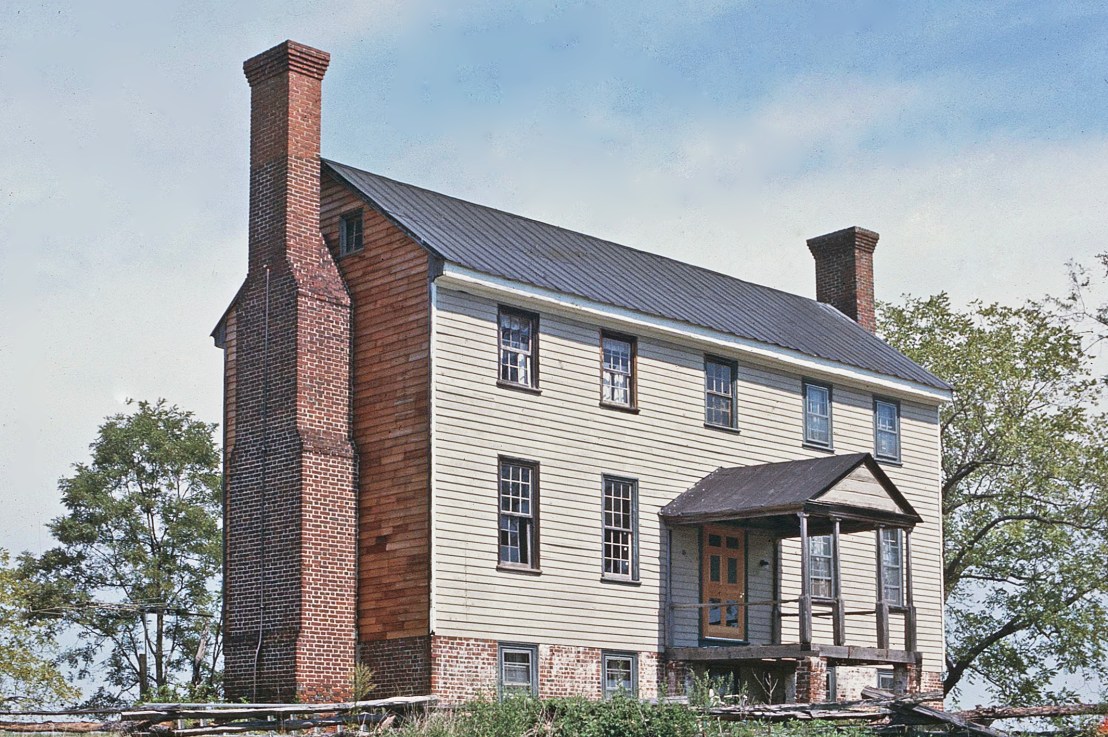
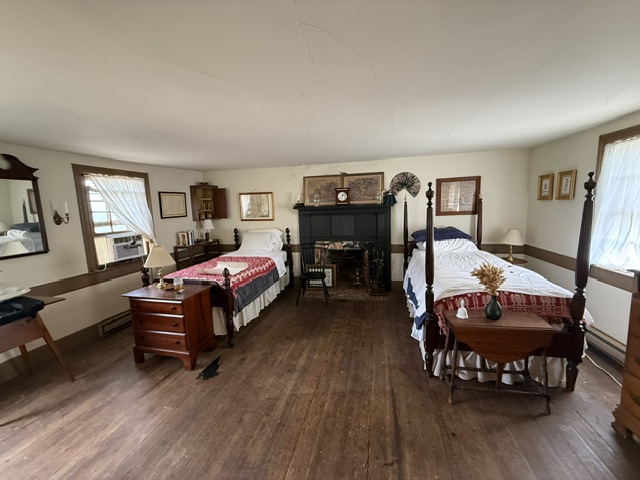
A few weeks ago, I had the opportunity to join my cousin, John David Morris, on a visit to the home where our 2x great‑grandmother Ann Octavia Vaughan (1844–1942) and her sister Mary Spencer Vaughan (1846–1881) lived after the deaths of their parents. The house—known today as the Farmer House—stands quietly along Little Creek in Amelia County, its early‑1820s frame still solid, its rooms still holding stories. As it happens, a cousin on John David’s maternal side, Jeff Samuels, became the owner earlier this year and generously invited us for a private tour. Jeff is working diligently to restore the house. We look forward to seeing his progress.
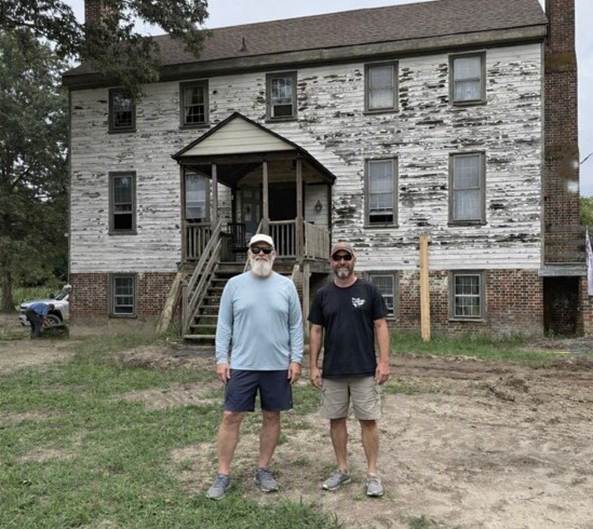
Ann and Mary’s mother, Mary Spencer (Farmer) Vaughan died in 1846, and their father, Augustus Vaughan, died in 1851. The orphaned girls were just 7 and 5 years old. They went to live with their maternal uncle Charles Willson Farmer (c.1825-1890) and his wife Alice Gabriella Gills (1834-1915). The girls were raised by the Farmers and lived at the Farmer House until their marriages. Mary married Nicholas Dekraft in 1866, and Ann married John Rives Morris in 1867.
Growing Up at the Farmer House
When the girls arrived, Charles and Alice had no children, but that changed quickly. Between 1853 and 1879, they welcomed eleven children, creating a bustling household in which Ann and Mary grew up.
How the Land Became a Family Legacy
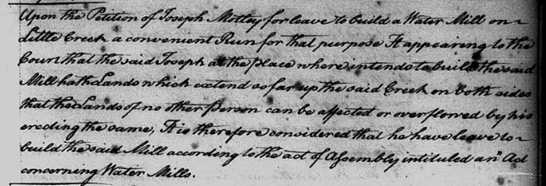
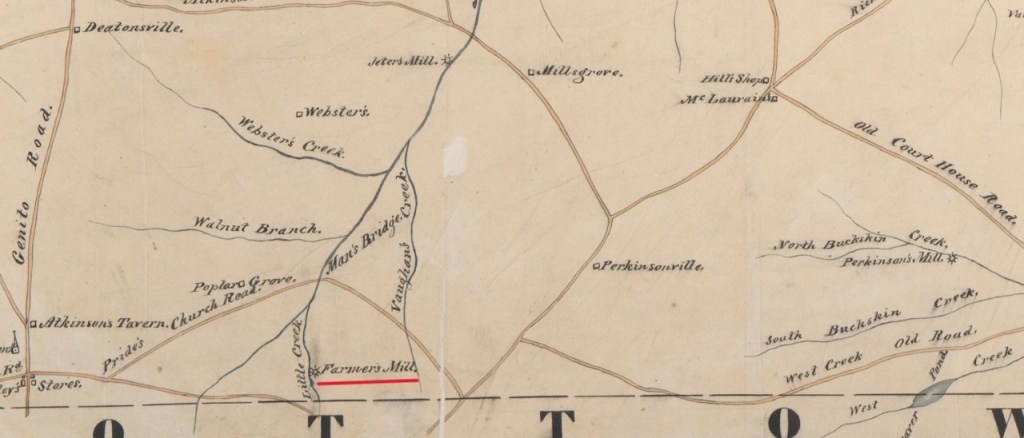
To understand how the Farmer House came into our family’s orbit, we have to go back nearly a century earlier to our 6x great‑grandparents Joseph and Elizabeth (Forrest) Motley. Their daughter Elsie (c.1738-aft.1805) married Robert Vaughan II (c.1734-1905) who are our 5x great grandparents. In 1737, Joseph Motley was living in Gloucester County, Virginia when purchased 400 acres on both side of the Little Creek of Flatt Creek from Matthew Mayes for £25.[2] In 1747 he received a land grant for 1,383 acres on both sides of Little Creek, Ellis’s fork and Flat Creek that included lands he had earlier acquired by deed or grant.[3] In 1762, the Amelia County Court granted Joseph permission to build a water grist mill on Little Creek, noting that his land holdings were so extensive that no neighboring property would be affected.[4]
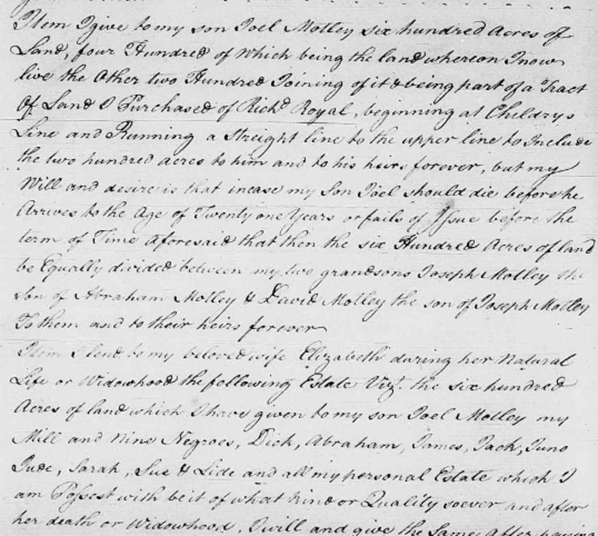
When Joseph died around 1777, his son Joel Motley inherited 600 acres, including the mill.[5]
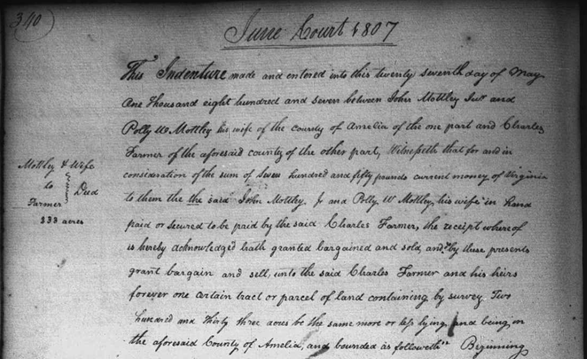
Joel Motley died intestate in 1789, leaving several children—including John Motley, who eventually sold 233 acres and the mill to Charles Farmer in 1807.[6] This is the uncle of Charles Willson Farmer, evidently his namesake. John Mottley had purchased 100 acres of the tract in 1798 from John and Sarah W Hannah for £255. The deed notes that the sale included the Hannah’s “rights and title to the Mill formerly the property of Joel Mottley, decd.”[7]
Ten years later Charles Farmer added an adjacent 133 acre tract that fell in both Amelia and Nottoway Counties at public auction. This tract was also part of Joel Motley’s 600 acres that had passed to his son-in-law and daughter James H. & Sally R. (Mottley) Thurston. It became the subject of a Superior Court of Chancery suit between the Thurston’s and defendants Thomas C. Armstrong, Richard Jones and Samuel Jones where it was ordered sold.[8]
“Trading Places”: How Nelson Farmer Came to Amelia
When Charles Farmer died in 1822 unmarried and without children, he crafted a will that transferred his Amelia estate to his brother Nelson Farmer (1784-1847), but only under specific conditions. Nelson had to convey all of his own property in Chesterfield County, except for what he had inherited through his wife Rebecca Booker (Dance) Farmer (c.1791-by.1827), into a trust to be distributed among their siblings.[9]
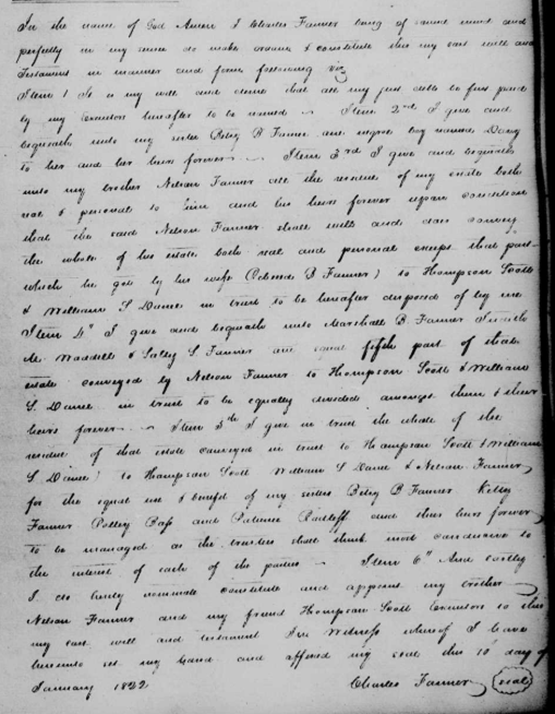
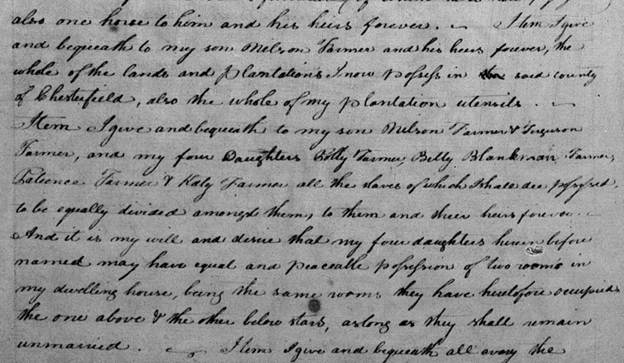
This unusual arrangement becomes clearer when read alongside their father Francis Farmer’s 1806 will. Francis had left his Chesterfield County land to Nelson, while granting his four unmarried daughters lifelong use of two rooms in the family home.[10] Charles appears to have wanted Nelson to relocate to Amelia—taking over his estate—while ensuring that their sisters could remain in the Chesterfield house.
Nelson agreed. In February 1822, he and Rebecca conveyed his Chesterfield inheritance into the trust, fulfilling Charles’s conditions.[11]
Building the Farmer House
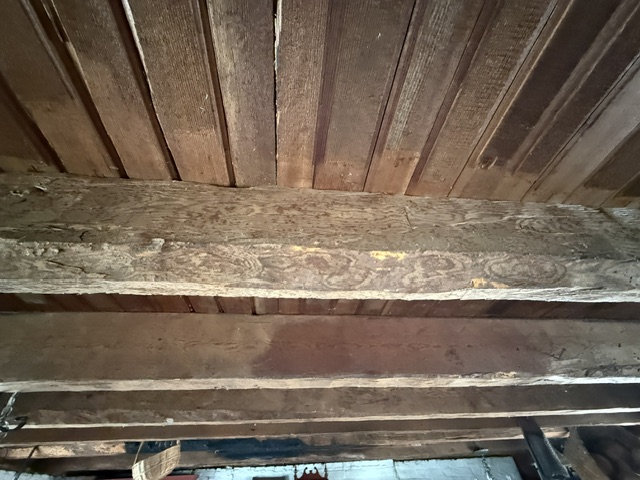
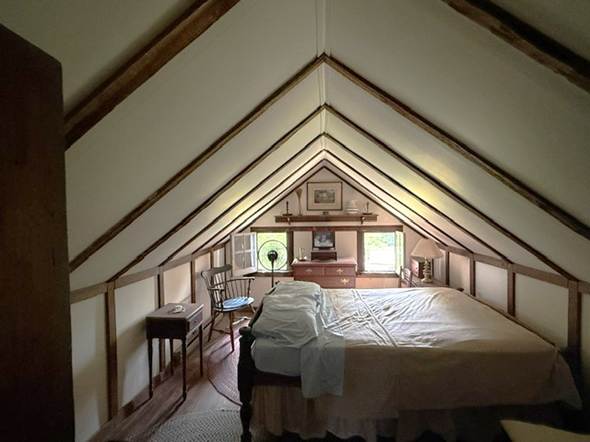
Nelson and Rebecca (our 3x great grandparents) likely moved to Amelia soon after the 1822 deed. There must have been an earlier dwelling on the property—perhaps where Charles and their brother Ferguson Farmer (also died unmarried and without children) had lived—but the present Farmer House was built between 1820 and 1825, likely closer to 1825 given the timing of Nelson’s relocation.
The couple had two children: Mary Spencer Farmer, born about 1823 and Charles Willson Farmer, born about 1825. Sadly, their mother Rebecca died about 1827.[12] Nelson never remarried. When he wrote his will 1845, he left the Farmer House and land to son Charles, and $2,500 to daughter Mary – considering that to be equivalent to the value of the property he gave Charles. He left the water grist mill and cotton gin jointly to both children.[13]
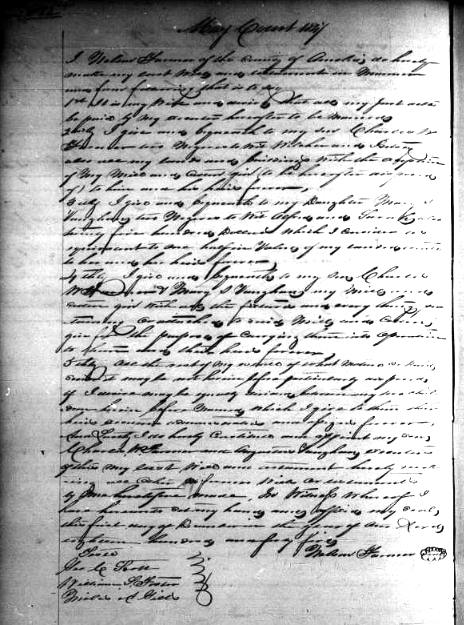
Mary, who had married Augustus Vaughan, died shortly before her father, who died on 14 April 1847. Her husband, Augustus Vaughan, filed a noncontroversial chancery suit in 1848 on behalf of their daughters Ann (age 4) and Mary (age 2) to ensure proper division of the part of Nelson’s estate that was not specifically given to either child.[14]
The Enslaved Community at the Farmer House
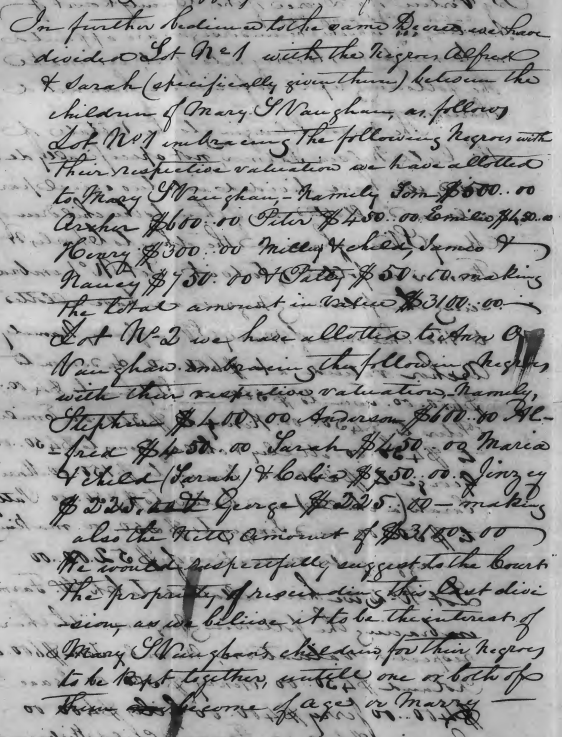
Of course they were talking about the enslaved men, women and children held by Nelson Farmer. His will specifically bequeathed Wilcher & Betsy to son Charles and Alfred & Sarah to daughter Mary. The remaining enslaved individuals were divided into two equitable lots—one for Charles, and one for Mary’s daughters – Ann O. Vaughan , age 4 and Mary S. Vaughan, age 2. The commissioners listed each person by name and assigned monetary values, a stark reminder of the human cost of slavery.
The girls’ lot included: Archer, Anderson, Tom, Stephen, Peter, Henry, Emilie, Milly & child James, George, Nancy, Maria, Sarah (a child), Catie, Patty, and Jinzey (Total value: $5,200). Charles’s lot included: Tom, Roland, Henry, Isaac, Jerry, Giles, Gracie, Fanny & child William, Pascal, Susan, Julia, Amanda & Eliza, Fanny, Robin, and Sally (a child) (Total value: $5,200). The commissioners recommended that the enslaved individuals assigned to the girls “be kept together until one or both of them come of age or marry.”[15]
Walking through the house today, it is impossible not to think about the enslaved people whose labor built and sustained this property. Their names—preserved in legal documents and in Charles W. Farmer’s record book—are among the few traces of their lives that remain.
Charles W Farmer’s Record Book
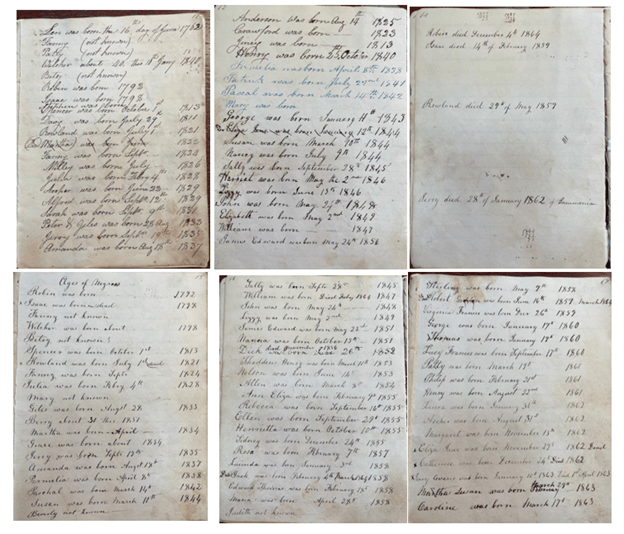
One of the most remarkable surviving artifacts connected to the Farmer House is Charles Willson Farmer’s record book, held by the Virginia Museum of History and Culture. The book contains birth and death records for 100 enslaved individuals born between 1762 and 1864. Many of the names listed in Nelson’s estate appear here, along with their family relationships and life events.[16] The record book can be viewed online (see Footnote 16). This record book is a rare and invaluable resource—one that preserves identities that might otherwise have been lost to history.
Reflections on our Visit
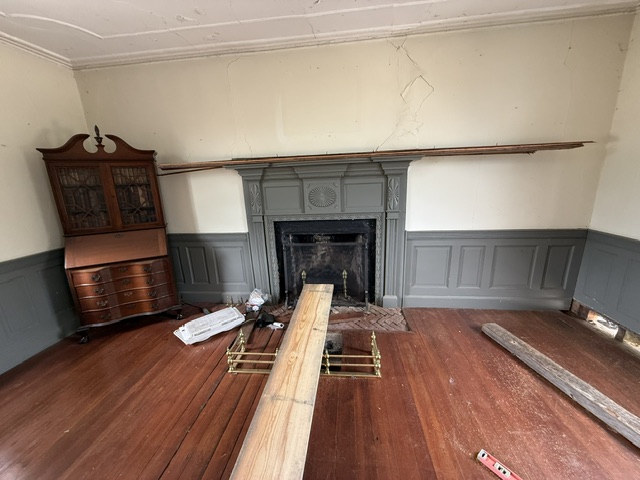
Walking through the Farmer House was more than a historical exercise. It was a moment of connection—across generations, across lives, across the complicated legacy of a place shaped by family, land, and the institution of slavery. Ann and Mary Vaughan spent their childhood here. Their uncle and aunt raised eleven children within these walls. Enslaved men, women, and children lived, worked, and suffered here. And through wills, deeds, and chancery suits, the story of this house reveals the intertwined lives of all who inhabited it. Standing in the west room, looking at the mantel carved two centuries ago, we felt the weight of that history—and the privilege of being able to walk through it.
[1] National Register of Historic Places, Farmer House Nomination Form, 1978; https://catalog.archives.gov/medialive/0/6795/41679500/content/electronic-records/rg-079/NPS_VA/78003004.pdf
[2] Amelia County Virginia Deed Book 1, 1734-1743, p. 112; “Amelia, Virginia, United States records,” images, FamilySearch (https://www.familysearch.org/ark:/61903/3:1:3Q9M-CS4H-8Q6J-B?view=explore : Aug 5, 2026), image 74 of 298; Image Group Number: 007893730
[3] 25 June 1747, 1,083 acres to Joseph Motley, Land Office Patents No. 28, 1746-1749 (v.1 & 2 p.1-730), p. 111 (Reel 26), Library of Virginia.
[4] Amelia County Order Book 6, 1760-1763, p. 213; “Amelia, Virginia, United States records,” images, FamilySearch (https://www.familysearch.org/ark:/61903/3:1:3Q9M-CS4H-19JM-C?view=explore : Aug 5, 2026), image 133 of 217; Image Group Number: 007893733
[5] Amelia County Virginia Will Book 2, 1771-1780, p. 233; “Amelia, Virginia, United States records,” images, FamilySearch (https://www.familysearch.org/ark:/61903/3:1:3QS7-L9P4-XQZR?view=explore : Aug 5, 2026), image 123 of 193; Image Group Number: 007643926
[6] Deed dated 27 May 1807 and recorded 25 June 1807. Amelia County Virginia Deed Book 22, 1804-1808, p. 340; “Amelia, Virginia, United States records,” images, FamilySearch (https://www.familysearch.org/ark:/61903/3:1:3Q9M-CSLD-1SZ5-G?view=explore : Aug 3, 2026), image 181 of 251; Image Group Number: 008190015
[7] Amelia County Virginia Deed Book 20, 1794-1799, p. 510; “Amelia, Virginia, United States records,” images, FamilySearch (https://www.familysearch.org/ark:/61903/3:1:3Q9M-CSL6-SCHZ?view=explore : Aug 4, 2026), image 169 of 192; Image Group Number: 008190014
[8] Deed dated 6 March 1817, recorded in Richmond 11 February 1820, recorded in Amelia 27 April 1820. Amelia County, Virginia Deed Book 25, 1817-1821, p. 422; “Amelia, Virginia, United States records,” images, FamilySearch (https://www.familysearch.org/ark:/61903/3:1:3Q9M-CSL6-SVGV?view=explore : Aug 4, 2026), image 225 of 365; Image Group Number: 008190017
[9] Charles Farmer Will. Amelia County, Virginia Will Book 9, 1818-1823, p. (?) Image 160 of 240; “Amelia, Virginia, United States records,” images, FamilySearch (https://www.familysearch.org/ark:/61903/3:1:3QSQ-G9P4-FHZ?view=explore : Aug 3, 2026), image 160 of 240; Image Group Number: 007643929
[10] Francis Farmer’s will dated 21 February 1806 and recorded 12 December 1814 “I give and bequeath to my son Nelson Farmer and his heirs forever the whole of the lands and plantations I now possess in the said County of Chesterfield, also the whole of my plantation utensils.” Chesterfield County, Virginia Will Book 8, 1813-1818, p. 260; “Chesterfield, Virginia, United States records,” images, FamilySearch (https://www.familysearch.org/ark:/61903/3:1:3QS7-L9PH-YQLY?view=explore : Aug 4, 2026), image 142 of 350; Image Group Number: 007644377
[11] Chesterfield County Virginia Deed Book 24, 1821-1823, p. 271; “Chesterfield, Virginia, United States records,” images, FamilySearch (https://www.familysearch.org/ark:/61903/3:1:3Q9M-C373-8SFY-8?view=explore : Aug 4, 2026), image 146 of 327; Image Group Number: 008572346
[12] A deed dated 3 December 1827 give a portion of Rebecca’s father Ezekiel Dance’s land to Mary S. and Charles W. Farmer, heirs of Rebecca B Farmer, decd. Chesterfield County, Virginia Deed Book 27, 1827-1830, p. 80; “Chesterfield, Virginia, United States records,” images, FamilySearch (https://www.familysearch.org/ark:/61903/3:1:3Q9M-CSL6-4SY7-H?view=explore : Aug 1, 2026), image 53 of 189; Image Group Number: 008190121
[13] Nelson Farmer Will. Amelia County Virginia Will Book 15, p. 692; “Amelia, Virginia, United States records,” images, FamilySearch (https://www.familysearch.org/ark:/61903/3:1:3QS7-L9P4-FHYY?view=explore : Aug 5, 2026), image 360 of 363; Image Group Number: 007643932
[14] Amelia County Virginia Chancery Court, #1848-003, Augustus Vaughan v. Charles W Farmer, Executor, Image 15 of 16, Virginia Chancery Court Records, Library of Virginia Digital Collections; https://old.lva.virginia.gov/chancery/case_detail.asp?CFN=007-1848-003
[15] Amelia County Virginia Chancery Court, #1848-003, Augustus Vaughan v. Charles W Farmer, Executor, Virginia Chancery Court Records, Library of Virginia Digital Collections; https://old.lva.virginia.gov/chancery/case_detail.asp?CFN=007-1848-003
[16] Farmer, Charles Willson Record Book 1762-1887, Virginia Museum of History and Culture, Richmond, Virginia; http://librarycatalog.virginiahistory.org/final/portal.aspx?lang=en-US


Hello My name is Phyllistine Ward Mosley my ancestors were enslaved and Labored on the Farmer Plantation.
I understand my gggrand father Beverly Ward was a horseman and his sibling live there until the emancipation proclamation and the civil warfare ended in 1865.
The name of the ancestors and I hope they can be compared with Charles Farmers records will show this is where my ancestors lived.
Thaddeus Henry born March 10, 1853; Beverly; Martha born April 1834; Anna Eliza born Feb 9,1855; Rosa born Feb 7,1857; Phillip born 21 1861;
Martha Susan born March 28,1862;
There are two children that did not show on the records book I found. They are Emanuel born 1854; and Hannah born in 1858. I hope the Farmers records in Richmond will show these children of Beverly and Martha Booker.
July23-26, 2015 Ward Family bReunion. Our family spent the afternoon Sat July 24th at the farmer Planation to walk the grounds of our ancestors home place.
We toured the house, had our family meeting there. We had family members from all over the country and appreciated the opportunity to learn about our Ward family history.
We will have our 30 years family reunion in July 2027 and hope to tour the plantation again for other family members that was not with us in 2015.
I would like to contact the Farmers children to share our stories and maybe come together in 2027 to visit the planation together.
LikeLike
Thank you so much for writing to me. I looked on the Charles W. Farmer record book and found all the people you listed except for Emanuel and Hannah:
Thaddeus Henry born March 10, 1853 – listed on page 8 of 11
Beverly – listed on page 7 of 11 – the page says “ages of Negroes” and for Beverly “not known”
Martha born April 1834 – listed on page 7 of 11
Anna Eliza born Feb 9,1855 – listed on page 8 of 11
Rosa born Feb 7,1857 – listed on page 8 of 11
Phillip born 21 1861 – listed on page 9 of 11
Martha Susan born March 28,1862 listed on page 9 of 11 (lists her birthdate March 29, 1863)
Here is the link to the record book you can view online (you just have to copy and paste into your search bar): https://librarycatalog.virginiahistory.org/final/Download.aspx?template=MixedMat&field=Attachment&record=d00f9b09-fbcc-4254-bbd7-b78528393b08&showSave=False&repeat=1ed36da6-01af-445d-9570-071636d43e64
If you want to see it in person at VMHC in Richmond the catalog record is:
Record 60Mss5:5 F2295:1, Author: Farmer, Charles Willson, Title: Record book, 1762-1887.
Charles had 11 children. I’m sure he has living descendants, but I don’t know any of them. If you are on Ancestry you could probably make a tree for Charles Willson Farmer (1825-1890) and Alice Gabriella Gills (1835-1915) and track descendants up to 1950. You can also access Virginia Chronicle https://virgiinachroncile.com. This is free and you can search Virginia newspapers for obituaries and figure out more recent living people from that.
I have been researching my family tree since I was 11 years old – I’m now 62. I find it fascinating. For my ancestors who enslaved people, I always make that part of the story I tell in my blog posts and include their genealogical information if I can find it. Thank you again for writing and I hope you are successful in your search. Steve
LikeLike
Thank you for the research information. Are you related to the. Farmers ? It’s been 12 years since visiting the Farmers home place but has it deteriorated. Iam trying to locate family members over the years. I have an indirect contact Susan and need o contact her since meeting you. I will keep
LikeLike
Yes I am related to the Farmers. Nelson Farmer was my 3x great grandfather. Nelson built or had built the Farmer House. His son was Charles W Farmer who inherited the place. I descend from Nelson’s daughter Mary Spencer Farmer who married Augustus Vaughan. The house is in very poor shape, but the new owner is determined to restore it.
LikeLike
So sorry to see that. I was so beautiful when we were there
LikeLike