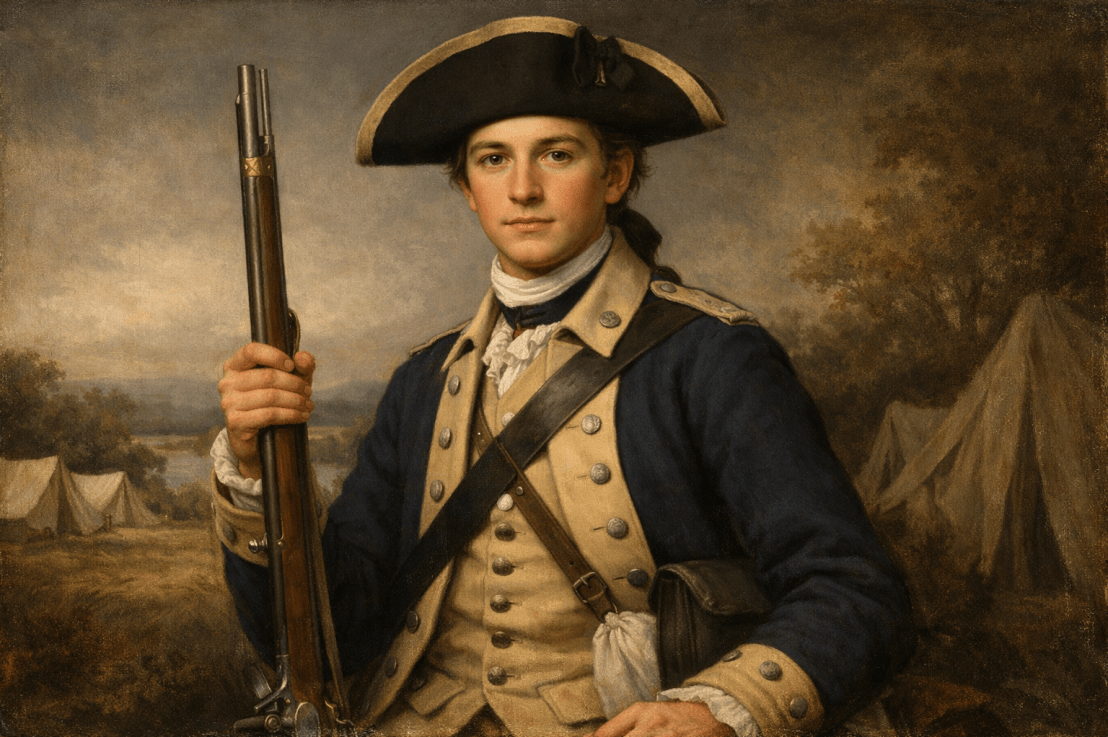
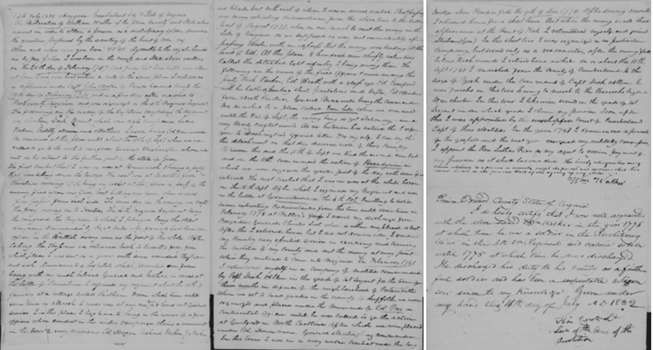
According to his own testimony given years later to secure his pension, William Walker enlisted on 19 February 1776, just a week before his 19th birthday, as a rifleman in Captain John Morton’s Company. A few days later his Company marched from Prince Edward County to Portsmouth where they were organized into the Fourth Regiment under Col. Lawson. The regiment remained in Portsmouth until September 1776, when they received orders to march to New Jersey to reinforce troops serving under General George Washington. His first combat was at Brunswick, New Jersey covering a party attempting to take down a bridge.[1]
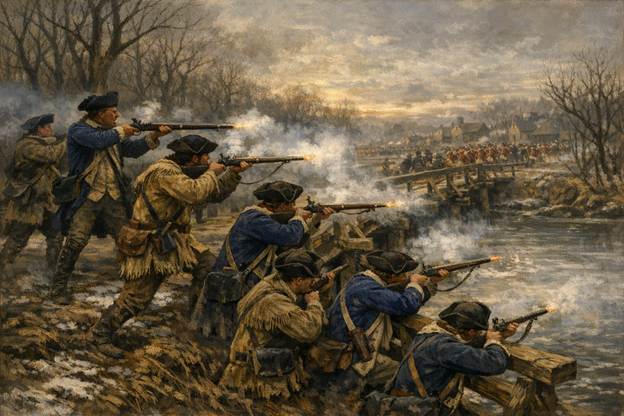
Walker’s reference to “Brunswick” refers to the fighting at New Brunswick on 1 December 1776, during Washington’s retreat across New Jersey. In that action, Washington’s rear guard destroyed part of the bridge over the Raritan and exchanged cannon fire with the British while the army withdrew further west into Pennsylvania before moving back into New Jersey for the attack on Trenton.[2]
On Christmas morning 1776, William Walker recalled being on picket at Coryell’s Ferry when British troops fired on the ferryboat and killed one man. Coryell’s Ferry was a major Delaware River crossing in the Revolutionary era, located at what is now New Hope, Pennsylvania, and Lambertville, New Jersey. It was one of the key ferry points Washington’s army used when moving between New Jersey and Pennsylvania, especially during the winter campaign of 1776–1777.
On Christmas morning, 1776, William Walker was in combat at Currell’s Ferry, New Jersey, where they were fired upon by British troops. Later that day, his regiment moved by ferry to Trenton where the 4th Virginia Regiment crossed the Delaware with General Washington and served in the vanguard in the attack on the Hessian garrison.[3]
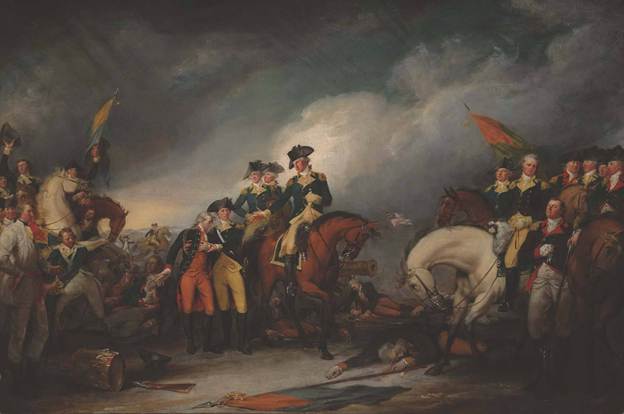
Afterward, the Fourth Regiment returned to Currell’s Ferry where William Walker was assigned to transport some wounded Hessians and sick Americans to a hospital. He rejoined his regiment at Chatham about 10 Jan 1777 and was engaged in several battles including the Battle of Princeton, 3 January 1777, Battle of Brandywine, 11 September 1777 and the Battle of Germantown, 4 October 1777.[5]
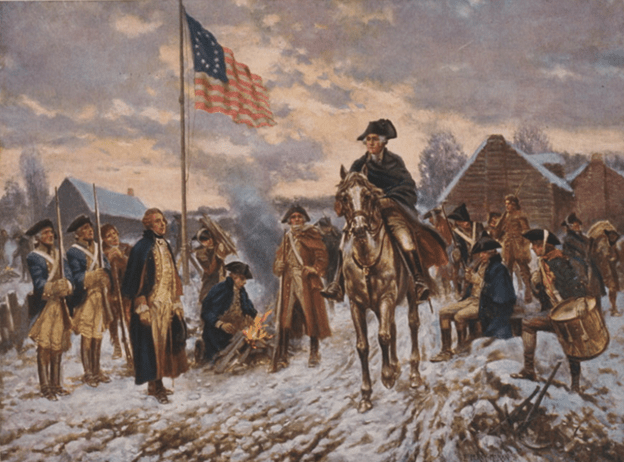
Winter at Valley Forge
Eighteenth-century armies routinely suspended active campaigning in winter. Roads became impassable mud, horses weakened, disease spread faster in prolonged field conditions, and supply lines collapsed in cold weather. By late November 1777, Washington’s army was physically spent after a brutal fall campaign — the defeats at Brandywine and Germantown, combined with the British capture of Philadelphia in September, had left the men exhausted, under-equipped, and demoralized.
Valley Forge was chosen by Washington because it was 20 miles from Philadelphia – close enough to monitor British troop movements and far enough to avoid a surprise attack. Valley Forge also offered defensible terrain with its elevated plateau and the Schuylkill River served as natural barrier from the north.
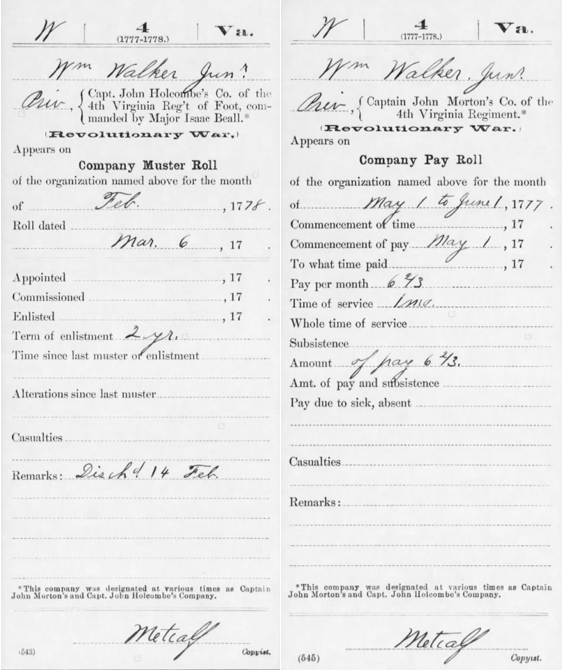
The Americans at Valley Forge that winter suffered from relentless shortages of food, clothing, shoes, and shelter, which left soldiers cold, hungry, and exhausted for months. Poor sanitation and overcrowded conditions also allowed disease to spread through the camp, and nearly 2,000 men died before the army left in June 1778.[7] Fortunately for William Walker, he received his discharge from Brigadier General Charles Scott on 14 February 1778 at which time he returned to Virginia.
William Walker’s service as a soldier was not complete. In February 1781, he decided to enlist again joining Captain Dick Allen’s Company, Prince Edward County Militia, as a First Sergeant for a three-month period for the purpose of defending the “neighborhood” of Portsmouth.
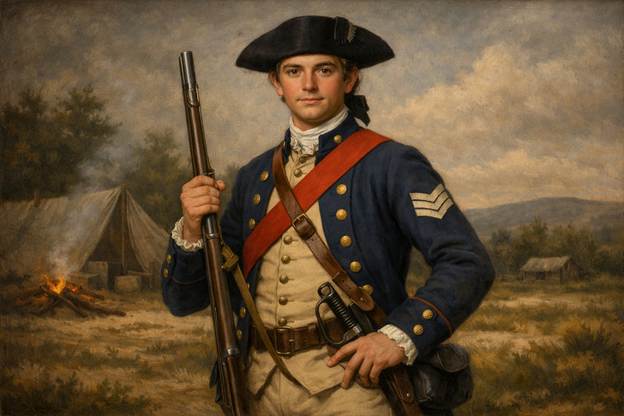
The Company marched to the vicinity of Suffolk, Virginia where they were placed under the command of Colonel Posy, a continental officer, until he was called to North Carolina and the Company was placed under the command of Colonel Dowman. After serving three months, William Walker returned to Cumberland County, but served intermittently until 11 Sep 1781, when he marched from Cumberland County to participate in the siege of Yorktown under the command of Captain Dick Allen. The siege began on 28 September and ended with the surrender by Cornwallis in 19 October 1781.[8]
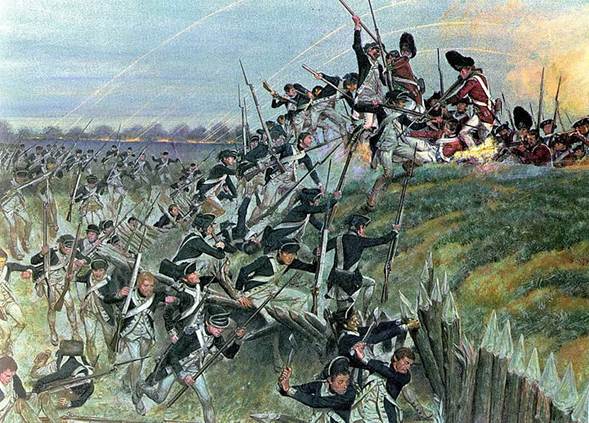
After the surrender at Yorktown, William Walker returned home and was appointed by the Court of Cumberland as Captain of the local militia.[10]
William Walker was born on 26 Feb 1757 at “High Hill” in Cumberland County, Virginia[11] and was the eldest son of Warren and Magdalene (Burton) Walker.[12]
A Virginia census taken in 1782 includes William Walker living in Cumberland County. He was living by himself and held 17 enslaved people.[13] His father, Warren Walker, made his will in 1785, leaving son William “the tract of land on the North side of Broad Branch” with no acreage stated.[14]
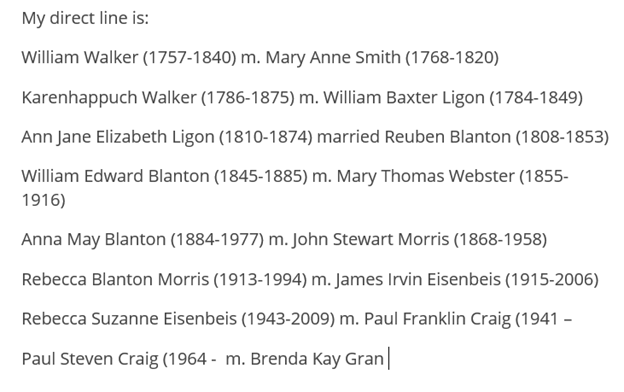
On 31 March 1785, William Walker, age 28, married Mary Anne Smith, a daughter of John and Suzanna (Watson) Smith of Prince Edward County.[15] William & Mary Anne (Smith) Walker would go on to have at least nine children over the next two decades and owned a plantation that used enslaved labor. In 1820 William Walker enslaved 29 people and by 1830 the number had climbed to 37.[16] In 1840, the year of his death, he held 30 enslaved men, women and children. Thirteen engaged in agriculture and 11 were under the age of 10.[17] William Walker, age 83, died at his home called “White Hall” in Cumberland County, Virginia on 20 July 1840.[18]
He likely descends from the William Walker (c.1640-c.1723), who appears as a headright of Charles Edmonds in New Kent County in 1658 where Edmonds was granted 2750 acres in New Kent County for the importation of 55 people into the Colony. John Davis was the original person who had received most of that acreage, but he assigned or sold the rights to Edmonds. Another headright on that list was Francis Warren. Both men came to Virginia as indentured servants.[19] William Walker later married a daughter of Francis Warren and had children including a son named William II (c. 1690-c.1752) who was the first of this line to settle in Cumberland County, Virginia and the grandfather of the subject of this blog post.
[1] Military Record: Vol. VIII, p. 455, Revolutionary Soldiers of the State of Virginia-Library Report, Nat. No. 141, 433, Record of the Pension Office, Saffell’s List. On 14 Jul 1832, William Walker gave an account of his service record as a Revolutionary War soldier to obtain his pension. Digitally available at Fold3.com (subscription required) – US, Revolutionary War Pensions, 1800-1900, Pub. No. M804, Nara catalog id 300022, Nara catalog title, Case Files of Pension and Bounty-Land Warrant Applications Based on Revolutionary War Service, compiled ca. 1800 – ca. 1912, documenting the period ca. 1775 – ca. 1900, Publisher NARA, Record group 15; https://www.fold3.com/image/19827153/walker-william-page-1-us-revolutionary-war-pensions-1800-1900
[2] Revolutionary War New Jersey, Battle of New Brunswick; https://www.revolutionarywarnewjersey.com/new_jersey_revolutionary_war_sites/towns/new_brunswick_nj_revolutionary_war_sites.htm
[3] American Battlefield Trust, Battle of Trenton; https://www.battlefields.org/learn/revolutionary-war/battles/trenton
[4] Trumbull, J. & Detroit Publishing Co, P. Capture of the Hessians at Trenton. Trenton United States New Jersey, None. [Between 1900 and 1912] [Photograph] Retrieved from the Library of Congress, https://www.loc.gov/item/2016796516/.
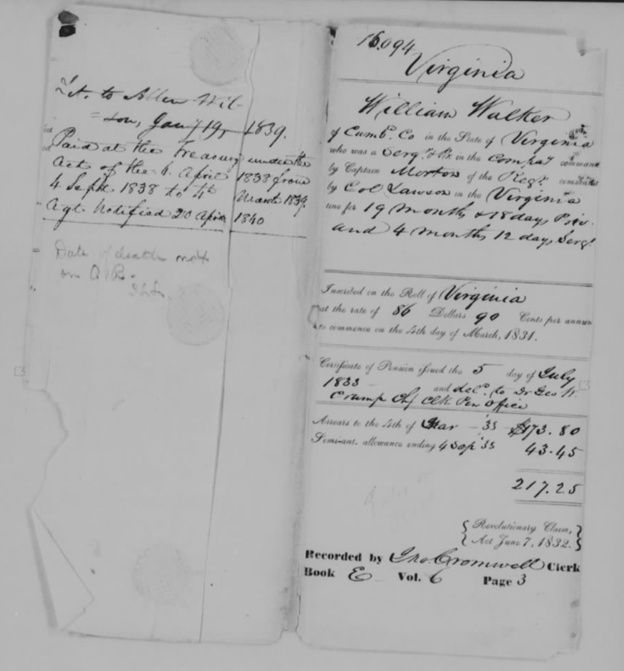
[5] William Walker’s 1832 Pension Application
[6] Moran, P. (ca. 1911) Washington at Valley Forge / E. Percy Moran. United States Valley Forge Pennsylvania, ca. 1911. [Photograph] Retrieved from the Library of Congress, https://www.loc.gov/item/92506172/.
[7] Valley Forge Muster Roll, A Legacy Project of the Valley Forge Park Alliance, https://valleyforgemusterroll.org/
[8] William Walker 1832 Pension Application and McAllister, J.T. Virginia Militia in the Revolutionary War, McAllister Publishing Co., Hot Springs, Virginia, 1913, pp. 223-227; https://www.google.com/books/edition/Virginia_Militia_in_the_Revolutionary_Wa/KKc-AAAAYAAJ?hl=en&gbpv=1
[9] Mark, H. W. (2024, September 05). Siege of Yorktown. World History Encyclopedia. https://www.worldhistory.org/article/2532/siege-of-yorktown/
[10] Military Record: Vol. VIII, p. 455, Revolutionary Soldiers of the State of Virginia-Library Report, Nat. No. 141, 433, Record of the Pension Office, Saffell’s List. On 14 Jul 1832, William Walker gave an account of his service record as a Revolutionary War soldier to obtain his pension.
[11] William Walker grave White Hall Cemetery, Cumberland County, Virginia; U.S., Find A Grave Index, 1600s-Current, Ancestry.com, 2012
[12] Will of Warren Walker, Cumberland Co., VA Will Book 2, p. 473-74; Division of Estate of Warren Walker, Sr., recorded Cumberland Co., VA, 28 Sep 1785 names wife, Magdalen and sons William Walker, Warren Walker, William McGehie, Baker Legrand and Elisha Meredith (the last three sons-in-law). (2) Will of John Burton, Amelia Co., VA Will Book 2, p.254 names wife Sarah; Will of Sarah Burton, Amelia County Will Book 3, p. 54, names daughter Magdalene Walker and granddaughter Mary Walker, daughter of Warren Walker
[13] Heads of Families at the First Census of the United States taken in the year 1790: Records of the State Enumerations 1782-1785 (Baltimore: Genealogical Publishing Co., Inc., 1986, p. 16
[14] Will of Warren Walker, Cumberland Co., VA Will Book 10, p. 230-231; “Cumberland, Virginia, United States records,” images, FamilySearch (https://www.familysearch.org/ark:/61903/3:1:3Q9M-C9TC-Z9PL-2?view=explore : Apr 27, 2026), image 121 of 230; Image Group Number: 007675922
[15] Prince Edward County Marriage Bond 21 March 1785, image 576, https://www.familysearch.org/search/film/007741931; accessed 21 July 2022
[16] 1820 U S Census; Census Place: Cumberland, Virginia; Page: 109; NARA Roll: M33_130; Image: 210; Year: 1830; Census Place: Cumberland, Virginia; Series: M19; Roll: 192; Page: 209; Family History Library Film: 0029671; Ancestry.com
[17] Year: 1840; Census Place: Cumberland, Virginia; Roll: 554; Page: 290; Family History Library Film: 0029684; Ancestry.com
[18] U.S., Find A Grave Index, 1600s-Current, Ancestry.com
[19] Nugent, Nell Marion. Cavaliers & Pioneers: Abstracts of Land Patents and Grants 1623-1800, Volume I, p. 386


Quite a man
LikeLiked by 1 person