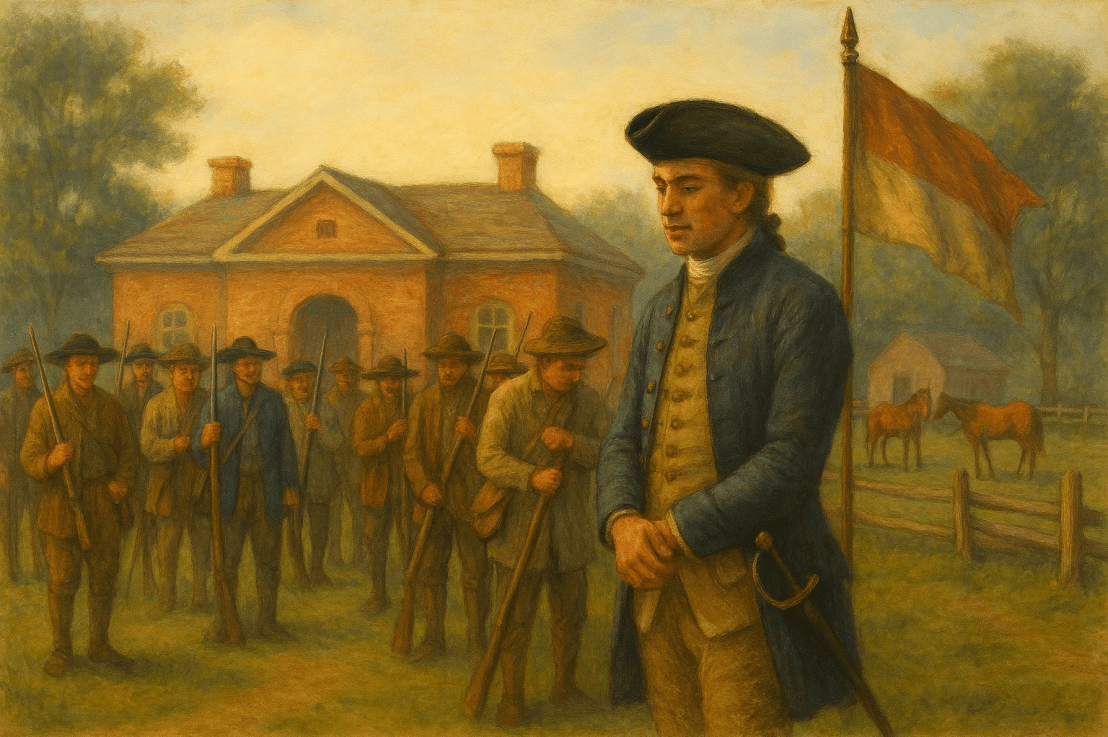
As we approach the 250th anniversary of American Independence, I am profiling each of my Revolutionary War ancestors and the many different ways they experienced that era. One of the most documentable is Ambrose Jeter of Caroline and Amelia Counties, Virginia, who rose from a frontier Huguenot community to become a militia officer, landowner, and local official in the new Commonwealth.
Ambrose Jeter steps into the Virginia record in 1756 as a young man witnessing a family land transfer, but by the time his estate is settled in 1803 he has become a militia officer, a substantial landowner, a town trustee, and the patriarch of a sprawling Amelia County family network. His paper trail—scattered across deeds, wills, tax lists, court orders, and even dueling newspaper notices—offers a surprisingly vivid portrait of one man’s climb from the Mattapony frontier to local prominence in Revolutionary-era Virginia.
Huguenot Roots on the Mattapony
Ambrose was born by 1739 in Caroline County, very likely the grandson of the immigrant John Jeter, who may have been among the French Huguenot settlers placed along the Mattapony River around 1700. That settlement never rivaled Manakintown in fame, but Huguenot families such as Jeter, Seay, Duval, and Chenault forged lasting ties that would later carry them into Amelia County and other developing interior counties.[1]
The first firm glimpse of Ambrose appears in a 22 December 1756 deed, when he witnessed his presumed parents, John and Elizabeth Jeter of St. Mary’s Parish in Caroline, giving 154 acres on Whetstone Creek in Amelia County to their son John “for natural love and affection.” A few months later in March 1757, Ambrose returned to court to prove the deed, a small but telling act that placed him squarely within an emerging multi-county Jeter network moving south and west.[2]
A Revolutionary War Militia Officer

During the Revolutionary War, Ambrose served in the Caroline County militia as an Ensign in Captain Stern’s company. In May 1778 he was recommended for the rank,[3] and in June he took the oath to the new Commonwealth of Virginia as an officer in the local defense force.[4] His role was on the home front rather than in the Continental Line, but like many county officers he shouldered real responsibilities during a turbulent time when local militias were expected to enforce new laws, respond to threats, and support the wider war effort.

After the war, the county recorded several public service claims from Ambrose for a bay horse and multiple beeves taken in 1780 and 1781 for military use.[5],[6],[7] Those entries are brief, but they hint at the day-to-day costs of supporting the patriot cause—losses in livestock and resources that families like the Jeters absorbed in addition to their militia service.
Marriage, Children, and Loss
Ambrose’s personal life in the years just before and during the Revolution begins to take shape in January 1760, when an Amelia County marriage bond was issued for his marriage to Jane “Jean” Stern, with his kinsman John Jeter providing security.[8] Because there is no note of parental consent, the bond also tells us that Ambrose was at least twenty-one, anchoring his birth no later than 1739.[9] Though married in Amelia, Ambrose and Jean continued to live in Caroline, where in 1769 he was replaced as overseer of a road—one of those routine but revealing local duties that show how he fit into the county’s civic life.[10]
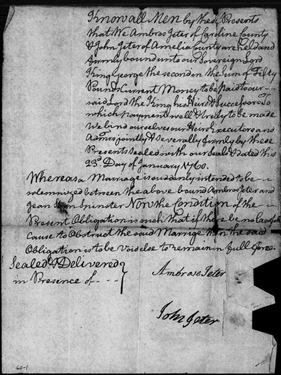
The couple’s marriage produced five children: Allen, Rodophil, Tabitha Anderson, Mason, and Jane. When Jean’s mother, Ann (Anderson) Stern, wrote her will in 1773, she named those grandchildren along with her son-in-law, Ambrose, linking the Jeters tightly with the Anderson and Stern families.[11] Jean herself had died by the time that will was written, and by 1775 Ambrose formally took on the role of guardian to his own children in Amelia County court, giving bond “with security as the law directs.”[12]
“To the Public”: A Dispute in Print
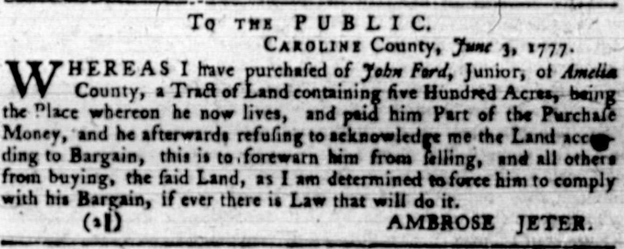
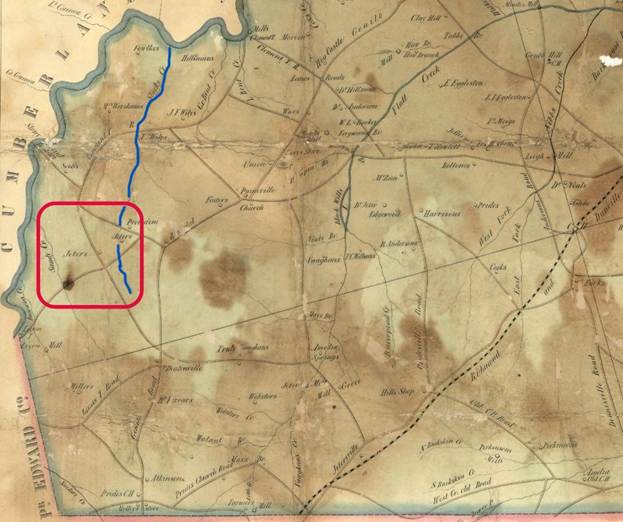
Ambrose’s move toward Amelia during the Revolutionary crisis was not just a quiet drift; it included a very public dispute played out in the pages of the Virginia Gazette. In June 1777, he published a notice from Caroline County declaring that he had bought 500 acres from John Ford Jr. in Amelia, had paid part of the purchase money, and now intended to force Ford to honor the bargain if any law would support him. Ford’s response, in a matching public notice dated a week later from Amelia County, accused Ambrose of misrepresenting the deal and claimed he never was under “any Obligation” to Jeter for land or anything else.
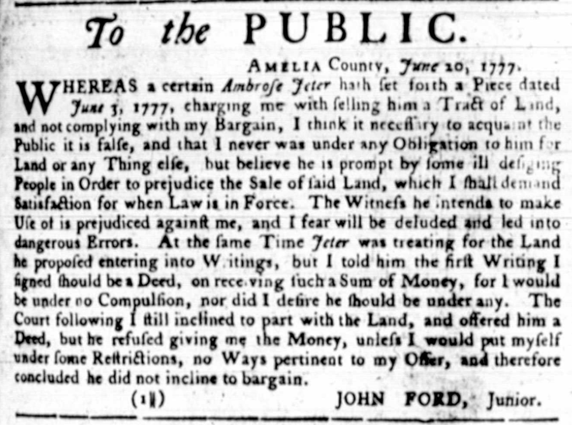
The quarrel, with its pointed references to “ill designing People” and prejudiced witnesses, offered readers an unusually candid glimpse into the friction that could accompany land speculation in wartime Virginia. In the end, however, the dispute moved from print back into the deed book: on 27 September 1777, John Ford Jr. and his wife Frankey sold Ambrose 500 acres in Amelia for £625, the same tract Ford had been living on, complete with buildings. The deed was recorded in February 1778, confirming that Ambrose had won his way into Amelia on the strength of that contested bargain.
A Second Marriage and Carefully Guarded Property
Ambrose’s second marriage illustrates the careful legal planning that could accompany late-18th-century remarriages among property holders in the new Commonwealth. In September 1779, he and Mary (Craddock) Farley, the widowed relict of George Farley, signed a prenuptial agreement with her brother Richard Craddock acting as the third party. The contract specified that during their marriage they would share their combined estates, but upon the death of either, each party’s property would revert to their respective heirs “as if the marriage never occurred.”[14]
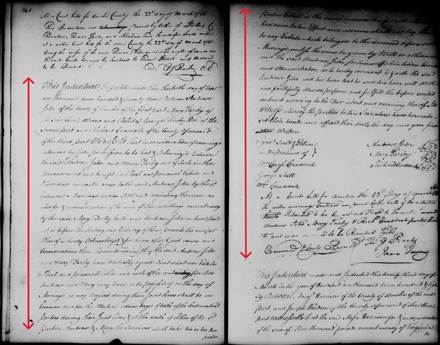
The arrangement makes more sense in light of later records: when Mary died around 1792, Ambrose executed a deed of trust conveying all the property he had received from her—including land, livestock, and seven enslaved people named Mack, Ned, Rose, Jonathan, Archer, Fanney, and Hannah—to another Craddock relative, Charles, in order to fulfill the terms of the earlier agreement.[15] The surviving documents make it clear that Mary brought significant assets to the marriage and that the Craddock family intended to protect those assets for their own kin line.
Planter, Slaveholder, and Local Official
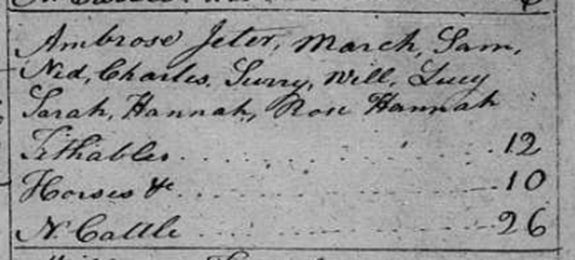
By the early 1780s, as the war was winding down and Virginia shifted from colony to Commonwealth, Amelia County personal property tax lists present Ambrose as a substantial slaveholder and stock owner. In 1782, he was charged for twelve tithables (enslaved people over a certain age) whose names were carefully listed—March, Sam, Ned, Charles, Surry, Will, Lucy, Sarah, Hannah, Rose, and another Hannah—along with ten horses and twenty-six head of cattle.[16] Other entries record his claims for a bay horse and several “beeves” taken for Revolutionary public service, a reminder that local patriotism came at material cost to farmers like Jeter and that those costs often involved both livestock and enslaved labor.
By the mid-1780s, Ambrose’s name appears regularly in the Amelia County order books and tax rolls, marking him as a man frequently present in court, often serving as a witness, juror, or party to suits. In one case in 1785, a jury found that he had indeed “assumed upon himself” a debt to Moses Craddock and failed to perform, assessing damages of eight pounds fifteen shillings and one penny halfpenny against him.[17] The entry is a reminder that even established men could end up on the losing side of a civil case in a county court that doubled as both business forum and community stage.
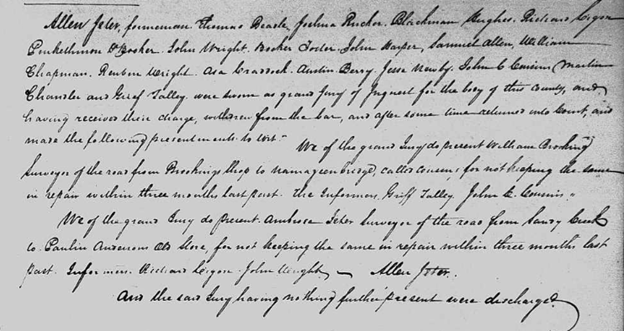
He also took on public responsibilities that were both mundane and revealing in the postwar years. In 1791, he wrote to Governor Beverley Randolph expressing willingness to serve as a reassessor of Amelia County lands, noting that he held land under both existing assessments and believed his appointment would meet with general approval.[18] Later in the 1790s, he served as a trustee of Ligon town,[19] helping to oversee the sale of town lots, and as surveyor of a road from Sandy Creek to Paulin Anderson’s old store—duties that brought him into conflict with his own son when a grand jury, with Allen Jeter as foreman, presented Ambrose for failing to keep the road in repair.[20]
Family, Enslaved People, and an Estate
The final phase of Ambrose’s life is documented through tax records, deeds, and his 1798 will, which together sketch a mature planter household centered on land along Stocks Creek in Amelia County.[21] By 1801 and 1803, the personal property tax lists show him and his adult sons Allen, Rodophil, and John each being taxed separately, with Ambrose still responsible for several enslaved people, horses, and cattle.[22],[23]
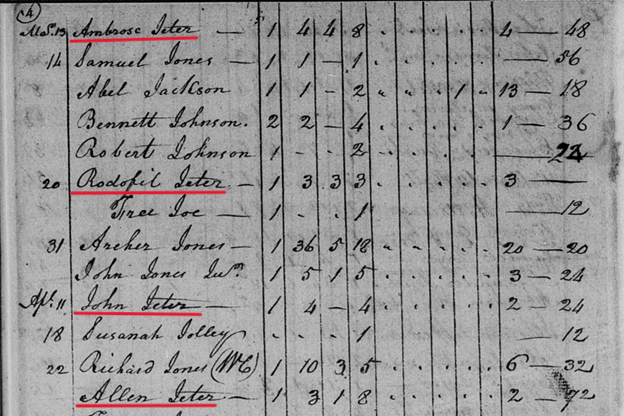
His will divides his land and enslaved property among his children in specific ways. Allen received half of the land on the west side of Stocks Creek; Rodophil received all the land on the east side; John received the other half of the western tract “with the Improvements thereon” and six enslaved people—Hannah, Julia, Frank, Phill, Archer, and Jenny—while daughters Tabitha A. Gills, Mason Crenshaw, and Jane S. Wood each received an enslaved child or youth by name. The rest of his estate was to be equally divided among all of his children, with Allen, Rodophil, John, and son-in-law William Wood serving as executors.
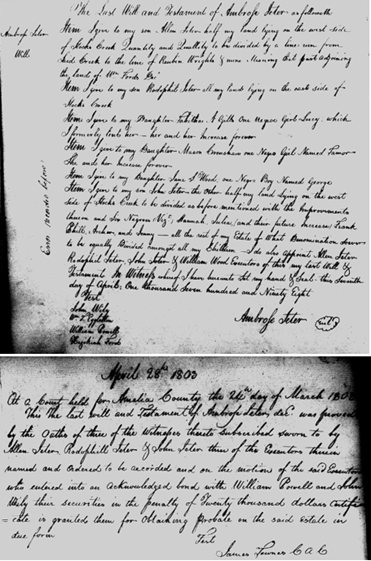
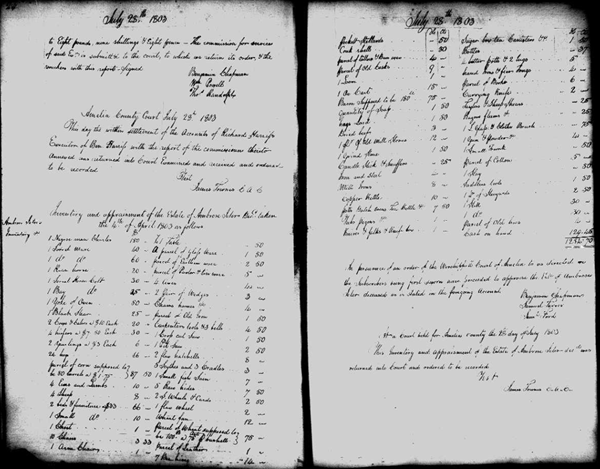
Ambrose’s will was proved in March 1803,[24] and his inventory and appraisal, recorded that July,[25] itemized the material legacy of a lifetime: land, enslaved people, livestock, household goods, and tools that would sustain the Jeter descendants in Amelia and beyond. His children’s marriages into the Gills, Crenshaw, Wood, and allied families carried that legacy further, weaving the Jeters into a dense web of kin and property relations characteristic of the region’s white planter class.
Why Ambrose Matters in a 250th-Anniversary Series
Ambrose Jeter’s story is not one of spectacular battlefield heroics, but rather the steady accumulation of land, enslaved labor, and local influence by a man who began as the grandson of Huguenot refugees on the Mattapony frontier. For my own family, he represents the county-level face of the Revolution: not a Continental officer or famous politician, but a man whose militia service, wartime losses of horses and cattle, and steady civic work helped sustain Virginia during and after the conflict.
As this series continues, I’ll be setting Ambrose alongside my other Revolutionary War ancestors to show the many different ways ordinary Virginians experienced the war.
Ambrose Jeter, b. by 1739, Caroline County, Virginia, d. 1803, Amelia County, Virginia, m. (1) 1760, Amelia County, Virginia, Jane “Jean” Stern, b.c. 1740, Caroline County, Virginia, d. bef. 1775, Caroline County, Virginia, m. (2) 1779, Amelia County, Virginia, Mary (Craddock) Farley, d.c. 1792, Amelia County, Virginia, issue (1st marriage):
Allen Jeter, b.c. 1761, Caroline County, Virginia, m.b. 11 January 1785, Amelia County, Virginia, Judith Crowder
Rodophil Jeter, b.c. 1763, Caroline County, Virginia, m.b. 15 October 1785, Lucy Ann Gills (daughter of John and Elizabeth (———-) Gills
Tabitha Anderson Jeter, b.c. 1764, Caroline County, Virginia, m.b. 11 March 1786, John Gills (son of John and Elizabeth (———-) Gills
Mason Jeter, b.c. 1765, Caroline County, Virginia, m.b. (1) 3 January 1786, Amelia County, Virginia, Anthony W. Crenshaw, m.b. (2) 30 April 1804, Amelia County, Virginia, Jacob A. Lockett
Jane Stern Jeter, b.c. 1772, Caroline County, Virginia, m.b. 2 July 1788, Amelia County, Virginia, William Wood
John Jeter, b. 17 July 1774, Caroline County, Virginia, m.b. (1) 31December 1794, Jane “Jinney” Chaffin, m.b. (2) 28 April 1804, Amelia County, Virginia, Ann Scott
[1] Here is an excerpt from an article by Cameron Allen taken from Genealogical Research by the American Society of Genealogists (1971, 2 volumes): “The Mattapony group settled in what was then King William County, perhaps attracted by the fact that a Huguenot clergyman, James Boisseau had settled there a decade or so earlier. Later the Mattapony area was cut off as Caroline County. Here we know that another Huguenot clergyman, the Rev. Francis Fontaine, served in St. Margaret’s parish, Caroline County,1721-1722. Unfortunately, the county records of both King William and Caroline (save the Order Books of the latter) have been destroyed, as have the Church of England Parish Records. Among the Huguenots residents in this settlement were the families of Seay, Peay, Derieux, Desmaizeau, Dismukes (originally DesMeaux, it is said), Jeter, Mallin, LaFoe, Chenault, DeJarnette, Micou, Flippo, Duval, Vigon, Micalle Debusie, and DeShazo (DeChazeau). The Mattapony settlement seems never to have been as strong as Manakintown, and there was some tendency to gravitate from the first to the latter….Contact between the two must certainly have been maintained for decades. Families from both participated and were closely associated in the development of Amelia County.” (Vol. II, p. 283); https://www.huguenotmanakin.org/history-of-virginia-and-huguenot-se
[2] Amelia County, Virginia Deed Book 5, 1749-1757, p. 282 535; “Amelia, Virginia, United States records,” images, FamilySearch (https://www.familysearch.org/ark:/61903/3:1:3Q9M-CSKH-Q9J9-B?view=explore : Feb 23, 2026), image 290 of 295; Image Group Number: 008141097
[3] Caroline County Court Records, Minutes Book 1774-1871, p. 161; “Caroline, Virginia, United States records,” images, FamilySearch (https://www.familysearch.org/ark:/61903/3:1:3QS7-89PC-2K67?view=explore : Feb 23, 2026), image 86 of 174; Image Group Number: 007644360
[4] Caroline County Virginia Order Book 1777-1780, p. 89; “Caroline, Virginia, United States records,” images, FamilySearch (https://www.familysearch.org/ark:/61903/3:1:3QSQ-G9PC-33H8?view=explore : Feb 28, 2026), image 63 of 226; Image Group Number: 007644361
[5] Revolutionary War Public Service Claims, 1765-1781, Amelia County Court, Booklet 2, p. 3; “Virginia, United States records,” images, FamilySearch (https://www.familysearch.org/ark:/61903/3:1:3Q9M-CSK4-DSSJ-J?view=explore : Feb 16, 2026), image 55 of 786; Image Group Number: 008140687
[6] Revolutionary War Public Service Claims, 1765-1781, Amelia County Court, Booklet 1, p.32; “Virginia, United States records,” images, FamilySearch (https://www.familysearch.org/ark:/61903/3:1:3Q9M-CSK4-6SY?view=explore : Feb 16, 2026), image 84 of 786; Image Group Number: 008140687
[7] Revolutionary War Public Service Claims, 1765-1781, Amelia County Court, Booklet 1, p.12; “Virginia, United States records,” images, FamilySearch (https://www.familysearch.org/ark:/61903/3:1:3Q9M-CSK4-6S4?view=explore : Feb 16, 2026), image 130 of 786; Image Group Number: 008140687
[8] Amelia County Virginia Marriage Bonds 1735-1766, unpaged (image 237 of 461); “Amelia, Virginia, United States records,” images, FamilySearch (https://www.familysearch.org/ark:/61903/3:1:3Q9M-C914-K4KK-Z?view=explore : Feb 23, 2026), image 237 of 461; Image Group Number: 007736612
[9] According to Virginia law, individuals under the age of twenty-one needed the consent of a parent or guardian to marry. Research Note Number 26, Library of Virginia; https://old.lva.virginia.gov/public/guides/Research_Note_26.pdf
[10] Caroline County Virginia Order Book 1767-1770, p. 313; “Caroline, Virginia, United States records,” images, FamilySearch (https://www.familysearch.org/ark:/61903/3:1:3Q9M-C9TC-C94G-C?view=explore : Feb 23, 2026), image 68 of 260; Image Group Number: 007675973
[11] Amelia County Virginia Will Book 2, 1771-1780, p. 157; “Amelia, Virginia, United States records,” images, FamilySearch (https://www.familysearch.org/ark:/61903/3:1:3QS7-L9P4-XQWJ?view=explore : Feb 23, 2026), image 85 of 193; Image Group Number: 007643926
[12] Amelia County, Virginia Order Book 13, 1772-1778, p. 329; “Amelia, Virginia, United States records,” images, FamilySearch (https://www.familysearch.org/ark:/61903/3:1:3Q9M-CSKH-Q9X5-5?view=explore : Feb 23, 2026), image 172 of 178; Image Group Number: 008141104
[13] Booker, W. L. (1850) A map of Amelia County, Virginia. [Philadelphia: r.l. barnes, between 1850 and 1859] [Map] Retrieved from the Library of Congress, https://www.loc.gov/item/2014588019/.
[14] Amelia County Deed Book 15, 1778-1780, p. 269; “Amelia, Virginia, United States records,” images, FamilySearch (https://www.familysearch.org/ark:/61903/3:1:3Q9M-CSYD-LSM5-N?view=explore : Feb 16, 2026), image 140 of 212; Image Group Number: 008358439
[15] Amelia County Virginia Deed Book 19, 1789-1794, p. 179; “Amelia, Virginia, United States records,” images, FamilySearch (https://www.familysearch.org/ark:/61903/3:1:3Q9M-CSL6-SZY2?view=explore : Feb 16, 2026), image 104 of 185; Image Group Number: 008190014
[16] Amelia County, Virginia personal Property Tax, 1782, p. 41; “Amelia, Virginia, United States records,” images, FamilySearch (https://www.familysearch.org/ark:/61903/3:1:3Q9M-CSQF-2B5D?view=explore : Feb 16, 2026), image 34 of 77; Image Group Number: 007846298
[17] Amelia County Virginia Order Book 17, 1785-1786, p. 13; “Amelia, Virginia, United States records,” images, FamilySearch (https://www.familysearch.org/ark:/61903/3:1:3Q9M-CSKH-Q9S1-W?view=explore : Feb 16, 2026), image 31 of 82;Image Group Number: 008141105
[18] Calendar of Virginia State Papers and other Manuscripts: Virginia. Legislation Petitions 1789-1792; “Virginia, United States records,” images, FamilySearch (https://www.familysearch.org/ark:/61903/3:1:3QSQ-G9CL-T9PS?view=explore : Feb 16, 2026), image 141 of 394; Image Group Number: 007412570
[19] Amelia County Virginia Deed Book 20, 1794-1799, pp. 365-371; “Amelia, Virginia, United States records,” images, FamilySearch (https://www.familysearch.org/ark:/61903/3:1:3Q9M-CSL6-SCBD?view=explore : Feb 16, 2026), image 95 of 192; Image Group Number: 008190014
[20] Amelia County Virginia Order Book 22, 1797-1800, p. 39; “Amelia, Virginia, United States records,” images, FamilySearch (https://www.familysearch.org/ark:/61903/3:1:3Q9M-CSKH-QBX8?view=explore : Feb 23, 2026), image 87 of 279; Image Group Number: 008141106
[21] Amelia County Virginia Personal Property Tax, 1798, p. 13; “Amelia, Virginia, United States records,” images, FamilySearch (https://www.familysearch.org/ark:/61903/3:1:3Q9M-CSQF-2Y17?view=explore : Feb 23, 2026), image 9 of 18; Image Group Number: 007846298
[22] Amelia County Virginia Personal Property Tax records, 1801, p. 14; “Amelia, Virginia, United States records,” images, FamilySearch (https://www.familysearch.org/ark:/61903/3:1:3Q9M-CSQF-2YPM?view=explore : Feb 23, 2026), image 10 of 20; Image Group Number: 007846298
[23] Amelia County Virginia Personal Property Tax records, 1803, p. 14; “Amelia, Virginia, United States records,” images, FamilySearch (https://www.familysearch.org/ark:/61903/3:1:3Q9M-CSQF-2YKN?view=explore : Feb 23, 2026), image 10 of 18; Image Group Number: 007846298
[24] Amelia County Virginia Will Book 7 1803-1811, p. 8; “Amelia, Virginia, United States records,” images, FamilySearch (https://www.familysearch.org/ark:/61903/3:1:3QS7-89P4-XFJM?view=explore : Feb 23, 2026), image 14 of 168; Image Group Number: 007643928
[25] Amelia County Virginia Will Book 7 1803-1811, p. 24; “Amelia, Virginia, United States records,” images, FamilySearch (https://www.familysearch.org/ark:/61903/3:1:3Q9M-C9TH-PJX9?view=explore : Feb 23, 2026), image 22 of 168; Image Group Number: 007675944
 A Son of Virginia
Ambrose was quite a man.A relative to be proud of
LikeLike