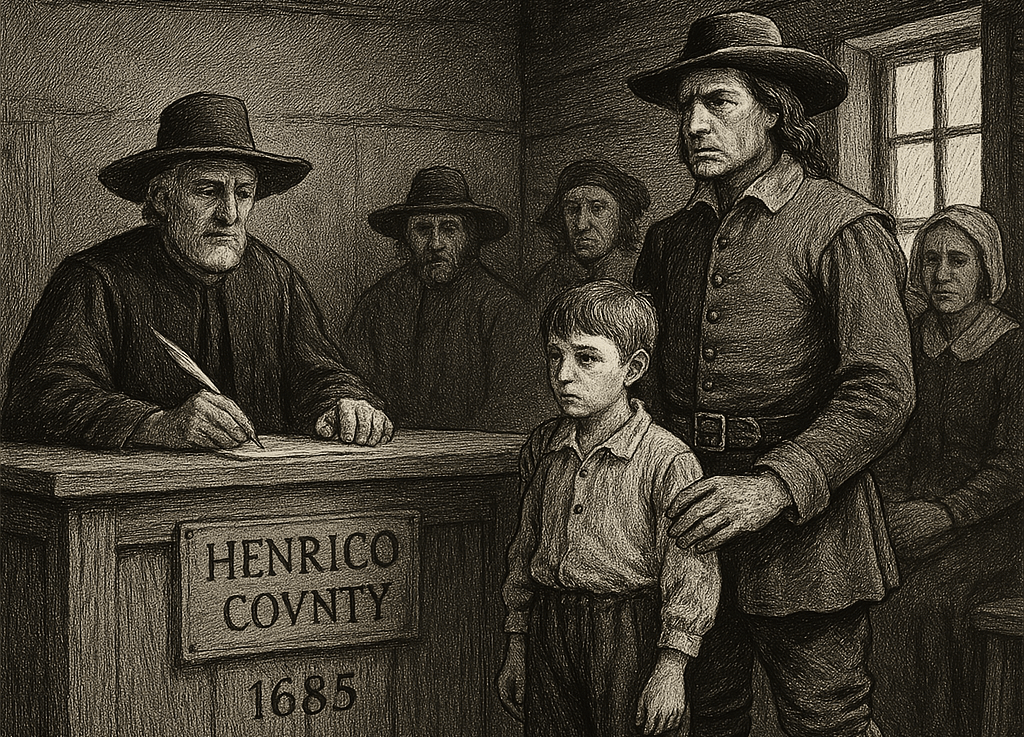
On 1 April 1685, my 7x great grandfather John Hatchett entered the Virginia record when he appeared before a Henrico County Court: “John Hatchett a servant boy belonging to Jno Farley being by him brought before the Wor[shipful] Court is adjudged ten years of age.”[1]

The Henrico County Virginia Court was deciding how old he was because that determined how long he would be an indentured servant. Contract terms had been set by the Virginia legislature in 1658 so that someone “under fifteen [was] to serve till hee shall be one and twenty yeers of age, and the courts to be judges of their ages.”[2] John Hatchett was to spend the next eleven years as an indentured servant.
John Hatchett’s Origins
The Hatchett surname is English and perhaps surprisingly, there is no evidence of the name being from Middle English hachet(te) or ‘small axe’. Rather Hatchett is thought to be a variant of the surname Hackett, which is also English, but of Norman [French] origin from the given name Hacket, which, in turn, is from an Old Norse given name, “Haki.” [4] The transition from Hackett to Hatchett happened through a process called palatalization, which is “the production of consonants with the front of the tongue drawn up farther toward the roof of the mouth than in their normal pronunciation.” In this case, resulting in sound change in which a nonpalatal consonant, like “k” [Hackett] changes to a palatal consonant like “ch” [Hatchett].[5] Another possibility is that Hatchett comes from Middle English “hacead,” a kind of fish suggesting either a nickname or an occupational name.[6]
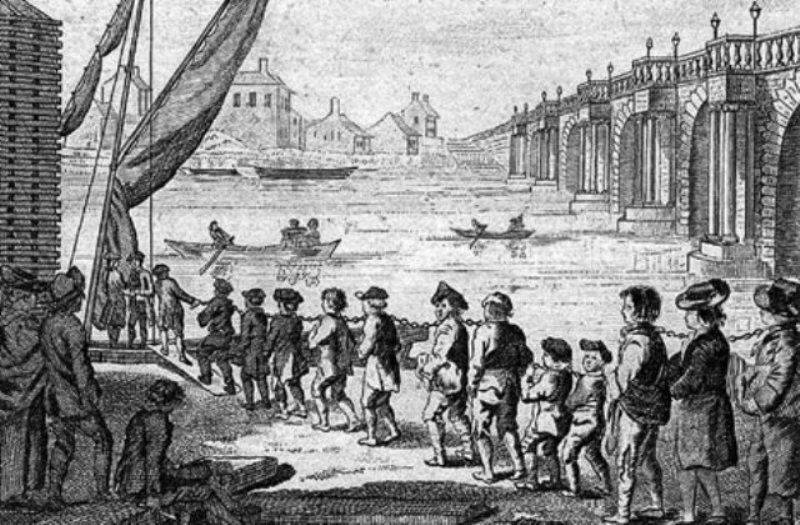
According to accounts given during the 1800s by two great grandsons, John Hatchett was born in England.[7] Unfortunately, nothing is known of his life before his arrival in Virginia. Perhaps he was among the hundreds, if not thousands of poor, orphan or vagrant children rounded up by English authorities and forceably transported to the colonies. While the practice was nearly as old as the Colony itself, kidnapping children for transportation had increased significantly over the last half century leading to John Hatchett’s time.[8] By the 1670s, the British Parliament began attempts to address the situation, but politics and lobbying got in the way and nothing much happened. In 1682, Parliament did act by requiring that any servant contract for anyone under 21 must be signed by a judge or magistrate – and only with consent of their parents or current master.[9] Despite these and other measures implemented, the kidnapping of children remained a problem well into the next century.[10] No doubt the transition to use of enslaved Africans by Virginia planters played a key role in its eventual demise.
Indentured Servitude in a Foreign Land
One can imagine that even for adults who indentured themselves voluntarily, it must have difficult to leave everything familiar behind for a new life in Virginia. By the 1680s word would have certainly made its way back to England about the difficulties of Virginia life for indentured servants. It is estimated that about half of indentured servants did not survive their contract term.[11] What must a 10-year-old John Hatchett thought about during those several weeks at sea?
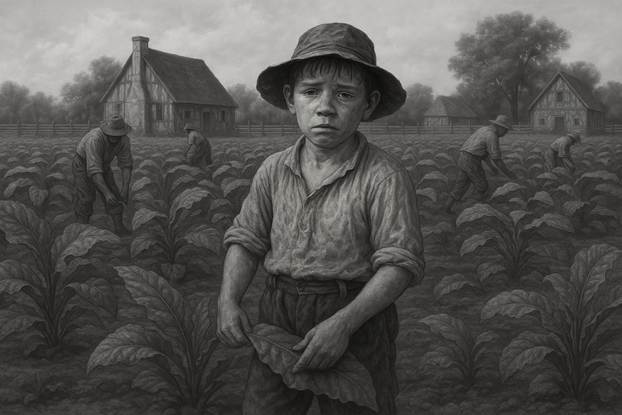
How John Hatchett became a servant to John Farley is unknown. In 1685, Virginia’s white population was about 45,000 and the black population was about 6,000.[12] Henrico County was still the English frontier with indigenous peoples very much in the area. Given the time period, John Farley was almost certainly a tobacco planter. While young John Hatchett undoubtedly performed a variety of tasks over eleven years, he surely spent much of his time working six days a week from sunrise to sunset cultivating tobacco. This was physically demanding work for adults, much less a child.
While we have no records of John Hatchett’s service, we know that he was still serving John Farley on 17 April 1693, when he gave a deposition indicating his age as “about 20 years” and mentioned “his master John Farley. [14] Even as a servant, Hatchett was paid the daily rate of 40 lbs of tobacco for being subpoenaed as witness by John Worsham in his suit against his master John Farley.[15]

A Free Man Gets Stabbed
Surviving records do not tell us when John Hatchett became a free man. While he testified to being about 20 years old in 1693 (b.c.1673), the Henrico Court adjudged him 10 years old in 1685 (b.c. 1675) so he likely served until about 1696. John Hatchett was certainly a free man by July 1699 when he was working as an overseer for John Stewart, Jr. It was then that a man named – get ready for this – Sigfred Clemetton Talsilius – “did furiously assault & wound this complain’t in the body by stabbing him.”On 11 December 1699, the Henrico Court heard the case of John Hatchett against Sigfred Clemetton Talsilius otherwise called Sigfred Clemet. Fortunately for me John Hatchett survived the attack!
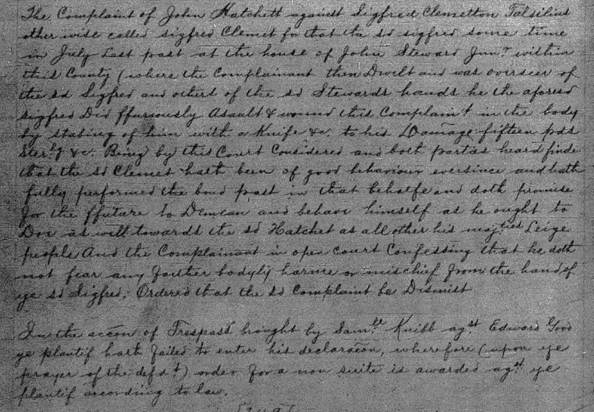
The minutes state “that the sd Sigfred sometime in July last past at the house of John Steward Junr within this County (where the complainant then dwelt and was overseer of the sd Steward’s hands[)]. He the aforesed Sigfred did furiously asault & wound this complain’t in the body by stabing of him with a knife &c., to his Damage fifteen pds sterlg &c. Being by this Court Considered and both parties heard finde that the sd Clemet hath been of good behaviour ever since and hath fully performed the bond part in that behalf and doth promise the future to D—–[?] and behave himself as he ought to Doe as will towards the sd Hatchet at all other his majties Leige people and the Complainant in open Court confessing that he doth not fear any farther bodyly harme or mischief from the hand of ye sd Sigfred, Ordered that the complaint be Dismist.”[16] A few months on 1 March 1699/1700, the case of John Steward vs. John Hatchett was referred to the next court.[17] There is no follow up suggesting the two men settled their differences.
A Tenant Farmer In Debt
John Hatchett appears just over two dozen times in the records. Initially, he appears 10 times in Henrico County records from 1700-1718. He was a plaintiff twice and a defendant eight times – all related to debts owed. Then there is a substantial 13 year gap with no mention of any Hatchett from 1719-1731.[18] From 1731-1746, John Hatchett appears just four more time in the Henrico record before the area in which he lived became part of newly formed Chesterfield County. During this period he witnessed a deed and a will, the others include a sheriff’s execution of a writ and a store account/tax levy. An entry in John Nash’s 1736 Account Book suggests Hatchett was tenant of Mr. Worsham: “ Yr debt to J Worsham last year. Paid by butter.”
What is not included in the record is also telling. There are no deeds or grants of land to John Hatchett. He never served on a jury nor was he appointed by the court to inventory and appraise an estate. John Hatchett seems to have remained a tenant farmer for many years as these duties were for landowners.
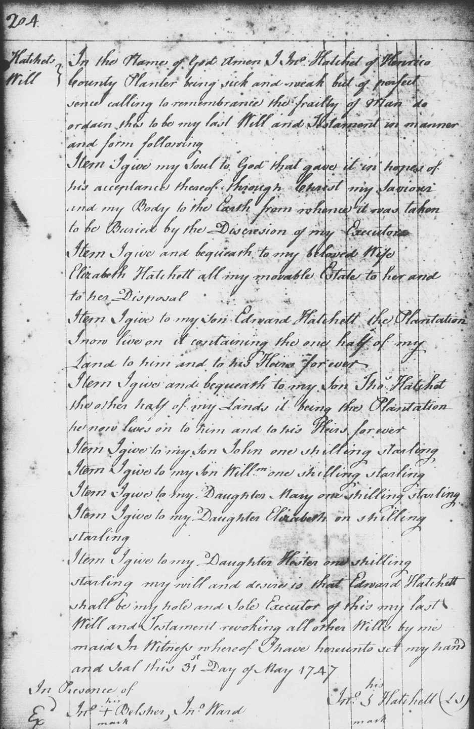
John Hatchett, Planter, makes his will
John Hatchett, about 72 years old, made his will on 31 May 1747.[19] To his wife Elizabeth he left “all my disposal estate to her and her disposal.” To his son Edward he left “the Plantation I now live on containing one half of my land.” To his son Thomas he left “the other half of my land.” To his other children, John, William, Mary, Elizabeth and Hester he left one shilling sterling each. Finally, he named son Edward as executor.
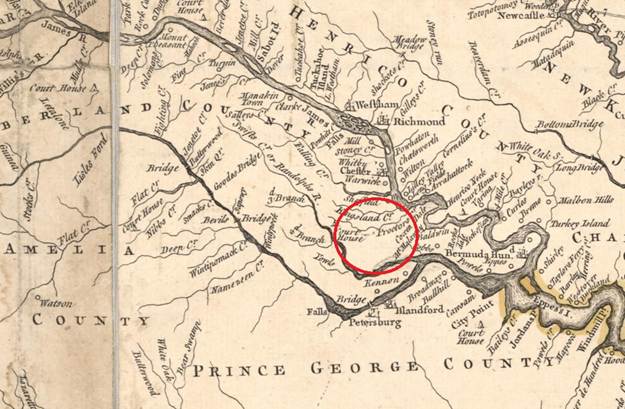
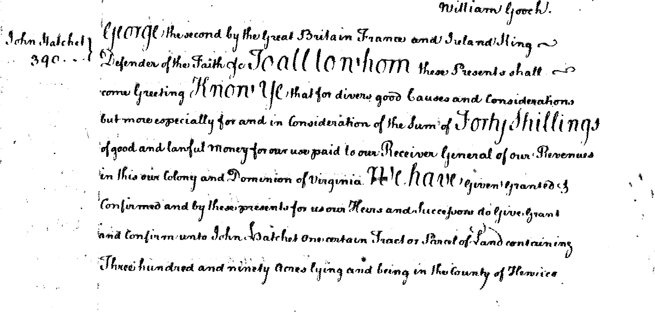
The land referred to in John Hatchett’s will was 390 acres he was granted on 20 August 1748 – after he made his will. He had been on the land for a while before the grant was issued, which was common. After decades as a tenant farmer, John Hatchet became a landowner and could call himself a planter. While the grant was for land in Henrico County, it fell into newly formed Chesterfield County the following year.[20]
While son Edward was to receive the plantation on which his parents lived, son Thomas received the other half of his land. This was formalized on 30 April 1755 with a deed from John Hatchett of Chesterfield County to Thomas Hatchett of same for £10, 195 acres “being one half and the northwest and uppermost part of 390 acres granted to John Hatchett by patent bearing date 20 August 1748.”[21]
John Hatchett likely died shortly before his estate inventory and appraisal (I&A) was taken on 5 April 1756 at about age 81.[22] His wife Elizabeth, if she was still alive, was about 76. John Hatchett’s “moveable” estate, left to his wife in his will, was valued at a modest £11.8.11:

John Hatchett’s Family
According to his great grandson, also named John Hatchett, whose transcribed diary was published in the Farmville Herald in 1932, the immigrant John Hatchett married a “Miss Bass” and settled in Chesterfield County. Another great grandson, Edward Hatchett, stated that John Hatchett married a daughter of a wealthy planter named Josiah Bass who disapproved of the marriage and disinherited her.[23]
John Hatchett’s wife was probably Elizabeth Bass, daughter of William Bass who died in 1695, his will naming his wife Hester Bass and one daughter named Elizabeth Bass. He was the only contemporary Bass in the area. As far as being wealthy, William Bass left his daughter one cow called “Pretty Maid,” a yearling heifer belonging to said cow, four pewter dishes, and “the last bed I fitted into.”[24] Elizabeth Bass (b.c. 1680) was above 21 “as she in Court confesseth” on 1 October 1701 when she acknowledged that she had received her portion of her father’s estate and discharged her guardian Henry Farmer [also my ancestor] who had married her mother Hester (———-) Bass.[25]
When John Hatchett (b.c. 1675) and Elizabeth Bass (b.c. 1680) married is not known, but it was after 1 October 1701 and probably between 1702-1707 and went one to have seven children. I descend from their son William Hatchett who received a land grant in Prince George County on 20 May 1735 on the south side of the Beaverpond Branch of Deep Creek, which fell into newly formed Amelia County later that year.[26]
Thoughts on John Hatchett
It is thought that as many as 80 percent of Virginians in the colony in 1700 were or had been an indentured servant.[27] I have identified several indentured servant ancestors to Virginia as early as 1620. Most were young adults – except one in Surry County who was 14 years old. John Hatchett was a 10 year old child, who survived an indenture that half of servants did not. That he remained a tenant farmer for decades after his freedom is curious. In the decades following John Hatchett’s freedom several new counties were created. I have run into this before with a few of my other early Virginia ancestors who were tradesmen in Essex and Spotsylvania, but the records don’t reveal that for John Hatchett. In the end, John Hatchett lived a long life on two continents. He realized that era’s version of the “American Dream“ by becoming a landowner. And he found happiness (hopefully) in marrying and having a family. As the progenitor of the Hatchett family, John Hatchett has many descendants spread over the country. However, I write this blog post from Henrico County where John Hatchett’s Virginia story began 340 years ago.

Summary of John Hatchett records 1700-1746:
1 March 1703/4 – Estate of John Potter – account current:[28]
James Cocke is Dr to John Potter, his estate. To be pd by John Hatchett 76 [lbs tobacco]
Capt. Giles Webb Dr to Jno Potter Estate. To be pd by John Hatchett 76 [lbs tobacco]
2 September 1708 – Action of Trespass upon the case entered by John Hatchet against Richard Womack is Dismissed neither party appearing. Two witnesses that Hatchett subpoenaed including Joseph Wilkinson and Capt. Thomas Jefferson were awarded eighty pounds of tobacco each for two days attendance.[29]
5 June 1708 – John Hatchett was summoned to Henrico Court to show cause why a prior judgement which Abraham Womack and Allanson Clarke obtained against him for £3 should not be revied, but he failed to appear. The court ordered Hatchett to pay both the £3and the plaintiffs’ costs for both suits.[30]
1 July 1709 – John Hatchett was in court as a defendant in two debt suits including one filed by Essex Bevil for £6.15 and the other by Richard Womack for 55 shillings. Hatchett attended but offered no reason the judgements should not be imposed. The court ordered him to pay the plaintiffs both the amounts and the costs for their suits.[31]
August Court 1711 – Action of Trespass brought by John Herbert against James Jupiter for 20 lbs sterling. Jupiter is a now show. Court awards plaintiff amounts plus his costs and orders Jupiter and his security John Hatchett to the next court. At prayer of the said Hatchett ordered that as much of Jupiter’s estate be attached to pay said debt.[32]
November 1711 – Herbert v. Jupiter – Defendant moved that the Court let him bring witnesses, but he was overruled. Ordered to pay 40 shillings sterling with costs. The defendant appeals to the next general court for which John Hatchett and Richard Womack enter themselves securities.[33]
From 1731 – 1749 [in Henrico County] from 1749 [in new Chesterfield County]:
4 October 1731 – John Hachet witnessed a deed from Richard Grills to John Muby (Newby).[34]
March 1731/2 – John Hatchett witnessed the will of Richard Wilson.[35]
1736 Henrico County Sheriff John Nash’s Account Book & Store Account Abstracts – John Hatchett, Senr. Dr. 1736. 3 Levys [prob. John Sr., Edward & Thomas as William already in Amelia and John, Jr. living in Henrico on his own]. Store Debt. Yr debt to J Worsham last year. Paid by butter. And by Inspector’s note.[36]
October 1746 – Sheriff’s Executions Returned: David Bell vs. John Hatchett – John Hatchett hath no goods or chattles in my bailiwick; David Bell vs. John Hatchett, Junior – by virtue of this writ to me directed of the goods and chattles of the within named John Hatchett Junior I have caused to be made the sum of as within to me.[37]
[1] Henrico County, Virginia Order Book 1678-1693, p. 58; https://www.familysearch.org/ark:/61903/3:1:3Q9M-CS4V-YSZP-3?i=36&cat=361766; accessed 28 March 2023
[2] General Assembly. “How long Servants without Indentures shall Serve” (1658). (2020, December 07). In Encyclopedia Virginia. https://encyclopediavirginia.org/primary-documents/how-long-servants-without-indentures-shall-serve-1658.
[3] An Artificial Intelligence generated image created by P Steven Craig using Microsoft Copilot.
[4] Dictionary of American Family Names 2nd edition, 2022, Ancestry.com; https://www.ancestry.com/last-name-meaning/hatchett?msockid=231ea135cd8c652e11e1b25dcc88649b
[5] Palatalization. Encyclopedia Britannica; https://www.britannica.com/topic/palatalization
[6] Dictionary of American Family Names 2nd edition, 2022, Ancestry.com; https://www.ancestry.com/last-name-meaning/hackett
[7] Eggleston, J.D. A Short Narrative of the Life of John Hatchett, The Farmville Herald, 29 January 1932, p. 9; newspapers.com.
[8] Phillips, Richard Hayes, Ph.D. Without Indentures: Index to White Slave Children in Colonial Court Records (Baltimore: Genealogical Publishing Company, 2013), p. xiii-xiv [Preface].
[9] Austin, Angela. Capitalism, Colonial Expansion, and Forced Child Indenture in the British Atlantic, 1618-1776, p. 108
[10] Ibid, p. 110
[11] Becoming Virginians, Virginia Museum of History & Culture; https://virginiahistory.org/sites/default/files/uploads/sov_virginians.pdf
[12] United States Census Bureau, Colonial Statistics, Chapter Z, p. 756; https://www2.census.gov/library/publications/1960/compendia/hist_stats_colonial-1957/hist_stats_colonial-1957-chZ.pdf
[13] An Artificial Intelligence generated image created by P Steven Craig using Microsoft Copilot.
[14] Henrico County Deeds, Wills, Etc., 1688-1697, p. 413; https://www.familysearch.org/ark:/61903/3:1:3QSQ-G9P6-S7BH?i=469&cat=397197; accessed 27 March 2023
[15] Henrico County Virginia Deeds, Wills, Settlement of Estates Book 2, 1678-1693, p.446; “Henrico, Virginia, British Colonial America records,” images, FamilySearch (https://www.familysearch.org/ark:/61903/3:1:3QSQ-G9GY-Q4GF?view=explore : May 31, 2025), image 191 of 192; Image Group Number: 007642295
[16] Henrico County Virginia Court Record Book 3, Part 1, 1694-1701, p. 248; “Henrico, Virginia, British Colonial America records,” images, FamilySearch (https://www.familysearch.org/ark:/61903/3:1:3QSQ-G9P6-KSLD?view=explore : May 28, 2025), image 124 of 212; Image Group Number: 007645099
[17] Henrico County Virginia Court Record Book 3, Part 1, 1694-1701, Image 129 of 212; “Henrico, Virginia, British Colonial America records,” images, FamilySearch (https://www.familysearch.org/ark:/61903/3:1:3QSQ-G9P6-KSXY?view=explore : Jun 2, 2025), image 129 of 212; Image Group Number: 007645099
[18] No Hatchett, Hatchet, Hatchitt, Hatchit, Hachett, Hachet, Hachitt or Hachit found.
[19] Chesterfield County, Virginia Will Book No. 1, 1749-1765, Part 1, p. 204 https://www.familysearch.org/ark:/61903/3:1:3QS7-99PC-3JJ1?mode=g&i=231&cat=417637; accessed 27 March 2023
[20] Land Office Patents No. 26, 1747-1748 (v.1 & 2 p.1-730), p. 550 (Reel 24), Library of Virginia, Richmond, Virginia
[21] Chesterfield County Virginia Deed Book 2, 1753-1755, p. 292; “Chesterfield, Virginia, United States records,” images, FamilySearch (https://www.familysearch.org/ark:/61903/3:1:3Q9M-C37X-ZSYZ-9?view=explore : Jun 4, 2025), image 160 of 200; Image Group Number: 008578887
[22] Chesterfield County, Virginia Will Book No. 1, 1749-1765, Part 1, p. 205 https://www.familysearch.org/ark:/61903/3:1:3QS7-99PC-3JJ1?mode=g&i=231&cat=417637; accessed 27 March 2023
[23] Farmville Herald, Volume 42, Number 18, 29 January 1932, p. 9, Virginia Chronicle; https://www.virginiachronicle.com/?a=d&d=FH19320129.1.9
[24] Henrico County Virginia Court Record Book 5, 1688-1697, p. 603; “Henrico, Virginia, British Colonial America records,” images, FamilySearch (https://www.familysearch.org/ark:/61903/3:1:3QSQ-G9P6-KS4Q?view=explore : Jun 4, 2025), image 318 of 384; Image Group Number: 007645099
[25] Henrico County Virginia Orphans Court 1677-1739, p. 44; https://www.familysearch.org/ark:/61903/3:1:3Q9M-C9TC-6CHM?cat=365008&i=276&lang=en
[26] Land Office Patents No. 15, 1732-1735 (v.1 & 2 p,1-522), p. 511 (Reel 13), Library of Virginia
[27] Source: Richard Frethorne, “‘Our Plantation Is Very Weak’: The Experiences of an Indentured Servant in Virginia,” letter, 1623, History Matters: The U.S. Survey Course on the Web, accessed September 20, 2011. Original in Susan Kingsbury, ed., The Records of the Virginia Company of London (Washington, D.C.: Government Printing Office, 1935), 4: 58-62; https://virginiastudies.org/content/indentured-servants
[28] Henrico County Virginia Deeds, Wills and Court Records, 1697-1704, Image 203 of 241; “Henrico, Virginia, British Colonial America records,” images, FamilySearch (https://www.familysearch.org/ark:/61903/3:1:3QS7-L9P6-KVF?view=explore: Jun 2, 2025), image 203 of 241; Image Group Number: 007645094
[29] Henrico County Virginia County Court Orders 1707-1709, pp. 76-77; “Henrico, Virginia, British Colonial America records,” images, FamilySearch (https://www.familysearch.org/ark:/61903/3:1:3Q9M-CS4V-YSZ1-1?view=explore : Jun 2, 2025), image 43 of 95; Image Group Number: 007898204
[30] Henrico County Virginia Court Orders 1707-1709, p.48; “Henrico, Virginia, British Colonial America records,” images, FamilySearch (https://www.familysearch.org/ark:/61903/3:1:3Q9M-CS4V-YS8Q-L?view=explore : Jun 2, 2025), image 29 of 95; Image Group Number: 007898204
[31] Henrico County Virginia Court Orders 1707-1709, p. 162; “Henrico, Virginia, British Colonial America records,” images, FamilySearch (https://www.familysearch.org/ark:/61903/3:1:3Q9M-CS4V-YSZG-7?view=explore : Jun 2, 2025), image 87 of 95; Image Group Number: 007898204
[32] Henrico County, Virginia Records 1710-1714, Part 2 Orders, p. 94; “Henrico, Virginia, British Colonial America records,” images, FamilySearch (https://www.familysearch.org/ark:/61903/3:1:3QS7-L9P6-KYF?view=explore : Jun 2, 2025), image 216 of 325; Image Group Number: 007645094
[33] Henrico County Virginia Records 1710-1714, Part 2 Orders, p. 109; “Henrico, Virginia, British Colonial America records,” images, FamilySearch (https://www.familysearch.org/ark:/61903/3:1:3QS7-L9P6-KTP?view=explore : Jun 2, 2025), image 223 of 325; Image Group Number: 007645094
[34] Henrico County Virginia Wills and Deeds No. 2 Part 1 1725-1737, p. 336; “Henrico, Virginia, British Colonial America records,” images, FamilySearch (https://www.familysearch.org/ark:/61903/3:1:3QS7-89P6-SGS6?view=explore : Jun 3, 2025), image 4 of 98; Image Group Number: 007645095
[35] Henrico County Virginia Wills and Deeds No. 2 Part 1 1725-1737, p. 338; “Henrico, Virginia, British Colonial America records,” images, FamilySearch (https://www.familysearch.org/ark:/61903/3:1:3QS7-89P6-SGQ7?view=explore : Jun 16, 2025), image 5 of 98; Image Group Number: 007645095
[36] Virginia Colonial Abstracts; “Henrico, Virginia, British Colonial America records,” images, FamilySearch (https://www.familysearch.org/ark:/61903/3:1:3QSQ-G9PC-QJC?view=explore : Jun 7, 2025), image 20 of 60; Image Group Number: 007644675
[37] Henrico County Virginia Order Book 1737-1746, p. 424; “Henrico, Virginia, United States records,” images, FamilySearch (https://www.familysearch.org/ark:/61903/3:1:3Q9M-CS46-SF6Y?view=explore : Jun 3, 2025), image 225 of 230; Image Group Number: 007894525
 A Son of Virginia
Very interesting story about the persistence of many of the early settlers.
LikeLiked by 1 person
Thanks for writing. I appreciate it!
LikeLike
Rough start to what appears to have been a worthy life!
LikeLiked by 1 person
He was also my 8x great grandfather if my little brother did this right.
LikeLike
Well thank you for writing cousin!
LikeLike
My name is John Hatchett. But I can read and write………
LikeLike