My connection to the Joneses is through my 5x great grandmother Martha (Jones) Walker Holland (c.1755-c.1821). She married (1) Capt. Henry Walker who was killed in 1779 at the Battle of Stono Ferry in South Carolina during the Revolutionary War and (2) Capt. Richard “Dick” Holland (c.1750-c.1803). By her first husband she had two children including Lucy Walker (c.1776-c.1796) who married Micajah Woods and died soon after without children and Dr. James Walker of Buckingham County (c.1778-c.1814) who never married.
By her second husband [my 5x great grandfather] Richard “Dick” Holland (c.1750-c.1803), Martha had seven children including Nancy Holland, b.c. 1785, Henry Walker Holland, b.c. 1788, William Holland, b.c. 1794, Elizabeth “Betsy” Holland, b.c. 1796, Richard “Dick” Holland, Jr., b.c. 1797, John “Jack” Holland, b.c. 1798 and Martha “Patsy” Holland, b.c. 1801. Martha outlived Dick Holland as well as four of her children. Both Walker children from her first marriage predeceased her and from her second marriage she lost both her bachelor son Dick Holland, Jr. and daughter Elizabeth “Betsy” (Holland) Stewart about 1819.
I have written extensively about my Holland and Morris ancestors. You can check out all of my previous posts here: https://asonofvirginia.blog/
Proof of kinship found
While researching my Holland ancestors, I found an 1803 Buckingham County deed that was used as evidence in an 1825 Prince Edward Chancery Court Chancery Court suit between Henry Walker Holland and John and Nancy (Holland) Morris [my 4x great grandparents]. The deed proves that Martha (Jones) Walker Holland was a daughter of William Jones, Sr. of Buckingham County.
In a deed dated 21 July 1803 between William Jones, Sr. of Buckingham County and his grandchildren, the “children and issue of Dick Holland, deceased,” and “for and in consideration of the natural love and affection which he bears toward the said Nancy Holland [my 4x great grandmother], Henry [Walker] Holland, William Holland, Dick Holland, Elizabeth Holland, John Holland & Martha Holland, his grandchildren.” William Jones, Sr., gave his grandchildren two enslaved men named Ned & George whom he noted he had previously purchased from their father Dick Holland. This deed was recorded at the Buckingham County Court on 12 September 1803. [1]

William Jones, Sr. of Buckingham County
Buckingham County’s courthouse burned in February 1869 destroying more than a century of will books, deed books, order books, marriage bonds, tithe lists, chancery court records and more. Such a catastrophic loss presents a significant challenge for genealogical researchers. Jones was -and is -a common surname and don’t get me started the number of Jones families that used Thomas, John and William for their given names. Not surprisingly there were numerous Joneses in Buckingham County during the lifetime of William Jones, Sr. including at least another three William Joneses along with numerous others in the counties surrounding Buckingham. Once in a while, however, the genealogy gods smile upon us. Prince Edward County – just across the Appomattox River from Buckingham County was the location of the 16th District Court, which heard cases from Buckingham, Charlotte, Cumberland, Halifax and Prince Edward Counties. One such case from the 1790s was Jones vs. Jones, which is simply a genealogical goldmine.[2]
Jones v. Jones
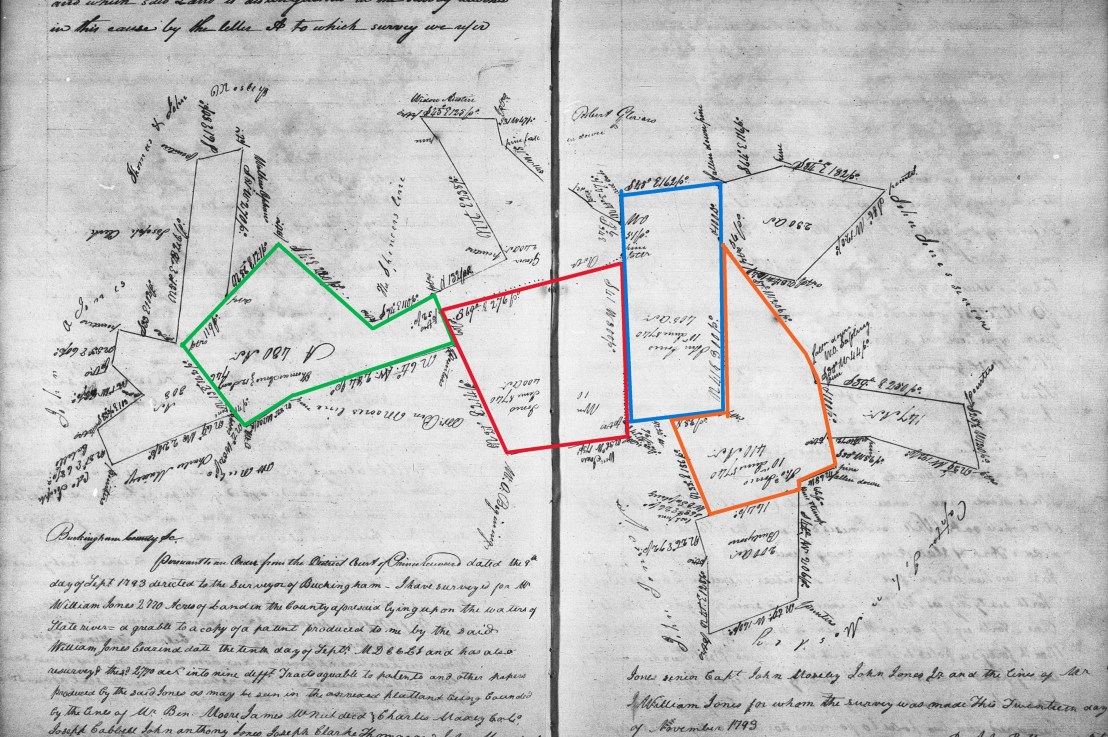
In 1793, John Jones, Sr. sued his brother William Jones, Sr. Both men lived in Buckingham County on the forks of Slate River on land each had been granted in 1740. At issue was a 400 acre tract of land their father, Thomas Jones patented in 1746. John Jones, Sr. asserted that while William Jones, Sr. possessed the land, he as the oldest son and heir-at-law was entitled to it by right.

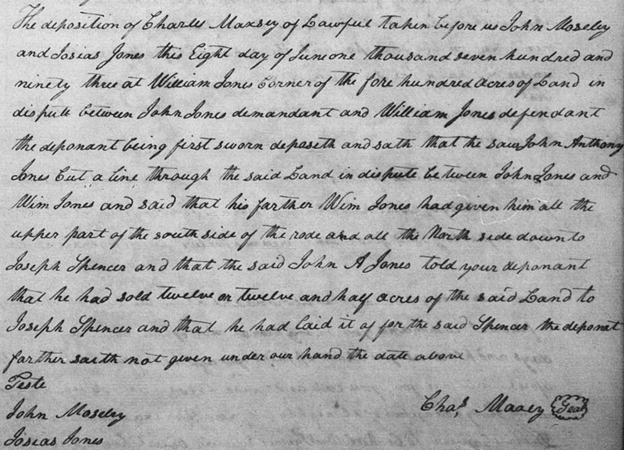
The trigger for the suit appears to have been William Jones Sr. giving his son John Anthony Jones part of the land who then sold 12 acres to neighbor Joseph Spencer. According to the testimony of Anthony Winston, John Anthony Jones also tried to sell him some land, but his father William Jones would not consent.

John Jones, Sr. emphasized his status as the eldest son and “heir at law,” a claim supported by multiple witnesses. He apparently relied on the law of primogeniture to secure a favorable outcome in the legal proceedings. Generally, under primogeniture the eldest son was recognized as the legal heir to his father’s estate, inheriting his father’s land absent a will that stipulated otherwise. Personal property, which included enslaved individuals, was generally distributed among all heirs. Primogeniture in Virginia continued until its abolition in 1787, following the enactment of a law in 1784 that included a delayed implementation.[4] William Jones, Sr. was relying on an “inclusive grant” issued in 1755, which he argued entitled him to one-third of the total acreage granted.[5]
The legal proceedings commenced in 1793, culminating in a jury verdict in favor of John Jones, Sr. in 1796. However, this ruling was overturned in 1799, favoring William Jones, Sr. The case file is replete with various depositions, plat surveys, and copies of relevant patents and deeds, along with the jury’s findings, which provides for interesting reading. You can check it out here (Prince Edward County, Virginia District Court Will Books 1&2 with inventories and accounts, pp. 13-44: https://www.familysearch.org/ark:/61903/3:1:3Q9M-C9PX-L9XV-W?view=fullText&keywords=William%20Jones&groupId=M9XH-C4D
A Family History Revealed
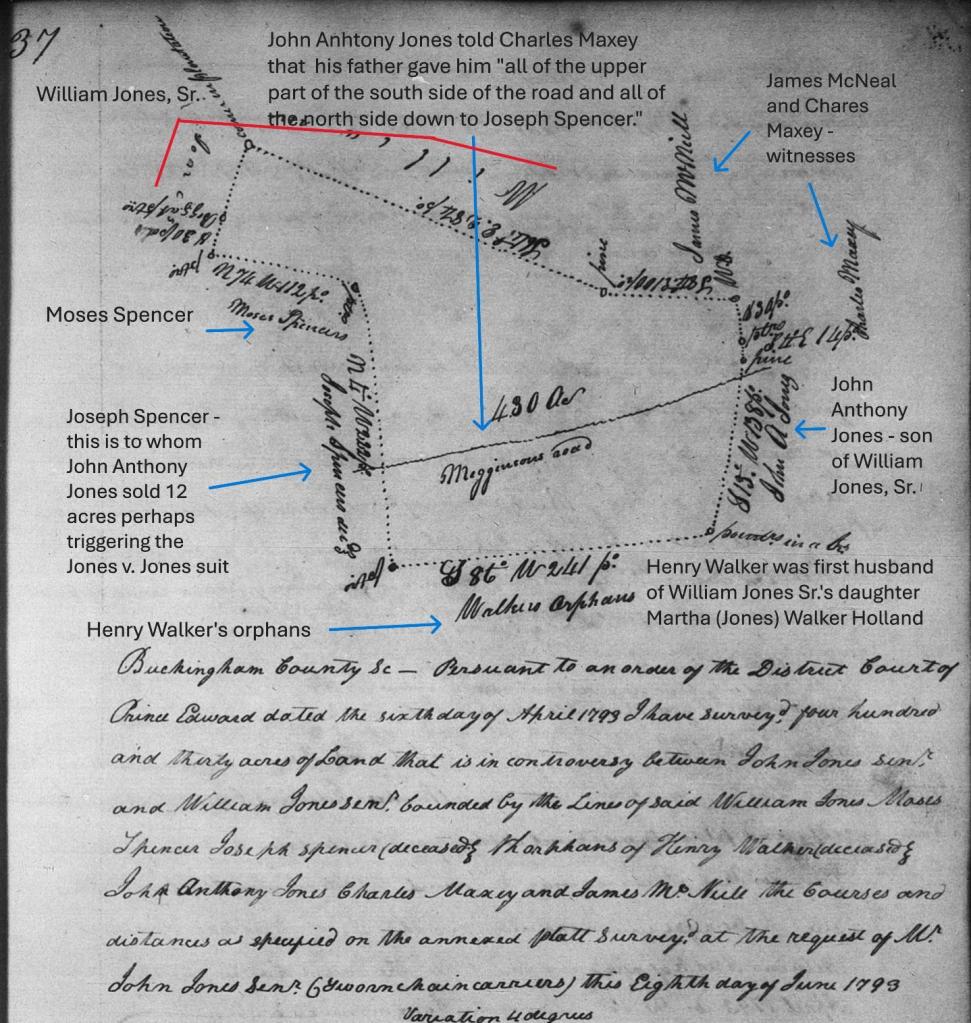
The Jones vs. Jones case file contains important genealogical information. With respect to land grants, we learn that Thomas Jones, [Sr.] and sons John Jones and William Jones each received 400-acre grants on the forks of the Slate River and Frisby’s Creek in 1740 and that Thomas Jones [Sr.] received a grant for another 400 acres on the north branches of Slate River bounded by William Jones in 1746 – the disputed land. In 1755, the three men received an “inclusive patent” for 2,762 acres in Albemarle County (Buckingham from 1761), including a joint repatent of the separately granted tracts from 1740 and 1746 [1,600 acres] plus 1,162 acres of adjacent land never before granted.
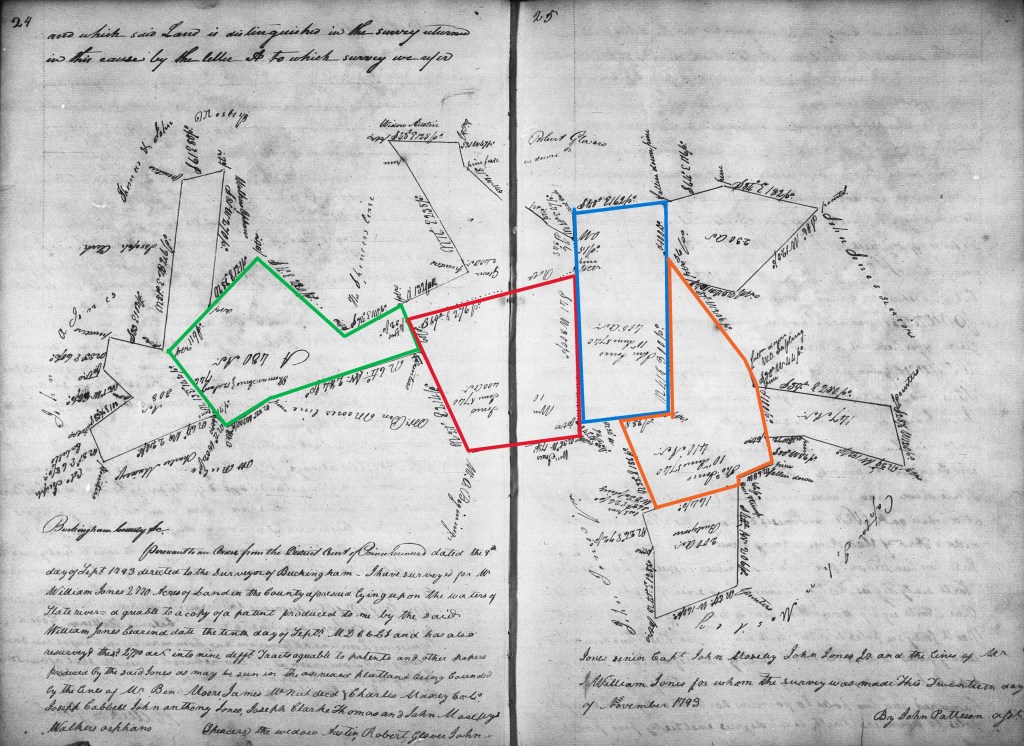
The three men sold part of the 1,162 acres to Robert Glover (236 acres) and John Hoy (340 acres) by deeds recorded in Albemarle (1760) and Buckingham (1763) reducing their joint holdings to 2,186 acres. Notably, brothers John and William had lived next to one another for more than 50 years when the suit was filed in 1793, both living on their respective 1740 tracts with John also having his father’s 1740 grant tract and William the 1746 disputed tract.
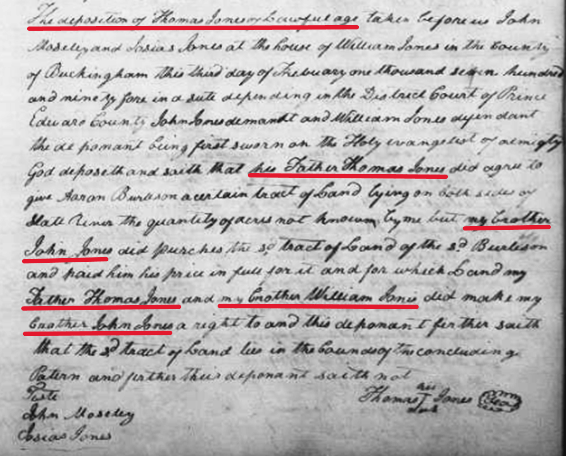
From the depositions and the detailed findings of the jury we learn about family relationships. Thomas Jones was the father of John Jones, Sr. and William Jones. Sr. – and Thomas Jones, Jr., a third brother who was deposed. He testified that “his father Thomas Jones did agree to give Aaron Burleson[6] a certain tract of land lying on both sides of the Slate River.” Thomas Jones, Jr. stated that his brother John Jones purchased the land from Burleson. He also stated that “his father Thomas Jones and his brother William Jones did make my brother John Jones a right to the said land.”
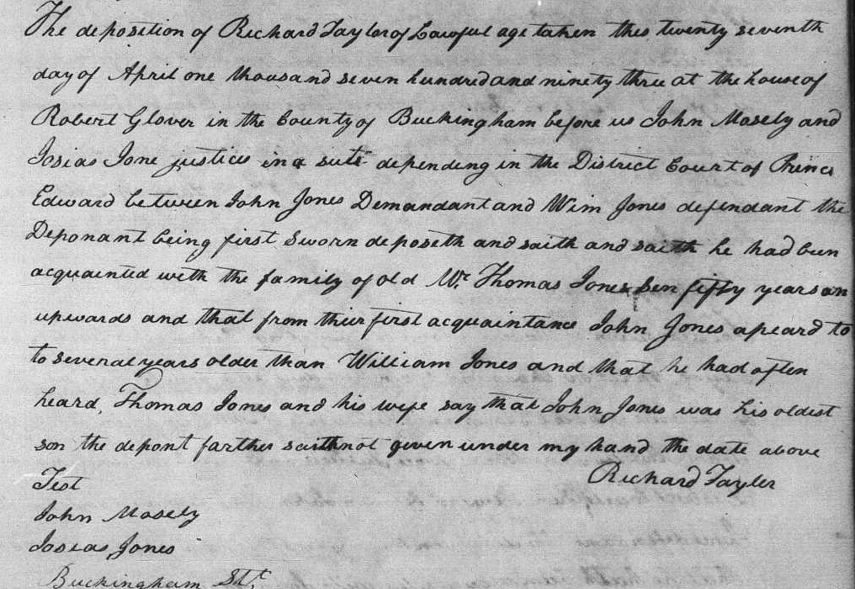
Richard Taylor testified that he had been acquainted with the Jones family for fifty years or more. He stated that from his first acquaintance, he thought that John Jones appeared to be several years older than William Jones. He also stated that he had often heard Thomas Jones and his wife say that John Jones was his oldest son.
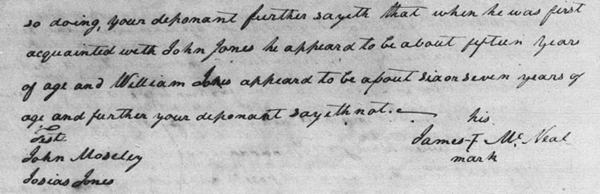
James McNeal testified that he “carried the chain with Robert Glover” [surveyed the land in dispute] and that William Jones was in possession of part of it and had disposed of part of it. McNeal also stated that he had heard Thomas Jones, the elder say he wouldn’t make a will because “his children had or would get their parts.” Significantly, McNeal said that when he first met them, John Jones appeared to be about 15 and William Jones about 6 or 7.
We also learn that William Jones, Sr. had a son named John Anthony Jones.
Finally, we learn that Thomas Jones, Sr. died intestate “sometime before the year 1770 and after the year 1766.”

Genealogical evidence contained in this court case:
Thomas Jones, the elder, born by 1690, received a 400 acre grant in Goochland County 10 July 1740, d.c. 1767-1769, Buckingham County, Virginia, m. unknown, issue:
John Jones, born by 1711, plaintiff, 400-acre patent in Goochland County 10 July 1740, oldest son & heir at law [8 or 9 years older than brother William Jones]
William Jones, born by 1719[7], defendant, 400-acre patent in Goochland County 10 July 1740, m. unknown, issue: John Anthony Jones
Thomas Jones, born after 1719
Thoughts
I consider myself fortunate to be able to prove a connection from my 5x great grandmother Martha (Jones) Walker Holland to my 6x great grandfather William Jones, Sr. I consider myself incredibly lucky that a family feud found its way to court in Prince Edward County, which proved his relationship to my 7x great grandfather Thomas Jones (c.1690-c.1768). Often with Buckingham County or other burn county research, we researchers often think ourselves confident of a familial relationship, but lack the record or records to prove it. Next time we will explore this family further and reveal what luck I have distinguishing them from the many others of the same name living in Virginia at the time.
Next time: The Jones Family of Slate River, Buckingham County, Virginia – Part 2
My Line (10 generations):
Thomas Jones (c. 1690-c.1768) m. unknown
William Jones (c.1719-1804) m. Lucy Anthony
Martha Jones (c.1755-1821) m. Dick Holland (c.1750-c.1803)
Nancy Holland (c.1785-1851) m. John Morris
John James Morris (c.1812-c.1858) m. Elizabeth Smith Gills
John Rives Morris (1840-1904) m. Ann Octavia Vaughan
John Stewart Morris (1868-1958) m. Anna May Blanton
Rebecca Blanton Morris (1913-1994) m. James Irvin Eisenbeis
Rebecca Suzanne Eisenbeis (1943-2009) m. Paul Franklin Craig
Paul Steven Craig (1964-
[1] Prince Edward County Chancery Suit file 1825-003 Henry W. Holland vs. John Morris & wife, image 14 of 15. Virginia Memory, Library of Virginia, Digital Collections; https://www.lva.virginia.gov/chancery/full_case_detail.asp?CFN=147-1825-023#img
[2] Warren, Mary Bondurant and Weeks, Eve B. Virginia’s District Courts 1789-1809: Records of the Prince Edward District (Danielsville, GA: Heritage Papers, 1991), p. v (Preface).
[3] Fry, J., Jefferson, P. & Jefferys, T. (1755) A map of the most inhabited part of Virginia containing the whole province of Maryland: with part of Pensilvania, New Jersey and North Carolina. [London, Thos. Jefferys] [Map] Retrieved from the Library of Congress, https://www.loc.gov/item/74693089/.
[4] Bob’s Genealogy File Cabinet citing Hening’s Statutes; https://genfiles.com/articles/primogeniture-succession/
[5] 2,792 acre grant in 1755 less the 576 acres sold to Hoy and Glover
[6] Use of the word “give” suggests that Aaron Burleson may have been a son-in-law of Thomas Jones, the elder.
[7] Given one could not receive an unrestricted land grant unless 21 years or older, we can assume both John Jones and William Jones were of age in 1740. This would make William Jones birth no later than 1719 and John Jones no later than 1711. This also suggests that their father Thomas Jones was born by 1690.
 A Son of Virginia
This is fantastic. I carry a photocopy of this lawsuit around in my stack of active research. Wherein we find that Richard Taylor and James McNeil were advanced in years and unable to travel for a deposition, and I believe that at some point in the suit that McNeil died because the map lists the neighboring landowners and it says James McNeal dec’d.
Absolute gold mine of info in this, thanks for writing this up coherently.
LikeLiked by 1 person
What a great find and persistent research! This also gets me back one more generation, being an ancestor of Dick Holland. Thanks for all the work on these families
LikeLike
Thank so much for writing cousin! Have you read my posts on the Hollands?
LikeLike
Yes I have. We emailed about a year ago and I follow your posts. I am related to John Holland that moved to Missouri.
Ken Haynes
LikeLike
A very interesting family to say the least. Thanks for writing – and for reading!
LikeLike
please email me at jimburleson8554@gmail.com or call me at 505-919-9007 regarding Aaron Burleson receiving acreage from Thomas Jones “the elder” potentially as a dowry for a Jones daughter. Thank you. Jim Burleson- Burleson Family Research Group.
LikeLike
Love your blog! Thanks for sharing your research!
LikeLike
Thank you so much! What are your interests or family lines?
LikeLike