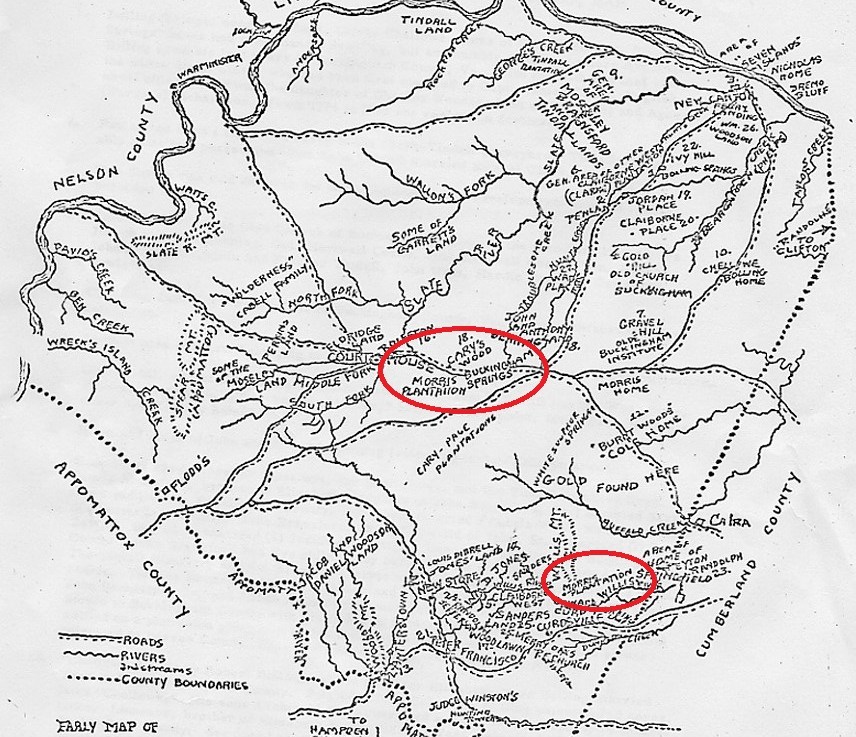
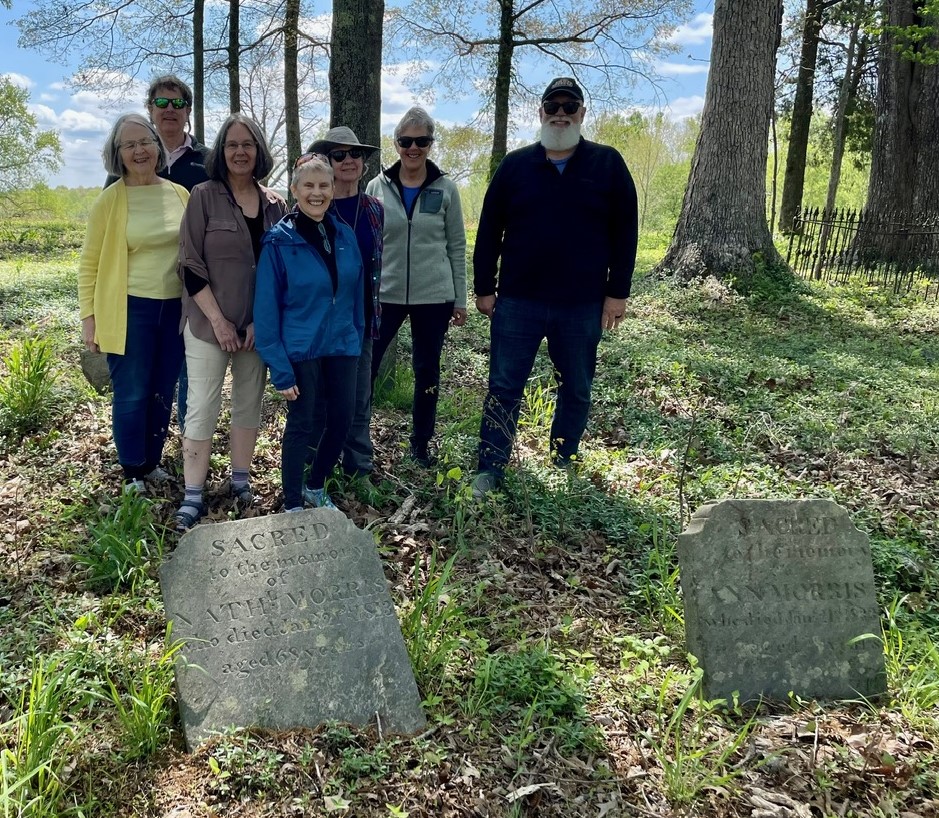
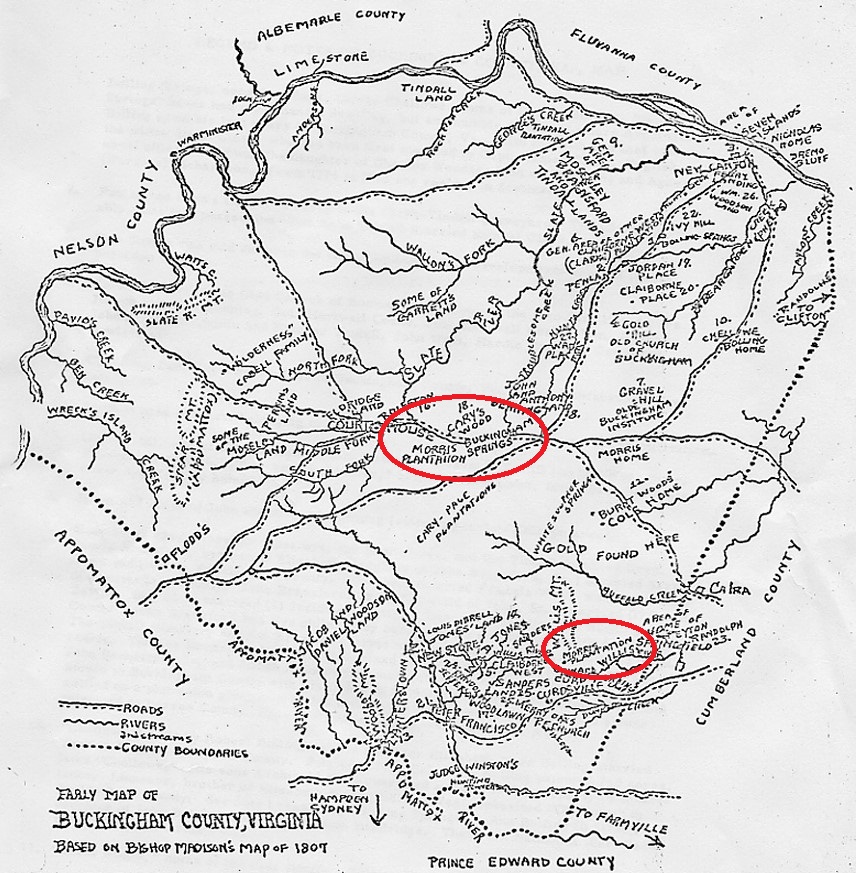
I had the pleasure of spending a couple of days in Buckingham County in late April meeting some Morris family cousins and visiting two of our Morris ancestors plantations called Vassars and Buckingham Springs. When I was researching my book Along the Willis River: Descendants of Nathaniel & Nancy (Jeffries) Morris of Buckingham County, Virginia, I used Ancestry to track down distant cousins I thought might have information I could include in the book. One such cousin was Mardi (Morris) Deluhery who I originally wrote to in 2013. After I published the book, I sent a couple of copies to Mardi who shared the information with her near relatives.
Fast forward 11 years and another distant cousin, Betsy (Morris) Sinnott, wrote to say she and her sister Mary (Morris) Becker, and their three first cousins – the aforementioned Mardi (Morris) Deluhery, Jennie (Morris) Gundy and Andrea Morris – were traveling to Buckingham County and invited me to join them during their visit. Their great grandfather James Thomas “J.T.” Morris (1861-1947) was born at Buckingham Springs. His parents moved to Amelia County and as a teenager J. T. decided to leave Virginia and made his way to New York where he founded a successful publishing business.
We met at Historic Buckingham (http://www.historicbuckingham.org/) where we were welcomed by Margaret Thomas one of Historic Buckingham’s board of directors. We had a wonderful time chatting and touring the Adams Museum, which features an extensive collection of Native American artifacts. Margaret was instrumental in connecting us to Buckingham natives Claude and Lucy (Bryant) Morris who kindly served as out tour guides.[1]
Vassars
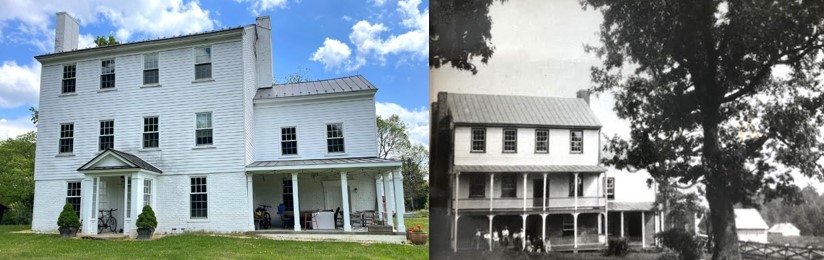
The following day we met Russell Harper, who is also a Nathaniel & Nancy (Jeffries) Morris descendant as well as the current owner of the Vassars tract Nathaniel Morris purchased in 1800 from John Vassar. Nathaniel and Nancy Morris made their home at Vassars until their deaths in 1813 and 1833, respectively. Both were laid to rest in the family cemetery on the grounds. The property has remained in the family for 224 years.
Buckingham Springs
We also visited Buckingham Springs, which was owned by descendants of Samuel Morris well into the 20th century. It is now owned by Philip Fenaux and Synthia Starkey-Fenaux who were gracious enough o allow us to visit and explore the property. In 1795, Nathaniel Morris bought a 300-acre tract of land, which he conveyed to his son John Morris in 1804.[2] In 1812, John Morris purchased an adjacent tract of 360 acres from Anthony Walton.[3] John and his wife Nancy (Holland) Morris made their home on these 660 acres, which came to be known by 1826 as Green Springs.[4] The 360-acre tract John purchased in 1812 from Walton, was conveyed by John to his mother’s estate in 1833 and was subsequently purchased from the estate by John’s brother, Samuel Morris. John Morris also sold his 300-acre Willis River tract to brother Samuel in 1841 and these 660 acres became Buckingham White Sulphur Springs. Samuel Morris turned Buckingham Springs into a popular destination where regional gentry visited for social and political events, rest, relaxation and to take advantage of the healing properties of the springs.
How we are all related
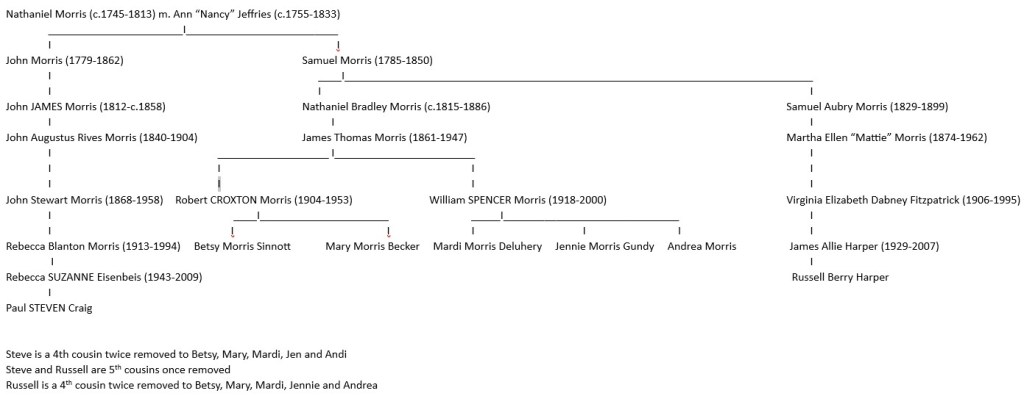

Nathaniel & Ann “Nancy” (Jeffries) Morris of Buckingham County – my 5x great grandparents
My 5x great grandfather enters the Virginia record in 1764 when he was about 19 years old.[6] He was one of three men working as overseers in Buckingham County for Col. Archibald Cary of “Ampthill” (1721-1787) of Chesterfield County.[7] Cary was one of Virginia’s wealthiest men with diversified interests in land, enslaved people, an iron works, a ropery and a flour mill. He served in the Virginia House of Burgesses from 1756 until 1774 when it was dissolved by the Royal Governor as tensions mounted between the Colonies and Great Britain. Cary then served as a delegate to the Virginia Conventions, a series of political meetings from 1774-1776, which served as a provisional government until the independent Commonwealth of Virginia was created in 1776. He then became the first speaker of the Virginia Senate and retained that position until his death.[8]
Among Cary’s land holdings were more than 4,000 acres in Goochland County that had been patented by his father, Henry Cary II (c. 1675-1748). On 27 September 1729, the senior Cary obtained a patent for 3,924 acres in then Goochland County “at a place called Buckingham” on the “west side and on the branches of the Buck River, alias Willis’s Creek.”[9] When Archibald Cary turned 21-years-old in 1742, his father gave him the “Buckingham” lands, which by then totaled 4,132 acres.[10] The younger Cary extended his holdings in the area when he received two patents dated 12 January 1746 and 1 June 1750, for 440 acres on the North branches of Willis’s River and 440 acres on both sides of Barren Lick Branches of Willis’ Creek, respectively.[11] Buckingham County was created in 1761 from a part of Albemarle County, which was created in 1744 from part of Goochland County.

In 1764, Cary is listed as owning 13,688 acres in Buckingham County, much of which was probably wooded given that three overseers were supervising just 36 enslaved men and women. The overseers probably lived separately, each managing a different tract. While the three men were probably in regular contact, Nathaniel, who was just 19 or 20 years old, was essentially on his own on a tract of 500 or more acres overseeing nine enslaved men and women all 16-years-old or older. They included seven men named David, Sangle, Harry, Jack, Branch, Dick and Ben and two women named Lucy and Young Lucy.[12]
No records of Nathaniel’s work as an overseer for Cary are known to exist; however, other planter records shed light on how overseers worked and lived during this time. As the colony’s frontier expanded westward, large planters who had sufficient capital to invest patented large tracts of “new lands” sometimes far removed from populated areas. These large landowners sold smaller tracts to settlers and also established their own remote plantations called “quarters” that typically ranged from 500 to 1500 acres. Overseers were hired to live there and manage the production of tobacco using enslaved labor. The purpose of these quarters was strictly commercial and overseers were typically paid a share of the tobacco output providing a strong incentive to maximize production. While tobacco would have been the primary crop, corn and other grains would have been grown and there may have been a small herd of cattle, pigs and chickens. There would have been housing for an overseer and the enslaved. They may have a tobacco barn, smokehouse, kitchen and other outbuildings. The enslaved typically worked six days a week from sunrise until sunset and lived primarily on hominy (made from corn) with small quantities of meat provided occasionally.[13]
My sense is that Nathaniel Morris was born in Virginia. Working for a prominent man like Archibald Cary at the age of 19 suggests that Nathaniel had experience in the management of enslaved people and in tobacco production. That would have been something he would have learned from growing up in a plantation environment. Family tradition holds that Nathaniel Morris was from Hanover County and that his forebearers had roots in Hanover’s parent county New Kent.
Posited Brother Benjamin Morris
Benjamin Morris was born about 1734, dying in Buckingham County, Virginia in 1823 at the age of 89.[14] In 1773 and 1774, Benjamin Morris was working as an overseer for Captain Richard Chamberlayne of New Kent County [parent of Hanover County] who was a successful planter with 29 tithables in Buckingham.[15] Benjamin Morris never married, lived adjacent to Nathaniel Morris in Buckingham County and served a Justice of the Peace for many years. Approximately eleven years older than Nathaniel Morris, he is thought to be an elder brother.
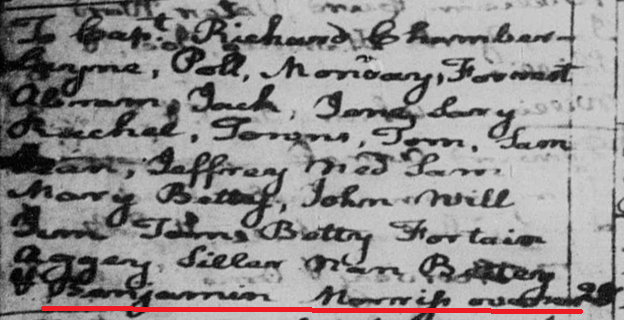
Hanover County [formed out of New Kent County in Kent County in 1719]
Whether or not Nathaniel Morris was born in Hanover County is unknown as the county lost most of its records due to a fire on 3 April 1865 in Richmond where records had been moved for safekeeping during the Civil War. The fire was started by Confederate troops who set fire to bridges, tobacco warehouses and weapons caches as they retreated from the city to prevent them from falling into the hands of approaching Union forces. It was windy that day and the fire quickly spread ultimately destroying an estimated 800 buildings comprising much of the business district including the State Court House where many records had been moved.
Hanover’s parent county, New Kent, also experienced significant records loss from fire on multiple occasions including an arson in 1787, in 1862 due to Civil War action in the area and lastly in the 3 April 1865 Richmond fire. Nathaniel Morris is not listed in any surviving records of either county [which are relatively few] nor does he appear in the surviving vestry records for St. Peter’s (Hanover County) or St. Paul’s (New Kent County) parishes. While there are Morris’s included in both sets of parish records, there are no apparent connections to our Nathaniel.
There is one extant record placing Nathaniel Morris in Hanover County, which is an advertisement for a runaway slave advertisement that ran in the Virginia Gazette on 29 June 1769:[16]

Another record from 1801 places Nathaniel Morris in the vicinity of Manchester, Virginia, before the Revolutionary War. British merchant William Cunningham & Company was trying to collect debts owed to them for credit given at their Rocky Ridge store prior to the Revolution. British mercantile claims resulted from terms of the 1783 Treaty of Paris, which ended the war and allowed British merchants to attempt to collect debts owed by Americans. Rocky Ridge was the former name of Manchester, which became an incorporated town in 1769 and an independent city in 1870. Manchester is located on the south bank of the James River at the fall line and was an active port for the importation of slaves during the 18th century as well as an export point for tobacco and coal. Manchester was later annexed by the City of Richmond.[17]
A Cunningham & Company debtors list dated 24 June 1801 includes Nathaniel Morris with an account balance of £16.5.5 ¾. The notation reads, “He moved several years ago, but to the southward or westward or whether he had or had not property I do not know.” The entry beneath Nathaniel’s is for a Samuel Morris, who also had an account at the Rocky Ridge Store with a balance of £8.12.8 ½. The notation for Samuel Morris reads “He died about 18 months ago in Campbell County. John Morris, his son and executor has assets to pay this debt.”[18]
My immediate thought was Eureka! This Samuel Morris made his will on 15 December 1800 and it was recorded on 12 January 1801 in Campbell County with his son John Morris and his son-in-law Robert Armistead as executors.[19] Known as the Father of Presbyterianism, Samuel Morris lived in eastern Hanover County from at least the 1740s until about 1770 when he removed to the portion of Bedford County, Virginia that became Campbell County in 1782.
In 2015, I found a male line descendant of Samuel Morris of Campbell County (David Morris) as well as a male second cousin of mine (Kevin Morris) descended from Nathaniel Morris and both agreed to provide a DNA sample to see if they shared a common male ancestor. I was disappointed that the results indicated the men are not related. However, the test did indicate that Nathaniel Morris of Buckingham County and George Morris (c. 1725-1786) of Louisa County share a common male ancestor. George Morris is also thought to have been from Hanover County (out of which Louisa County was formed). His 1785 will named children George, David, Isaac, Samuel, Joshua, John, Mary and Anna. The Morris DNA project can be accessed at https://www.familytreedna.com/public/morrisDna/.
Louisa County [formed out Hanover County in 1742]
Nathaniel Morris next appears in 1772 and 1773 in Louisa County, where he is involved in three lawsuits over debts owed to merchants. One of these cases, on 8 June 1772, involved the firm of Hart and Marshall, with Nathaniel admitting to the debt. The Court ruled in favor of the plaintiffs, awarding them £37.7.7 along with their costs. They also mentioned that the debt could be settled by paying £18.13.7 ½, plus interest from 11 November 1771 and court costs. Finally, the Court stayed the order “till Xmas.”[20]
Another case on the same day involved William Anderson & Co. as the plaintiff, with Nathaniel and Samuel Morris as defendants. Another Samuel Morris! In that case, it was noted that “the Sheriff having made return on the capias [writ commanding appearance] that he had left a copy for Nathaniel Morris and he failing to appear altho [sic] solemnly called on the motion of the Plts. by their Attorney it is ordered that an Attachment do issue against the Estate of the Defendt. returnable here at next Court.“[21]
At the next Louisa Court session held on 10 August 1772, both Nathaniel and Samuel Morris appeared and admitted the debt. The court ordered awarded the plaintiff £13.13.6 plus costs. The court then indicated the debt could be satisfied by payment of £6.16.4 plus interest from 6 July 1771 until paid.[22] The following year at the 14 September court session another merchant, George Kippen & Co. was suing Nathaniel to recover a debt. The notation reads “This suit abates by return.”[23] Neither Nathaniel nor Samuel used the services of an attorney for any of their Louisa legal matters, which suggests they were not of the planter class.
There were two men named Samuel Morris in Louisa County during this period. One was a landowner and one was not. The landowning Samuel Morris first appears on a 1769 list of tithables for Trinity Parish (Louisa County) paying on four tithes and 400 acres.[24] In 1771, Samuel Morris appears on a list of landowners whose properties were surveyed by Louisa County surveyor William Petitt – Samuel owned 150 acres.[25] In 1774, George Morris paid on 400 acres and four tithables including Samuel Morris and three enslaved people indicating that George Morris, while responsible for the tax, was not living there.[26] In 1777, Samuel Morris is listed as being responsible for tax on 400 acres and 4 tithables.[27] This Samuel Morris is the son of George Morris, Sr. who shares a common male ancestor with Nathaniel Morris of Buckingham.
The non-land owning Louisa County Samuel Morris was listed as a tithable of John Tisdale in 1771 who was also tithing on himself and four enslaved people.[28] In 1773, John Boswell of Fredericksville Parish (Louisa County) paid on 19 tithables including himself, 13 enslaved people as well as five white men – among them Samuel Morris.[29] This Samuel Morris is still unidentified, but perhaps he is the same Samuel Morris who was a co-defendant with Nathaniel Morris. I have not been able to discover anything further about this Samuel Morris. My sense is that he is another brother to Benjamin and Nathaniel.
Also in Louisa County during this time was Benjmain Morris who in both 1775 nd 1776, he was in St. Martin’s Parish, Louisa County where he tithed on himself and three enslaved people and one enslaved person, respectively.[30] Benjmain Morris witnessed a deed in Louisa County dated 13 May 1777 and then disappears from Louisa County records.[31]
Despite the lack of concrete evidence about Nathaniel’s origins, his movements before settling in Buckingham County suggest that he worked as an overseer for planters in Buckingham, Hanover, and Louisa Counties. Posited brother Benjamin worked as an overseer in Buckingham and possibly in Louisa. Posited brother Samuel Morris, while not styled as such, appears to have worked as an overseer in Louisa County.
Buckingham County
Nathaniel Morris settled permanently in Buckingham County by the time he signed, as “Natt” Morris, a legislative petition from citizens of Albemarle, Amherst and Buckingham Counties dated 22 October 1776.[32] This petition called for equal rights for religious dissenters – those who were not followers of the Anglican Church, which until 1786 was the established church in Virginia. After the Revolutionary War, the Anglican Church in Virginia became the Protestant Episcopal Church. Dissenters were other Protestant groups – primarily Baptists, Presbyterians and Quakers. From 1774 until 1802, more than 400 petitions were filed with the state legislature dealing with issues such as the debate over the separation of church and state, rights of dissenters, the sale and division of property in the established church, and the dissolution of unpopular vestries.

Nathaniel Morris Take a Wife
On 6 February 1778, a marriage bond was issued in Prince Edward County for Nathaniel Morris, who was about 33 years old, and Nancy Jeffries, who was about 23 years old and daughter of Nathaniel and Mary (———-[33]) Jeffries. Nathaniel’s older brother Benjamin Morris was surety.[34] The bride, Ann “Nancy” Jeffries, was born about 1755, probably in the portion of Albemarle County that became Buckingham County in 1764. Her father, Nathaniel Jeffries, bought land [acreage unknown] in Albemarle County in 1746 from Gideon Patteson.[35] On 20 September 1745, Patteson received a grant of 350 acres in then Goochland County on both sides of the main branch of Willis River.[36] This tract may be the one referenced in a deed dated 1 October and recorded 11 November 1757, when John Low, Jr. of St. Ann’s Parish, Albemarle County sold 250 acres on both sides of Willis River, part of which was a 50 acre tract Low bought from John Childress and 150 acres Low bought from Daniel Johnson. The entire tract was described as adjoining land owned by John Childress, Nathaniel Jeffries, Daniel Johnson, John Low, Jr. and John Cook.[37]
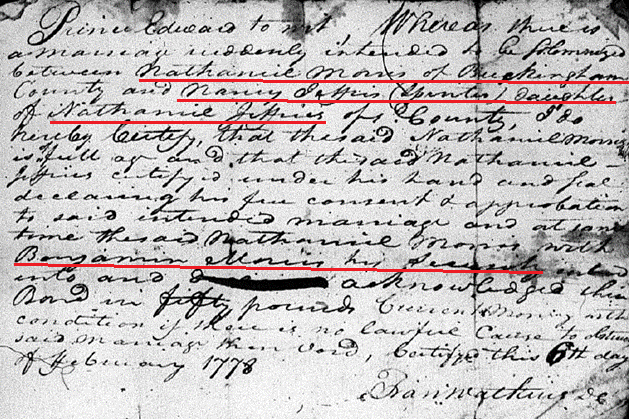
Nathaniel & Nancy (Jeffries) Morris start a family
After their wedding, Nathaniel and Nancy settled in at Nathaniel’s farm. It wasn’t long before Nancy was pregnant and their first child, a son they named John, was born on 25 June 1779. Daughter Mary, who they called “Polly” was born on 6 July 1780 and another son, Nathaniel, Jr. followed on 24 December 1781. Over the next 14 years Nancy gave birth to another eight children including Ann “Nancy” (1783), Samuel (1785), Hannah (1787), Sarah (1789), Goodrich (1791) Frances “Fannie” (1793), Elizabeth “Betsy” (1795) and Martha “Patsy” (1798).[38]
In 1782, when Buckingham County’s first property tax list was recorded, Nathaniel paid tax on six enslaved people named London, Phil, Beck, Lucy, Ben and Jem. He also paid tax on three horses and 20 head of cattle. Real property tax records show that Nathaniel paid tax 260 acres that same year.[39] This tract is referred to as “The old tract of land adjoining Chamberlyn’s called Bristors.” in Nathaniel’s 1813 will. No land grant has been found for Nathaniel Morris has been found. He likely purchased his land from a member of the Bristow family, of whom Jedidiah Bristow and his sons James and Thompson who lived in Buckingham County during this period.
Benjamin Morris was similarly situated paying tax on seven enslaved people, four horses, 14 head of cattle and 333 acres. Nancy’s father, Nathaniel Jeffries paid tax on seven enslaved people, seven horses, 24 head of cattle and 350 acres. From 1782 until 1793, Nathaniel Morris and Benjamin Morris owned and paid taxes on their 260 and 333 acres, respectively, while Nathaniel Jeffries owned and paid tax on his 350 acres.[40] In 1795 Nathaniel Morris held 11 enslaved people while Benjamin Morris and Nathaniel Jeffries each held six.[41] All three men were middling landowners who enjoyed a relative amount of success in the post-Revolutionary War economy.
It was in 1795 that things began to change for the Morris family. Nathaniel, now about age 51, bought two additional tracts of land including 332 acres from Benjamin Morris and 300 acres from an unknown purchaser.[42] These tracts were contiguous to Nathaniel’s 260-acre tract and expanded Nathaniel’s holdings to 892 acres. Benjamin’s sale of his land is curious. It appears he kept an acre; perhaps surrounding his home. Personal property tax records indicate that Benjamin continued to hold between four and 11 enslaved people through 1815,[43] which he probably leased to Nathaniel or another farmer to generate income. Benjamin was about 61 years old in 1795 with no heirs of his own. Perhaps he decided to help Nathaniel amass something for his heirs as they approached adulthood. Nathaniel’s father-in-law, Nathaniel Jeffries also died in 1795 leaving his wife, Mary, as head of household paying tax on 310 acres; 40 of the 350 owned prior were now in the hands of eldest son William Jeffries.[44]
Over the next few years, Nathaniel Morris bought and sold additional tracts. In 1797, Nathaniel sold 91 ¼ acres of the 332 he purchased from Benjamin Morris to his brother-in-law John Jeffries.[45] In 1800, he purchased a 682 ½ acre tract of land from John Vassar bringing his total holdings to 1483 ¼ acres.[46] This would become Nathaniel and Nancy’s new home. In 1804, Nathaniel bought an additional 289 acres from Epperson [probably John] and gave his eldest son John, who was now 25 years old, the 300-acre tract he had acquired in 1795.[47]
After his gift to son John, Nathaniel owned four tracts (260-acre original tract, 240 ¾ of the 332 acre tract from Benjamin, 682 ½-acre tract bought from Vassar and the 289-acre tract bought from Epperson) totaling 1,472 ¼ acres, which he held until his death in 1813.
Benjamin Morris purchased 81 acres from Robert Saunders in 1807.[48] In 1813, Benjamin received “for life” 170 acres from Peter Francisco on Payne’s Creek, a tributary of the Willis River.[49] While Benjamin never married nor had children, his neighbor, Peter Francisco, well known for his size and strength, and called “The Hero of the Revolution,” named one of his sons Benjamin Morris Francisco.[50]
Community Affairs
Nathaniel Morris and Benjamin Morris took an active interest in their community. Benjamin was appointed as a justice of the peace for Buckingham County on 15 April 1784, although it was not until 1789 that he took his oath. He was still serving in 1793.[51] Nathaniel affixed his signature as “Natt Morris” to various legislative petitions. First was the aforementioned petition dated 22 October 1776, signed by citizens of Albemarle, Amherst and Buckingham Counties calling for equal rights for religious dissenters.[52] He also signed the famous 10,000 name petition dated 1 November 1776, which called for the newly formed government of the United States to place all religious denominations on equal footing and to support themselves rather than have taxpayers be required to support the Protestant Episcopal (formerly Anglican) Church.[53]
Nathaniel, Benjamin and Nathaniel’s father in law, Nathaniel Jeffries, signed an 18 June 1783 petition whereby the Petitioners were complaining that neither Buckingham County Sheriff Charles Patteson nor anyone in his stead showed up at the appointed place and time to collect taxes in 1780. They asserted that the currency had depreciated and that the sheriff now refuses to accept the tax payments at their former value and now ask the legislature to force him to do so.[54] Nathaniel signed another petition dated 27 October 1785 protesting a bill that would have required taxpayers to pay teachers of the Christian religion citing their earnest opposition and belief such a measure was “contrary to the Spirit of the Gospel and the Bill of Rights.”[55]
Nathaniel and Benjamin both signed a petition dated 16 November 1789 asking for relief from the gradual depreciation of property, the low price of produce and the scarcity of money to pay debts and taxes.[56] Both also signed a petition dated 30 October 1790 asking the legislature to repeal an act previously passed allowing a town by the name of Greensville to be established near the courthouse on lands owned by John Cox. At that time it was felt that “the establishment of a town would attract industrious mechanics and tradesmen and would be of service to the community. The residents now find that industrious citizens can easily acquire fertile lands on the western waters and that all hopes for a considerable inland town must be postponed. The petitioners believe that the buildings and tavern at the courthouse owned by John Cox, deceased, will continue to serve the residents and strangers sufficiently if operated in the same manner as Mr. Cox had done previously.”[57]
A petition was sent to the legislature dated 29 Jul 1797 in which inhabitants on or near the waters of Appomattox River ask that an act be passed establishing a Town on the lands of Ichabod Hunter and John Epperson at the Cut Banks Plantation in Buckingham County on said river. The location of this site is described as “lying on a public road leading from north to south and within two miles of the main Buckingham Road leading from Richmond to the Western Country.” Among the signatories were Nathaniel, Benjamin, Nathaniel’s son John, William and John Jeffries (Nathaniel’s brothers-in-law) and Edward Saunders (Nathaniel’s son-in-law).[58] This would eventually become known as Planterstown and Nathaniel’s son, John Morris would come to own Cutbanks Plantation.
In 1780, during the Revolutionary War, the Virginia General Assembly passed an act authorizing the governor to impress supplies needed by the American army. The governor appointed commissioners of the provision law in each locality to carry out the terms of the act. The commissioner, when he impressed property, gave the owner a certificate describing what was taken. Between 1781 and 1783 county courts held special sessions at which certificates were presented and authenticated, and booklets listing authenticated certificates were compiled and sent to Richmond for settlement. Two commissioners appointed to settle the claims recorded those for which they authorized payment, and warrants were issued by the auditor of public accounts. On 1 August 1783, Nathanial was presented a certificate noting that he had provided mutton for the troops for which he was reimbursed £1 and 7 pence. Benjamin was reimbursed £16 for providing oats and £7, 10 shillings and 7 pence for providing bacon. On the same date Nathanial Jeffries was reimbursed 15 shillings for providing bacon.[59]
The earliest surviving U.S. Federal Census of 1810 lists Nathaniel Morris as head of a household in Buckingham County. Although unnamed, the household probably consisted of Nathaniel and his wife (identified as a white male and a white female 45+ years of age), one white male aged 16-25 (son Samuel), two white females 10-15 and two white females aged 16-25 (four unmarried daughters Hannah, Fannie, Betsy and Patsy) as well as 22 unnamed enslaved people.[60] Sons John and Nathaniel are listed on their own in 1810 and son Goodrich died in childhood. Their daughters Mary, Nancy and Sarah were married and all living in the area.
Nathaniel Morris made his will on 18 January 1813.[61] He “lent” his wife “during life or widowhood the tract of land on which my house stands called Vassers” as well as ten enslaved people and half his stock of cattle and sheep, his stock of horses and hogs and household and kitchen furnishings. Son Nathaniel, Jr. inherited, at his mother’s death, 150 acres from the 682 ½-acre Vassar’s tract “beginning at the mouth of the Mountain Branch up the same branch to the said Nathanial’s line.” Land tax records indicate that Nathaniel, Jr. also received the 289-acre tract his father purchased from Epperson in 1804.[62] Youngest surviving son Samuel inherited “the old tract of land adjoining Chamberlyn’s called Bristors” [Bristow’s] of 260 acres “together with three hundred and thirty-three acres purchased of Benjamin Morrisadjoining the same.“
According to land tax records, Samuel was already occupying a portion of the original 260-acre tract, paying tax on 108 acres in 1812.[63] For his four single daughters, Hannah, Fannie, Betsy and Patsy, Nathaniel provided joint ownership of 15 enslaved people along with their future children to be divided among them upon their marriage or coming of age along with a horse and saddle each. He also provided for one grandchild named Allie Simms Saunders, “one little Negro to be taken from among those heretofore lent my wife.” Nathaniel directed that at his wife’s death all of the land, enslaved people and personal property be auctioned off and the proceeds divided among all of his children. He made a special provision that daughter Nancy’s portion be willed to trustees appointed for her benefit during her life and at her death divided among her children. Finally, Nathaniel’s three sons were appointed executors.
One might be curious about the disparate treatment of land provided to Nathaniel’s sons by his will. Land tax records provide some insight. The eldest son John Morris was 33 years old when his father’s will was written and already owned 660 acres including the 300 acres received from his father in 1804. Nathaniel, Jr., age 31, already owned three tracts totaling 706 acres. Both sons were well established with their father’s help and his will recognized this. Nathaniel’s married daughters likely received their inheritance in the form of a dowry up on their marriages.
Nathaniel Morris, Sr. died three days after writing his will on 21 January 1813 and was laid to rest in the Morris family cemetery at Vassar’s.[64] His gravestone reads ” SACRED to the memory of NATHL MORRIS who died Jany 21 1813 aged 68 years.” Nancy (Jeffries) Morris continued to live as Vassars and in 1820 was listed as head of household for the census taken that year.[65] Living with her were one female age 26-44, one female age 16-25 and one female age 10-15. The census also records that Nancy had 22 slaves. The other white females probably included unmarried daughters or granddaughters. When the 1830 census was taken, Nancy (Jeffries) Morris, now in her 70’s, was listed as head of household with 12 enslaved people.[66] Living with her was an unidentified white male aged 20-29 [b. 1801-1810]; perhaps a grandson. Ann “Nancy” (Jeffries) Morris outlived her husband by exactly 20 years dying on 21 January 1833. She is buried beside her husband in the Morris family cemetery at Vassar’s.[67]
An 1842 Buckingham County Chancery Court decree concerning settlement of the estate of Nancy (Jeffries) Morris appeared in the Richmond Enquirer. Plaintiffs included daughters Mary (Morris) Saunders and heirs of daughter Elizabeth (Morris) Hooper (her children Mary Jane (Hooper) Hocker, James E., Ann M., Thomas B. and Elizabeth Hooper – the last four being minors). Defendants included sons John, Nathaniel and Samuel, son-in-law and daughter Edward and Martha (Morris) Baxter, heirs of deceased sister Sarah (Morris) Holland (her children Nathaniel and Ann Holland), daughter Frances (Morris) Smith and children of deceased sister Nancy (Morris) Saunders (Goodrich Saunders and Alice (Saunders) Price). Son John Morris was also named in his capacity as administrator of their mother’s estate.
The notice directed that John Morris “render an account of his administration of the estate” and Samuel Morris “render an account of the annual rents and profits of the said estate.” Edward and Martha (Morris) Baxter, Henry W. Holland (widow of Sarah (Holland) Morris) and ——— and Alice (Saunders) Price were noted as absent defendants as they were living in Alabama, Missouri and Kentucky, respectively. Neither the Baxter’s nor Alice (Saunders) responded to the bill of complaint. Henry W. Holland did respond. Frances (Morris) Smith and Goodrich Saunders lived locally and a summons to appear and answer the suit was executed on each of them but neither responded in more than two months. The court decreed that non-respondents were considered to be in agreement with the bill of complaint. Neither Goodrich Morris nor Hannah Morris or any heirs were listed indicating both were deceased without heirs. The suit was specifically about land in Buckingham County of which son Samuel Morris was in possession, which was the land that became the Buckingham White Sulphur Springs, a popular summer retreat featuring natural healing springs. While records concerning details of the suit do not exist, it appears to involve Samuel Morris buying out his living siblings and the heirs of his deceased siblings.[68]
Nathaniel Morris, b.c. 1745, prob. Virginia, d. 21 January 1813, Buckingham County, Virginia, m.b. 6 Feb 1778, Prince Edward County, Virginia, Ann “Nancy” Jeffries, b.c. 1755, d. 21 January 1833, daughter of Nathaniel and Mary (———-) Jeffries, issue:
John Morris b. 1779 d.c. 1862 m. Nancy Holland
Mary “Polly” Morris b. 1780 d. 1860 m. Edward Saunder
Nathaniel Morris b. 1781 d. 1872 unmarried
Nancy Morris b. 1783 d.c.1830 m. Rev. James Saunders
Samuel Morris b. 1785 d. 1850 m. Ann B. Moore
Hannah Morris b. 1787 d. by 1842 unmarried
Sarah Morris b. 1789 d. 1841 m. Henry W. Holland
Goodrich Morris b. 1791 d.c. 1801 unmarried
Frances “Fannie” Morris b. 1793 d. aft. 1842 m. James Smith
Elizabeth “Betsy” Morris b. 1795 d.c. 1828 m. Benjamin Hooper
Martha “Patsy” Morris b. 1798 d. aft 1850 m. Edward Baxter
Will of Nathaniel Morris of Buckingham County, VA
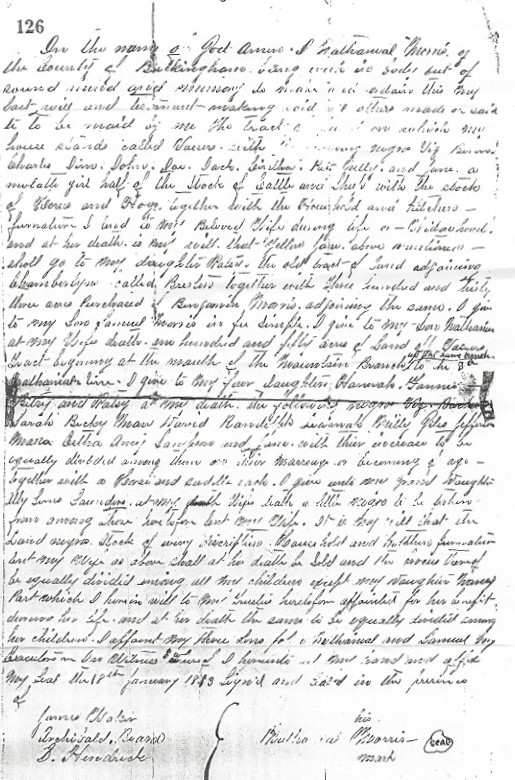
Will Transcription
In the name of God Amen. I, Nathaniel Morris of the County of Buckingham, being weak in body but of sound mind and memory do make and ordain this my last will and testament – making void all others made or said to be maid [sic] by me. The tract of land on which my house stands called Vassers with the following negros Viz. Benn, Charles, Jim, John, Joe, Jack, Cinthia, Pat, Chelly and Jane, a mulatto girl, half of the stock of cattle and sheep with the stock of horses and hogs, together with the household and kitchen furnishings I lend to my beloved wife during life or widowhood and at her death it is my will that Yellow Jane, above mentioned shall go to my daughter Patsy. The old tract of land adjoining Chamberlyn’s called Bristors [260 acres] together with three hundred and thirty three acres purchased of Benjamin Morris adjoining the same I give to my son Samuel Morris in fee simple. I give to my son Nathaniel, at my wife’s death one hundred and fifty acres of land off Vassers tract [682 1/2 acres total] – beginning at the mouth of the Mountain Branch up the same branch to the said Nathanial’s line. I give to my four daughters Hannah, Fannie, Betsy and Patsy at my death the following negros Viz. Rachel, Sarah, Becky, Nan, David, Randolph, Leannah, Milly, Giles, Jefferson, Maira, Estha, Amy, Sampson and Jane with their increase to be equally divided among them on their marriage or becoming of age – together with a horse and saddle each. I give unto my granddaughter Ally Simms Saunders at my wife’s death, a little Negro to be taken from among those heretofore lent my wife. It is my will that the Land, negros, stock of every description, household and kitchen furnishings lent my wife as above shall at her death be sold and the proceeds thereof be equally divided among all my children except my daughter Nancy’s part which I herein will to my trustees heretofore appointed for her benefit during her life and at her death the same to be equally divided among her children. I appoint my three sons John, Nathaniel and Samuel my Executors. In witness whereof I hereunto set my hand and affix my Seal the 18th [of] January 1813. Signed and sealed in the presence of
James Walker his
Archibald Beard [Baird] Nathaniel (M) Morris
E. Hendrick mark[69]
[1] Whether our Morris’ are connected to Claude’s family is not known. He is a descendant of Nicholas “Hudson” Morris (1770-1845).
[2] Buckingham County Land Tax Book, 1795-1813, Reel 51, Library of Virginia, Richmond, VA
[3] Buckingham County Land Tax Book, 1795-1813, Reel 51, Library of Virginia, Richmond, VA
[4] Buckingham County Land Tax Book, 1823-1833A, Reel 53, Library of Virginia, Richmond, VA
[5] https://floodfamily.org/other/BuckinghamMap.PDF
[6] Nathaniel Morris died on 21 January 1813 at the age of 68.
[7] Edythe John Rucker Whitley. Genealogical Records of Buckingham County, Virginia, (Baltimore: Genealogical Publishing Company, 1984), p. 4
[8] Wikipedia contributors. “Archibald Cary.” Wikipedia, The Free Encyclopedia. Wikipedia, The Free Encyclopedia, 4 May. 2016. Web. 16 May. 2016.
[9] Virginia Land Office Patents No. 13, 1725-1730 (v.1 & 2 p.1-540), p. 423 (Reel 12), Library of Virginia, Richmond, Virginia
[10] Fairfax Harrison. The Virginia Carys, An Essay in Genealogy, (Virginia: De Vinne Press, 1919), pp. 91-93
[11] Virginia Land Office Patents No. 25, 1745-1747, p. 471 (Reel 23); No. 29, 1749-1751, p. 113 (Reel 27), Library of Virginia
[12] Greg Crawford. “New Images Added To Lost Records Digital Collection.” 11 December 2013, Web. 13 May 2016 http://www.virginiamemory.com/blogs/out_of_the_box/2013/12/11/new-images-added-to-lost-records-digital-collection/
[13] Gerald W. Mullin. Flight and Rebellion: Slave Resistance in Eighteenth Century Virginia, (London: Oxford University Press, 1972), pp. 35-55
[14] Patricia P. Clark, ed. “Obituaries from the Family Visitor, April 6, 1822–April 3, 1824.” Virginia Magazine of History and Biography, Vol. 68, Part 1 (January 1960), p. 79
[15] Buckingham County, Virginia Tithables 1773-1774, Image 15 0f 30; https://www.familysearch.org/ark:/61903/3:1:3Q9M-CSL6-4RB1?i=14&cat=274745
[16] Virginia Gazette, 29 Jun 1769, p. 4
[17] Francis E. Lutz. Chesterfield: An Old Virginia County, (Richmond: William Byrd Press, 1954), p. 49
[18] Virginia Genealogist, Vol. 21, pp. 98-99, British Mercantile Claims 1775-1803, Reports of Christopher Clark 24 June 1801
[19] Campbell County, Virginia Will Book 2, p. 16, Library of Virginia, Richmond, VA
[20] Ruth and Sam Sparacio. Louisa County, Virginia Orders 1747-48/1766/1772, (Arlington, VA: The Ancient Press, 1999), p. 91
[21] Ruth and Sam Sparacio. Louisa County, Virginia Orders 1747-48/1766/1772, (Arlington, VA: The Ancient Press, 1999), p. 92
[22] Ruth and Sam Sparacio. Louisa County, Virginia Orders 1747-48/1766/1772, (Arlington, VA: The Ancient Press, 1999), p. 99
[23] Ruth and Sam Sparacio. Louisa County Orders 1766-1774, (Arlington, VA: The Ancient Press, 1999), p. 66
[24] Rosalie Edith Davis. Louisa County, Virginia Tithables and Census 1743-1785, (Manchester, MO, 1988), p. 13
[25] Rosalie Edith Davis. Louisa County, Virginia Deed Books C, C 1/2, D and D 1/2 1759-1774, (Manchester, MO 1977), p. 124
[26] Rosalie Edith Davis. Louisa County, Virginia Deed Books C, C 1/2, D and D 1/2 1759-1774, (Manchester, MO 1977), p. 28
[27] Rosalie Edith Davis. Louisa County, Virginia Deed Books C, C 1/2, D and D 1/2 1759-1774, (Manchester, MO 1977), p. 40
[28] Rosalie Edith Davis. Louisa County, Virginia Deed Books C, C 1/2, D and D 1/2 1759-1774, (Manchester, MO 1977), p. 18
[29] Rosalie Edith Davis. Louisa County, Virginia Tithables and Census 1743-1785, (Manchester, MO: 1988), p. 84
[30] Rosalie Edith Davis. Louisa County, Virginia Tithables and Census 1743-1785, (Manchester, MO, 1988), pp72-73.
[31] Rosalie Edith Davis. Louisa County, Virginia Deed Books E & F, 1774-1790, (Manchester, MO, 1983), p. 18
[32] Inhabitants: Albemarle, Amherst & Buckingham County Legislative Petition dated 22 Oct 1776, Library of Virginia, (Religious Petitions 1774-1802), digital image, Library of Virginia, Richmond, VA
[33] Some researchers suggest that Mary’s last name was Tate. William Tate will dated 2 Apr 1751, Lunenburg County, VA, mentions daughter Mary Jeffers [sic].
[34] Prince Edward County Marriage Bonds, undated and 1755-1788, Reel 51 (unindexed), Library of Virginia, Richmond, VA
[35] Joanne Lovelace Nance. “Albemarle County Court Orders 1744/45 – 1748, August term 1746 – September Term 1746,” Virginia Genealogical Society Quarterly, Vol 27, No. 3, 1989, p. 170.
[36] Virginia Land Office Patents No. 24, 1745-1746, p. 148-49 (Reel 22), Library of Virginia, Richmond, VA
[37] Sparacio, Ruth and Sam, Albemarle County, Virginia Deed Book 1758 – 1761, (Arlington, VA: The Ancient Press, 1988), p. 62
[38] Morris Family Bible Record 1756-1872, Library of Virginia, Bible Records Collection #21365, digital image http://image.lva.virginia.gov/Bible/21365.pdf, Library of Virginia, Richmond, VA
[39] Buckingham County Land Tax Book, 1782-1795, Reel 50, Library of Virginia, Richmond, VA
[40] Buckingham County Land Tax Book, 1782-1795, Reel 50, Library of Virginia, Richmond, Virginia
[41] Buckingham County, Virginia Personal Property Tax Records, Reel 60 (1782-1809), Library of Virginia, Richmond, Virginia
[42] Buckingham County Land Tax Book, 1795-1813, Reel 51, Library of Virginia, Richmond, Virginia
[43] Buckingham County, Virginia Personal Property Tax Records, Reel 60 (1782-1809) and Reel 61 (1810-1826), Library of Virginia, Richmond, Virginia
[44] Buckingham County Land Tax Book, 1795-1813, Reel 51, Library of Virginia, Richmond, Virginia
[45] Ibid.
[46] Ibid.
[47] Ibid.
[48] Ibid.
[49] Ibid.
[50] Edythe Johns Rucker Whitley. Genealogical Records of Buckingham County, Virginia, (Baltimore: Genealogical Publishing Company, 1984), p. 147.
[51] Sherwin McRae. Calendar of Virginia State Papers and Other Manuscripts, Vol. VI, August 11, 1792 – December 31, 1793, (Richmond, VA: A. R. Micou, Supt. of Public Printing, 1886), p. 441
[52] Inhabitants: Albemarle, Amherst & Buckingham County, 22 Oct 1776, Religious Petitions Digital Collection, 1774-1802, Library of Virginia, Richmond, Virginia
[53] Early Virginia Religious Petitions, Library of Congress, American Memory, memory.loc.gov/ammen/collections/petitions/rressay3.htm, accessed 13 Nov 2013
[54] Inhabitants: Petition, Buckingham County, 1783-06-18, Legislative Petitions Digital Collection, Library of Virginia, Richmond, Virginia
[55] Inhabitants: Buckingham County, 27 Oct 1785, Legislative Petitions Digital Collection, Library of Virginia, Richmond, Va. Legislative Petitions of the General Assembly, 1776-1865, Accession Number 36121, Box 314, Folder 14
[56] Inhabitants: Petition, Buckingham County, 1789-11-16, Legislative Petitions Digital Collection, Library of Virginia, Richmond, Virigina
[57] Inhabitants; Petition, Buckingham County, 1790-10-30, Legislative Petitions Digital Collection, Library of Virginia, Richmond, Virginia
[58] Inhabitants: Petition, Buckingham County, 1797-12-06, Legislative Petitions Digital Collection, Library of Virginia, Richmond, Virginia.
[59] Revolutionary War Public Service Claims Commissioner’s Book I, Microfilm Reel 5, Library of Virginia, Richmond, Virginia
[60] 1810 US Census, Buckingham County, VA; Roll 66; Page 814; Image 0181426; Family History Library Film No. 00810, Ancestry.com
[61] Will of Nathaniel Morris, dated 18 Jan 1813, Library of Virginia, Virginia Historical Inventory Project, McCraw, Elizabeth, 26 Jun 1936, Library of Virginia, Richmond, Virginia
[62] Buckingham County Land Tax Book, 1795-1813, Reel 51, Library of Virginia, Richmond, VA
[63] Ibid.
[64] Janice J. R. Hull. Buckingham Burials: A Survey of Cemeteries in Buckingham County, Virginia, Vol. I, (Hearthside Press, 1997), p. 367
[65] Ancestry.com; 1820 U S Census; Census Place: New Canton, Buckingham, Virginia; Page: 141; NARA Roll: M33_132; Image: 118
[66] Ancestry.com; 1830; Census Place: Buckingham, Virginia; Series: M19; Roll: 193; Page: 287; Family History Library Film:0029672
[67] Janice J. R. Hull. Buckingham Burials: A Survey of Cemeteries in Buckingham County, Virginia, Vol. I, (Hearthside Press, 1997), p. 367
[68] Richmond Enquirer (Richmond, VA), 20 Dec 1842, p. 4
[69] Nathaniel Morris could sign his names as evidenced by the several petitions he signed. He wrote his will just three day before he died. Perhaps he was too weak to sign his name.
 A Son of Virginia
Great story! And an awesome blog! I thoroughly enjoyed reading about Nathaniel Morris.
The YDNA tester thought to descend from Samuel Morris who died about 1800, Campbell County, VA has an error in his genealogy. This YDNA tester descends from John Morris (m. Lucretia Howell, step daughter of John Goodman) who descends from William Morris and (probably) Sarah McCormack and was born in Buckingham County, VA but migrated to Campbell County, VA and died there in 1861. John Morris and his father, William Morris, lived on Flint Stone and Cheese Creek on Otter River in Campbell County, VA.
This John Morris (m. Lucretia Howell) has been confused with John Morris, the son of Samuel Morris, the religious dissenter who built the Morris Reading Houses in Hanover, VA. Samuel Morris did have a son named John but he married Mary Jameson (granddaughter of Clement Read of Charlotte County, VA). Samuel Morris had nephews named Joshua Morris (m. Sabra Hix) and Nathaniel Morris (m. Unknown). Nathaniel Morris died young and his brother, Joshua, who had no children, left half his estate (on Turnip Creek) in Charlotte County, VA to his nieces and nephews “the children of my brother Nathaniel.” Samuel Morris and his son, John Morris (m. Mary Jameson) lived on Little Falling River.
To my knowledge, the line of Samuel Morris (religious dissenter) has not been YDNA tested.
The line of John Morris (m. Lucretia Howell, step daughter of John Goodman) has been YDNA tested and is in Group M29 at FTDNA Morris Project.
LikeLike
Thanks so much for writing. What a great update. So many Morrises and so many Nathaniels,
Johns and Samuels. DNA is opening new doors all the time. I hold out hope I’ll find my Nathaniel’s father someday. Thanks again for writing!
LikeLike