
I have an old copy of A. R. Hudgins History of Amelia County published in 1965, which includes the following information about Robert Vaughan I [my 6x great grandfather] and Jeter’s Mill:
“In 1740 Robert Vaughan [my 6x great-grandfather] was granted 800 acres of land on the lower side of Flatt Creek. (When a map hangs on the wall the lower side is always the south side.) This land was bounded on the north by Flatt Creek and joined the land of Thomas Winford. Franks Creek[1] ran through this large tract of land. It was located just a very short distance west of Tomahawk Creek which flows north into Flatt Creek. The mill pond of a very early mill, built on Flatt Creek backed water some distance west of Tomahawk creek or branch, and it is almost certain that a part of Robert Vaughans low grounds were covered with water of this mill pond. More about this mill later. Later it becomes Jeter’s mill.”
“I have been told by a member of the Jeter family that this mill was built by a man named Atkinson. I have not been able to find out when it was built. The mill was located on Flatt Creek not more than a mile above Amelia Sulphur Springs. Most of the dam is there now, and the canal that leads to the mill site. A part of the mill foundation wall was there twenty five years ago and some old scrap metal was there. This mill ceased to operate about 1875. The old mill house stood until about 1898. I am just about sure that the stones from this mill were moved to Perrins Mill near Painesville in 1902. The road from Paineville to Jetersville passes close to this mill site. I feel sure the mill was there first and the roads were built to the mill, which later became this public road. Although this mill was not built by the Jeters it was operated by them for many years. This mill was called Grove Mill and the home of Tilmon Jeter who owned and operated the mill. Mill Grove was operated as a tavern for many years. This house is now the home of Mr. Reps Jeter. The last member of that well known pioneer family of Jeters in Amelia County to operate this mill was Dr. Jim Jeter who was an old man in 1900.”[2]
Robert Vaughan III Estate Distribution
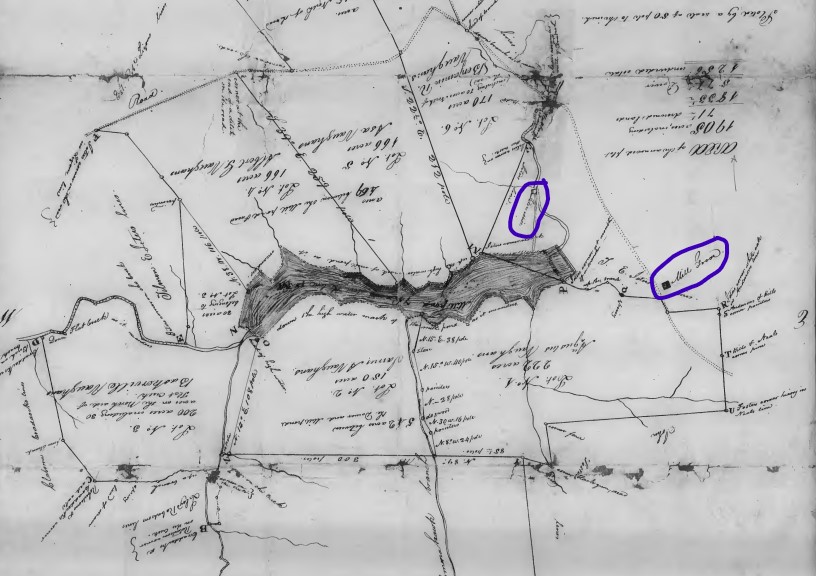
Robert Vaughan I’s grandson, Robert Vaughan III died about 1820[3] in Amelia County. A chancery suit was filed to divide his 1,905 acre estate.[4] This suit contains a plat [see below] showing the division into seven lots including the widow’s dower and six sons. Right in the middle of it is a millpond and clearly marked is Jeter’s Mill as well as Tilmon Jeter’s Mill Grove. Note that the plat is oriented with south at the top. I have also included an inset rotated 180 degrees so that north is at the top.


Booker’s Mill
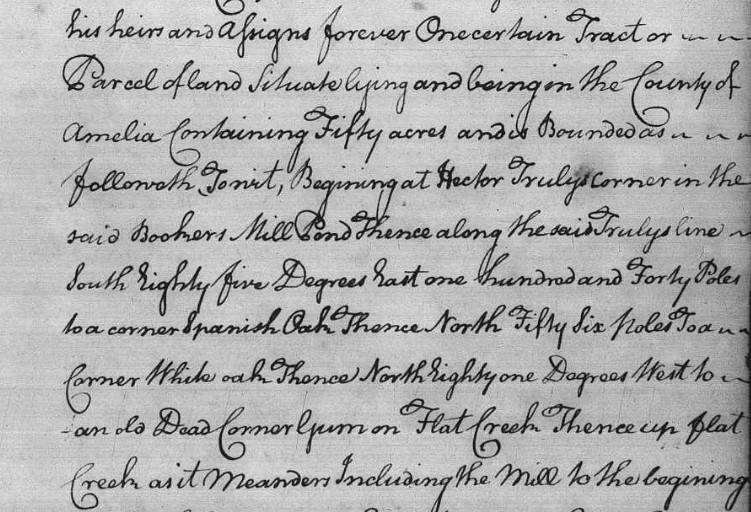
The first mention of this mill was on 7 December 1759, when Edmund Booker [Jr.] of Raleigh Parish, Amelia County sold it to John Spencer of same for £80, 50 acres bounded by Hector Truly’s corner[7], said Booker’s mill pond, said Truly’s line, Flatt Creek, up Flatt Creek as it meanders including the mill.[8] Booker, Jr. bought the mill tract on 10 December 1747 from Samuel & Edith Cobbs of Amelia County and Clement & Mary Read of Brunswick County who sold him three tracts for £100, one totaled 468 acres; one totaled 418 acres, and the other “50 acres, the residue, conveyed by deed from Thomas Spencer to Samuel Cobbs.”(no date given).[9]Cobbs had purchased the 50 acre tract just five months earlier on 17 July 1747 when Thomas Spencer sold it to him for £50. The tract was described as being bounded by “Cheatam’s corner in fork of branch there along his line”, “said Cobb’s own line”, and “Doctors Branch.”[10] It may be part of the 200 acre grant given to Thomas Spencer on 26 July 1735 in then Prince George County between Hill’s and Nash’s lines on the Beaver Pond Branch of Flatt Creek.[11] Samuel Cobbs apparently planned to build a mill on the site as he petitioned the Amelia Court on 21 November 1747 to build a water grist mill on one side of Flatt Creek. He asked for one acre of Robert Ferguson’s land (located opposite side of creek) for this purpose and requests that a jury determine damage if a mill is built.[12] At court on 21 March 1747/8, Cobbs was granted the one acre and paid damages to Robert Ferguson.[13] Apparently Cobbs decided not to move forward with the mill as he sold the tract to Booker just eight months later.
Booker’s Mill
In April 1753, nearly five years after Edmund Booker, Jr. bought the tract from Cobbs, he petitioned to build a water mill on Flatt Creek and that one acre of land on the opposite side belonging to Henry Farley be laid off and assigned to him for that purpose. The Court ordered jury to be summoned to value the damage the building such may do by over flowing the same.[15] At the May 1753 court session Farley testified that he had been paid [does not say how much] and order was recorded.[16] On 27 February 1752, Edmund Booker, Jr. sold to Henry Farley for £215, 268 acres adjacent land of James Cheatham, Thomas Spencer, James Cocks, James Scott & one other tract said Edmund Booker has sold to Benjamin Ward of 200 acres known by the name of Rice’s & is part of 468 acres conveyed by Samuel Cobbs and Clement read to said Edmund Booker.[17]
Spencer’s Mill (1759-1762), Pride’s Mill (1762-1771) and Ward’s Mill 1771-1784
We began with the 1759 sale of the mill by Booker to John Spencer. He owned the mill for less than three years when on 25 October 1762, he and wife Mary of Amelia County sold the 50 acre tract to John Pride, Jr. of York County for £50. It was described as being in Raliegh Parish on the lower side of Flatt Creek, adj. lands of said Pride, James Hill, William Pride [Hector’s Truly’s former land], being land said Spencer purchased from Edmund Booker & includes the mill Spencer now owns.[18]
John Pride, Jr. owned the mill for nine years before selling it on 24 Oct 1771 to Benjamin Ward, Sr. for £275. The tract was described as being 50 acres on both sides of Flatt Creek specifying that of the acreage, 15 ¼ acres were on the north side and 34 ¾ acres on the southside of the creek beginning on the bank below the mill. It also noted that the sale included the mill and all houses, etc. This deed was recorded on 28 Nov 1771[19]
Atkinson’s Mill (1784-1797)
After 13 years, on 22 September 1784, Benjamin Ward of Raleigh Parish, Amelia County, sold it to Joshua Atkinson (c.1755-1837)[20] of the same for £425. Described as being 50 acres in Amelia County on both sides of Flat Creek and including a water grist mill. Adjoining lines of said Atkinson, Francis Anderson and Richard Ogilby. The deed was recorded September 23, 1784.[21]
Joshua Atkinson also owned a nearby 325 acre tract he purchased on 3 March 1778 from William Pride on the south side of Flat Creek beginning where Friend’s line crosses Tomahawk Creek, adjoining lines of Foster, Hill, Ward,a stump on Flat Creek near Ward’s mill pond, the mouth of Tomahawk Creek, and the creek as it meanders. [22]
Chaffin & Atkinson
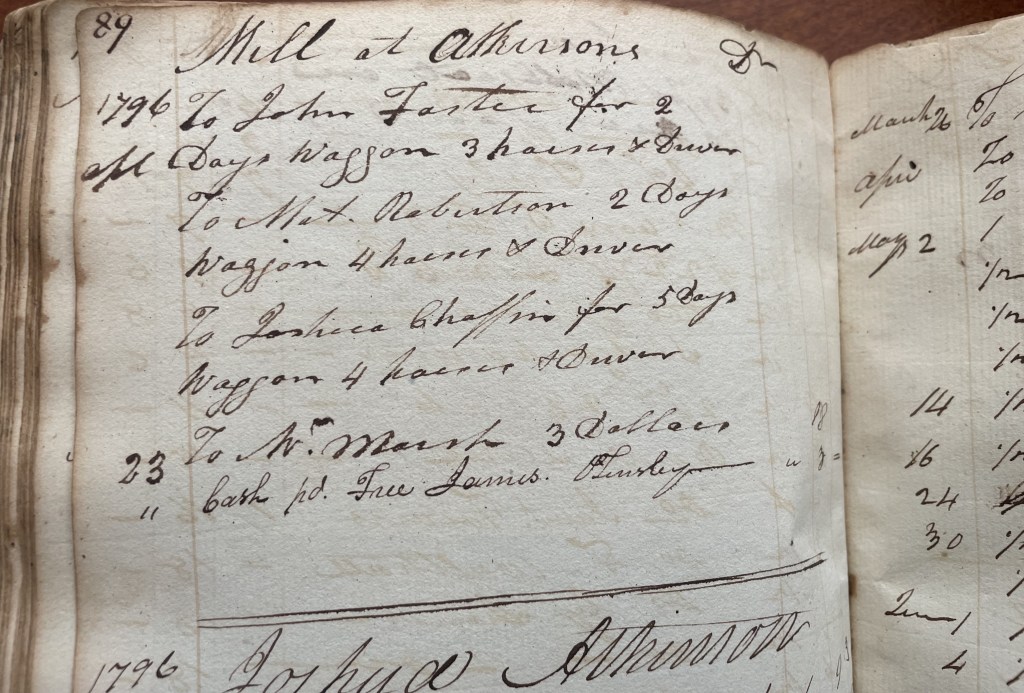
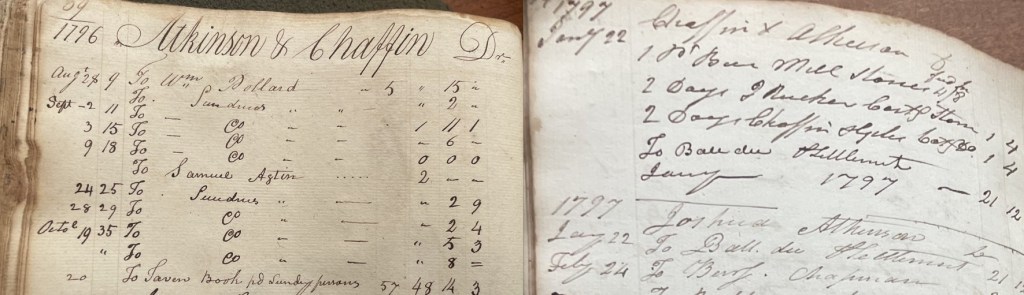
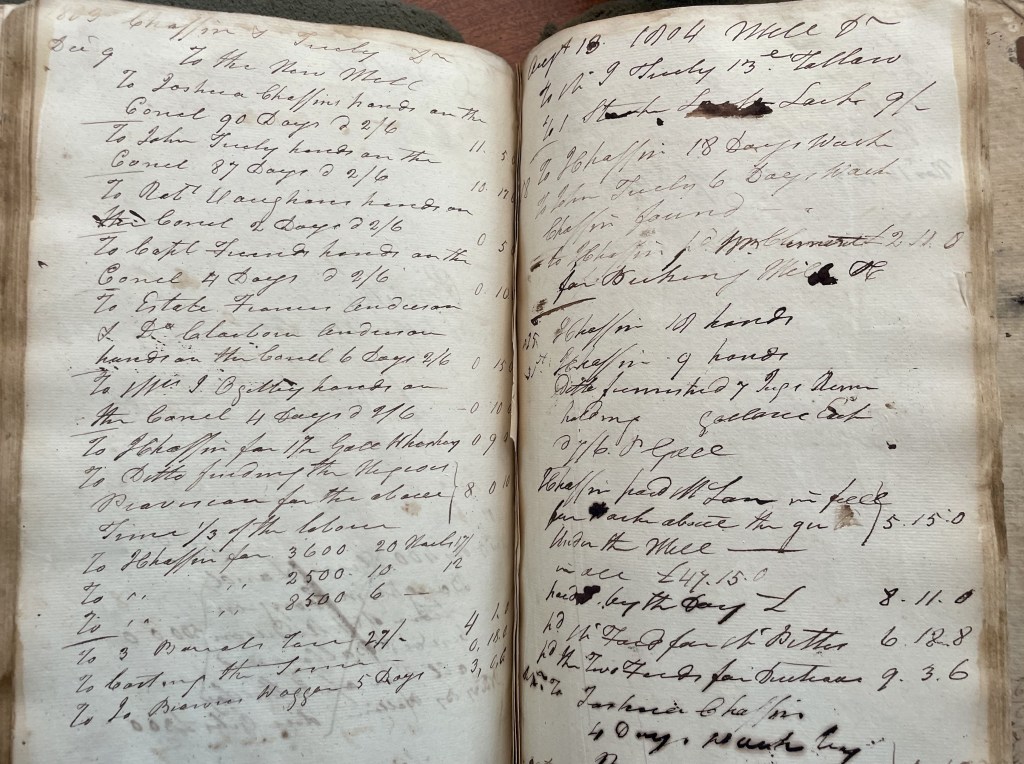
Joshua Atkinson began a partnership with Joshua Chaffin in the mill operation. The partnership was styled Atkinson & Chaffin in August 1796 and as Chaffin & Atkinson in January 1797.[23]
Chaffin and Truly (1797-1805)
On 13 March 1797, Joshua Atkinson sold the tract and mill for £542 to Joshua Chaffin, John Truly, and Matthew Robertson. It was now described as being 55 acres on both sides of Flatt Creek, bounded by estate of Francis Anderson, John Hill, said Atkinson’s land, which he bought of William Pride, across a small branch, to said Atkinson’s spring, down the spring branch including all the flat land on the said branch to the mill pond, Est. of Richard Ogilby . . .includes a mill which land & mill the said Atkinson purchased of Benjamin Ward except about 5 acres which is included by a new line.[24] On 22 July 1802, Joshua and Frances Atkinson sold a 316 ½ acre tract [by survey] to John Truly Sr. for $1,899 “bounded by Flat Creek adjoining the estate of Richard Ogilby, estate of William Craddock, Jr., [1st husband of Sarah (Truly) Craddock Vaughan] John Foster, John Hill Estate, Francis Anderson and Chaffin and Truly it being part of the land the said Atkinson bought of William Pride.”[25] Atkinson removed to Adair County, Kentucky.
A Chancery Court suit reveals details of the partnership
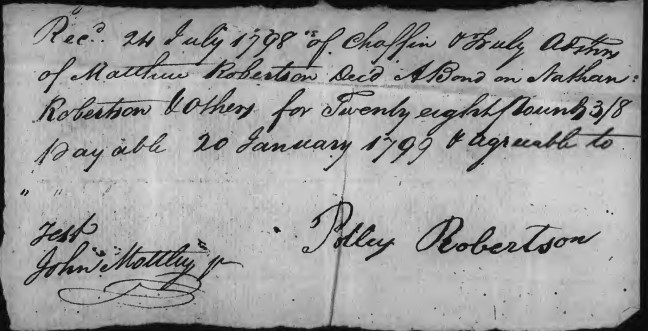
Joshua Chaffin, John Truly [my 5x great grandfather] and Mathew Robertson formed a partnership in a mill operation that included 58 acres of land. The men were tenants in common in fee simple in the land and mill meaning that each had a separate interest in the partnership and could individually sell their interest. Robertson died and in 1798 his heirs (10 children & 2 grandchildren) brought suit to sell his interest to the highest bidder so they could each receive their portion of the estate. Neither Chaffin nor Truly opposed the sale, which occurred on 20 January 1798. Son Nathan Robertson was the high bidder at 310 pounds current money on 12 months credit. On the same day, Joshua Chaffin and John Truly bought out Robertson’s interest for 310 pounds using four bonds totaling 11 shares (one to each heir) Each of the shares was worth £28.3.8 for a total of £310 and were payable on 20 January 1799 (12 months credit).[26] In a deed dated 28 June 1798 and recorded 26 July 1798, Nathan Robertson (on behalf of all the heirs) sold Joshua Chaffin and John Truly for £310, their one-third part of a mill and 58 acres on Flat Creek “which mill and land Nathan bought at public sale.” John Truly, Jr., Dabney Miller and John Chaffin were witnesses.[27]
The death of John Truly, Sr. – a new partner and a new mill
John Truly, Sr. made his will in 1803 [month and day are blank], which was proven in Amelia court on 27 September 1804.[28] He mentions land he bought in 1802 from Joshua Atkinson as well as the mill, provides a description of its location and his partnership with Chaffin:
I also give my daughter Sarah Vaughan[29] three hundred acres of land part of the tract I bought of Joshua Atkinson & to her heirs forever.
I give and bequeath unto my son John Truly sixteen acres of land the remaining part of the tract of land I purchased of Joshua Atkinson which is to be laid off as following beginning at Atkinson’s Spring thence to a corner of gardain [sic] on the east side of the road being from Atkinson’s bridge to the main road thence along the said road until a parallel line with Chaffin and Truly line to unto John Gills [my 6x great grandfather] line will make the quantity. I also give unto my son John Truly my interest in the land and mill building which I hold in partnership with Joshua Chaffin it is also to be remembered that the said Chaffin and myself began to build a new mill for the purpose of manufacturing wheat &c. and to repair the present dam half of which expense must be raised out of my Est. (as I am obligated to pay the same) to him and his heirs forever.
Chaffin and Perkinson (1805-1805) & Chaffin (1805-1809)
John Truly, Jr. did not hold his interest in the mill for long. In a deed dated 27 May 1805 and recorded 24 October 1805 he sold Joshua Chaffin “all right title and interest & claim to which he has in & to the one half of the land, houses, on the south side of Flatt creek including about 15 acres of land which said half whereon said Chaffin now lives & the 15 acres thereunto adjoining was devised to me by the last will and testament of my father John Truly” for $1,000.[30] In another deed dated a recorded the same day, John Truly, Jr. sold to Thomas Perkinson for £450, all his right title and interest which he hath to one half of the mill & the land on the north side of Flat creek devised by last will of father, etc.[31] Perkinson sold his interest to Joshua Chaffin just a few months later for the same price.[32] Notice how the two deeds with the same date differ. The first deed is in dollars while the second is in pounds.
John Truly, Jr. (1809-1810)
Then in a deed dated 21 January 1809 and recorded 23 February 1809, Joshua Chaffin sold the tract and mill back to John Truly, Jr. for £800. It now contained 80 acres bounded by lands of James Hill, Henry Anderson, est. of Richard Ogilby & Robert Vaughan [my 4x great grandfather] “being land whereon Joshua Chaffin now resides, including his mill of Flat creek.”[33]
Asa Vaughan (1810-1813)
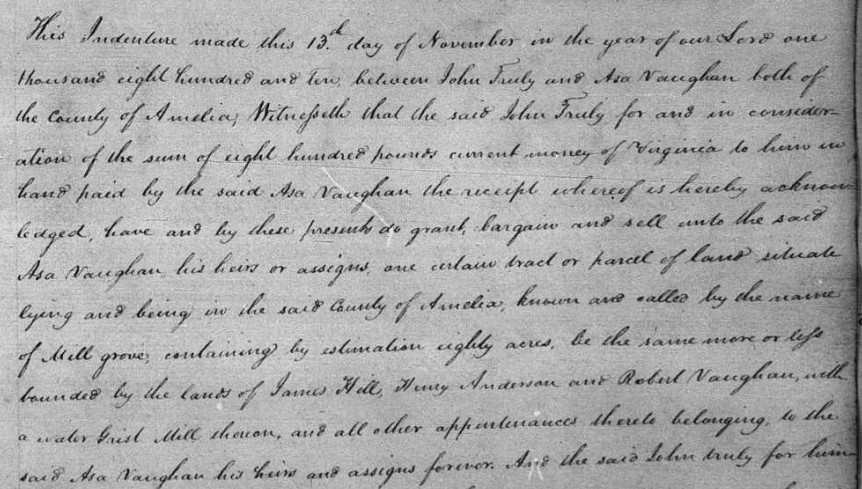
Less than two years later on 13 November 1810, Truly sold the 80 acres to his brother-in-law Asa Vaughan[34] for the same price. The deed mentions that the tract was “known and called by the name of Mill Grove with a Water Grist Mill thereon.” Bounded by James Hill, Henry Andersen, Robert Vaughan.[35]
Tilmon E. Jeter (1813-1836)
In a deed dated 15 December 1813, Asa Vaughan & his wife Jane (Truly) Vaughan to Tilmon E. Jeter for £1017.17.8, 107 acres bounded by James Hill, Henry Anderson, Robert Vaughan on which a water grist mill now stands. His wife released her dower rights.[36] Jeter opened a “public house” or tavern and offered lodging and meals for those visiting the nearby Amelia White Sulphur Springs.[37]

Jarratt Allen Jeter’s Mill Grove and Grove Mills (1836-c.1890)
In a deed dated 1 November and recorded 5 November 1836, Tilmon E. Jeter and Mary P. his wife of Nottoway County, Virginia sold to Jarratt A. Jeter of Amelia County, Virginia for $4,000, 107 acres on both sides of Flat Creek called and known by the name of Mill Grove, on which is a water grist mill situated on the said Flat Creek known as the Grove Mills and bounded by lands of Henry Anderson, Robert T. Vaughan and the land of the late Robert Vaughan, decd. Same that Tilmon E. Jeter purchased from Asa Vaughan and Jane (Truly) Vaughan. Pertaining to the mill the deed states “all fixtures and machinery also all the rights and privileges the said Tilmon and Mary has to the water power to work the said mill.”[38]
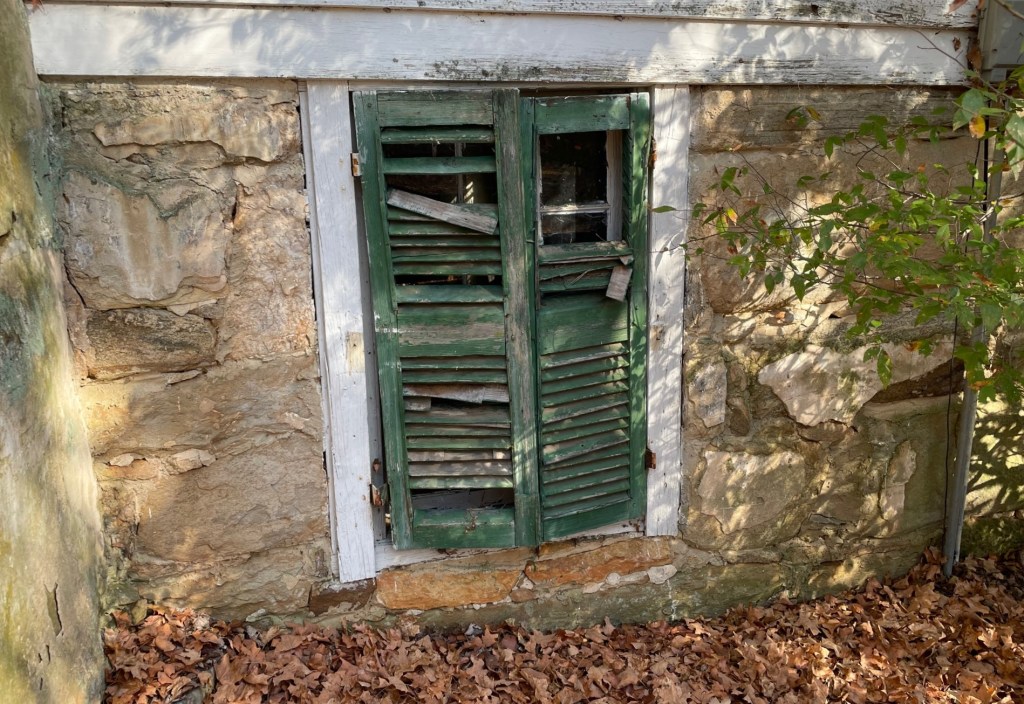
The aforementioned Mill Grove was featured in the first volume of Old Homes and Buildings of Amelia County, Virginia, which was published in 1964. It noted that Mill Grove was “located 2 1/2 miles from Jetersville on the Jetersville-Painesville Road in a grove of large oak trees.” Also mentioned was the fact that “a grist mill was on the place, but the pond fed by Flat Creek has been dry since 1890. The mill was burned during the Civil War and later rebuilt. The mill dam repeatedly caused trouble and was finally abandoned.” It also states that “Jarratt Allen Jeter, grandfather of the present owner of the place, bought it from Tilmon E. Jeter and his wife Mary P. in 1836. This mill was called Grove Mill and the home of Tillman Jeter, who owned and operated the mill, Mill Grove was operated as a Tavern for many years. This house is now the home of Mr. Reps Jeter. The last member of that well known and pioneer family of Jeters and amelia county to operate this mill was Dr. Jim Jeter who was an old man in 1900. He learned dentistry before the civil war.”

Jarratt Allen Jeter family
The Jeter Family
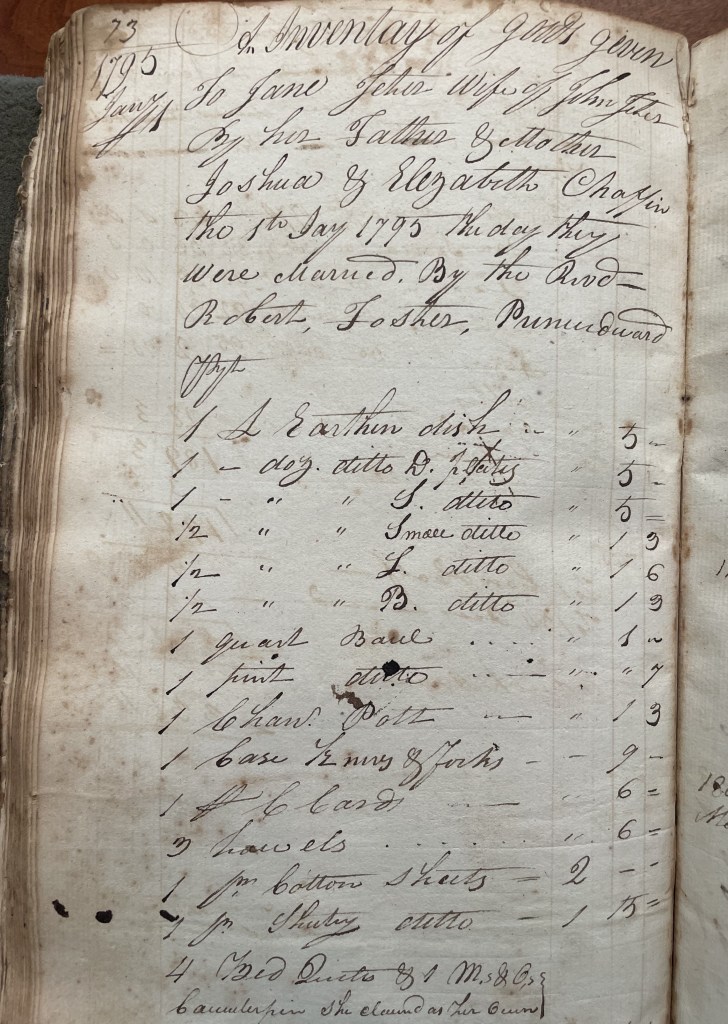
There were a lot of Jeters who likely all descend from the John Jeter who was in Essex County (Caroline County from 1728) about 1700. Caroline records loss prevents certainty, but the first and second John Jeter’s appear to have left several sons each. Several of these Jeters ended up in Amelia County. Tilman E. Jeter was a second cousin once removed to Jarratt Allen Jeter. Jarratt Allen Jeter’s grandfather Ambrose Jeter arrived in Amelia County from Caroline County during the 1770s. On 27 September 1777, he bought 500 acres on both sides of Stocks Creek from John Ford, Jr.[39] Some Jeters, not uncommon for time, married cousins as you will see in the chart below of the Jarratt Allen Jeter line. Those associated with the mill since 1836 are in bold. Note that Joshua Chaffin was the maternal grandfather of Jarratt Allen Jeter.
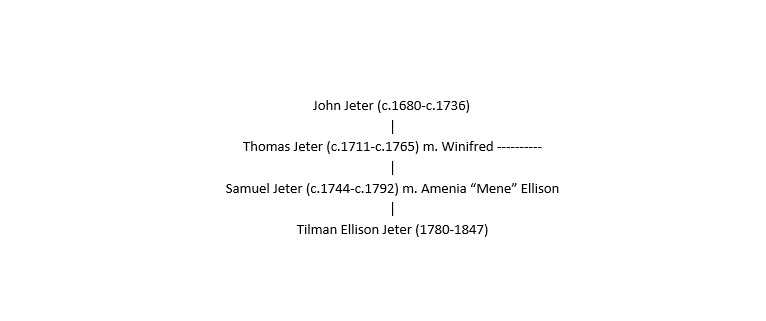
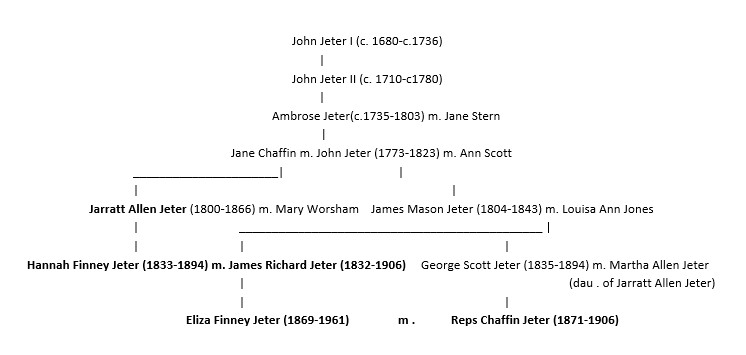
My ancestors mentioned in this post (in bold):
Hector Truly (c.1720-1761) m. Sarah Holt
John Truly, Sr. (c.1750-1804) m. Jane Hatchett
Sarah Truly (c.1770-1839) m. Robert Vaughan III (c.1770-1822)
Augustus Vaughan (c.1811-c.1851) m. Mary Spencer Farmer
Ann Octavia Vaughan (1844-1942) m. John Rives Morris
John Stewart Morris (1868-1958) m. Anna May Blanton
I am also a Jeter descendant:
John Jeter I (c.1680-c.1736)
John Jeter II (c.1710-c.1780)
Ambrose Jeter(c.1735-1803) m. 1760, Jane Stern
Rodophil Jeter (c.1765-1843) m. 1786, Lucy Gills (dau. of John & Elizabeth (———-) Gills, Sr.)
Rebecca Jeter (c.1797-c.1843) m. 1818, Richard Webster
Thomas Edward Webster (c.1819-1867) m. 1845, Mary A. Gills (dau. of Miles A. & Mary (Atkinson) Gills)
Mary Thomas Webster (1855-1916) m. 1879, William Edward Blanton
Anna May Blanton (1884-1977) m. John Stewart Morris (my great-grandparents)
[1] Frank’s Creek became Vaughan’s Creek during the 1740s, which it remains today.
[2] A. R. Hudgins history of Amelia County, 1965. Accession 50805. Personal papers collection, The Library of Virginia, Richmond, Virginia.
[3] Robert Vaughan is listed on the 1819 Personal Property Tax list, but his Estate is listed in 1820. Amelia County, Virginia Personal property tax lists, 1814-1835; https://www.familysearch.org/search/film/007842574?i=213&cat=775675
[4] Amelia County Chancery Court records, 1824-020 Dist. of Robert Vaughan v. Admr. Of Robert Vaughan, Virginia Memory Digital Collections, Library of Virginia; https://www.lva.virginia.gov/chancery/case_detail.asp?CFN=007-1824-020
[5] Topo Map of Streams in Amelia County, Virginia; https://www.topozone.com/virginia/amelia-va/stream/
[6] Amelia County, Virginia Chancery Court, 1824-020, Dist. of Robert Vaughan v. Admr. of Robert Vaughan, Image 10 of 12; Virginia Memory Digital Collections, Library of Virginia, Richmond, Virginia
[7] Hector Truly [my 7x great-grandfather] bought two tracts totaling 300 acres from Edmund Booker, Jr. in 1758 and 1759. On 23 February 1758 Hector Truly bought a 172-acre tract from Edmund Booker. Jr. for £100 described as “beginning on Flat Creek above mouth of the Great Tomahawk” and Truly bought an adjacent 128-acre tract from Booker on 24 May 1759 for £150 described as being on the lower side of Flat Creek and adjacent to “said Truly’s line” and the “corner in the said Booker’s Mill Pond.” When Hector truly died in 1761, his heirs sold the land to William Pride in 1762 to pay debts. Amelia County Deed Book 6, p. 226 & Deed Book 7, p. 27, p. 591
[8] Amelia County, Virginia Deed Book No. 7 1759-1762, p. 260, https://www.familysearch.org/ark:/61903/3:1:3Q9M-CSKH-Q9FS-Z?i=168&cat=282005
[9] Amelia County, Virginia Deed Book 3 1747-1750, p. 413; https://www.familysearch.org/ark:/61903/3:1:3Q9M-CSKW-MS5Z-Z?i=210&cat=282005
[10] Amelia County Deed Book 2 1743-1747, p. 531; https://www.familysearch.org/ark:/61903/3:1:3Q9M-CS4H-8QDD-D?i=580&cat=282005
[11] Land Office Patents No. 16, 1735, p. 62 (Reel 14), Library of Virginia, Richmond, Virginia
[12] Amelia County Order Book No. 2 , p. 62; https://www.familysearch.org/ark:/61903/3:1:3Q9M-CS4H-C9ZT-D?i=578&cat=275453
[13] Amelia County Order Book No. 2 , p. 83; https://www.familysearch.org/ark:/61903/3:1:3Q9M-CS4H-C98M-9?i=599&cat=275453
[14] Amelia County, Virginia Deed Book No. 7 1759-1762, p. 260, https://www.familysearch.org/ark:/61903/3:1:3Q9M-CSKH-Q9FS-Z?i=168&cat=282005
[15] Amelia County Court Order Book 3 1751-1755, p. 92; https://www.familysearch.org/ark:/61903/3:1:3Q9M-CS4H-CQ91-Z?i=96&cat=275453
[16] Amelia County Court Order Book 3 1751-1755, p. 103; https://www.familysearch.org/ark:/61903/3:1:3Q9M-CS4H-CQ9D-T?i=107&cat=275453
[17] Amelia County Deed Book No. 4 1750-1754, p. 266; https://www.familysearch.org/ark:/61903/3:1:3Q9M-CSKW-MS59-W?i=419&cat=282005
[18] Amelia County Deed Book No. 7 1759-1762, p. 699; https://www.familysearch.org/ark:/61903/3:1:3Q9M-CSKH-Q9JJ-P?i=389&cat=282005
[19] Amelia County Deed Book 11 1769-1772, p. 332; https://www.familysearch.org/ark:/61903/3:1:3Q9M-CSKH-Q98X-L?i=520&cat=282005
[20] A son of Thomas Atkinson (c.1731-c.1804) – my 6x great-grandfather. In 1833 Joshua Atkinson applied for a Rev War pension and declared he was 78 years old [b.c. 1755].
[21] Amelia County Deed Book 17 1784-1786, p. 69; https://www.familysearch.org/ark:/61903/3:1:3Q9M-CSYD-295S-H?i=264&cat=282005
[22] Amelia County Deed Book 14 1776-1778, p. 393; https://www.familysearch.org/ark:/61903/3:1:3Q9M-CSYD-LS9M-P?i=539&cat=282005
[23] Chaffin, Joshua. Joshua Chaffin Ledgers, 1792-1818. N.p., 1792. Print, Library of Virginia, Richmond, Virginia
[24] Amelia County Deed Book 20 1794-1799, p. 288; https://www.familysearch.org/ark:/61903/3:1:3Q9M-CSL6-SCKF?i=538&cat=282005
[25] Amelia County Deed Book 21 1799-1804, p. 255; https://www.familysearch.org/ark:/61903/3:1:3Q9M-CSLD-1SDL-3?i=140&cat=282005
[26] Amelia County Chancery Suit 1798-024, images 1-12; https://www.lva.virginia.gov/chancery/case_detail.asp?CFN=007-1798-024 ; accessed 1 May 2023
[27] Amelia County Deed Book No. 20, 1794-1799, p. 441; https://www.familysearch.org/ark:/61903/3:1:3Q9M-CSL6-SCNX?i=615&cat=282005; accessed 1 May 2023
[28] Amelia County Will Book No. 7 (1803-1811), p. 118; https://www.familysearch.org/ark:/61903/3:1:3QS7-89P4-XFFS?i=257&cat=275408; accessed 1 May 2023
[29] My 4x great grandmother Sarah (Truly) Craddock Vaughan, wife of Robert Vaughan III
[30] Amelia County, Virginia Deed Book 22 1804-1808, p. 144; https://www.familysearch.org/ark:/61903/3:1:3Q9M-CSLD-1S81-7?i=367&cat=282005 ; accessed 28 April 2023
[31] Amelia County, Virginia Deed Book 22 1804-1808, p. 145; https://www.familysearch.org/ark:/61903/3:1:3Q9M-CSLD-1S81-7?i=367&cat=282005 ; accessed 28 April 2023
[32] Amelia County, Virginia Deed Book 22 1804-1808, p. 176; https://www.familysearch.org/ark:/61903/3:1:3Q9M-CSLD-1S8Z-T?i=383&cat=282005; accessed 28 April 2023
[33] Amelia County Deed Book 23 1808-1814, p. 13; https://www.familysearch.org/ark:/61903/3:1:3Q9M-CSL6-M9HN-Z?i=21&cat=282005 ; accessed 28 April 2023
[34] Asa Vaughan (1761-1820) was a son of Robert II and Elsie (Motley) Vaughan and he married Jane Truly, a daughter of John Truly, Sr.
[35] Amelia County Deed Book 23 1808-1814, p. 286; https://www.familysearch.org/ark:/61903/3:1:3Q9M-CSL6-M9H8-L?i=158&cat=282005
[36] Amelia County Deed Book 23 1808-1814, p. 690; https://www.familysearch.org/ark:/61903/3:1:3Q9M-CSL6-M9HW-6?i=361&cat=282005
[37] Richmond Enquirer. (June 24, 1815). Tilmon E Jeter. Newspapers.com. Retrieved November 2, 2023, from https://www.newspapers.com/article/richmond-enquirer-tilmon-e-jeter/134457890/
[38] Amelia County Deed Book 33 1836-1838, p. 88; https://www.familysearch.org/ark:/61903/3:1:3Q9M-CSYD-2SFH-5?i=56&cat=282005
[39] Amelia County Deed Book 14 1776-1778, p. 282; https://www.familysearch.org/ark:/61903/3:1:3Q9M-CSYD-LS9C-B?i=483&cat=282005
 A Son of Virginia
I’m excited to read this blog as it proves ownership line of the Jeter’s mill and home. My ancestor was Thomas Atkinson via his first marriage which was not mentioned in his 1803 will since he’d started another younger family. My previous information pointed to Thomas owning Jeter’s mill and homestead but this new blog points to Joshua Atkinson?
LikeLike
Thanks so much for writing. I too thought Thomas had owned it but turns out it was his son Joshua.
LikeLike