
My 6x great-grandparents Richard (c.1718-1784) and Sarah (Hudson) (c. 1720-1795) Holland were born with proverbial silver spoons in their mouths. Both came from very well to do Hanover County families. Richard Holland was a son of Michael Holland (c.1690-1746) who amassed nearly 45,000 acres during his lifetime in the counties of Hanover, Henrico, Goochland, Louisa and Amelia.
For more on Michael Holland you can check out my three part series on him here:
Sarah Hudson’s father was Charles Hudson (c. 1690-1748) who I will cover in a future blog post. He was also a large landowner who amassed some 17,000 acres by patent and jointly patented another 52,000 acres. He was a co-patentee with Michael Holland on three separate land grants. Both Charles Hudson and Michael Holland served terms as sheriff of Hanover County and Charles Hudson served on the St. Paul’s Parish Vestry for many years.
Richard and Sarah (Hudson) Holland were probably married during the early 1740s given Richard’s father mentioned him having children in his 1746 will. While they both were born and raised in Hanover County, they made their marriage home in Henrico County on a 500 acre tract on Meredith’s Creek [sometime called Meredith’s Branch]. Richard Holland was noting as living on this tract when his father made his 1746 will, but he was there earlier according to a store account book kept by Francis Jerdone. In 1744, he was listed as “Mr. Richard Holland of Henrico.”[1]
The young couple benefited through gifts from their fathers. When Richard’s father died over the winter of 1746/7, he left the 500 acre Meredith’s Branch tract to Richard along with an adjacent 450 acre tract. He also received a 500 acre tract in Louisa County located on both sides of Beaver Creek. In addition to these 1,450 acres, Richard also inherited seven enslaved men, women and children named Harry, Nann, Robin, Sarah and two of her children (unnamed) and a boy called Jerry. He also received £50 to be paid eighteen months after his father’s death and was to receive 20% of the proceeds of the sale of his father’s non-bequeathed land (some 32,000 acres) and an unknown number of enslaved people that were to be sold by his executors. [2] Sarah (Hudson) Holland also brought a substantial marriage gift from her father, which consisted of 12 enslaved people named Patt, Jerry, York, Caesar, Margaret, Lewis, Harry, Nan, Hannah, James, Binah and Tom.[3]
On 2 April 1747, less than a month after his father’s will was recorded, Richard Holland sold the 500 acre tract in Louisa County he inherited to John Dixon, Gentleman of Hanover County who paid £110. Sarah Holland waived her dower right and the deed was recorded on 28 April 1747.[4] The couple made their home on the 950 acre plantation in Henrico County worked by 19 enslaved men, women and children. They lived there for five years until May 1752 when they sold it to William Hughes for £200.[5] They used the £200 to buy a much smaller 372 acre Henrico County tract on Tuckahoe Creek adjacent Randolph, George Freeman and Mr. William Harding.[6]
Regular A Son of Virginia readers will know that I love Chancery Court case files, of which the Library of Virginia is constantly adding to their Virginia Memory Digital Collection.[7] These files sometimes include detailed information and can be a fantastic resource for family historians and genealogists. One such suit filed in 1768 in Louisa County styled Thomas Pleasants vs. Richard and Sarah Holland reveals much about this couple and much of what follows comes from that 56 page suit file.[8]
Tobacco cultivation could be a risky business
Before we dig in, a little background may be useful. In colonial Virginia, planters obtained goods on credit from local merchants or local agents for English and Scottish merchants [united as Great Britain since 1707] and paid their debts when crops were harvested and sold. Bad weather, drought, insect infestation, government limits placed on tobacco production volume and sale price, variability of shipping costs, goods lost in transit, goods arriving damaged or spoiled, and politics in both Virginia and Europe all played a role in their success or lack thereof.
If planters were unable to pay their debts when due, the merchant would bring a suit to collect the debt. The suit often resulted in the person in debt using their property as collateral to secure payment through a mortgage deed. Planters used land, enslaved people, furniture, household goods and farm implements as collateral. If the debt was not repaid by a date certain with interest and reimbursement for the costs of the merchant to bring the suit, the mortgaged property would be sold at public auction to the highest bidder and the funds raised used to satisfy the debt. This was certainly the case for the Hollands.
The Hollands debts begin to mount
Not long after Richard and Sarah moved to Tuckahoe Creek evidence of their financial problems began to show. Richard Holland entered into a mortgage deed dated 10 April 1753, wherein he sold Robert Donald, a Hanover County merchant, for 5 shillings, seven enslaved people named Jenny, Sarah, Nan, Nead [Ned], Phillis, Liddie and Hannah. The deed notes that the mortgage is for securing payment for a bill of exchange for £200 sterling between Richard Holland and Mr. Leighton Wood of Bristol (England), merchant, of whom Robert Donald was a Virginia agent. The agreement was that if the debt was paid off in a year the deed would be void. Otherwise, the seven enslaved people would be sold at public auction to the highest bidder and the proceeds used to satisfy the debt. The deed was recorded on 3 June 1753.[9] Richard Holland, in his answer to the later Pleasants Chancery suit, indicated that he paid off this first mortgage soon after it was taken out.[10]
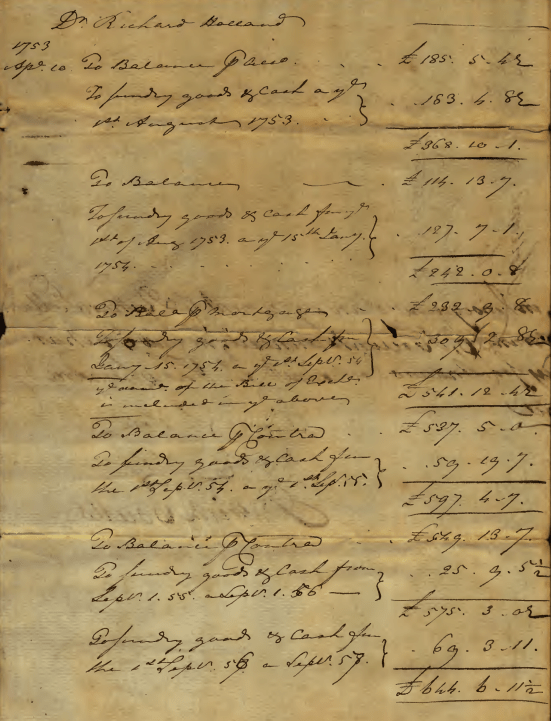
On 9 January 1754, Richard Holland bought 250 acres from James Meredith for £36.15. This tract was on Meredith’s Branch joining Robert Webb, Thomas Bowles “and the plantation said Holland sold to William Hughes.” The deed was recorded 4 February 1754.[11]
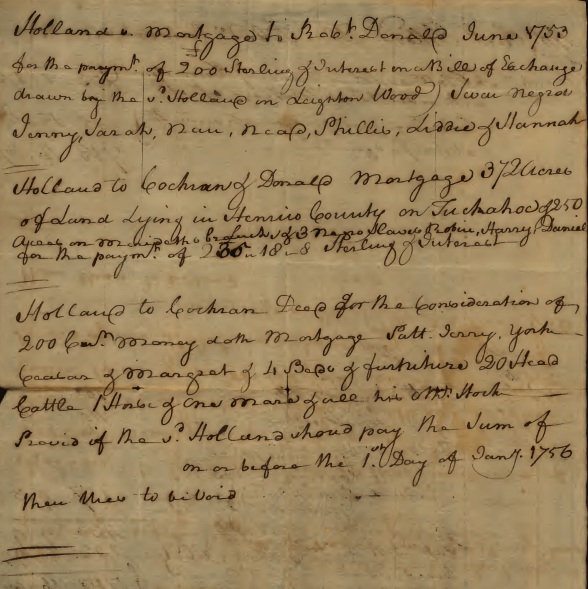
Less than a week later, on 14 January 1754, Richard and Sarah Holland entered into a second mortgage deed to secure a debt owed to merchants Andrew Cochran and James Donald of the City of Glasgow in Scotland. The deed notes that “Richard Holland stands indebted to Cochran and Donald in the sum of £235.18.8 current money of Virginia and other bills of exchange, some not paid, to pay Robert Donald [agent for Cochran and Donald] £200 sterling, which were due to Andrew Cochran and James Donald which bills were endorsed by Robert Donald payable to one George Riddle and it is unknown if said debt will be paid or not.” To secure the debt, the Holland’s used the 372 acre tract on Tuckahoe Creek, the 250 acres purchased from James Meredith and three enslaved people named Robin, Harry and Daniel. The agreement required Richard Holland to pay them £235.18.8 plus Interest at 5 percent per annum on or before 1 October 1754 to void the deed. Richard Holland represented that the mortgaged properties had no incumbrances and agreed to pay their costs for bringing the suit. Sarah Holland was privately examined and waived her dower right and the deed was recorded on 1 April 1754.[12] In his answer to the suit brought by Thomas Pleasants, Richard Holland said of the above that William Harding claimed that Holland owed him a debt that Holland described as “unjust.” Harding was his neighbor on Tuckahoe Creek and had recovered a sizeable amount against Holland in Court. To secure his debt to Harding, Holland took out a mortgage from the merchants secured by “a considerable part of his estate.” [13]
Just five months later, on 6 May 1754, a third mortgage for £200 was taken out with Cochran and Donald. This time they used as collateral five enslaved people named Patt, Jerry, York, Caesar & Margaret, four beds and furniture, 20 head of cattle and 1 horse, 1 mare and all of their household stock. These five enslaved people were among those given to Richard and Sarah (Hudson) Holland as a marriage gift from her father. The terms were that if Holland paid them the full sum by 1 January 1755 with 5 % interest and their costs to bring the suit the deed would be void. The agreement was recorded on 3 March 1755.[14]
On 24 September 1754, Richard Holland lost 200 of the 250 acres tract he bought from James Meredith just nine months prior. George Wilkinson sued to have the land patented to him when Holland failed to pay his quitrent [tax] on the property and did not make the required improvements.[16]
William Harding brought a Chancery suit against Richard Holland in Henrico County, which unfortunately does not survive. However, Henrico County Order Books provide some details. At the November 1755 court, the case was “discontinued the parties having agreed.”[17]
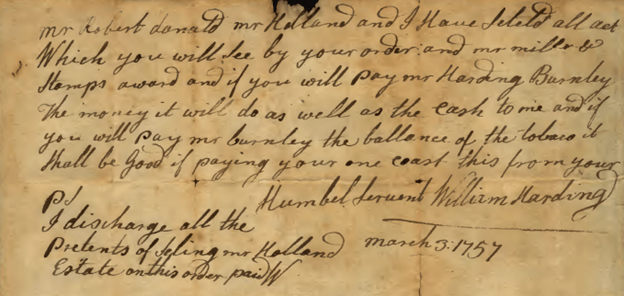
The Hollands were not able to pay what they owed to Cochran & Donald and on 7 November 1757, Richard and Sarah Holland of Henrico County & Robert Donald of the County of Hanover actor and agent for Andrew Cochran & James Donald of the City of Glasgow, Scotland, Merchants signed a deed acknowledging the sale of the 372-acre tract on Tuckahoe Creek to Benjamin Duval. The deed notes that Richard and Sarah Holland had mortgaged the property on 14 January 1754 to secure several sums of money owed Cochran & Donald. The Henrico County Order Book also mentions the suit by William Harding against both Cochran & Donald and Richard Holland setting forth that the mortgage made “to defraud and deprive said William Harding of the benefit of judgment” which Harding has obtained “for a considerable sum of money and quantity of tobacco” against Richard Holland. Harding forced the sale of the mortgaged property at public auction. Benjamin Duval was the highest bidder at £160 pounds. This deed was to convey the land to Duval and was recorded 5 December 1757.[19]
For whatever reason, Andrew & Donald [now styled Andrew Cochran & Company] continued to front the Hollands funds to pay their other creditors as well as for their purchase of sundry goods at their store. By the end of 1757, their debt to Cochran & Co. amounted to £891.11.11 ½ including interest and court fees. The Henrico Court ordered their mortgaged assets to be sold.[20]

The wheels of justice turned slowly back then for a variety of reasons and the previously mentioned Henrico County Harding vs. Holland case, as it turned out, was not over. On 4 February 1760, in that case, Richard Holland failed to appear and the Henrico Court ordered attachment of his estate for £94.18.5.[21] At the next court on 5 May 1760 Richard Holland did appear and told the court he had paid Harding and the Court set the matter for trial.[22] The trial took place on 5 August 1760 and the jury found for Harding who was awarded £32.10.2.[23] While the record does not say why, Holland must have indicated he would appeal because the case was continued on 1 September 1760.[24]
The next record of the case was not until 1 February 1762 when Richard Holland again failed to appear. The Court ordered that an “alias scire facias” be issued against him.[25] This was a judicial writ requiring a defendant to appear in court and prove why an existing judgment should not be executed.[26] The following month on 1 March 1762 Richard Holland again failed to appear and the sheriff reported that he was not found in the jurisdiction. The Court awarded Harding the £32.10.2 plus 264 pounds of net tobacco and 15 shillings as well as 150 pounds tobacco for his costs to bring the suit.[27] Richard Holland appeared at Court on 1 June 1762 to file an injunction against Harding, which the court promptly lifted saying Holland failed to give bond and security.[28]
A Move to Louisa County
Perhaps when the Henrico Sheriff reported the Hollands could not be found within his jurisdiction they were in Louisa County. It was there on 12 August 1766, the Louisa County Court continued the case of Richard Holland vs. Thomas Ballard Smith.[29] Two years later on 6 August 1768, Holland’s petition against Smith for £3.11.1 said to be due by account was rejected after hearing from the parties by their attorneys. The Louisa Court ordered Holland to pay Smith’s costs.[30]
On a brighter note, Richard and Sarah Holland’s daughter Mary wed Joseph Hughes on 2 Nov 1767 in Louisa County. Her father was surety.[31] The Hughes relocated to Rowan County, North Carolina where they had several children. Joseph Hughes died there in April 1793 and Mary (Holland) Hughes followed on 1 August 1794 according to their estate files.[32]
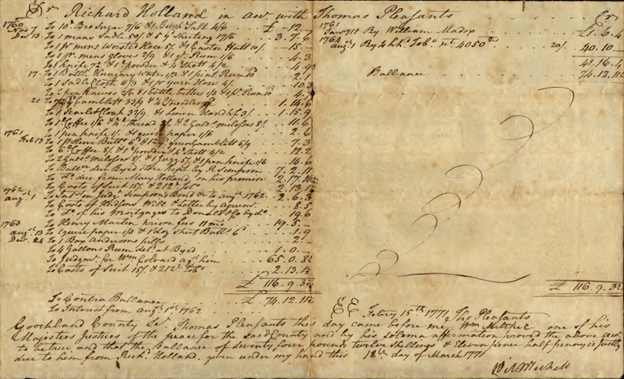
The following year, on 13 April 1768 Thomas Pleasants filed suit against Andrew Cochran & Richard Holland and Cochran & Co. in Louisa County Chancery Court. While Cochran & Co. filed its answer, Richard Holland moved for time to answer the bill until the next court. The Court ordered that a “true state of Holland’s debt due to Cochran &Co. on several mortgages and make a report to the court.”[33]

Meanwhile on 10 May 1768, Richard Holland file suit against John Bradley for assault & battery. Bradley asked to plead at the next court.[35] On 20 August 1768, Bradley pled “not guilty with leave” and trial was set for the next court.[36] The case was continued on 11 April 1769[37] and on 13 June 1769, the parties settled with defendant paying plaintiffs costs only.[38]
At the Louisa Chancery Court held on 20 August 1768, Richard Holland failed to answer the bill filed by Pleasants. The court ordered attachment for his contempt returnable to next court.[39]
There is an interesting page in the Pleasants suit dated 1769 listing the enslaved people held by the plaintiff, which included Old Harry, Patt, Jerry, York, Caesar, Young Nan, Daniel and Cajah (since dead). These enslaved people were working for the plaintiff or hired out annually so that the income they produced would go toward paying the Holland’s debt. It was also noted that enslaved people named Hannah, Margaret, Lewis, Harry, Binah, Charles and Nan were in the possession of the Hollands. Finally, two enslaved men named Tom and James were noted as being in North Carolina with son-in-law and daughter Joseph and Mary (Holland) Hughes.[40]

In 1769, Richard Holland was listed on a Trinity Parish tithe list in Louisa County with 3 tithables and no acreage[41] and on 9 February 1769/70 at a Vestry meeting held for Fredericksville Parish, Richard Holland was among several men included on a list of those who were insolvent. John Martin made the report to the Vestry noting that the collector “received what he can of them.”[42]
On 29 September 1770, William Cabell and Joseph Cabell were deposed in the Pleasants vs. Holland case. William Cabell testifed that in 1764, Richard and Sarah Holland came to his house with a list of his creditors and entered in to a conveyance of his negroes labor until their labors was capbale of discharging the said debts. At that time was present Mr. Peter Field Trent, Neill Campbell and George Robinson. Cabell quesationed whether the Holland’s cresditors who were absent would be bound by the agreement. Robinson said he would answe for Thomas Pleasants being agreeable to it. He also noted that Holland objected to the sum [of the debt] mentioned due to Pleasants saying he had paid part to wehich Robinson answered that he would acknowledge tht he [Holland] should be allowed all just credits. Joseph Cabell testified much the same.[43]
At Louisa Court held 10 December 1770 the court ordered “that the sheriff take Richard Holland into custody for misbehavior before this court and that he do not discharge him out of his custody till he give bond himself in £5 with two securities each in 50 shillings for his good behavior one year &c.”[44] Seemingly this was for his habit of failing to appear at court.
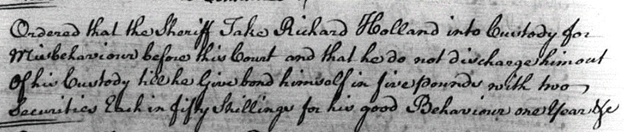
Richard Holland did not remain in custody long. At same court session, he appeared with his securities Nathaniel Anderson and George Gibson and acknowledged themselves indebted to “our Sovereign Lord the King, his Heirs and Successors” in the amount of £5 for Holland and 50 shillings for Anderson and Gibson “if the said Richard Holland should not be of the good behavior one year &c.”[45]
Richard Holland appears on tithe lists for Trinty Parish in Louisa County in both 1770 with 4 tithables [himself and Nan, Hannah, Margaret] and no acreage[46] and in 1771 with 5 tithables [unnamed] and no acreage.[47]
On 9 March 1773, the Pleasants case was continued by mutual consent.[48] The continuation did not last long as on 12 April 1773, defendant Robert Donald, the agent of Cochran & Co. filed a motion with the Court to hear the case. Richard Holland, through is attorneys objected, giving the following reasons: (1) the case is on the docket, (2) William Bowles an attorney for Holland was absent by sickness and (3) Bowles had material papers relating to this cause in his possession. The court overruled the motion for delay noting that Bowles had not appeared in eight months and that Holland offered no proof such papers were in his possession. After a few more objections that were all denied the court decreed that Holland was to pay Cochran & Co. £453.7.6 with interest from 5 October 1768 until paid plus their costs to bring the suit. The court also ordered Holland to pay Pleasants £74.12.11 ½ with interest from 1 August 1763 and his costs. The court ordered that all of the Holland’s mortgaged property was to be sold and the money from the sale used to pay deft Donald first and then Pleasants. Holland “prays leave to appeal to the General Court which is granted on giving bond.”[49]
In another case from April 1773 styled John Jones vs. Richard Holland, the court awarded Jones £3.6 with interest from the 10 July 1768 plus seven shillings and six pence and 62 pounds of net tobacco and his costs to bring the suit.[50]
On 10 May 1773 Holland’s attorneys for the Pleasants suit moved for a rehearing and to have time to depose witnesses. While the plaintiff and the other defendant objected, the court granted the motion. They further ordered that an accounting of the debts be made and returned to the next court and that Richard Holland agreed to be barred from any appeal or writ of error unless the said Thomas Pleasants refuses to settle.[51] On 14 June 1773 the case was continued on the defendant’s motion and was set to be tried on the first day of next court.[52]
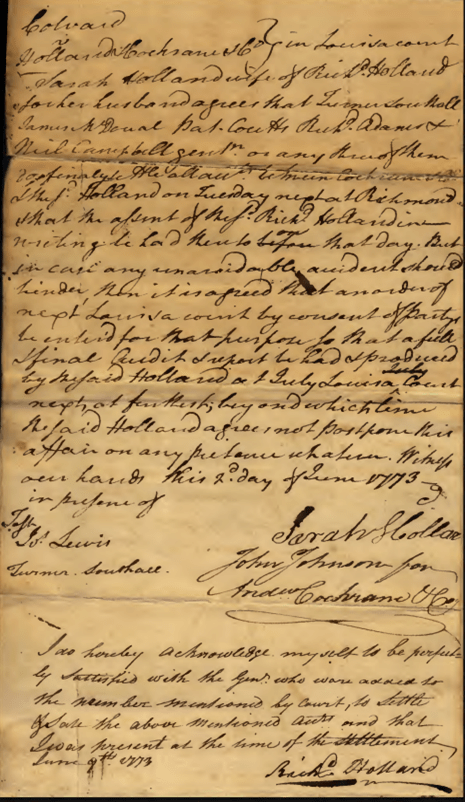
On 11 October 1773, the parties and their attorneys appeared, and the Court having heard the bill answer and sundry exhibits read, “ordered and decreed that the lands, Negroes, goods and chattles mortgaged by the Defendant Richard Holland to the Defendants Andrew Cochran &Co. be sold agreeable to the Law by the Sheriff of this County.” They further ordered that that the money arising from the sale be first applied toward discharging the debt owed to Andrew Cochran &Co. amounting to £343.3.8 ½ with interest and costs and that the balance [if any] be applied towards the payment to Pleasants of £74.12.11 ½ with interest from 1 August 1762 and his costs unless Richard Holland paid the “several sums of money with interest and cost aforesaid on or before the next Court to be held for this County in November next.” [53]
Finally, at Louisa Co Court 10 January 1774, William Duval, attorney for Cockran & Co. moved to have Gentlemen appointed to sell the estate of Richard Holland agreeable to the former decree. The Court noted that “as it appears that the slaves were carried out of this colony and that some of them are brought back to Henrico County it is ordered and decreed that Patrick Coutts, James Buchanan, Turner Southhall, Archibald Bruce and William Henderson or any three of them sell and dispose of the slaves to satisfy their Mortgage agreeable to the former decree and make report to the Court &c.”[54]
While the Pleasants case lasted six years, it has taken Andrew Cochran & Company more than two decades to get their money. While one might tend to feel some sympathy for the Hollands, it was the people they enslaved who bore the brunt. To be mortgaged meant working for a creditor or being hired out annually. This meant separation from family and constant instability as they toiled in tobacco fields.
Next time – The Aftermath – for the Hollands and the people they enslaved.
[1] McDonald, Edgar. A Merchant’s Account Book: Hanover County, Virginia 1743-1744, Virginia Genealogical Society Quarterly [Magazine of Virginia Genealogy], Vol. 35, No. 4, p. 340; Ancestry.com
[2] Will of Michael Holland. Goochland County, Virginia Wills and Deeds No.5, 1745-1749, p. 222-224; https://www.familysearch.org/ark:/61903/3:1:3QSQ-G9P6-9SF9?i=417&cat=406600; accessed 14 June 2023
[3] Virginia Memory, Library of Virginia, Louisa County, Virginia Chancery Suit 1773-010; https://www.lva.virginia.gov/chancery/case_detail.asp?CFN=109-1773-010
[4] Deed dated 2 April 1747 & recorded 28 April 1747. Louisa County, Virginia Deed Book A, p. 274; https://www.familysearch.org/ark:/61903/3:1:3Q9M-CS42-433L-K?i=149&cat=281398; accessed 25 June 2023
[5] Henrico County, Virginia Deeds, Wills, Etc. 1750-1767, Part 1, p. 118; https://www.familysearch.org/ark:/61903/3:1:3QS7-L9P6-S89Y?i=96&cat=397197; accessed 26 May 2023
[6] Henrico County, Virginia Deeds, Wills, Etc. 1750-1767, Part 1, p. 116; https://www.familysearch.org/ark:/61903/3:1:3QS7-L9P6-S89B?i=95&cat=397197; accessed 26 May 2023
[7] Virginia Memory, Library of Virginia; Chancery Records Index; https://www.lva.virginia.gov/chancery/
[8] Virginia Memory, Library of Virginia, Louisa County Chancery Suit, 1773-010 https://www.lva.virginia.gov/chancery/case_detail.asp?CFN=109-1773-010
[9] Henrico County, Virginia Deeds, Wills, Etc. 1750-1767, Part 1, p. 233; https://www.familysearch.org/ark:/61903/3:1:3QS7-L9P6-SZBD?i=154&cat=397197; accessed 27 May 2023
[10] Pleasants vs. Holland, Louisa County, Virginia Chancery Court, 1773-010, Virginia Memory, Library of Virginia; Image 4 of 56, https://www.lva.virginia.gov/chancery/full_case_detail.asp?CFN=109-1773-010#img
[11] Henrico County, Virginia Deeds, Wills, Etc. 1750-1767, Part 1, p. 289; https://www.familysearch.org/ark:/61903/3:1:3QS7-L9P6-SZTS?i=188&cat=397197; accessed 27 May 2023
[12] Henrico County, Virginia Deeds, Wills, Etc. 1750-1767, Part 1, p. 307; https://www.familysearch.org/ark:/61903/3:1:3QS7-L9P6-SZRZ?i=197&cat=397197 ; accessed 27 May 2023
[13] Pleasants vs. Holland, Louisa County, Virginia Chancery Court, 1773-010, Virginia Memory, Library of Virginia; Image 4 of 56, https://www.lva.virginia.gov/chancery/full_case_detail.asp?CFN=109-1773-010#img
[14] Henrico County, Virginia Deeds, Wills, Etc. 1750-1767, Part 1, p. 399; https://www.familysearch.org/ark:/61903/3:1:3QS7-L9P6-SZG7?i=243&cat=397197 ; accessed 27 May 2023
[15] Pleasants vs. Holland, Louisa County, Virginia Chancery Court, 1773-010, Virginia Memory, Library of Virginia; Image 21 of 56, https://www.lva.virginia.gov/chancery/full_case_detail.asp?CFN=109-1773-010#img
[16] Land Office Patents No. 32, 1752-1756 (v.1 & 2 p.1-715), p. 401 (Reel 30), Library of Virginia
[17] Henrico County, Virginia Court Orders 1755-1762, p. 4; https://www.familysearch.org/ark:/61903/3:1:3Q9M-CS46-SF6L?i=261&cat=361766; accessed 8 August 2023
[18] Pleasants vs. Holland, Louisa County, Virginia Chancery Court, 1773-010, Virginia Memory, Library of Virginia; Image 40 of 56; https://www.lva.virginia.gov/chancery/full_case_detail.asp?CFN=109-1773-010#img
[19] Henrico County, Virginia Deeds, Wills, Etc. 1750-1767, Part 2, p. 522; https://www.familysearch.org/ark:/61903/3:1:3QS7-L9P6-SZNR?i=314&cat=397197; accessed 27 May 2023
[20] Pleasants vs. Holland, Louisa County, Virginia Chancery Court, 1773-010, Virginia Memory, Library of Virginia; Image 53 of 56; https://www.lva.virginia.gov/chancery/full_case_detail.asp?CFN=109-1773-010#img
[21] Henrico County Orders 1755-1762, p. 404; https://www.familysearch.org/ark:/61903/3:1:3Q9M-CS46-SFTC?i=459&cat=361766; accessed 8 August 2023
[22] Henrico County Orders 1755-1762, p. 433; https://www.familysearch.org/ark:/61903/3:1:3Q9M-CS46-SF5X?i=473&cat=361766; accessed 8 August 2023
[23] Henrico County Orders 1755-1762, p. 455; https://www.familysearch.org/ark:/61903/3:1:3Q9M-CS46-SFY2?i=484&cat=361766; accessed 8 August 2023
[24] Henrico County Orders 1755-1762, p. 471; https://www.familysearch.org/ark:/61903/3:1:3Q9M-CS46-SFT5?i=492&cat=361766; accessed 8 August 2023
[25] Henrico County Orders 1755-1762, p. 551; https://www.familysearch.org/ark:/61903/3:1:3Q9M-CS46-SFT2?i=532&cat=361766; accessed 8 August 2023
[26] Scire facias – https://legal-dictionary.thefreedictionary.com/scire+facias
[27] Henrico County Orders 1755-1762, p. 570; https://www.familysearch.org/ark:/61903/3:1:3Q9M-CS46-SFKP?i=542&cat=361766; accessed 8 August 2023
[28] Henrico County Orders 1755-1762, p. 506; https://www.familysearch.org/ark:/61903/3:1:3Q9M-CS46-SFBK?i=510&cat=361766; accessed 8 August 2023
[29] Louisa County, Virginia Court Order Book 1766-1772, p. 118; https://www.familysearch.org/ark:/61903/3:1:3Q9M-CSY6-PYGN?i=85&cat=400438; accessed 25 June 2023
[30] Louisa County, Virginia Court Order Book 1766-1772, p. 214; https://www.familysearch.org/ark:/61903/3:1:3Q9M-CSY6-PBK4?i=133&cat=400438 ; accessed 25 June 2023
[31] Williams, Kathleen Booth. Marriages of Louisa County, Virginia 1766-1815, (Harrisonburg, VA: C. J. Carrier Company, 1977), p. 55
[32] Joseph Hughes Estate File, Rowan County, North Carolina, 1793, https://www.familysearch.org/ark:/61903/1:1:VH6F-S27; Mary Hughes Estate File, 1794, https://www.familysearch.org/ark:/61903/1:1:VH6F-S2W; accessed 15 August 2023
[33] Louisa County, Virginia Court Order Book 1766-1772, p. 139; https://www.familysearch.org/ark:/61903/3:1:3Q9M-CSY6-PYF4?i=95&cat=400438; accessed 25 June 2023
[34] Pleasants vs. Holland, Louisa County, Virginia Chancery Court, 1773-010, Virginia Memory, Library of Virginia; Image 30 of 56; https://www.lva.virginia.gov/chancery/full_case_detail.asp?CFN=109-1773-010#img
[35] Louisa County, Virginia Court Order Book 1766-1772, p. 166; https://www.familysearch.org/ark:/61903/3:1:3Q9M-CSY6-PYHB?i=109&cat=400438; accessed 25 June 2023
[36] Louisa County, Virginia Court Order Book 1766-1772, p. 230; https://www.familysearch.org/ark:/61903/3:1:3Q9M-CSY6-PB2H?i=141&cat=400438 ; accessed 25 June 2023
[37] Louisa County, Virginia Court Order Book 1766-1772, p. 293; https://www.familysearch.org/ark:/61903/3:1:3Q9M-CSY6-PBJL?i=172&cat=400438; accessed 25 June 2023
[38] Louisa County, Virginia Court Order Book 1766-1772, p. 325; https://www.familysearch.org/ark:/61903/3:1:3Q9M-CSY6-PB29?i=188&cat=400438 ; accessed 25 June 2023
[39] Louisa County, Virginia Court Order Book 1766-1772, p. 220; https://www.familysearch.org/ark:/61903/3:1:3Q9M-CSY6-PB2Q?i=136&cat=400438 ; accessed 25 June 2023
[40] Pleasants vs. Holland, Louisa County, Virginia Chancery Court, 1773-010, Virginia Memory, Library of Virginia; Image 36 of 56; https://www.lva.virginia.gov/chancery/full_case_detail.asp?CFN=109-1773-010#img
[41] Davis, Rosalie Edith. Louisa County, Virginia Tithables and Census 1743-1785 (Manchester, Missouri: Rosalie Edith Davis, 1988), p. 13
[42] Davis, Rosalie Edith. Fredericksville Parish Vestry Book 1742-1787 (Manchester, Missouri: Rosalie Edith Davis, 1978) p. 92
[43] Virginia Memory, Library of Virginia, Louisa County, Virginia Chancery Suit 1773-010; https://www.lva.virginia.gov/chancery/case_detail.asp?CFN=109-1773-010
[44] Louisa County, Virginia Order Book 1766-1772, p. 430; https://www.familysearch.org/ark:/61903/3:1:3Q9M-CSY6-PB69?i=241&cat=400438 ; accessed 25 June 2023
[45] Louisa County, Virginia Order Book 1766-1772, p. 431; https://www.familysearch.org/ark:/61903/3:1:3Q9M-CSY6-PB69?i=241&cat=400438 ; accessed 25 June 2023
[46] Davis, Rosalie Edith. Louisa County, Virginia Tithables and Census 1743-1785 (Manchester, Missouri: Rosalie Edith Davis, 1988), p. 15
[47] Davis, Rosalie Edith. Louisa County, Virginia Tithables and Census 1743-1785 (Manchester, Missouri: Rosalie Edith Davis, 1988), p. 21
[48] Louisa Count, Virginia Court Orders 1773, p. 17; https://www.familysearch.org/ark:/61903/3:1:3Q9M-CSY6-PBZ4?i=330&cat=400438; accessed 25 June 2023
[49] Louisa Count, Virginia Court Orders 1773, p. 23; https://www.familysearch.org/ark:/61903/3:1:3Q9M-CSY6-PBZV?i=333&cat=400438 ; accessed 25 June 2023
[50] Sparacio, Ruth and Sam. Louisa County, Virginia, Orders 1766/1774 (McLean, VA: Ancient Press, 1999), p.21
[51] Louisa Count, Virginia Court Orders 1773, p. 37; https://www.familysearch.org/ark:/61903/3:1:3Q9M-CSY6-PBJS?i=340&cat=400438 ; accessed 25 June 2023
[52] Louisa Count, Virginia Court Orders 1773, p. 46; https://www.familysearch.org/ark:/61903/3:1:3Q9M-CSY6-PBQC?i=345&cat=400438; accessed 25 June 2023
[53] Louisa Count, Virginia Court Orders 1773, p. 69; https://www.familysearch.org/ark:/61903/3:1:3Q9M-CSY6-PB7S?i=356&cat=400438; accessed 25 June 2023
[54] Sparacio, Ruth and Sam. Louisa County, Virginia, Orders 1766/1774 (McLean, VA: Ancient Press, 1999), p.87
 A Son of Virginia
Hello Steve, I stumbled across your blog while doing further research on my 6th-g-grandfathers Michael Holland and Charles Hudson and couldn’t believe all the research and details you have provided. Well done! My great aunt researched and compiled a family genealogy book in the 1980’s that got me started in family history which included our Holland line. She included wills for Michael, his son Richard and Richard’s son Dick (which was in the Revolution). My line continues through Dick’s son John Holland (1796-1855) and Elizabeth Wooldridge (1801-1841) then to their daughter Mary Susan Holland. Unfortunately as you know the Hollands before Michael both online and in books are speculative at best back to Gabriel Holland coming over on the ship Supply. She made the same mistake referencing available books at the time. I am only partly through your blogs and didn’t know if you had further info on Charles Hudson’s wife Sarah? Online info has her as Sarah Ann Royall but as most online posts I’m cautious. Thanks again for all the countless hours of research you have done and sharing it with others. Ken Haynes, Myersville, MD
LikeLike
Hi Ken, thanks for writing. My four-part series in Richard and Sarah (Hudson) Holland ends with John Holland out in Missouri. I descend from Dick Holland’s daughter Nancy who married John Morris of Buckingham County. John’s brother Henry Walker Holland married Sarah Morris (John’s sister). As to Charles Hudson – I’m pretty sure he was the immigrant – I’m working on a post about him now. As to his wife being Sarah Ann Royal – I don’t think so. On 13 September 1715 – Charles Hudson & Mary his wife of Charles City County, to John Witt and William Witt of same, for £10, 300 acres on a fork of Tuckahoe Creek, bounded by the southern branch and John Bradley. Signed Charles Hudson, Mary Hudson. Recorded 3 October 1715. This is the only record mentioning a wife I have ever found. In fact, I’ve never seen any evidence of the existence of Sarah Ann Royal. Her parents are supposed to have been Joseph Royal III and Mary (——-) widow of George Archer. Some have said she was Mary Eppes daughter of Francis and Elizabeth Littlebury Eppes, but their daughter Mary married John Hardiman so clearly not right. I wish we were descended from Joseph Royal, but thus far I don’t see it. Glad you are enjoying the blog. I have written several Holland posts. Thanks again for writing!
LikeLike
Hi Steve, Thanks for the quick response and clarifying the Sarah Ann Royal relation. I’m attaching of copy of a photo of John Holland my 3rd g-grandfathers and his daughter Mary Susan. Mary Susan went on to marry HHT Grill a German immigrant in Linneus, MO in 1847 then they fled the Civil War to Denver in 1863. Thanks, Ken
[cid:1cfdbb36-dece-47ee-a598-a919956c23e0] [cid:e86f76e5-f8c4-4f7c-b816-2deb7eba2b88]
LikeLike