
Have you ever wondered about how your ancestors celebrated the Fourth of July? Well, these celebrations have been held from the earliest days of our republic. In fact, the Virginia Gazette reported on 18 July 1777 that in Philadelphia on 4 July, “the anniversary of the Independence of the United States of America was celebrated in this city with demonstrations of joy and festivity.”[1] And this was only a year into the Revolutionary War!
While these public gatherings were social occasions attended by both ladies and gentlemen, they were also political gatherings. This is often evident in the toasts offered, which were generally of two types. The first were offered by the elected officers of the day and/or an event committee appointed for that purpose. These were typically patriotic and politically benign.
Then there were the volunteer toasts, which is where things can get interesting for genealogists and family historians. Volunteer toasts may shine a light on what an ancestor and/or what a community was concerned about and arguing about at any particular time in history. What, you thought our current political climate is unique? Ha! Our ancestors have been arguing about what this country ought to be and what role government should play since the very beginning. That, my friends, is the beauty of a self-governing republic.
The following two accounts of Fourth of July celebrations include toasts made by two of my ancestors. The first account is from Buckingham County in 1831 where my 4X great grandfather John Morris (1779-c.1862) attended a celebration of the country’s 55th anniversary and made a toast to the Hero of [New] Orleans [Andrew Jackson]. John Morris was a Buckingham County Justice of the Peace for many years and also served as Buckingham County Sheriff. The second is from Amelia County in 1833 where my 5X great grandfather Rodophil Jeter (c.1765-1843) made a toast to the American people. Rodophil Jeter represented Amelia County in the Virginia House of Delegates for multiple terms and also was an Amelia County Justice of the Peace and Sheriff.
Early 1830s Politics
Andrew Jackson was in his first term as President having been elected in 1828. He defeated John Quincy Adams in a rematch from 1824 where Jackson lost to Adams despite having won both the popular vote as well as the most electoral college votes. Since no candidate received the necessary votes to win, the election was decided by the U.S. House of Representatives who ultimately chose Adams. Another candidate, Henry Clay of Kentucky, was accused of supporting Adams in return for being appointed as Secretary of State – known to history as the “corrupt bargain.” As you might well imagine, the country was deeply divided. What were they arguing about? First and foremost, they argued about proper interpretation of the U.S. Constitution and the respective roles of the federal and state government. Sound familiar?
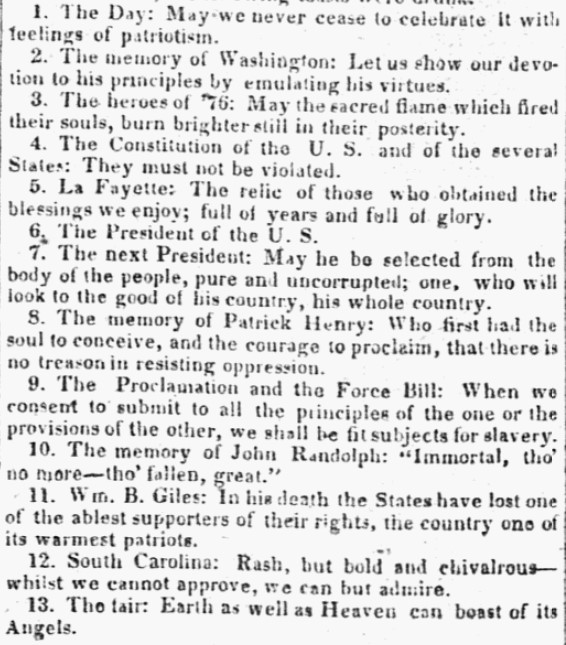
Among the issues of national importance in these accounts aside from federal and state elections, were internal improvements – specifically whether or not the federal government should be involved in overseeing and paying for the infrastructure improvements of the day. Also mentioned is the American Colonization Society, which was founded to remove free black people from the United States to Africa. While the abolitionist movement had been around since colonial era, it changed considerably in the late 1820s to early 1830s when it stopped advocating for removal in favor of immediate freedom and assimilation. A toast to South Carolina references the 1832-33 Nullification Crisis when South Carolina declared federal tariffs to be unconstitutional and as such void within the state prompting President Jackson to threaten to send U.S. troops to South Carolina to enforce federal law. Jackson’s Vice President was John C. Calhoun of South Carolina who resigned to defend South Carolina on nullification. A compromise was reached to avoid the fight [e.g., they kicked the can down the road].
July 4th 1831 – Buckingham Courthouse, Buckingham County, Virginia
The crowd assembled at the Courthouse and elected their only surviving Revolutionary War soldier Maj. David Patteson as President and Dr. J. S. Mills as Vice President. After they enjoyed a “barbacue,” toasts prepared by a committee were offered:

Then came the 29 volunteer toasts, which included a couple of speakers on the front end:
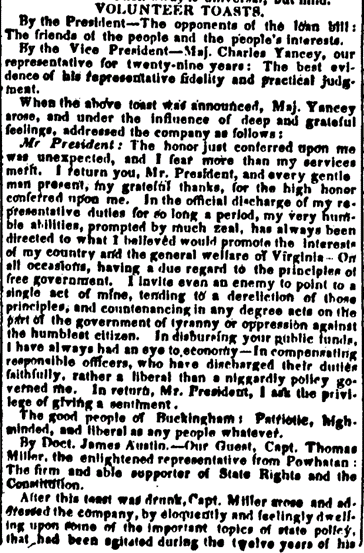
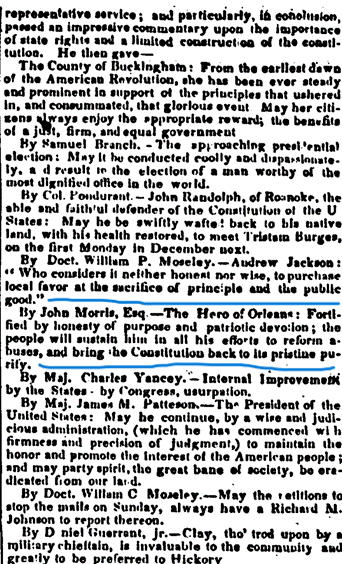
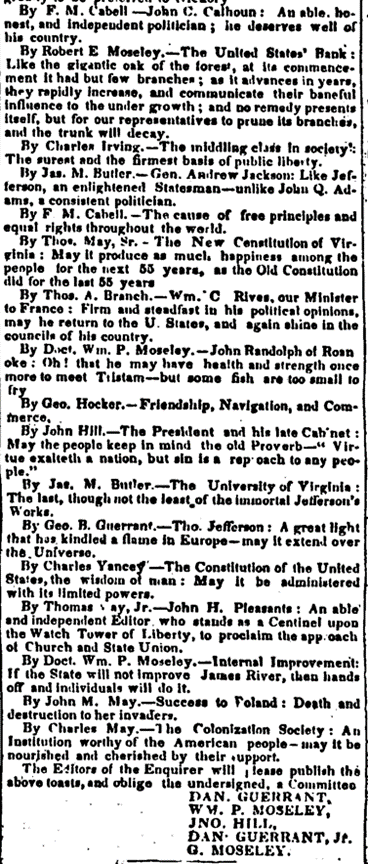
July 4th 1833 – Chinquepin Church, Amelia County, Virginia
On 12 July 1833, an article appeared in the Richmond Enquirer[2] concerning a 4th of July celebration in Amelia County, Virginia. The article begins, “A number of the citizens of Amelia, together with a portion of their fellow citizens from the adjacent counties of Cumberland and Prince Edward, assembled at Chinquepin Church in the county of Amelia, on the 4th of July, and celebrated the day with great spirit and hilarity.” As was often the case, a military parade was included and it was “Capt. John W. Baker’s company of Light Infantry Greys, in full uniform dash exhibiting an elegant and martial appearance. After marching the company to the church, where they were met by a numerous company of gentlemen and ladies, the Declaration of Independence was read in a clear and audible voice by Capt. George C. Moore of the Rifle corps, prefaced by appropriate remarks.”
Afterward, “the gentlemen and about 70 ladies assembled in the large two-story house occupied by Mr. Roberts, and with much glee enjoyed the music and the dance, and never were they enjoyed with better feeling or more zest.” One perhaps can imagine the scene in which “the mirth and hilarity of the young were soon imparted to the older part of the company, and made them forget their age and infirmities, and think themselves once more in the days of their youth.”
About 2 p.m. the crowd “sat down to a plentiful dinner, prepared by Mr. Roberts.” Let’s be honest here. Enslaved people supervised by Mrs. Roberts prepared that plentiful meal. Once the meal was over and “the ladies had returned to the dance” the “cloth was removed from the table.” Elected officers of the day included John T. Leigh, President and Capt. John F. Wiley, Vice President and the drinking of toasts began. The prepared toasts numbered 13:
Next came the 19 volunteer toasts from the crowd:
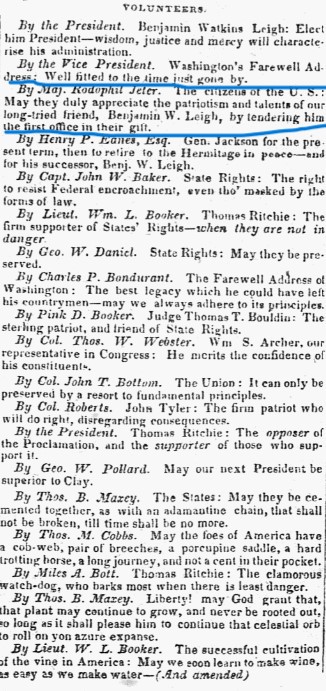
If my math is correct, there were 43 toasts drunk at the 1831 Buckingham County celebration and 32 toasts drunk at the 1833 Amelia County celebration. What have we learned about our ancestors? Aside from caring very much about the politics of the day, they liked to party. Take notice of the last toast by Lt. W. L. Booker – “To the successful cultivation of the vine in America: May we soon learn to make wine, as easy as we make water.” Cheers to All and Happy 247th Anniversary!
[1] Virginia Gazette, 18 July 1777, Williamsburg, Virginia, Issue 129, p. 2; www.genealogybank.com
[2] Richmond Enquirer, 12 July 1833, Richmond, Virginia, Vol. 30, Issue 19, p. 3; www.genealogybank.com
 A Son of Virginia
Fun read, for a moment there, I almost forgot my age and infirmities!
Happy Independence Day, y’all!
LikeLike