
If you missed Part 1 you can check it out here: https://asonofvirginia.blog/2023/06/20/michael-holland-of-hanover-and-goochland-counties-virginia-my-7x-great-grandfather-part-1/
Despite catastrophic records loss in Hanover County, Michael Holland left a sizeable paper trail because he owned acreage in several counties. In all, I found 60 patents, petitions and deeds from 1724-1746 where Michael Holland was a grantee or grantor. I am attaching these as an Appendix rather than covering them all in this post. Here I am going to cover some highlights to provide a sense of the economic path of his life as well as to convey relevant family history/genealogical information.
Michael Holland emerges in a changing and growing Colony
Michael Holland is in the Virginia records from 1711 to1746. By the time he received his first patents in 1724, the headrights system had given way to a patent system just as indentured servitude had given way to racial based enslavement. As such, Michael Holland did not get land for transporting people into the colonies. He paid 5 shillings per 50 acres.[1] It was not without obligation – the patentee was required to pay an annual quitrent [tax] and the cultivate and improve the land. You could lose the patent for failure to meet this obligation and the land could be patented by someone else.
Virginia’s population was also changing. In 1710, just before Michael Holland enters the Virginia record the English and African population was just over 78,000 (55,163 white; 23,118 black). In 1750, shortly after his death, it was just over 231,000 (129,581 white; 101,452 black).[2] While the white population grew by 134% from 1710-1750, the black population dramatically increased by 985% over the same period. This is another indicator that indentured servitude and given way to racial based enslavement.
As Virginia born English children reached adulthood they needed new lands as did an influx of new colonists. Tobacco cultivation wore out the soil which also created demand for new land. Inevitably, the boundary of English civilization continued to expand outward in all directions along Virginia’s rivers and creeks. In 1703 Virginia had 25 counties and had not moved inland much beyond the fall lines on the major rivers and their tributaries. By 1750, Virginia had 44 counties and settlement had extended to the Blue ridge. Patents for new lands were readily available and Michael Holland took advantage of the opportunities presented to him.

Michael Holland expands his land holdings
St. Paul’s Parish processioning records indicate Michael Holland owned unspecified acreage in Hanover County from 1711. In 1724 he patented 800 acres [two 400 acre tracts] in Henrico County on the south side of Chickahominy Swamp,[4] which he sold to Roger Thompson in 1728.[5] Interestingly, no waiver of dower rights was included. A dower right generally entitled a widow to retain use of [not ownership of ] one-third of her husband’s real and personal estate for her life or widowhood. It is unusual that a buyer would have accepted a deed without the dower waiver due to the potential of a future legal challenge.
His wife Judith (———-) Holland first enters the Virginia record in February 1729/30 when she waived her dower rights for a deed between her husband and Henry Chiles whereby Holland mortgaged 400 acres in Goochland on Lickinghole Creek to secure a £132 debt he owed Chiles.[6] The deed was void if the debt was paid by a date certain, if not the land sold to pay the debt.
Did Michael Holland marry Judith ———- between 1725/6 and 1729/30? Michael Holland had children before 1725, which would make Judith a second [or beyond] wife. Surprisingly, in 16 of 20 deeds where Michael Holland is the seller between 1725-1746, there is no dower waiver. Judith waives dower so just four occasions from 1729-1736. Is Judith the mother of all of Michael Holland’s children?
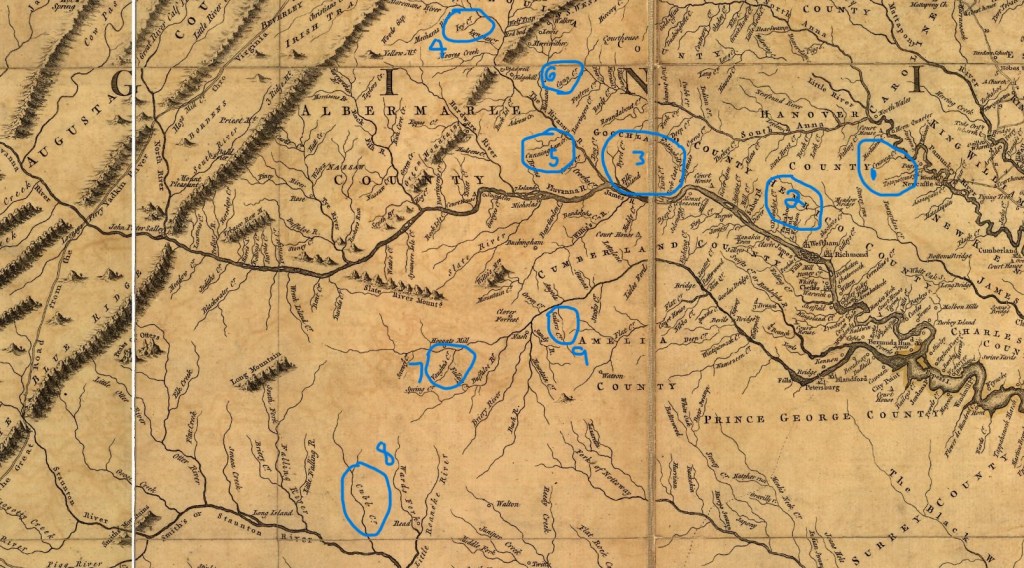
In the late 1720’s Michael Holland’s land acquisitions began in earnest. From 1727-1736 he received patents or had petitions granted for more than 35,000 acres. It began with seven patents in 1727 by which he received 2,471 acres in Henrico County concentrated on the south side of Chickahominy Swamp on Meredith’s Branch and on Lickinghole Creek. The latter fell into Goochland County when it formed in 1728. In February 1727/8, he received 2,000 acres in Hanover County and now owned 4,471 acres in two counties. Over the next seven years, Michael Holland acquired another 31,364 acres by way of 14 patents or petitions. He continued to focus on Goochland County adding another 19,330+ acres [Lickinghole Creek/Byrd Creek 15,000+ acres] and Cunningham Creek [1,600 acres] as well as on Ivy Creek south of the Rivanna River [4,300+]. He added acreage in Hanover County [5,600+] as well as in Henrico County [3,050] on Meredith’s Branch.
During that same period Michael Holland was a party to 12 deeds – two as buyer and 10 as seller. He sold two 400 acre tracts in Goochland on Lickinghole Creek. He sold 10 tracts including 1,100 acres in Henrico in three tracts, 1,775 acres in Goochland County in five tracts and 170 acres in Hanover County in two tracts. In a deed dated and recorded 21 January 1734/5, Michael Holland sold his son John Holland for £100, 400 acres on Lickinghole Creek in Goochland County.[7]
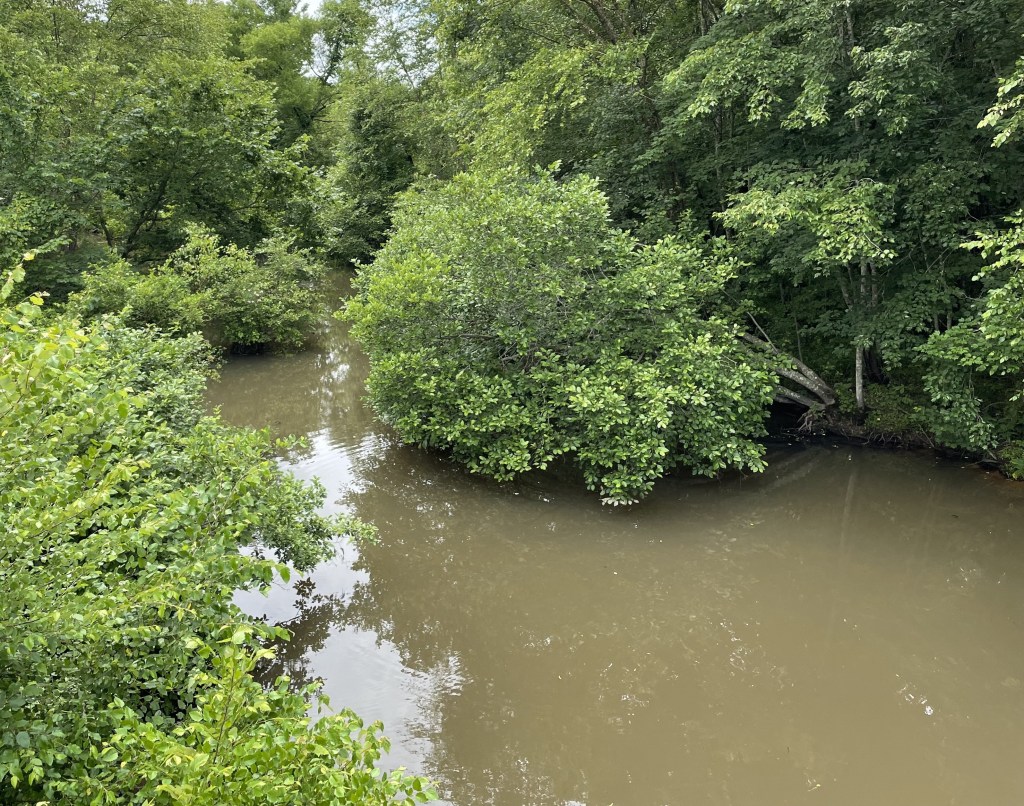
From 1738 to 1746, he received nine more patents. First in 1738, he received three patents totaling 4,630 acres including 2,630 acres in newly created Amelia County. The other tracts were in Hanover County and included 1,200 acres “on the county line” and 800 acres on Camp Creek [Louisa County from 1742]. In 1740, he received three Hanover County patents for 400 acres each. One was on Owens Creek in what became Louisa County in 1742. Two tracts were described as “on the west side of the Little Mountains,” which fell into Louisa and then Albemarle County in 1761. His last three patents included two in 1743 [400 acres in Hanover County on Cuffey’s Creek [Louisa from 1742], 300 acres in Amelia County on the “lower side of the little Saylors Creek.” and finally one in March 1744/5 for 4,753 acres in Goochland County [388 new acres and a repatent of 4,365 acres].
Michael Holland was a buyer or seller in 14 deeds from 1738 to 1746. He bought 400 acres in Louisa County [Albemarle from 1761] in 1743 and he bought 200 acres in Goochland County adjacent to his own land on Lickinghole Creek in 1745. He sold 2,322 acres in Goochland County and 800 in Louisa County. In 1744, he gave his son Michael Holland, Jr. “for love and affection” a 400 acre tract in Goochland on Lickinghole Creek.[8] Apparently, this tract was not to Michael Jr’s. liking so he sold it to his brother John Holland the following year for £100.[9] He then bought another 400 acre tract from his father for £100 and also on Lickinghole Creek – adjacent to his brother John Holland.[10] Michael Holland, Sr. also sold two tracts to his son-in-law Henry Martin who was married to his daughter Judith Holland. Both were in 1745 for land in Goochland (130 and 522 acres).[11],[12] The latter 522 acre tract was gifted to Henry Martin in Michael Holland’s 1746 will.
In all, Michael Holland patented and had petitions granted for more than 43,500 acres. After deducting for land sales, he owned more than 38,000 acres including 8,668 in Hanover, 3,921 in Henrico, 18,195 in Goochland, 5,000 in Louisa, and 2,930 in Amelia. The total is probably higher as it doesn’t count any Hanover County deeds outside of the few extant records from 1733-1735.

The Hollands move to Goochland County
As noted in Part 1, Michael Holland is regularly referred as “of Hanover” in deeds until 30 August 1745 when he is styled “of Goochland.” In a deed dated & recorded 19 May 1752, Henry Martin & Pouncey Anderson, executors of Michael Holland, sold David Massie of Goochland [husband of their sister-in-law Ann Holland], for £128.14, 591 acres “among the branches of the Little Byrd & Lickinghole Creeks, bounded by Thomas Craddock, Thomas Massie’s line [married to Susannah Holland], John Sandland, a branch of Lickinghole and Little Lickinghole Creek. Land Whereon Captain Michael Holland lived & died & is part of 3,360 acres granted said Holland by patent 11 April 1732.”[13]
The Last Wills and Testaments of Michael and Judith Holland
I do not know what prompted Michael and Judith’s move to Goochland after having been in Hanover for 35 years. Perhaps it was the pull of family and they wanted to be closer to their children and grandchildren. Goochland was where he owned the most land and it was more central to his various plantations. In any event, Michael did not live there long making his will on 10 October 1746 and dying by 17 March 1746/7 when his will was recorded.[14]
Note: The death of an enslaver meant uncertainty and disruption for the enslaved, in particular with respect to separation from family. There are multiple examples in Michael Holland’s will, which I have highlighted and, in some cases, made comment.
Details of his bequests and directives are as follows:
His wife Judith (———-) Holland was given two 400 acre tracts in Louisa County that was currently being rented to a tenant farmer. It was hers to do with what she pleased. In fact, she sold it in two contiguous 400 acres tracts on 28 May 1751, about five years after her husband’s death.[15],[16] Michael Holland also lent Judith for her lifetime, 800 acres on Lickinghole Creek in Goochland County, “use of the stock of cattle and hogs and all of the household goods her own support” and “use, benefit, and profit of the labor of the six following negroes Frank, Pompy, Will, Nan, Dennis & Noell, which negroes after her decease I will, direct, and appoint to be sold by my Executors and the money equally divided between the children of my son John when they arrive at age or married.” I wonder if Frank, Pompy, Will, Nan, Dennis & Noell had any idea they were to be sold when Judith died?
His son John Holland was to receive the 800 acres after his wife’s death “with the two plantations thereon,” all the livestock and “a negro named Hager and her three children and Daniell.”
His son Michael Holland, Jr. received 400 acres in Louisa County and £50 current money to be paid eighteen months after his father’s death.
Pouncey Anderson, who was married to Michael’s daughter Elizabeth Holland, received 400 acres on Lickinghole Creek where Pouncey and Elizabeth were living as well as 500 adjacent acres. Michael Holland also gave Pouncey Anderson “two negroes which he now has in possession [named] Thom and David; likewise, I give him Hampshire and his wife called Judith and their two children Venus and Roger.” In my experience it is unusual that an enslaver recognized a family unit headed by an enslaved man.
His son Richard Holland received “a plantation lying in Louisa County which I bought of Ambrose Smith.” I found no deed for this. While the will does not provide the acreage, when Richard Holland sold the tract to John Dixon in 1747, it was described as 500 acres “on both sides of Beaver Creek in Louisa County left to him by his father’s will.”[17] Richard Holland also received “a plantation called Meredith’s Branch in Henrico County whereon he now lives containing 500 acres” and “450 acres land I promised to give him joining thereto where William Webb formerly lived.” He also received “the following negroes, Harry, Nann, Robin, Sarah and two of her children and a negro boy called Jemmy and £50 current money to be paid eighteen months after my death.” Note that it does not read “Sarah and her two children,” rather it is “Sarah and two of her children.”

His son George Holland received 1,200 acres in Louisa County and another 500 acres “I promised said son on Lickinghole [Creek],” which was in Goochland County. His father also left George “the following slaves Mingo, Lucy and their two children Betty and Dilley, and a negro girl called Delph, and Jack and his wife called Peg.” George also received “two feather beds and furniture and all the other household goods which is on the said plantation whereon he now lives, likewise twenty head cattle and two horses named Spark and Jack and one half the hoggs on the said plantation and two breeding mares.” His father added in his will, “All the above mentioned articles, land, slaves, stock and household goods and all other appurtenances here in mentioned I give to my son George in consideration of a promise given from under my hand to Mr. Wm. Ford which obliges me to give my said son £600 current money, it being on account of him marrying Mr. Wm. Fords daughter wherein the said Wm Ford obliges himself to give his daughter Sarah Ford two hundred pounds Current money.”
Henry Martin, who was married to Michael’s daughter Judith Holland, received 522 acres “on Lickinghole joyning the said Martins own land.” Henry Martin also received 50 acres in Hanover County “on the right side the road going down the county line and about half mile below the plantation whereon I lived.” Henry and Judith Martin also received enslaved men women and children named “Cook, Sue, Sarah and their [not a typo] child Sue, likewise a girl called Sue and a fellow named Bristoll” and noted they were already in Martin’s possession. It should probably read “Cook, Sarah and their child Sue.” Finally, Martin was to receive £50 current money to be paid eighteen months after Michael Holland’s death.
Michael and Judith Holland still had three underaged daughters at home. Their father left Ann, Susannah and Mercy Holland each £400, but directed that £200 be paid either when of age or married and £200 be paid two years after that. Michael Holland then directed that if any of the girls were to die before they come of age or marry, that their part of the money would be divided between the children of sons Michael and Richard Holland. Finally, to each of his daughters he willed an enslaved girl: “To my daughter Anne a negro girl named Nan, to my daughter Susanna a negro girl named Patt, to my daughter Mercy a negro girl named Lucy.” He appointed Henry Martin, Pouncey Anderson and Richard Holland as guardians for his three underage daughters.
Then he directed that “all the rest of my lands, Negro’s and Personall Estate not before mentioned, I will, direct and appoint to be sold by my Executors Henry Martin, Pouncey Anderson and Richard Holland and the money aplyed toward the payment of my debts and legacies and maintaining my daughters Ann, Susannah and Mercy. The residue when all the land Negro’s and personall Estate shall be sold to be equally divided among my sons John, Micheal, Richard and George and my daughters Eliz. Anderson and Judith Martin.”
Lastly, he gave grandson John Holland [son of John] 500 acres in Orange County. He also directed that his estate should not be appraised, which is a real shame because it would have been an interesting read.
Judith Holland’s will
Judith Holland outlived her husband by between five and six years. She made her will on 22 August 1751 and was dead by 19 November 1751 when it was recorded.[18] Her youngest daughter Mercy Holland was the chief benefactor of her small personal estate receiving “one horse named Dragon with my side saddle & bridle, one mare named Lightfoot & her increase, a horse colt belonging to my white mare with one feather bed & pillow, two blankitts, five sheets, six deep plaits, three basons, two dishes, one salt seller, six Sasers [saucers], fore teacups, twenty barrels of Indian corn with 26 hoggs & their increase.” Mercy Holland also received “20 yards of cloth which is now at Weavers.”
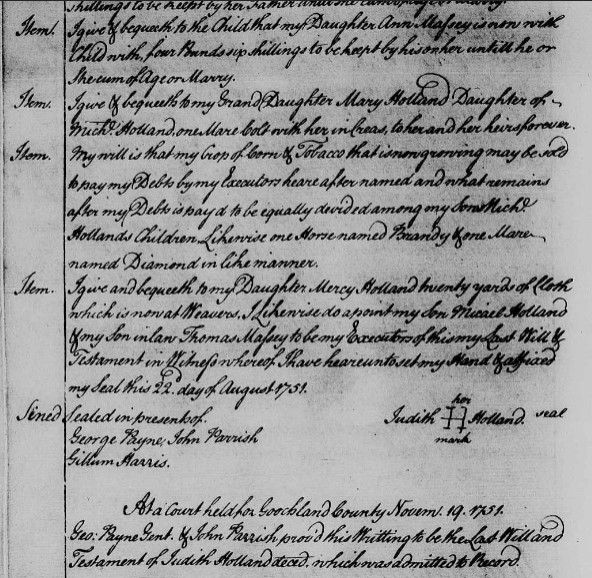
Judith also made bequests to four granddaughters and to one as yet unborn grandchild. Granddaughters Mary Massie, Jude Massie, Constance Massie and “the child my daughter Ann Massie is now with” each received £4.6 with the instruction “to be kept by his or her father until she comes of age or marries.” Daughter Ann was married to David Massie and their daughter was Constance Massie, while daughter Susannah was married to Thomas Massie [brother of David] and their daughters were Mary Massie and Jude [Judith no doubt] Massie. Judith Holland also made a bequest to “granddaughter Mary Holland, daughter of Michael Holland, one mare colt with her increase.”
Lastly, she directed “It is my will that my crop of corn & tobacco now growing may be sold to pay my debts by my Executors heareafter named and what remains after my Debts is payd to be equally divided among my son Michl Holland’s children. Likewise, one Horse named Brandy & one mare named Diamond in like manner.” She then appointed “my son Michael Holland & my son-in-law Thomas Massie to be my executors.”
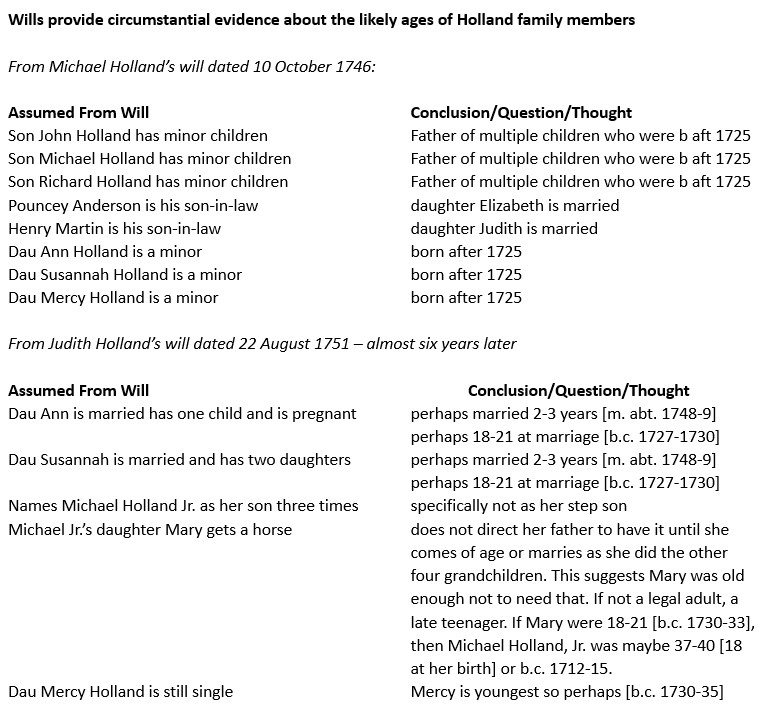
How old can Judith (———-) Holland have been if her daughters Ann, Susannah and Mercy were born 1727-1730? If Judith were 45 between 1730-1735 when her youngest child was born, she would have been born about 1685-1690.
I have attached a spreadsheet with all of the land transactions for Michael Holland I have found thus far:
Next time: Putting it all together: The family of Michael & Judith (———-) Holland – Part 3
We will end our series on Michael Holland with a brief biography of his children and reveal what those records have to say about Michael Holland’s origins, his and/or Judith’s ages [or their children’s ages] and whether he was married more than once.
[1] Library of Virginia. The Virginia Land Office, Research Note 20: https://www.lva.virginia.gov/public/guides/Research_Notes_20.pdf
[2] Historical Statistics of the United States, Colonial times to 1957; https://www2.census.gov/library/publications/1960/compendia/hist_stats_colonial-1957/hist_stats_colonial-1957-chZ.pdf
[3] Virginia County Formation Maps: https://homepages.rootsweb.com/~george/countyformations/virginiaformationmaps.html
[4] Land Office Patents No. 12, 1724-1726, p. 18-19 (Reel 11), Library of Virginia
[5] Henrico County, Virginia Deeds and Wills 1725 -1737, No. 1, Pt. 2, p. 176; https://www.familysearch.org/ark:/61903/3:1:3QS7-89P6-SLVC?i=274&cat=397197
[6] Goochland County, Virginia Wills & Deeds 1728-1734, p. 165; https://www.familysearch.org/ark:/61903/3:1:3QS7-99P6-9QVR?i=96&cat=406600
[7] Goochland County, Virginia Deed Book No. 2 1734-1736, p. 46; https://www.familysearch.org/ark:/61903/3:1:3QS7-99P6-9QCB?i=314&cat=406600
[8] Goochland County, Virginia Wills and Deeds No.4 1741-1745, p. 399; https://www.familysearch.org/ark:/61903/3:1:3QSQ-G9P6-9SLM?i=218&cat=406600
[9] Goochland County, Virginia Wills and Deeds No.5, 1745-1749, p. 17; https://www.familysearch.org/ark:/61903/3:1:3QSQ-G9P6-9SVF?i=314&cat=406600
[10] Goochland County, Virginia Wills and Deeds No.5, 1745-1749, p. 44; https://www.familysearch.org/ark:/61903/3:1:3QSQ-G9P6-9SVM?i=328&cat=406600
[11] Goochland County, Virginia Wills and Deeds No.5, 1745-1749, p. 36; https://www.familysearch.org/ark:/61903/3:1:3QSQ-G9P6-9SV8?i=324&cat=406600
[12] Goochland County, Virginia Wills and Deeds No.5, 1745-1749, p. 38; https://www.familysearch.org/ark:/61903/3:1:3QSQ-G9P6-9SJP?i=325&cat=406600
[13] Goochland County Deed Book with Wills, Inventories, Etc., No. 6 1748-1755, p. 197; https://www.familysearch.org/ark:/61903/3:1:3QS7-89P6-9VBF?i=116&cat=406600; accessed 14 June 2023
[14] Goochland County, Virginia Wills and Deeds No.5, 1745-1749, p. 222-224; https://www.familysearch.org/ark:/61903/3:1:3QSQ-G9P6-9SF9?i=417&cat=406600; accessed 14 June 2023
[15] Louisa County Deed Book A, p. 424; https://www.familysearch.org/ark:/61903/3:1:3Q9M-CS42-433C-B?i=227&cat=281398; accessed 25 June 2023
[16] Louisa County Deed Book A, p. 425; https://www.familysearch.org/ark:/61903/3:1:3Q9M-CS42-433C-B?i=227&cat=281398; accessed 25 June 2023
[17] Louisa County, Virginia Deed Book A, p. 274; https://www.familysearch.org/ark:/61903/3:1:3Q9M-CS42-433L-K?i=149&cat=281398; accessed 25 June 2023
[18] Goochland County, Virginia Wills and Deed, No. 6 1748-1755, p. 179; https://www.familysearch.org/ark:/61903/3:1:3QS7-89P6-9VBY?i=107; accessed 14 June 2023
 A Son of Virginia