
My 8x great-grandfather William Vaughan was the first of my line to arrive in Virginia, first appearing in the records of Charles City County, Virginia on 20 April 1658 when he was granted a nonsuit by the county court in a case against Francis Gray. No details and no outcome are provided.[1]
Nothing is known of William Vaughan’s origins. The Vaughan surname originated as a nickname of sorts. It is from the Welsh “fychan” or “bychan”, a diminutive of “bach” meaning little, which was used to distinguish the younger of two bearers of the same personal name. For example, “Guyn Vaghan ap Guyn” or “Gwyn the younger son of Gwyn.” This is also found as the modern Welsh surname “Baugh”, from “bach”, used as a nickname for a small or short man.[2] Whether he came from Wales or England and when he arrived in Virginia are unknown.

A New World Indeed
When William Vaughan shows up in the record, Virginia’s English population was about 27,000 – up from just over 10,000 twenty years earlier.[3] Charles City County was one of the original eight shires created in 1634, although settlement at “Charles Cittie” by the English goes back to 1619.[4] The county encompassed land on both sides of the James River – most of it being on the south side – and this was very much the English frontier (see map inset below).[5] Note the Blackwater Swamp underlined in red. The Treaty of 1646, which ended the third Anglo-Powhatan War, set a boundary for English settlement that included the Blackwater to the south and east. Land south of the Blackwater was reserved for the Indians.[6] We’ll see where this touches the Vaughans later in this post.
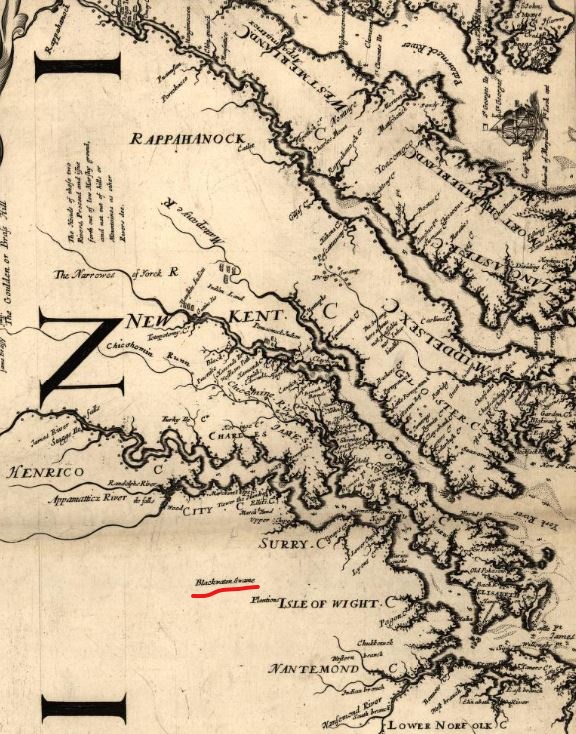
Charles City County has suffered what the Library of Virginia describes as “Catastrophic Loss” to its records noting that records were “destroyed at various times” Most of the damage occurred during the Civil War when records “were strewn through the woods in a rainstorm.”[7] Despite limited records, we are fortunate to have some good information about William Vaughan.
At a Charles City County court held on 13 October 1662, William Vaughan was among a list of several men receiving a bounty from the county of 100 pounds of tobacco for killing a wolf.[8] Bounties paid by counties for killing wolves was commonplace as they killed livestock.
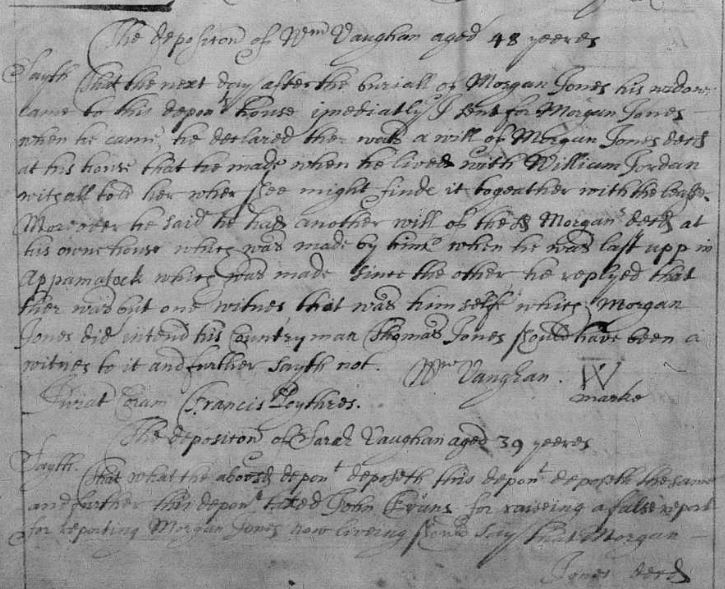
When I say “good” information here is an example. On 3 April 1673, William Vaughan and his wife Sarah Vaughan were deposed as witnesses in a court case in Charles City County and gave their ages as 48 and 39 respectively. Now we know his wife’s name and their approximate birth years, This would make William Vaughan’s birth year about 1625 and Sarah’s about 1634.[9]
William Vaughan’s Partnership with Samuel Johnson
Wasn’t everyone a tobacco farmer back then? Yes, and I am sure William Vaughan was one. But a series of court orders tell us William Vaughan was a also partner with Samuel Johnson in an undescribed venture. Johnson died about 1677 without a will and on 13 September administration of his estate was granted to Thomas Mudgett (who coincidentally (?) was a son-in-law of Francis Gray – the guy William Vaughan sued and then nonsuited in 1658).[10] On 3 December, William Vaughan petitioned the court to be the administrator in lieu of Mudgett, but the court rejected his request and ordered that an inventory be taken of Johnson’s estate and report to the next court.[11],[12] William Vaughan was back on court on 14 February 1677/8, but the inventory had not been completed so it was again referred to the next court.[13] On 3 June 1678, William Vaughan’s petition was granted and he was granted administration of the estate of Samuel Johnson being partner and greatest creditor.[14] No wonder he was so persistent! Unfortunately, I found nothing further on this. They owned no real estate together so I am left to wonder what sort of partnership they may have had.
William Vaughan patents land
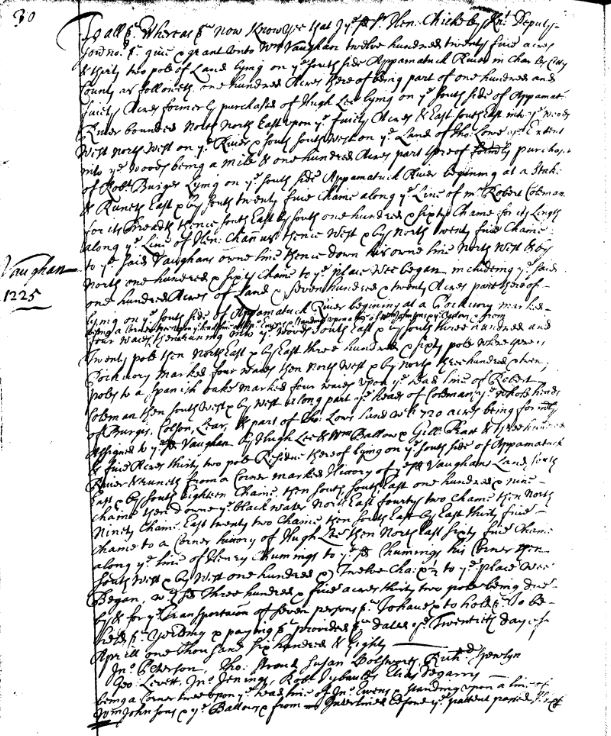
When William Vaughan bought his first tract of land is uncertain, but on 20 April 1680, he patented 1,225 acres and 32 poles [surveyors’ term – a pole equals 16 ½ feet – an acre is 160 square poles[15]] in Charles City County on the south side of the Appomattox River. This patent was for multiple tracts he had acquired over time.
The patent is available in its entirety below and on-line through the footnote. I encourage you to check it out and see what you can read! Most of the description is about poles in various directions and lots of references to trees as markers. My interest is in its general location rather than its shape, so I am looking for names of neighbors and bodies of water. Neighbors also often moved together and often ended up becoming in-laws. Who else were you going to meet living on a 1225-acre farm?
Back to William’s land – its bounds are described [in part] “100 acres . . . being part of 150 acres formerly purchased of Hugh Lee . . .north north west on ye River . . . adjacent land of Thomas Low . . . 100 aces formerly purchased of Robert Burgess . . .along the line of Robert Colman . . line of Hen: Chumings . . . Vaughan’s own line . . . 720 acres . . . line of Wm. Johnson’s . . . line of Robert Coleman . . . assigned to Vaughan by Hugh Lee, William Ballow & Gill: Pratt . . . Vaughan’s own land . . . south south east down ye Blackwater . . . Hugh Lee’s corner . . . Henry Chumings line . . . 305 acres and 32 poles for transportation of seven persons into the colony.[16] In 1688, Henry Alley received a grant for 390 acres in Charles City County “on the Northern main branch of ye Blackwater beginning at a corner black oak belonging to ye land of Willm Vaughan.”[17]
Where is this land today?
William Vaughan’s 1225 acres abutted both the Appomattox River and Northern Main Branch of the Blackwater (see map inset below] in present day Prince George County. The Blackwater River originates in a number of swamps at and just south of Petersburg, Virginia. It is called Blackwater Swamp as it flows southeast through Prince George County until it reaches the border between Surry County and Sussex County and becomes the Blackwater River. Near the Virginia – North Carolina border, the Blackwater River is joined by the Nottoway River, forming the Chowan River, which continues south to Albemarle Sound.[18]

Capturing a Runaway Servant
On 13 April 1688, William Vaughan, John Edwards and Drury Stith “doe each of them exhibitt a certificate for taking up a runaway which is ordered to be returned to ye assembly.”[20] The certificate mentioned references the law at the time and the paperwork necessary to receive a bounty for capturing a runaway indentured servant or enslaved person. It was worth 200 pounds of tobacco.[21] These certificates were required to include the name of the runaway, the name(s) of their master/mistress, the county where they lived, when the runaway was captured and the distance from their master/mistress’s plantation. The colonial government paid the bounty and the master/mistress were “assessed” the amount. Then the runaway had to work it off to repay the master/mistress – by extending their time of servitude.[22] It was a cruel world back then. Still is in a lot of places.
William Vaughan’s Last Will and Testament
William Vaughan made his will on 24 March 1692 and it was proven at Charles City Court on 14 June 1694 and probate was granted to his widow and executrix.[23] It names his wife Sarah, seven sons William, Richard, John, Samuel, Daniel, James and Nicholas and daughter Sarah. It also names grandchildren including four children of his son William: a boy named William who received a yet to be born horse and girls named Mary, Julia and Elizabeth who each received 10 pence for the purchase of a cow apiece. Nicholas Overby and William Overby, sons of Nicholas Overby, Jr. also each received 10 pence for the purchase of a cow apiece. While William does not refer to them as grandchildren, their father Nicholas Overby was surety for William Vaughan’s widow as executrix for his estate and was almost certainly a son-in-law married to daughter Sarah. It may be notable that she is referred to twice in her father’s will – by first name only.
This is an outstanding record to have! For most of my life this will was not known to exist. Researchers knew the names of William’s seven sons because they were all included in the 1704 quit rent census each owning 169 acres [1/7 of their father’s land] in Prince George County (formed out of Charles City County in 1703) and that was about it.
Then in 2016 a genealogical miracle occurred. Nearly 300 pages of Charles City County court records covering the 1694-1700 period were returned to Virginia by the Urbania family from Pennsylvania and New Jersey. The Richmond Times Dispatch (RTD) reported that the family’s grandfather bought the partial book (pp. 188-486) from an antiques dealer decades ago. The pages disappeared in August 1862 when Union soldiers ransacked the county courthouse during the Civil War. The RTD also noted that a 20 August 1862 New York Times article noted that Charles City County records “had been wantonly scattered in confusion about the premises, covering the floors and dooryards, and are almost wholly destroyed. A more impressive exhibition of the destructive effects of war could scarcely be imagined, than to see those old and cherished books of record and title papers scattered to the winds or trodden under foot.”[24]
As someone who has spent thousands of hours researching my family tree and my state’s history, I can’t tell you how many times I have been thwarted by human destruction of records, fires, floods, and the like. But once in a great while something amazing happens. You never know when an invaluable old record might just turn up! An image of the last page of his will and a complete transcription of the entire will follow.
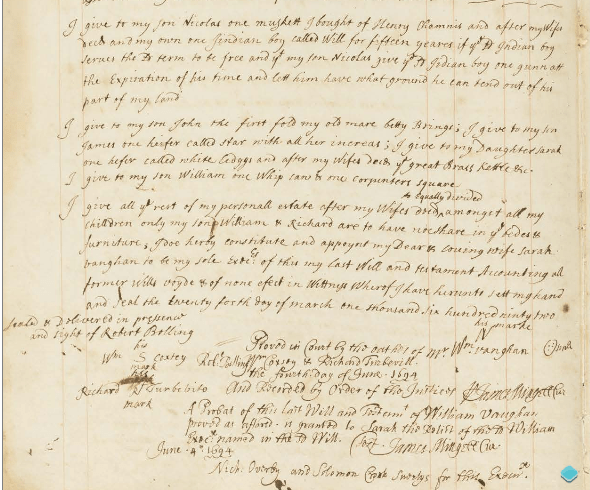
Transcription of William Vaughan’s will (using modern English/spelling for readability)
In the Name of God, Amen. I William Vaughan, Sr. of Charles City County in Virginia being weak of body but of Sound and perfect memory do make this my last Will and Testament in manner and form following utterly revoking all former Wills by me made.
I give and bequeath my soul to God that gave it me in sure confidence of a joyful resurrection to life eternal through the merits of my alone Savior Jesus Christ and my Body to be disposed of as shall seem meet to my Executor hereafter to be named.
Item. I give and bequeath all my land that I am possessed with to be equally divided amongst by seven sons, William, Richard, John, Samuel, Daniel, James and Nicholas Vaughan each son to have his part next and adjoining to the plantation they are seated on & my said land divided I give to my seven sons and their heirs forever.
[Item] I give to my son Samuel one mare called Rat with all her increase except the first mare filly she brings which filly (if any such) I give to my daughter Sarah.
[Item] I give to my son Nicholas one bay mare called Fanny with all her increase except the first mare filly she brings which filly I give William the son of my son William without her increase.
[Item] I give to Mary, Julia & Elizabeth three Daughters of my son William ten shillings each to be laid out to purchase each of the said girls one cow calf with all her increase; I give to Nicholas & William, sons of Nicholas Overby Jr. ten shilling each to purchase them one cow calf apiece; I give to my son Samuel one musket I bought of Mage Epes and one old gun commonly called Bess; I give to my [son] Daniel one [gun] which he always uses. I give to my son James one trading gun which he now uses and one gun called musqueran;
[Item] I give to my son Nicholas one musket I bought of Henry Chemnis [probably his neighbor Henry Chumings] and after my wife’s death and my own, one Indian boy called Will for fifteen years. If the said Indian boy serves the said term [he is] to be free and that my son Nicholas give the said Indian boy one gun at the expiration of his time and let him have what ground he can lend out of his part of my land.
[item] I give to my son John the first foal my old mare Betty brings; I give to my son James one heifer called Star with all her increase; I give to my daughter Sarah one heifer called White Legs and after my wife’s death the great brass kettle &etc.
[item] I give to my son William one whip saw & one carpenters square
[Item] I give all the rest of my personal estate after my wife’s death to be equally divided amongst all my children only my sons William & Richard are to have no share in the bed & furniture.
I do hereby constitute and appoint my dear & loving wife Sarah Vaughan to be my sole Executrix of this my last will and testament accounting all former wills void & of no effect in Witness Whereof I have hereunto set my hand and seal the twenty fourth day of March one thousand six hundred ninety two
Sealed & Delivered in presence
and sight of
Robert Bolling Wm. “V” Vaughan
Wm “S” Coxsey
Richard “R” Turbeville
Proved in Court by the oaths of Mr. Robt Bolling, Wm Coxsey & Richard Turbeville
this fourth day of June 1694 and Recorded by Order of the Justices. James Wingett
A Probate of this last Will and Testament of William Vaughan proved as aforesaid is granted to Sarah the Relict of the said William. Executrix named in the said will.
June 4, 1694 Test James Wingett
Nich. Overby and Solomon Crook Sureties for this Executrix.
One Indian Boy Called Will
I bolded the portions of the will that pertaining to Nicholas Vaughan from whom I descend. But I also wanted to point out the reference to William leaving Nicholas “one Indian boy called Will for fifteen years. If the said Indian boy serves the said term [he is] to be free and that my son Nicholas give the said Indian boy one gun at the expiration of his time and let him have what ground he can lend out of his part of my land.”
It was not uncommon for Indian children to be placed with English families as indentured servants for purposes of their salvation. The colonial government encouraged Indian parents to place their children with the English and passed laws at various times to outline how that would work. The English master would be responsible for providing the child a Christian education and a trade. They were servants and could not be sold or held past age 25.[25]
This was occurring at the same time as all sorts of restrictions were placed on the Indians by the English. The Treaty of 1646[26] basically created a “border” where the Indians were not allowed to enter the area inside the red boundary (rivers and streams) and could be shot on sight if they did so. They could only enter at designated locations for specific purposes – delivering a message for example – and had to wear a striped coat while inside the English area. The treaty also required that the Indians return any runaways – English indentured servants, African slaves, or Indian indentured servants.
I’m not sure what to make of William Vaughan. He did not own slaves, although he did have English indentured servants – and seven sons to work his land. While he held this Will as a servant and willed him to a son (for the balance of his term perhaps), he also provided for him by directing that Nicholas provide him with a gun and part of his land. Whether that ever happened is unknown.
1646 Treaty boundary line[27]
I mentioned earlier that this boundary line would affect our Vaughans. On 28 April 1691, William’s sons, William, Jr. and Richard Vaughan attempted to jointly patent 281 acres lying in Charles City County on the Moncusneck main Swamp, adjacent Thomas Low[28]and Hatcher’s Run for transportation of six persons to Virginia. In the margin is written [in part] “not signed – ye surveyor says he believed it was upon or over ye line between ye English and Indians.”[29] On 15 October 1698, William and Richard Vaughan received their joint patent for this land. Charles City County at Moncusneck Creek (now Rowanty Creek). The land was bounded by William Low [Thomas Low’s son], Hatcher’s Run and the Moncusneck Main Swamp.[30]
William Vaughan, b.c. 1625, d.c. 1694, Charles City County, Virginia, m. Sarah ———-, b.c. 1634, d.c. aft. 1694[31], issue:
William Vaughan
William Vaughan
Mary Vaughan
Julia Vaughan
Elizabeth Vaughan
Sarah Vaughan m. Nicholas Overby
Nicholas Overby
William Overby
Richard Vaughan
John Vaughan
Samuel Vaughan
Daniel Vaughan
James Vaughan
Nicholas Vaughan
Next Time: Nicholas Vaughan (my 7x great-grandfather)
[1] Charles City County Records 1655-1665, p. 141; https://www.familysearch.org/ark:/61903/3:1:3Q9M-CSLS-KTR9?i=98&cat=379935; accessed 9 January 2023
[2] https://www.surnamedb.com/Surname/Vaughan ; accessed 18 January 2023
[3] Historical Statistics of the United States: Colonial Times to 1970, Part 1; https://www.census.gov/history/pdf/colonialpops.pdf; accessed 17 January 2023
[4] History and Facts of Virginia Counties; https://mycounties.com/virginia/; accessed 17 January 2023
[5] Virginia and Maryland as it is planted and inhabited this present year 1670; Library of Congress; https://www.loc.gov/resource/g3880.ct000766/?st=image&r=-0.192,-0.254,0.904,1.422,270; accessed 17 January 2023
[6] https://encyclopediavirginia.org/entries/treaty-ending-the-third-anglo-powhatan-war-1646/
[7] Lost Records Localities: Counties and Cities with Missing Records; RESEARCH NOTES NUMBER 30; Library of Virginia; https://www.lva.virginia.gov/public/guides/rn30_lostrecords.pdf; accessed 17 January 2023
[8] Charles City County Records 1655-1665, p. 348; https://www.familysearch.org/ark:/61903/3:1:3Q9M-CSLS-KYKW?i=216&cat=379935; accessed 14 January 2023
[9] Charles City County, Virginia Court Orders 1672-1673; https://www.familysearch.org/ark:/61903/3:1:3Q9M-CS4V-J3Q6-Y?i=17&cat=379935 ; accessed 9 January 2023
[10] Ayres, Margaret McNeill. (Memphis; TN, 1968); Charles City County, Virginia Order Book 1677-1679, p. 12
[11] Ayres, Margaret McNeill. (Memphis; TN, 1968); Charles City County, Virginia Order Book 1677-1679, p. 33
[12] Ayres, Margaret McNeill. (Memphis; TN, 1968); Charles City County, Virginia Order Book 1677-1679, p. 33
[13] Ayres, Margaret McNeill. (Memphis; TN, 1968); Charles City County, Virginia Order Book 1677-1679, p. 41
[14] Ayres, Margaret McNeill. (Memphis; TN, 1968); Charles City County, Virginia Order Book 1677-1679, p. 57
[15] https://www.landsource.com/resources/units/
[16] Patents No.7 1679-1689 (VOL.1 & VOL.2 p. 1-719), p. 30; Library of Virginia https://lva-virginia.libguides.com/land-grants; accessed 9 January 2023
[17] Alley, Henry. Land Grant 23 April 1688. N.p., 1688; Land Office Patents No. 7, 1679-1689 (v.1 & 2 p.1-719), p. 654 (Reel 7); Library of Virginia; Land grant 23 April 1688. – Library of Virginia (exlibrisgroup.com); accessed 17 January 2023
[18] Blackwater River; https://en.wikipedia.org/wiki/Blackwater_River_(Virginia); accessed 17 January 2023
[19] North Fork Blackwater Swamp; Hometown Locator; https://virginia.hometownlocator.com/maps/feature-map,ftc,1,fid,1471597,n,north%20fork%20blackwater%20swamp.cfm; accessed 17 November 2023
[20] Charles City County, Virginia Orders 1687-1695, p. 123; https://www.familysearch.org/ark:/61903/3:1:3Q9M-CS4V-J33T-G?i=217&cat=379935; accessed 14 January 2023
[21] Hening’s Statutes at Large, Virginia Grand Assembly 1669-1670; http://vagenweb.org/hening/vol02-14.htm; accessed 14 January 2023
[22] Hening’s Statutes At large; Virginia General Assembly 1685-86; Act 1, p. 28-29; http://vagenweb.org/hening/vol03-02.htm#page_29; accessed 14 January 2023
[23] Charles City County Record Book 1692-1700, p. 204-05
[24] Richmond Times Dispatch, 3 August 2016, Charles City records taken by Union soldiers during Civil War are now returned, https://richmond.com/news/local/central-virginia/charles-city-records-taken-by-union-soldiers-during-civil-war-are-now-returned/article_146d2991-c9aa-506a-9d50-8cc8ff8eb69c.html#tncms-source=login; accessed 14 January 2023
[25] Cave, Alfred A. Lethal Encounters: Englishmen and Indians in Colonial Virginia (University of Nebraska Press: Lincoln and London, 2013, p. 140
[26] https://encyclopediavirginia.org/entries/treaty-ending-the-third-anglo-powhatan-war-1646/
[27] https://commons.wikimedia.org/wiki/File:1646linemap.jpg
[28] Thomas Low was neighbor to their father William Vaughan.
[29] Patents No.8 1689-1695, p. 149; http://image.lva.virginia.gov/LONN/LO.html; accessed 17 January 2023
[30] Land Office Patents No. 9, 1697-1706 (v.1 & 2 p.1-742), p. 156 (Reel 9).
[31] There is a 1715 lawsuit in Prince George County where John Vaughan and Samuel Vaughan are suing James Sevier (spelling varied Seveear, Savear, Severary, Sevear) who “intermarried with Sarah Vaughan, executrix of William Vaughan” over their father’s estate. If this is our Sarah (———-) Vaughan, b.c. 1634 she would have been about 81 years old in 1715. Prince George County, Virginia Orders 1714-1720, pp. 15, 23, 30, 33, 36
 A Son of Virginia

Interesting, my mother’s family name is Vaughan
Sent from my iPhone
>
LikeLike
Well, well, well! Stay tuned – more to come!
LikeLike