
Need to catch up? Click https://wordpress.com/post/asonofvirginia.blog/347 for Part 1!
In Part 1, we learned that four of my Surry County ancestors and some of their relatives joined Bacon’s Rebellion, a 1676 uprising in the Virginia colony and that the uprising was unsuccessful. My interest is in why my ancestors were willing to risk not only dying in the fighting but if they survived faced potential execution for treason, forfeiture of their estates and/or other lesser punishments. As I mentioned in Part 1, even if the rebels had taken over the colony militarily, the English King was not going to allow that to stand and, in fact, sent 1,000 well-trained English troops to put down the rebellion. To figure out the “why” we’ll need to learn who these men were that decided to risk it all. Let’s meet my ancestors.
Samuel Judkins [2] II (c.1653-c.1705) – my 7x great grandfather
Samuel Judkins II was born in Surry County, Virginia the eldest son of Samuel Judkins I (c.1635-c.1672) and Lydia Gray (c.1635-c.1678), a daughter of Thomas Gray, an [arrived in Virginia before May 1616] and his third wife Rebecca (———-).[3] While Samuel II’s mother Lydia was born in Virginia, his father, Samuel Judkins I origins are unknown. He first appears in the record on 7 March 1667/8 when he bought 200 acres in Surry County from Thomas Barlow.[4]
Samuel I made his will just four years later on 13 February 1671/2 and was dead by 7 May 1672 when the will was presented in court.[5] The will provides some insight into this family’s life and economic condition. First, Samuel I directed that his “land” [no acreage stated] go to his three sons Samuel, Robert and Charles to be equally divided. He then names his “eldest son” Samuel as co-executor with his wife. As executors, they were to pay his debts and to “divide all my moveables amongst them.” He then directed “my son Samuel shall live upon ye[the] plantation yt[that] he is now upon and his mother shall live with him.” After making specific bequests to his wife – “my featherbed & all ye furniture yt belongs to it and ye Bras Kittle [brass kettle]” – he directed the division of his “moveables of cattle and hogs” and “ye moveables yt are about ye house or mye plantation.”

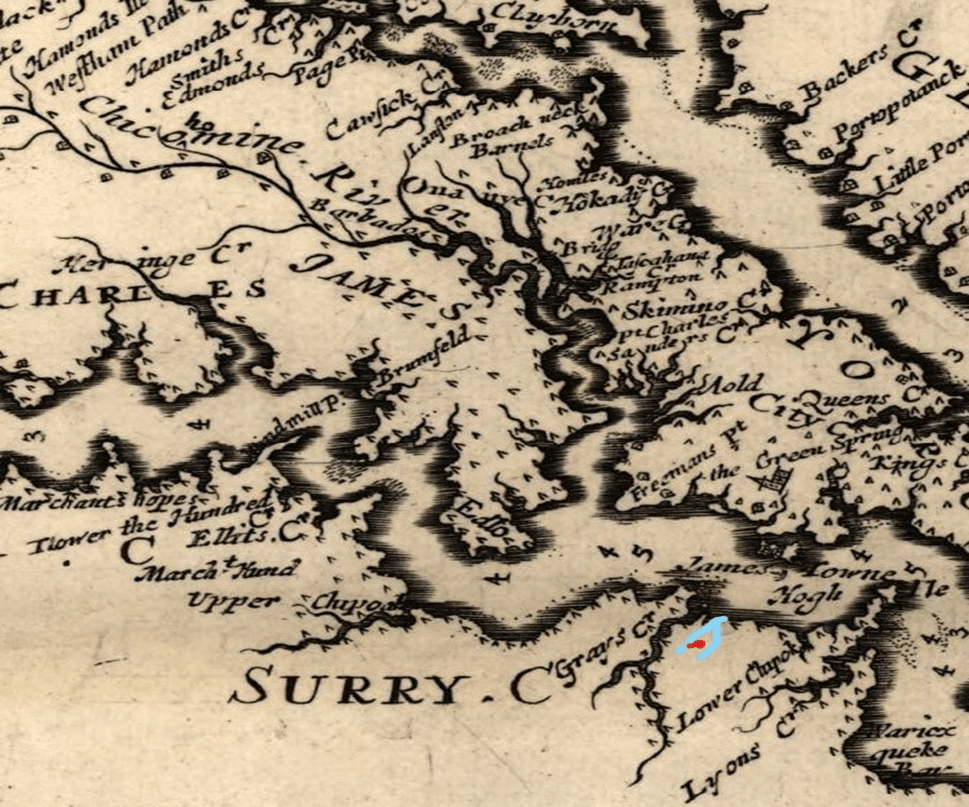
The will notes that Samuel II, who was about 19 in 1672, was already living apart from his parents and younger brothers. The will noted that the cattle, hogs and other “moveables” were at two locations – Samuel II’s “house” and Samuel I’s “plantation.” Samuel II was living on 100 acres of the 200 acres his father bought from Thomas Barlow while his parents and younger brothers were living at Gray’s Creek on land Samuel I and Lydia had inherited from her father, Thomas Gray.[6]
On 10 June 1672, widow Lydia Judkins was back at court asking that the justices order the inventory and appraisal (I&A) of the estate so it could be distributed among his widow and children.[7] No subsequent I&A was filed, but just weeks later on 2 July 1672, Lydia Judkins provided the share of the estate for youngest son Charles Judkins (he was still a minor), which included two cows appraised at £0.80.0, two heifers appraised at £0.50.0 and his share of household goods £1.5.12 – just over £7.[8] Samuel I’s will suggests that his wife and three sons would share his personal estate equally. If so, Samuel I’s total personal estate of perhaps 16 cattle, an unknown number of hogs and furniture valued at about £31. Compared to other Surry County taxpayers, the Judkins were on the lower end of middle class.[9] Lydia (Gray) Judkins did not follow her husband’s directive to move in with her son. Rather she married Lt. Thomas Pittman (c.1636-c.1692) sometime that fall, probably shortly after 10 September 1672 when Pittman – at her request – filed a declaration at Surry Court acknowledging that he would not “use her estate” and that she could decide how to dispose of it.[10] This was to protect not only her interest, but that of her Judkins children.
Samuel Judkins II reached his majority about 1674 and began to take on responsibilities of adulthood. His stepfather turned over control of his youngest brother Charles Judkin’s inheritance to Samuel II to manage until Charles reached adulthood.[11] His neighbor (and future father-in-law) Edward Pettway served as Samuel II’s security (financial guarantor) should Samuel II fail to meet his obligations.[12]
On 4 May 1675, Samuel Judkins II was named a county constable taking the place of his neighbor Pettway.[13] On 17 February 1676, the Surry Court tried Elizabeth Regan, wife of Daniel Regan, who “hath several times & in several places fomented many Malignant & rebellious Words tending to sedition.” Constable Samuel Judkins was ordered to “forthwith carry her the said Regan to the Common Whipping place, and there give her ten lashes on her bare back, well laid on.”[14]
Edward Pettway[15] (c.1630-c.1690) – my 8x great grandfather
Edward Pettway came to Virginia with his parents. His father Robert Pittway was granted 200 acres on 24 February 1638 in Charles River County [became York County in 1643] under the headright system that provided those paying passage to Virginia 50 acres for each person they transported. In Edward’s case, his father received fifty acres each for himself, his wife Mary and their children Edward and Mary.[16]
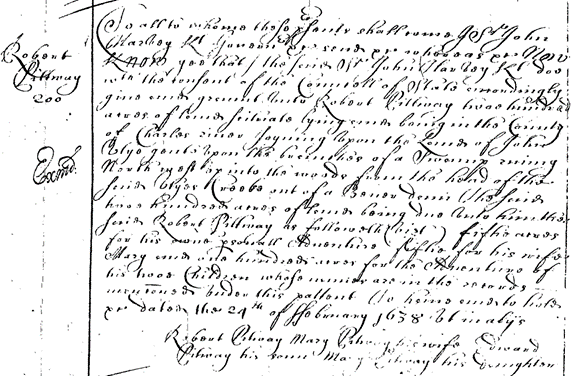
While he apparently grew up in York County – he first appears in the Surry County record on 31 August 1655 when bought a 500-acre tract from Peter Green. The tract was located on the south side of the James River at the head of Lower Chippokes Creek bordering Reedy Swamp, Mr. Pettaway’s Spring [he was apparently living there already] and William Carter’s line.[17]
Edward Pettway married Elizabeth (———-), widow of his neighbor William Carter. Carter’s stepmother Alice (Croxton) Carter, widow of William Carter, Sr., acknowledged the marriage in a deed dated 20 November 1655. She noted that William Carter, Jr. inherited 500 acres from his father and that she agreed that Edward Pettaway “shall enjoy the plantation he now lives on consisting of 145 acres – [Elizabeth Pettway’s dower share of her first husband’s estate] during the lifetime of his wife Elizabeth while the balance as to be leased to others.[18]
On 1 March 1661, Edward Pettway, planter of Lawnes Creek parish, bought 250 acres in Southwark Parish “with all houses, tenements, rents, etc.” between the two main branches of Crouches Creek from Thomas Hart.[19] On 20 May 1664, Edward Pettway signed over his right to the 145 acres he was given the right to occupy during his wife’s lifetime to George Carter with the exception of “half ye fruit yearly” during his wife’s lifetime.[20] On 13 December 1666, Edward Pettway received a patent for 700 acres on the East side of the main branches issuing out of Crouches Creek adjacent to John Twye and George Carter for the transportation of 14 persons.[21] On 28 August 1668 Edward and Elizabeth Pettway sold 200 of the 700 acres to Thomas Ware.[22]
Status in 1676 – When the Rebellion Began
In 1676, Samuel Judkins II was about 23 years old. He was single and living on the 100-acre tract he had inherited from his father. His younger brother Robert Judkins, about 17 or 18 years old in 1676, also joined the rebellion and may have been living on the other half of the tract their father purchased from Barlow. His stepfather Thomas Pittman (who also joined the rebellion) and his mother Lydia (Gray) Judkins Pittman, both about 40, his younger brother Charles, about 16 and his half-sister Lydia Pittman, about 2 were living nearby – perhaps on the land Samuel I and Lydia were living on when Samuel I wrote his will.
In 1676, Edward Pettway was in his 40s, married, a father of a son William who was about 18 year old [23] who also joined the rebellion as well as three daughters. He also owned about 550 acres in Surry County on Crouches Creek. Tithe records of the period indicate that Edward Pettway was well off enough to have the service of a small number of white indentured servants in the period leading up to the rebellion. It may be noteworthy that the number of servants shrunk in the years leading up to the rebellion [1668 (4 servants), 1669 & 1670 (2 servants), 1673 (no servants), 1674 (1 servant)]. In 1674, Edward Pettway tithed on himself, his son William Pettway, about and William Blunt. All three joined Bacon in the rebellion.[24]
Next Time: Samuel Plaw (my 7x great grandfather) and Arthur Long (my 9x great grandfather)
[1] Herrman, A., Faithorne, H. & Withinbrook, T. (1673) Virginia and Maryland as it is planted and inhabited this present year. [London: Augustine Herrman and Thomas Withinbrook] [Map] Retrieved from the Library of Congress, https://www.loc.gov/item/2002623131/.
[2] The name Judkins appears in the record as Judkins, Jerkin and even Jenkins.
[3] Frances Cullom Morgan offers an excellent example of how one conducts research in early Virginia and what long accepted “facts” can be proven or disproven. Conveniently for me, this one proves my x great grandmother Lydia (Gray) Judkins Pittman is a daughter of Thomas Gray. https://freepages.rootsweb.com/~fcharper/genealogy/LydiaGray.html#:~:text=Lydia%20Gray%20is%20now%20recognized%20as%20a%20previously,granddaughter%20of%20Samuel%20Judkins%20Sr%20and%20Lydia%20Gray.
[4] Surry County Deeds, Etc. No. 1 (1652-1672), p. 304
[5] Surry County, Virginia Deeds Wills Etc. No. 2 (1671-1684), p. 13
[6] Frances Cullom Morgan offers an excellent example of how one conducts research in early Virginia and what long accepted “facts” can be proven or disproven. Conveniently for me, this one about my 8x great grandmother Lydia (Gray) Judkins Pittman. https://freepages.rootsweb.com/~fcharper/genealogy/LydiaGray.html#:~:text=Lydia%20Gray%20is%20now%20recognized%20as%20a%20previously,granddaughter%20of%20Samuel%20Judkins%20Sr%20and%20Lydia%20Gray
[7] Surry County, Virginia Guardian Accounts 1672-1750, p. 1
[8] Surry County, Virginia Guardian Accounts 1672-1750, p. 3
[9] Hawley, Anna Louise, “Structures of daily life: the material culture of Surry County, Virginia, 1690-1715” (1986). Dissertations and Theses. Paper 3611. https://doi.org/10.15760/etd.5495. Hawley examined personal estate inventories and appraisals for 1690-99 and 1710-15 and divided the by the bottom 30%, lower middle 30%, upper middle 30% and the top 10% to determine economic status. For the 1690-1699 period, the bottom 30% (£3.5.1 to £34.16.12 range with a mean of about £12), lower middle (£16.6.0 to £37.10.0 range; £24 mean), upper middle (£38.19.10 to £128.19.11 range; £103 mean) and top 10% (£164.6.11 to £423.19.1; £304 mean)
[10] Surry County, Virginia Deeds, Wills, Etc., No. 2 1671-1684, p. 21
[11] Surry County, Virginia, Orders Part 1 (1671-1691), page 70
[12] Surry County, Virginia, Orders Part 1 (1671-1691), page 77
[13] Surry County, Virginia, Orders Part 1 (1671-1691), page 91
[14] Haun, Weynette Parks. Surry County, Virginia Court Records (Pt 1: Order Book 1671-1691) 1672-1682, Book III (Durham: Weynette Parks Haun, 1989), p. 59
[15] The name appears in the record spelled several ways – most commonly Pitway, Pittway, Pittaway, Pettaway, Pettway, Petway
[16] Nugent, Nell Marion. Cavaliers and Pioneers: Abstracts of Virginia Land Patents and Grants 1623-1800, Volume 1 (1623-1666), (Richmond: The Dietz Printing Company, 1934), p. 102
[17] Nugent, Nell Marion. Cavaliers and Pioneers: Abstracts of Virginia Land Patents and Grants 1623-1800, Volume 1 (1623-1666), (Richmond: The Dietz Printing Company, 1934), p. 312
[18] Surry County Deeds, Etc. No. 1 (1652-1672), p. 75
[19] Surry County Deeds, Etc. No. 1 (1652-1672), p. 253
[20] Nugent, Nell Marion. Cavaliers and Pioneers: Abstracts of Virginia Land Patents and Grants 1623-1800, Volume 1 (1623-1666), (Richmond: The Dietz Printing Company, 1934), p. 102
[21] Nugent, Nell Marion. Cavaliers and Pioneers: Abstracts of Virginia Land Patents and Grants 1623-1800, Volume 2 (1666-1695), (Richmond: Virginia State Library, 1977), p. 30
[22] Surry County Deeds, Etc. No. 1 (1652-1672), p. 310
[23] William Pettway’s arrival on the tithe list in 1674 suggests he turned 16 that year.
[24] MacDonald, Edgar and Richard Slatten. Surry County, Virginia Tithables 1668-1703 (Baltimore: Genealogical Publishing Company reprinted for Clearfield Company, 2007), pp. 6, 7, 10, 16, 19, 22


Hello, just discovered your blog today. My niece was doing some research on the Judkins family. I have deep roots in Surry County; the Warrens who owned Bacons Castle were distant relatives, and my maternal grandparents lived in the house in the 1920’s and 30’s. I attempted to contact you, but the link was a dead in. Feel free to contact me if you wish. I now live in Isle of Wight County. It will take a while for me to catch up on your blog posts, but I look forward to doing that.
LikeLike
Thanks for writing – and for letting me know about the bad link. I’m also a Thomas Warren descendant through my Rowell line. My paternal grandmother grew up in Surry. I live in Henrico and look forward to checking out your blog!
LikeLike
Hi Dianna,
What is the name of your blog?
LikeLike
http://www.thesedaysofmine.com Thanks for the interest!
LikeLike
Hi Dianna,
Love your blog. What a wonderful story and family connection to Bacon’s Castle. I am a Hunnicutt researcher, currently living near the coast of N.C. I lived in Virginia, including Virginia Beach, for several years – moved further south in 2008 and now back in N.C. where I was raised. I visited Bacon’s Castle in 2016 – amazing! I would love to connect with other Hunnicutt/Warren researchers.
Thanks,
Dianne Honeycutt Shields
LikeLike
Hi, Dianne (love the 2 N’s!). Dianne is my nickname. My niece is very involved in research of the Warren and Hunnicutt families. My maternal grandmother was a Warren (2nd cousin to Walker Pegram Warren, the last private owner of Bacon’s Castle), and we’re also connected to the Hunnicutts. Feel free to drop me an email at dbsmfd@aol.com (with a note in the subject line about Warren research) and I’ll try to connect you with her. She’s always anxious to possibly glean more info! She lives in Texas now, but I’m in Smithfield, Va, about 20 minutes from Bacon’s Castle. Thanks for the compliments on the blog!
LikeLike
* correction: the link was a dead END. By the way, I have a Bacon’s Castle category on my blog, so if you’d like, feel free to check out those posts.
LikeLike