
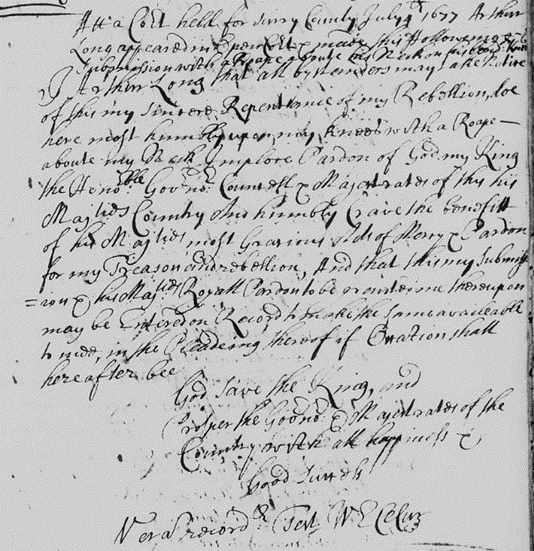
At a Court held for Surry County on July 4th, 1677[1], my 9x great-grandfather Arthur Long appeared in open court on his knees with a rope around his neck and made the following submission:
I Arthur Long, that all bystanders may take notice of my this my sincere Repentance of my Rebellion, to here most humbly upon my knees with a Roape [sic] about my Neck implore pardon of God, my King, the Honorable Governor and Council and Magistrates of this his Majesty’s Country, and humbly crave the benefit of his Majesty’s most Gracious Acts of Mercy & Pardon for my Treason and Rebellion. And this my submission and his Majesty’s Royal Pardon shall be granted me thereupon may be Entered on Record to make the same available to me in the Pleading thereof if Occasion shall hereafter be. God save the King and Prosper the Governor and Magistrates of the County with all happiness and Good success.[2]
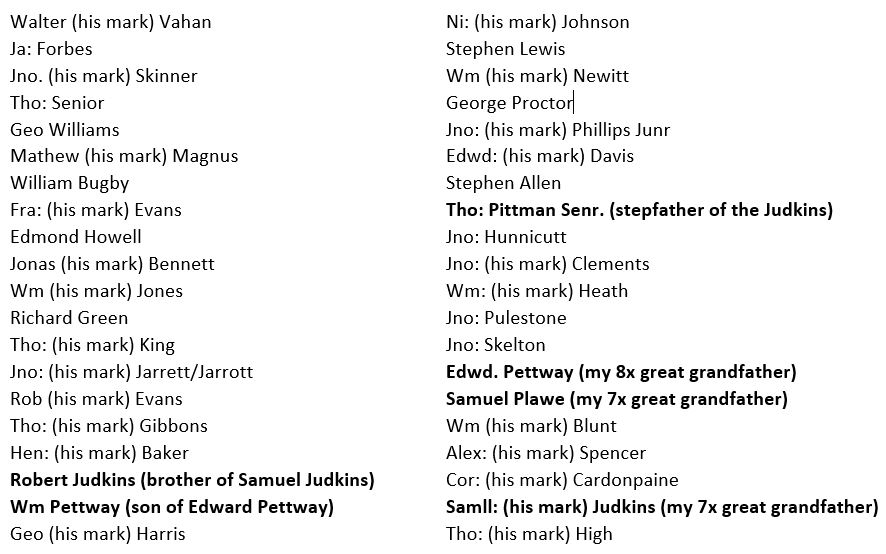
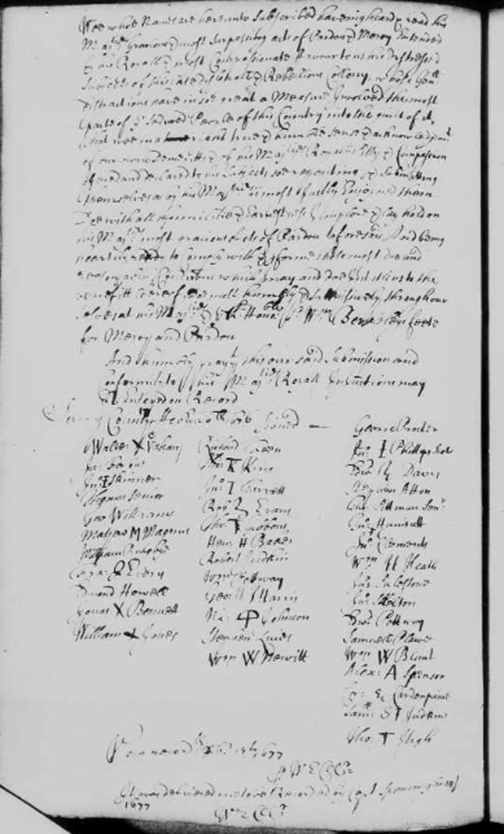
A few months later, at a court session on 18 November 1677, it was recorded that 40 men were formally pardoned in accordance with King Charles II’s general pardon for all colonists, save its leaders and other “notorious actors” who joined the rebellion of Nathaniel Bacon. Among these men were some of my ancestors and their familial connections (in bold below).
We whose names are hereunto subscribed having heard & read his Majesties Gracious & most surpassing acts of Pardon & Mercy extended by his Royall & most compassionate favor to us his distressed subjects of this late Disloyal & Rebellious Colony, whose General destructions have in so great a measure Involved the most part of ye seduced People of this country with the guilt of it that wee in a right true & humble sense & acknowledgment of our own Demerits & his Majesties Royall Pity & Compassion offered & declared to his subjects so repenting & submitting themselves as by his Majesties most Justly enjoined them Doe with all humility & earnestness Implore & lay hold on to his Majesties most gracious acts of Pardon aforesaid, And being heartily ready to comply with and perform those most due & reasonable Conditions with may and doe Entitle us to the benefit thereof, Do most humbly & submissively through ourselves at his Majesties & ye Rt. Honoble. Sr. Wm. Berkeley’s feet for Mercy and Pardon. And humbly pray yet this our said submission and conformity to his Majesties Royal Instructions may be entered on Record.[3]
The Rebellion
The year 1676 was a tumultuous time for the Virginia colony. Nathaniel Bacon was leading a rebellion against the colonial government of Sir William Berkeley. Bacon’s Rebellion has been written about extensively and has been reinterpreted over time based on the politics of the day. If you are unfamiliar with Bacon’s Rebellion or need a refresher click: https://www.nps.gov/jame/learn/historyculture/bacons-rebellion.htm
While the ranks of the rebels included tenant farmers, indentured servants and enslaved persons; far more were “of the middling sort” – small farmers who had managed to acquire land of their own and some were even among the gentry. Four of my Surry County ancestors and some of their family members joined Bacon in rebelling against the colonial government – and by extension the English King. I also have some Surry ancestors who were known to have been on the Governor’s side, but my interest is in why colonists chose to rebel.
As rebels or traitors, they had literally everything to lose. Not only did they risk dying in the fighting, but if they survived and were on the losing side they faced potential execution for treason along with the forfeiture of their estates leaving their families destitute. Did the rebels really think they could win? And if they managed to defeat the Governor’s forces and take control of the colony, did they think that the King was going to just let it go?
The English King Charles II, who had gained the throne in 1660 after his own father King Charles I had been executed in 1649 by parliamentary forces led by Oliver Cromwell during the English Civil War, was not likely to ignore a colonial rebellion. In fact, when he found out about it, he sent 1,000 English troops to put down the rebellion – although it was over by the time they arrived. If the rebels survived the fighting and lost – they were subject to punishments ranging from execution, forfeiture of their estates (leaving their families destitute), fines, banishment, being barred from holding public office or serving on juries and/or public whipping.
How desperate must a man be to take that kind of risk? I hope you’ll join me on this journey in the coming months as we explore 1670s Virginia in this series of blog posts considering why some of my ancestors chose to risk it all against very long odds.
[1] The dates herein may be confusing as prior to 1752 New Year’s Day was on March 25.
[2] Surry County, Virginia Deeds, Wills, Etc., No. 2, (1671-1684), p. 133
[3] Surry County, Virginia Deeds, Wills, Etc., No. 2, (1671-1684), p. 149
 A Son of Virginia
I’m buckled in and ready
LikeLiked by 1 person
Looking forward to the next piece!
LikeLiked by 1 person
A very interesting thought – can’t wait to hear the details.
LikeLike
Happened upon your blog while doing Hunnicutt family research (I’m a Honeycutt from N.C.) – enjoy reading and thank you for your research. I would love to hear more about the Hunnicutt’s (Augustine, John, etc) if you have anything you can share.
Dianne Honeycutt Shields
LikeLike
Thank you for writing and subscribing. You can count on some more about the Hunnicutts! Interestingly I have a brick wall ancestor 3x great grandmother named Sarah Honeycutt Judkins 1815-1901. She married William Holt Berryman. She was already married in 1850 and died between 1896-1912 when Virginia didn’t require death certificates. I descend through multiple paths to Samuel Judkins as well as Augustine Hunnicutt. Someday I’ll figure her parents out and I’m betting on there being Honeycutts hiding from me in that line too! Stay tuned!
LikeLike
Hope you can help me figure out the different Augustine’s and which Hunnicutt was the father (lol).
LikeLike
I descend from Joseph Wall(1649 – 1727), who mother married Capt. Thomas Pitman, of Surry County (1614 – 1686). I believe he was in the Bacons rebellion or his son.
LikeLike
Thank you for writing. Capt. Pitman was indeed in Bacon’s Rebellion. At the time, he was married to Lydia (Gray) Judkins – my ancestor. Her son Samuel Judkins I was also in the rebellion.
LikeLike
Steve- I would like to do research on the life of Joeseph Wall. Would you know if Surry has these records online or would I have to visit Surry
I actually visited Surry a few weeks ago and accidentally stumbled upon the Bacons Plantation. I drove down Rolfe Highway and just had a feeling that was where Capt. Thomas Pittmans Property was located.
LikeLike
I would like to research the life of Joeseph Wall and do you know if these records are online?
I Just visited Surry and stumbled upon the Bacon’s Plantation and did a tour of Fort Smith. I just knew that Rolfe Hwy was around where Captain Pittman property was located.
LikeLike
Surry has really great records so that helps. And there are many online records. First is FamilySearch’s full text search. You type in a name and it finds it. You can filter by state, county, decade, etc. completely free
Also the library of Virginia has many on line resources in particular Chancery Court records which can be a goldmine.
I live about an hour from Surry and still get there several times a year. If you follow Preservation Virginia and Bacon’s Castle on FB you can check out their events. They have a descendants day for anyone who has a Surry ancestor that was in Bacons rebellion. They are nice events and the house is unbelievable.
LikeLike