
Origin of Hector and Sarah Truly – What We Can Say – And What We Cannot.
It has long been thought that Sarah, widow of Hector Truly, d. 1761, Amelia County, Virginia, was a daughter of David[1] and Margaret (Dibdall[2]) Holt of Hanover County and a sister of Dibdall Holt.
The evidence – or rather lack thereof makes it very likely Sarah was not a Holt at all.
The single source for her connection to this family is her 15 March 1792 will, which is often quoted as mentioning her brother Dibdall Holt. Her will, however, does not identify him as such:
“To my daughter Eleanor Spain my feather bed and furniture after Mr. Dibdall Holt breaks up housekeeping.” [3]
This is a timing clause, not a kinship statement. Her will does not call him “my brother.” No document ever does. In fact, she refers to him as “Mr. Dibdall Holt.”

Hector Truly’s origins remain a mystery, but he is likely connected to the Peter Truly who also appeared in Amelia County on four tithe lists for 1750, 1751, 1755 and 1764.[4] Peter Truly also appears on a 1757[5] muster roll as a private in Captain Robert McKenzie’s Company during the French and Indian War (1754-1763). He is listed as being 29 years old [b.c. 1728], 5’5” tall, having enlisted in Caroline County, Virginia and his country is listed as Ireland.[6]
Sarah’s supposed siblings and extended family
Consulting Anne Thomas Tenny’s well- reasoned analysis that appeared in the National Genealogical Society Quarterly in 1981,[7] she provides the following genealogy for the family of David and Margaret Holt of Hanover:
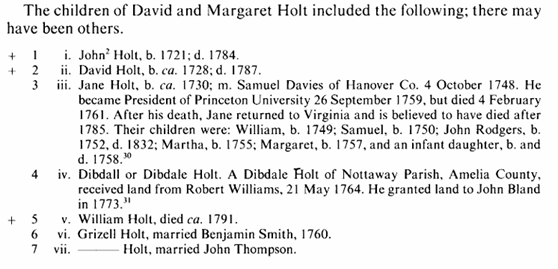
While Tenny allows “there may have been others,” there is no Sarah.
Will of John Holt
David and Margaret’s eldest son, John Holt who died in 1784, was a merchant, printer and one time mayor of Williamsburg. He relocated to the City of New York in 1754 and later removed to New Haven, Connecticut. He published the Connecticut Gazette, the New York Journal and the Independent. He left a will dated 1 October 1749, which was not proven for 35 years until 30 October 1784 by his widow Elizabeth (Hunter) Holt.[8] He named his wife (their children both died young), all of his known siblings (or their husbands) including Dibdall Holt, his nieces, his sisters’ in law (siblings of his wife), a friend’s daughter, as well as a nurse and her daughter. There is no Sarah.
Naming Patterns
Naming patterns in and of themselves are not good evidence. However, as part of a body of evidence the pattern is nevertheless interesting. Hector and Sarah named their children Eleanor, Sarah, John, Judith, James, Bennett and Martha. While the names John, James, Sarah and Martha are too common to consider, among the four generations of descendants of Randall and Mary (Bayly) Holt there is not a single Eleanor, Judith or Bennett among them.
Among Hector and Sarah’s children and numerous grandchildren neither the name David nor Holt appears – not even for a middle name. Dibdall and Elizabeth (Cocke) Holt did have a son named David Holt. Sarah Truly and Dibdall Holt were, in fact, in-laws when Dibdall’s daughter Elizabeth (Holt) Burch married (as her second husband) Sarah’s son James Truly.
The Most Useful Data – Hector and Sarah Truly’s “relationship” with Dibdall Holt
Most tellingly: Sarah never appears in any record with any Holt in either Amelia or Brunswick County — not once — despite decades of overlapping residence.
Hector and Sarah Truly appear dozens of times in Amelia County records and numerous times in adjacent Brunswick County over 30 years beginning in 1743. Not once is Dibdall Holt a party to any of those records. He did not witness a deed or will, serve as security, serve as a guardian – none of the roles a near kinsman would be expected to play – in particular for a debt ridden widowed sister with several minor children.
Dibdall Holt was in Amelia by 1749 and appears in records numerous times. He also shows up in Brunswick County records as few times. Neither Hector nor Sarah Truly nor any of their adult children appear in any record involving Dibdall Holt in Virginia.
The closest connection I found was through the Spain Family. On 24 June 1763 Dibdall Holt was ordered to pay Francis Spain (Hector and Sarah’s son-in-law) 275 lbs tobacco for 11 days attendance as a witness in his case against the Exors of Abraham Cocke, decd.[9] Hardly compelling.
After her husband’s 1761 death, Sarah Truly was involved in numerous suits over debts owed by her or her husband’s estate and lost the land they had owned. When things fell apart in Amelia, Sarah didn’t run to Hanover County, Williamsburg or Surry County where she supposedly had family – she went to Brunswick County. One would think that her “brother” living nearby would have been of some assistance, but there is no evidence of that.
There simply are no records of any kind linking Sarah (——-) Truly to Dibdall Holt or to any Holt family in Virginia. Moreover, her actions and the people in her orbit don’t even suggest the hint of such as relationship.
What can we conclude?
Hector “Truley” first appears a post October 1742 list of contributors for a Protestant Episcopal chapel to be built in the Garrison Forest section of St. Paul’s Parish, Baltimore County, Maryland.[10] Less than a year later he appears on a 1743 Ameia County tax list for the area “below Flat and Nibbs Creek.”[11]
Sarah’s first appearance in the historical record occurs on 16 September 1751, when she testified in Amelia County Court. She was already married to Hector Truly by then, and already a mother. No record identifies her maiden name. No record places her in Hanover County. No record connects her to the Holt family. There is no evidence that Sarah was a Holt. In fact, the evidence – or lack thereof – strongly suggests otherwise.
Thus, we begin Sarah’s story not in Hanover County, but where the records actually place her: Amelia County, Virginia.
[1] Sarah’s father is supposedly David Holt of Hanover County, Virginia, a posited son of John Holt (c.1664-.c.1705) of Surry County and a daughter of David Crawford/Crafford of New Kent County. This identification is offered in Adventurers of Purse and Person (AP&P), which states that “The identification rests on the possibility that David Holt is the David Holt, who 2 May 1706, received a patent for 300 acres . . . and the branches of Totopotomoy Creek, in New Kent County . . . deeded to him by his grandfather David Crawford [on] 28 May 1686, David Holt still being a minor in 1706.” AP&P also mentions that “The name David Holt does appear as a headright in two patents, 1670 and 1675, for land in (Old) Rappahannock County, which indicates there was another David Holt from which this David Holt . . . may have derived.” Adventurers of Purse and Person, Virginia 1607-1624/5, Fourth Edition, Volume Two, Families G-P, p. 313
[2][2] Margaret Holt was NOT a Dibdall. David and Margaret Holt named one of their sons Dibdall Holt, leading many researchers to conclude that Margaret was Margaret Dibdall, daughter of Rev. John Dibdall of New Kent County. In reality, she was his stepdaughter. Her mother, also named Margaret, had married the Rev. Dibdall as a widow with two daughters whose original surname is unknown. This relationship is confirmed by a 1723 case before the Board of Trade, which oversaw Virginia land matters for the English Crown. When Rev. Dibdall died around 1723, his New Kent (now Hanover) lands escheated—that is, reverted—to the Crown because he left no direct heirs. Both Thomas Marston and the widow Margaret Dibdall petitioned for the property. On 24 May 1723 The Board ruled in the widow’s favor, stating that “it appearing to this Board, That the said Tract of Land was by the Will of the said John [Dibdall] devised after the death of his said Wife to his two Daughters in Law now the wives of David Holt & Timothy Taylor.” In eighteenth-century usage, “daughter-in-law” meant stepdaughter. See: EXECUTIVE JOURNALS OF THE Council of Colonial Virginia, Vol. IV (October 25, 1721-October 28, 1739), PUBLISHED BY The Virginia State Library, H. R. McILWAINE, EDITOR, p. 39, & 70; Internet Archive, archive.org; https://archive.org/details/executivejournal04virg/page/38/mode/2up
https://archive.org/details/executivejournal04virg/page/70/mode/2up
[3] The 15 March 1792 will of Sarah Truly; https://www.familysearch.org/ark:/61903/3:1:3QS7-89Q8-FZK8?view=fullText&keywords=Hector%2CSarah%20Truly&lang=en&groupId=
[4] Amelia County, Virginia Tithable Lists, (1750), “Amelia, Virginia, United States records,” images, FamilySearch (https://www.familysearch.org/ark:/61903/3:1:3Q9M-CS79-1W68?view=explore : Oct 13, 2026), image 90 of 202; Image Group Number: 007856499 ; (1751), “Amelia, Virginia, United States records,” images, FamilySearch (https://www.familysearch.org/ark:/61903/3:1:3Q9M-CS79-1Q1Z?view=explore : Oct 13, 2026), image 28 of 202; Image Group Number: 007856499; (1755), “Amelia, Virginia, United States records,” images, FamilySearch (https://www.familysearch.org/ark:/61903/3:1:3Q9M-CS79-1WCB?view=explore : Oct 13, 2026), image 151 of 202; Image Group Number: 007856499, (1764), “Amelia, Virginia, United States records,” images, FamilySearch (https://www.familysearch.org/ark:/61903/3:1:3Q9M-CS79-1WMR?view=explore : Oct 13, 2026), image 172 of 289; Image Group Number: 007856499
[5] Robert McKenzie’s company: (1) necessary roll, undated (docketed 6 Aug. 1757), 87 men, signed by Robert McKenzie; (2) size roll, undated (August–October 1757), 89 men, unsigned; National Archives, Founders Online; https://founders.archives.gov/documents/Washington/02-04-02-0223
[6] Virginia Troops in French and Indian Wars (Continued). (1894). The Virginia Magazine of History and Biography, 1(4), 378–390, p. 379; http://www.jstor.org/stable/4241775
[7] Tenny, Anne Thomas. David Holt of Chesterfield County, Virginia and John Holt of Williamsburg and New York City, National Genealogical Society Quarterly, Vol. 69, December 1981, No. 4, pp. 251-8; https://www.ngsgenealogy.org/index.php?pda_v3_pf=/_pda/Archive/1981/69_web.pdf
[8] Will of John Holt. New York City Probate Administrator’s Records 1782-1787, Wills 1782, 1787, p. 271; “New York City, New York, United States records,” images, FamilySearch (https://www.familysearch.org/ark:/61903/3:1:3QS7-99GG-W2FX?view=explore : Feb 17, 2026), image 477 of 885; New York. Surrogate’s Court (New York County), Image Group Number: 007641872
[9] Amelia County Virginia Order Book 7, 1763, p. 99; “Amelia, Virginia, United States records,” images, FamilySearch (https://www.familysearch.org/ark:/61903/3:1:3Q9M-CS4H-19NC-S?view=explore : Feb 17, 2026), image 114 of 176; Image Group Number: 007893733
[10] Scharf, J. Thomas. History of Baltimore City and County From the Earliest Period to the Present Day, (Philadelphia: Louis H. Everts, 1881), p. 517-521; “Baltimore, Maryland, United States records,” images, FamilySearch (https://www.familysearch.org/ark:/61903/3:1:3QSQ-G9DX-TXNY?view=explore : Sep 3, 2026), image 314 of 558; Image Group Number: 007548955
[11] Amelia County, Virginia Tithe List 1743; https://www.familysearch.org/ark:/61903/3:1:3Q9M-CS79-17CN?i=107&cat=670006&lang=en
A Husband, A Family and an Ordinary Life
How Sarah Holt met Hector Truly is not known. Truly was – and is – an uncommon name and its origins are uncertain. He was very likely an immigrant to Virginia, but that is a story for another day.
Given their daughter Eleanor was born about 1744, Hector and Sarah (Holt) Truly were probably already married when he appears on a 1743 Amelia County, Virginia tax list for the area “below Flat and Nibbs Creek.”[6] Hector and Sarah started out as tenant farmers. It appears that one of their landlords was Samuel Cobbs. In 1748, Hector Truly was granted a license to keep an ordinary [a tavern] on Mr. Cobb’s land.[7] Cobbs was a large landowner in Amelia and represented the County in the House of Burgesses from 1742-1747 and 1748-1749.[8]
To be an ordinary keeper one had to get a license from the county, and which required a security bond from the licensee. In addition, another person to serve as security for the licensee. Hector’s security in 1748 was John Le Neve who was Samuel Cobb’s son-in-law. Ordinaries served travelers with lodging, food, drink, and fodder for their horses. For the local population, ordinaries served as gathering places for men – otherwise fairly spread out on their farms. The county also set annual rates that ordinary keepers could charge. Hector’s license was renewed annually with various others serving as security over the years.[9] While they ran the ordinary, Hector and Sarah would have also raised various crops and held livestock for their own use as well as for use at the ordinary.
They did not manage all that work alone. Hector and Sarah held enslaved men and women in bondage. Amelia County tithe lists for 1751-1755 indicate that the Holts held at least five slaves named London, Betty, Lucy, Jack, and Charles.[10] Hector also appeared at the September 1755 Amelia Court with an enslaved girl named Nanny whom the court determined to be 12 years old.[11] The Court determining an enslaved person’s age was about deciding when taxes were owed.
Over this time, Hector and Sarah’s family continued to grow as other children followed daughter Eleanor including Sarah (b.c. 1747), John (b.c. 1750), Judith (b.c. 1751), James (b.c. 1755), Bennett (b.c. 1756) and Martha “Patsy” (b.c. 1757).
On 17 February 1748, after about five years of tenant farming, Hector and Sarah purchased their first tract of land from William Foster. They paid £8 10 shillings and 6 pence for 100 acres described as “in the head branches of Great Bent Creek.”[12] About six years later, on 25 July 1754, they paid £50 for 100 acres from George and Margaret Burks in Raleigh Parish on the “lower side of Beaver Pond Branch of Flat Creek” and adjacent to Burks and Col. Harrison.[13] These tracts were not contiguous, the latter being further south toward Jetersville.
On 23 February 1758, the Trulys sold the tract they bought in 1754 – to Edmond Booker, Jr. – for £61.[14] On the same day they bought a 172-acre tract from the same Edmund Booker. Jr. – for £100 described as “adjacent Flat Creek above mouth of Great Tomahawk Creek.”[15] Hector and Sarah bought an adjacent 128-acre tract from Booker on 24 May 1759 for £150 described as being on the lower side of Flat Creek and adjacent to “said Truly’s line” and the “corner in the said Booker’s Mill Pond.[16] Lastly, on 26 June 1760, the Trulys sold the 100 acres they bought in 1748 to Elizabeth Allen for £17.
The Trulys now had a farm of three hundred contiguous acres, were running their ordinary and were raising seven children ranging in age from 16 to 3. Then everything changed for Sarah (Holt) Truly.

Hector Truly made his will on 11 January 1761 and was dead by 26 February when Sarah appeared at Amelia County Court to prove the will by oath of witnesses, have it recorded and pay her bond to serve as Executrix.[18] Hector’s will was written near the end of his life, which was quite common back then. At about 40 years old, he probably got sick – perhaps from the major influenza epidemic that began in the Spring of 1761 and spread throughout all thirteen colonies and to Europe by 1762.[19]
In his will Hector gave to Sarah “all my land purchased of Edmund Booker being 300 acres more or less to enable her to pay my debts.” He went on to say that should his land not have to be sold to pay his debts, that Sarah would have use of it for her natural life and then to be equally divided among his three sons John, James, and Bennett. Eldest son John was given “a man’s saddle” and all his father’s “wearing clothes” as well as a horse “that is now called his own” – meaning already in his possession. Eldest daughter Eleanor received a horse and sidesaddle, and the next oldest daughter Sarah got a featherbed.
Hector then gave wife Sarah use of his slaves until his sons came of age or his daughters “came of age or married.” He then directed that when either of these things occurred, that there was to be an equal division of the then held slaves. He then made the same provision for his livestock.
This was one of the many cruelties of slavery – separating enslaved families to settle an estate. This sometimes meant moving far away and being permanently separated from those one loved. While Hector’s will doesn’t mention any slaves by name, an Amelia County tithe list for 1762 lists Sarah Truly holding three enslaved persons named Jack, Lucy, and Beck.[20] The 1764 Amelia County tax list for Nottoway Parish includes “Sarah Truly’s list of tithes, Jack & Lucy.”[21] Jack and Lucy are presumably the same people mentioned on Hector’s 1755 tithe list.
The Widow Truly
Sarah (Holt) Truly was now a 37-year-old widow with seven children ranging in age from 17-4. Shortly after her father’s death, eldest child Eleanor Truly who was about 17-year-old, married Francis Spain.[22] Sarah still had six children at home and continued farming and running the ordinary. On 27 March 1762, she was granted a license in her own right to keep an ordinary at her house.[23]

Unfortunately, just a month later Sarah was forced to sell the farm to pay debts owed by her husband’s estate. On 22 April 1762 she sold it to William Pride for £260 with the transaction noting that “agreeable to the will of said Hector Truly, is unable to pay his debts, accounts from his books being insufficient to discharge them.”[24] Sarah (Holt) Truly was now landless and broke with six children aged 14 -5 for which she needed to provide.
Sarah would renew her ordinary license in Amelia on 27 May 1763.[25] She remained in Amelia and spent the next three years in and out of Amelia County court suing for debts owed to her husband’s estate. Most of these debts were for small amounts suggesting they were incurred at the ordinary. Between 1763 and 1766, Sarah was a plaintiff in at least 13 suits where she either prevailed or the case was dismissed by consent of the parties, which probably means she got paid.[26]
It was not all one sided as Sarah was a defendant in Amelia Court on several occasions during this period – mostly for debts. Notably on 24 September 1763, Sarah was tried by a jury for slander against Edmond Booker, Gentlemen who was a justice on the Amelia County Court. Sarah had two witnesses both of whom she was required to pay for their attendance. Mr. Booker, who was of the upper class in Amelia County, called and was ordered to pay four witnesses. The jury found her guilty and awarded Booker £5. Sarah then argued that the Court should set the verdict aide “because the words in the declaration are not actionable” and “for other errors.” The Court said it would advise at next court. The case was finally decided on 25 November 1763 when the Court ordered Sarah Truly to pay Edmond Booker £5 plus his costs to bring the suit.[27] Unfortunately, the record does not mention what was said.
In 1766, the legal tables turned even more unfavorably for Sarah Truly. She now appears in the record multiple times – not as a plaintiff but rather a defendant.[28] It was about this time Sarah Truly relocated from Amelia County to adjacent Brunswick County, which was noted in the margin of the Order Book in the 1767 case of Booker v. Truly (a debt case – not the slander case above).[29]
Controversy and legal battles followed Sarah to Brunswick County. First, in 1769, a man named Chamberlain Hudson of Bute County, NC placed an advertisement in the Virginia Gazette to inform and warn the public “that the estate now in the hands of Mrs. Sarah Truly, of Brunswick County, Virginia, is my property, and has been ever since the 4th day of April 1767. I therefore forewarn all persons from executing any part of the said estate for any debt due from the said Sarah Truly, under penalty of being sued.”[30]

Life would not get less complicated in the coming years for Sarah as her debts continued to result in her being brought to Court in Brunswick County. Most were for small amounts, but on 28 July 1772, Benjamin Harrison sued Sarah Truly, executrix of Hector Truly, for a debt of £208, 6 shillings and 3 pence. Sarah asserted she “oweth nothing of the debt in the declaration” and a trial was set for the next meeting of the Court. It took another year, but the trial took place on 24 August 1773 where Sarah was found guilty by a jury. The Court, however, allowed the debt could be discharged by Sarah paying £35 13 shillings and 2 pence – with interest at 5 percent per annum from 11 January 1764 until payment.[31]
Join me next time and find out what happens to Sarah and her children. You’ll be surprised!
[1] Nugent, Nell Marion. Cavaliers & Pioneers (Abstracts of Land Patents and Grants), Vol. III, p. 107.
[2] U.S. Census Bureau. Bicentennial Edition: Historical Statistics of the United States, Colonial Times to 1970: Part 2 (Washington, DC: 1975), p. 1152
[3] Hanover County, Virginia website: Hanover’s History | Hanover County, VA
[4] Encyclopedia Virginia. https://encyclopediavirginia.org/entries/great-awakening-in-virginia-the/
[5] Encyclopedia Virginia. https://encyclopediavirginia.org/entries/davies-samuel-1723-1761/
[6] Amelia County, Virginia Tithe List 1743, Binns Genealogy, http://www.binnsgenealogy.com/
[7] Amelia County, Virginia Order Book 2, p. 117
[8] Tyler, Lyon Gardiner. Encyclopedia of Virginia Biography, Vol. 1, p. 213; https://vagenweb.org/tylers_bios/vol1-21.htm
[9] Amelia County, Virginia Order Book 2, pp. 190 (1749), 299 (1750); Order Book 3, pp. 24 (1752), 224 (1755); Order Book 4, p. 124 (1757), Order Book 5, pp. 79 (1758), 212 (1759); Order Book 6, p. 16 (1760).
[10] Amelia County, Virginia Tithe Lists 1751-1755, Binns Genealogy, http://www.binnsgenealogy.com/
[11] Amelia County Order Book 4, p. 7
[12] McConnaughey, Gibson Jefferson. Amelia County, Virginia Deed Books 3&4, 1747-1753; (Amelia County, Virginia: Mid-South Publishing Company, reprinted by Iberian Publishing Company, 1999), p. 28
[13] Amelia County, Virginia Deed Book 3, p. 177
[14] Amelia County, Virginia Deed Book 6, p 244
[15] Amelia County, Virginia Deed Book 6, p. 226
[16] Amelia County, Virginia Deed Book 7, p. 27
[17] Fry, J., Jefferson, P. & Jefferys, T. (1755) A map of the most inhabited part of Virginia containing the whole province of Maryland with part of Pennsylvania, New Jersey, and North Carolina. [London, Thos. Jefferys] [Map] Retrieved from the Library of Congress, https://www.loc.gov/item/74693166/
[18] Amelia County, Virginia Will Book I, p. 191.
[19] TAUBENBERGER J.K.; MORENS D.M. Pandemic influenza – including a risk assessment of H5N1. Scientific & Technical Review. 2009 04 1; 28 (1): 187-202. doi: http://dx.doi.org/10.20506/rst.28.1.1879. https://doc.oie.int/dyn/portal/index.xhtml?page=alo&aloId=30911
[20] Amelia County, Virginia Tithe List 1762, Binns Genealogy, http://www.binnsgenealogy.com/
[21] Amelia County, Virginia Tithe List 1764, Binns Genealogy, http://www.binnsgenealogy.com/
[22] Williams, Kathleen Booth. Marriages of Amelia County, Virginia 1735-1815, (Baltimore: Genealogical Publishing Company for Clearfield Company, Inc., 2005), p. 101
[23] Amelia County Order Book 6, p. 250
[24] Amelia County, Virginia Deed Book 7, p. 591
[25] Amelia County, Virginia Order Book 7, p. 77
[26] Amelia County, Virginia Order Book 7, p. 21 (Truly v. Johnson), p. 105 (Truly v. Wily), p. 113, 246 (Truly v. Lewis); Amelia County Order Book 8, p. 25, 69, 141, 145, 182, 485 (Truly v. Drinkard), p. 91, 118 (Truly v. Roberts), p. 158 (Truly v. Adams), p. 158 (Truly v. Cannon), p. 159 (Truly v. Lacy), p. 174, 236 (Truly v. Lester), p. 185, 552 (Truly v. Booker), p. 265 (Truly v. Anderson), p. 449 (Truly v. Howell); Amelia County Order Book 8A, p. 30 (Truly v. Johnson)
[27] Amelia County, Virginia Order Book 7, pp. 223, 244
[28] Amelia County Order Book 8A, p. 17, 84, 147, 157, 168 (Tabb v. Truly), p. 42, 83, 113 (Booker v. Truly), p. 49 (Speirs & Co. v. Truly)
[29] Amelia County Order Book 8A, p. 113
[30] Virginia Gazette, 16 February 1769, p. 2
[31] Brunswick County, Virginia Order Book 12, pp. 59, 387


One thought on “Revisiting Sarah (———) Truly (c.1724–1792/3), formerly Sarah (Holt) Truly – Part 1”