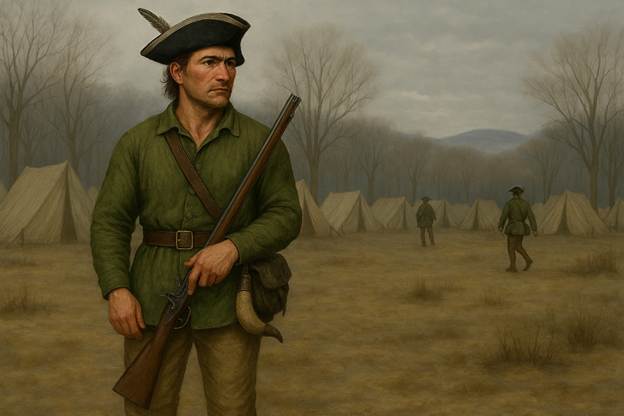
My 5x great grandfather Andrew Sharp’s life traces a vivid arc from young Continental soldier to Pennsylvania frontier captain and, finally, to a tragic death on the rivers leading toward Kentucky. His story embodies both the high ideals of the Revolution and the very real uncertainties of life on the western edge of the new republic.
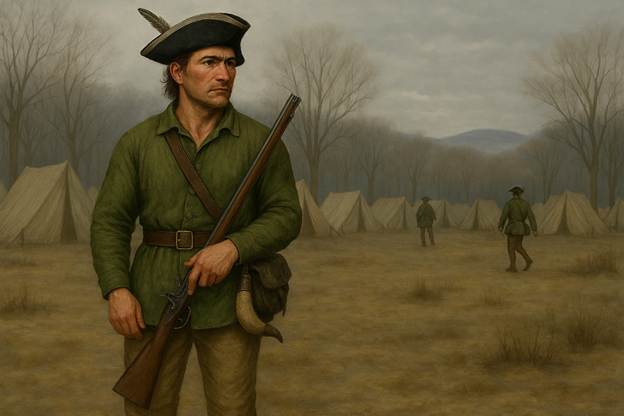
An Uncertain Birthplace
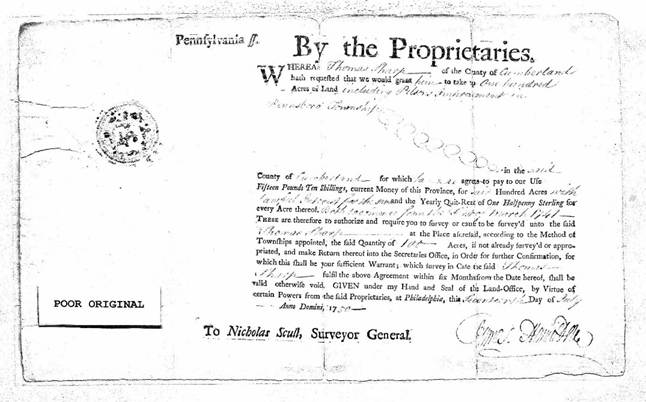
Whether Andrew Sharp was born in Scotland, Northern Ireland or Pennsylvania is an open question. His father, Thomas Sharp, applied for land warrant on 17 July 1750 for 100 acres in Pennsboro Township, Cumberland County, Pennsylvania.[2] Application for a land warrant was the beginning of this process suggesting that he was in Pennsylvania by this date.
One undocumented profile of the Sharp family published in 1905 suggests that Thomas and Margaret (Elder) Sharp immigrated about 1746 from Northern Ireland, living near Belfast in County Antrim. It goes on to provide an accounting of their children and grandchildren stating that Andrew was born in Cumberland County, Pennsylvania in 1750.[3]
Other undocumented accounts state that the family was from Campbeltown Parish, Argyll, Scotland. FamilySearch has two records (baptism and christening) for Andrew Sharp dated 13 and 19 November 1751. His parents are recorded as Thomas Sharp and Margaret Elder.[4]
A Young Rifleman in Washington’s War
What is certain is that Andrew Sharp came of age just as tensions with Britain erupted into open war. By 1776 he had joined the Patriot cause, first appearing as a private on the August muster roll of Captain William Peebles’ company in the 2nd Battalion of the Pennsylvania Rifle Regiment under Lt. Col. Daniel Brodhead and Col. Samuel Miles.[5] That year he was encamped with the regiment around Kingsbridge[6] and Harlem Heights[7] in New York and took part in the campaign that included the battle and evacuation of Long Island in August 1776.[8] Captain Peebles was captured on 27 August 1776 and died later that year.[9]
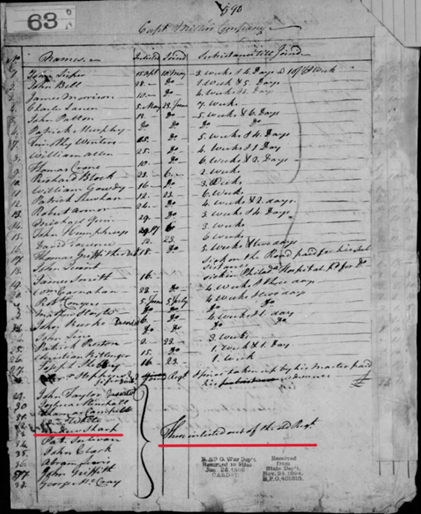
In early November 1776, Sharp transferred into Captain Henry Miller’s company of the 1st Pennsylvania Continental Line, putting him in the ranks for three of the most iconic winter actions of the war: the 1st Battle of Trenton on December 26, 1776, the 2nd Battle of Trenton (Assunpink Creek) and the Battle of Princeton on January 3, 1777.[10]
The First Battle of Trenton
We’ve all seen the famous painting of Washington crossing the Delaware by Emanuel Leutze. Andrew Sharp was among the 2,400 men with Washington who somehow managed to cross the Delaware in a snowstorm and surprise two brigades of Hessian soldiers. When they crossed, Washington divided his forces sending Sullivan south to block a Hessian retreat. The 1st Pennsylvania, under General Nathaniel Green and Washington, went north of town. About 8 o’clock the morning of 26 December, Washington’s men encircled the Hessian outpost with the 1st Pennsylvania riflemen on the far left. The Hessians fired volleys while retreating toward the town.
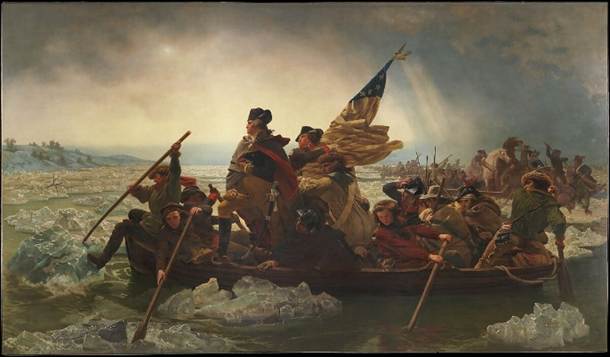
Sullivan’s forces, meanwhile, attacked from the west, further challenging the Hessians who counterattacked charging Washington left flank – including the 1st Pennsylvania. Washington ordered the left flank to extend so the American were attacking from the front and side. While cannons roared, the snow caused wet flints, rendering their rifles unusable – except to hold a bayonet. The Americans charged using their gunstocks, bayonets and swords as weapons. Fighting was intense, but the Hessians were soon overwhelmed and with their retreat cut off were forced to surrender. After losing New York to the British, the victory at the First Battle of Trenton gave the new nation hope.[12],[13]
The Second Battle of Trenton
With the Americans now holding Trenton, a British column of 8,500 soldiers was on the march from Princeton. On 2 January, 1777,1,000 riflemen under Col. Edward Hand’s 1st Pennsylvania Regiment, managed to surprise the British under Cornwallis. For more than five hours, riflemen, with a their 200 yard range, fired at the British, slowing their advance on Trenton. Washington set up his defense at Assunpink Creek. An American Army of some 7,800 men, including the 1,000 riflemen, formed in a three mile line along the south side of the creek. The 1st Pennsylvania was forward on the line. British attacks being fierce, Washington decided to retreat through town and across a bridge further up Assunpink Creek. Cornwallis ordered a rush of the bridge thinking the Americans would retreat as they had done before. Instead, the Americans unleashed a barrage of fire killing or wounding more than 100 British regulars. Other British charges followed but proved futile. The battle ended with a second American victory in a matter of a week. The British had about 500 men wounded or killed while the Americans suffered only 50 casualties. To add insult to injury, Washington managed move his troops during the night without arousing British suspicion by lighting large fires to make them believe the American army was still on the field.
The following morning, when Cornwallis realized the American army had slipped into the night, he assumed they had retreated south. But Washington and his 7,800 man army was heading north toward Princeton. Washington was unaware that Cornwallis had left 5,000 reserve troops in Princeton and had sent word for them to join him at Assunpink Creek. Two large armies were marching toward one another completely unaware they would soon meet.[14],[15]
The Battle of Princeton
For the march to Princeton, Washington divided his forces into two groups. Virginia native Brig. Gen. Hugh Mercer led a smaller forward group while Washington followed with the main army. At some point Washington saw the British troops and realized what was about to happen. He ordered a rider forward to warn Mercer and tell him to attack. The British had also seen the Americans and both sides quickly lined up for battle a mere 40 yards apart. They exchanged volleys and then British began a bayonet charge.
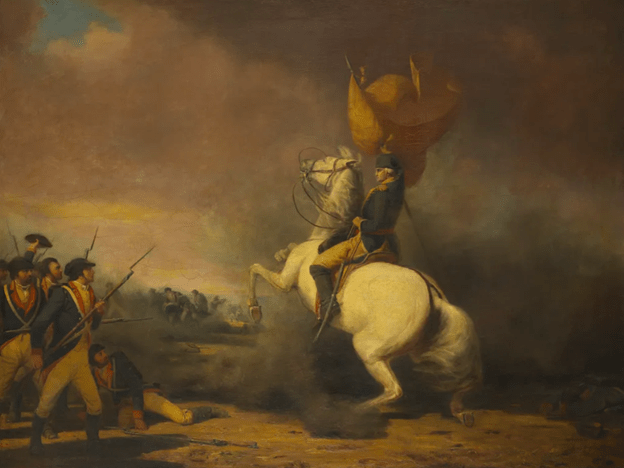
You may recall the story. Having no bayonets, Mercer’s men began a panicked retreat.[17] Just then Washington arrived with the main army and on his white horse galloped back and forth rallying the retreating soldiers. The now reformed and numerically advantaged American force began to advance.[18] The 1st Pennsylvania was on the American right flank under Col. Edward Hand. In time, cannon and rifle fire from both flanks and repeated assaults on the center by Washington’s forces, broke the British line. The 1st Pennsylvania captured British artillery field pieces vital to the American cause.[19]
An American army, including Private Andrew Sharp, won three victories over 10 days with little food or sleep. These proved to be decisive for the American cause who had been on the verge of defeat after New York. The British now knew they had underestimated Washington and his rag tag colonial army.
In 1777, Andrew Sharp served again as a private in Captain Matthew Scott’s company of the Pennsylvania State Regiment under Colonels John Bull and Walter Stewart, with muster rolls placing him in service from March through at least May of that year.[20]
Taken together, these scattered entries depict a seasoned enlisted man who marched, camped, and fought in some of the most critical months of the Revolution, moving from the New York campaigns into the winter strikes at Trenton and Princeton and then back into Pennsylvania service as the war shifted south and west.
From Cumberland County to the Crooked Creek Frontier
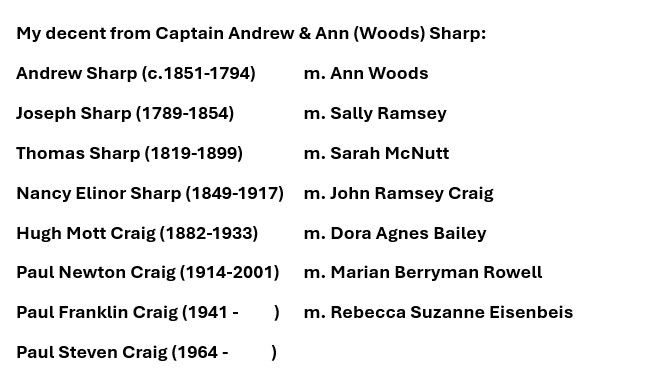
When his service ended, Sharp returned to Cumberland County, where he married Ann Woods around 1783. The following year Andrew and Ann, with their infant daughter Hannah, decided to move west, moving to the Crooked Creek–Plum Creek country then in Armstrong Township, Westmoreland County, near the future village of Shelocta. There they secured 300 acres, built a cabin, and began clearing land, part of the steady push of Revolutionary veterans onto the Pennsylvania frontier.[21],[22]
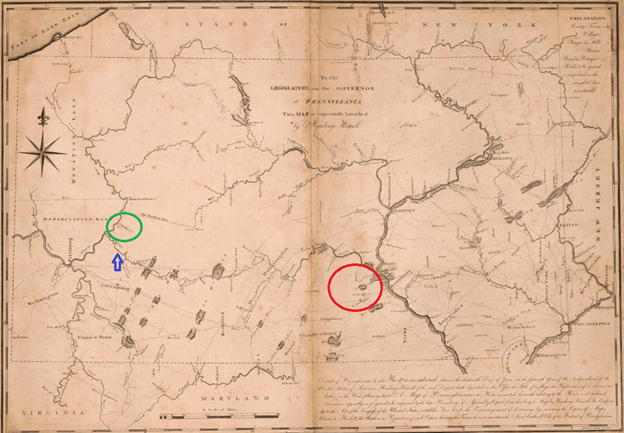
That frontier was anything but secure as it was part of the hunting grounds for the indigenous Lenape (Delaware) and Shawnee.[23] For roughly two years, the Sharps did not even sleep in their own cabin at night, instead crossing the creek to stay in a neighbor’s fortified dwelling for protection from wild animals and Indian raids. In this world of scattered cabins, improvised forts, and constant rumor, Andrew stepped into local leadership: by 1789 he appears as Captain Andrew Sharp in the Westmoreland County militia, commanding the 8th Company of the 2nd Battalion and later other companies in the 1792 and 1793 militia reorganizations.[24] The man who had once shouldered a rifle in Washington’s line now bore responsibility for defending isolated Crooked Creek families against the continuing threat of violence.
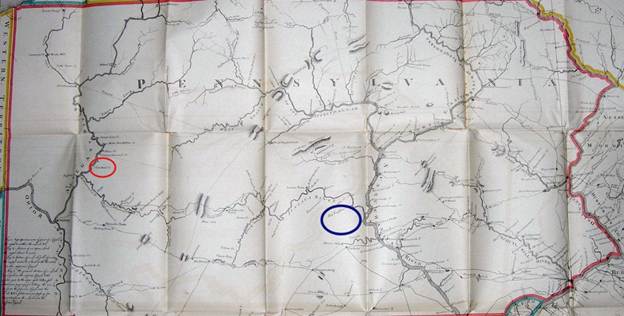
Andrew Sharp has been written about numerous times in county histories, newspaper accounts and most recently in January 2026 in the Indiana (Pa.) Gazette by Debby Bier, in part:
Andrew Sharp emerged as one of the central figures of the Crooked Creek frontier, a patriot whose service blended wartime defense with sustained peacetime leadership. His Revolutionary-era service was characteristic of frontier militia duty, focused on protecting scattered homesteads during years of instability when Native movement, political uncertainty, and distance from courts left families exposed.
On the western Pennsylvania interior frontier, security relied less on forts than on vigilance and readiness. Men like Sharp answered calls to protect settlements and maintain order during periods of unrest. Following independence, Sharp’s leadership shifted toward civic service. He participated in township affairs, served as a road viewer, and helped lay out overland routes that linked isolated farms to mills, churches, and neighboring settlements. His life reflects the essential transition from frontier defense to orderly self-government, demonstrating how liberty was preserved not only through military service but through the everyday work of building civil society.[26]
“Determined That His Children Should Have Facilities for Education”
After about a decade on the Plum Creek tract, the Sharps confronted a hard reality: the same wilderness that offered land and independence denied their children schools and safety. A county history recounts that Andrew revisited his kin in Cumberland County, deliberately securing schoolbooks and Bibles for his children before returning west; he then traded his Plum Creek farm for land in Kentucky, determined to combine opportunity with education. In the spring of 1794, he gathered his own family—Ann and their six children—along with the families of Mr. Connor and Mr. Taylor and two single men, McCoy and another Connor, and prepared for the river passage to their new home.
Low water on Black Lick Creek complicated the first leg, but at last they floated down the Conemaugh and Kiskiminetas toward the Allegheny, their flatboat loaded with 22 people, livestock, and household goods. It was a migration familiar across the early republic, veterans and their families drifting toward distant land patents and imagined security. For the Sharps, that dream would end violently just miles below the falls of the Kiskiminetas.
Ambush on the Kiskiminetas and a Soldier’s Death
Near the mouth of a small stream below the later town of Apollo, the party tied up their boat in late afternoon, intending to spend the night ashore and run the rapids by daylight. While the women prepared supper and the children played on the bank, a warning came that Indians were nearby; as the men were tying their horses, a band of at least seven, concealed behind a fallen tree where the children had been playing half an hour earlier, opened fire. In the first volley Captain Sharp lost his right eyebrow to a shot; as he cut the boat loose under fire he was struck first in the left side and then in the right, though he still managed to push the craft off before the attackers could board and even shot and killed one of the Indians when his wife handed him his rifle.
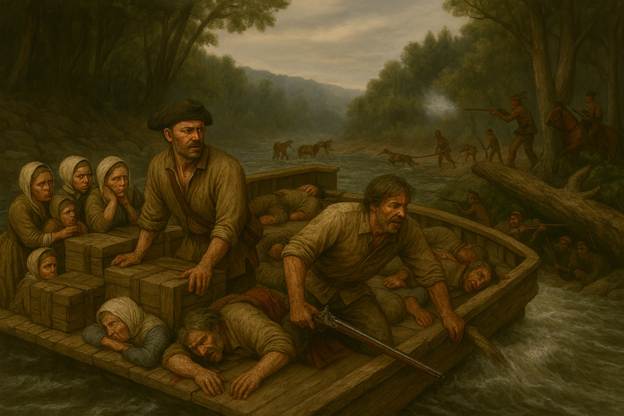
Chaos followed. McCoy and the eldest son of Mr. Connor were killed, and Mr. Connor was badly wounded; yet all the women and younger children survived the attack. As the wounded men collapsed, it fell to Ann Sharp to keep the flatboat in the current through the night while the Indians followed along the shore for miles, threatening to fire again if the party did not land. By dawn they were within a few miles of Pittsburgh, where men on the riverbank answered their signals, guided them in, and summoned medical aid.
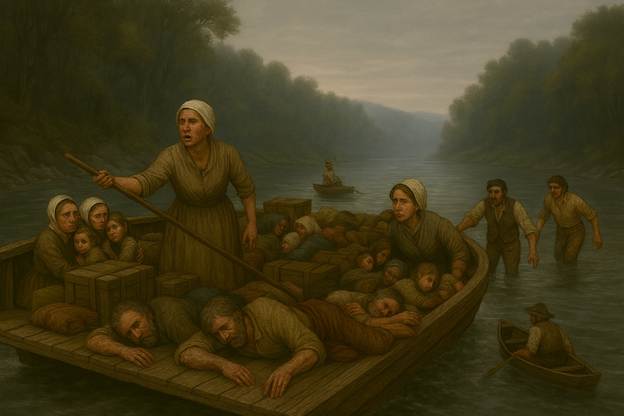
Andrew Sharp lingered forty days in Pittsburgh, dying on July 8, 1794, with the roar of Independence Day cannon salutes—marking the eighteenth anniversary of the Declaration, which he had helped defend—still echoing in his memory. The celebratory cannon fire on July 4th so startled him, that his most serious wound reopened. A contemporary account notes that he was buried “with the honors of war” in the presence of a large concourse of people, while his youngest child, born only eleven days before his death, lay in her mother’s arms. Letters of administration issued in Cumberland County that October formally named his widow Ann and his brother Alexander as administrators of his estate, closing the legal record on a life cut short by the very frontier hazards he had spent years resisting.[29]
Aftermath and Legacy on Crooked Creek
In the immediate aftermath of the attack, Andrew’s brother Alexander saw that Ann and her children were conveyed back east to their kin in Cumberland County, where they remained for about three years. Ironically, just weeks after Andrew’s death, General Anthony Wayne’s victory at Fallen Timbers in August 1794 effectively broke organized Indian resistance in the Old Northwest and ended large-scale raids into western Pennsylvania. With conditions calmer, the Sharp family returned in 1797 to their reclaimed lands near Crooked Creek, where Ann and the children resumed the work Andrew had begun.
Over time, his sons Thomas and Joseph built a gristmill on the old tract, and the small settlement that grew around it was first known as Sharpsburg or Sharp’s Mills before taking the name Shelocta. Local tradition remembered Andrew as “an officer in the revolutionary service, under Washington,” and his daughter Nancy Agnes was long celebrated as the first white child born in that section of Pennsylvania, a marker of how deeply the family’s story had become intertwined with the identity of the region. Even decades later, descendants preserved his rifle—nicknamed “Old Thump”—and his sword, weapons that had seen both the ordered lines of Continental battle and the desperate defense of a drifting flatboat on the Kiskiminetas. [31], [32], [33]
In Andrew Sharp’s life, the Revolution did not end at Yorktown; it followed him west, into militia musters, cabin clearings, and finally the fatal encounter below the falls. His service in the ranks of Pennsylvania’s riflemen and Continentals, his leadership as a frontier captain, and his death under fire in 1794 link the story of one Cumberland County farmer to the broader, ongoing struggle to secure and settle the interior of the new United States.
[1] Craig, P. Steven. (2026, March). Illustration of A Patriot Wearing the Colors of the 1st Pennsylvania, 1776 [Concept by author, rendered with AI assistance]. Perplexity AI (GPT Image 1)., 1st_Cont_Rifle_Regt1776.jpg”. American Civil War Gaming Club (ACWGC).
[2] Ancestry.com. Pennsylvania, U.S., Land Warrants and Applications, 1733-1952 [database on-line]. Provo, UT, USA: Ancestry.com Operations, Inc., 2012., Original data: Warrant Applications, 1733-1952. Harrisburg, PA: Pennsylvania State Archives. Land Warrants. Pennsylvania State Archives, Harrisburg, PA.
[3] Seilhamer, George Overcash. Biographical annals of Franklin county, Pennsylvania : containing genealogical records of representative families, including many of the early settlers, and biographical sketches of prominent citizens, (Chicago: The Genealogical Publishing Company, 1905, pp. 64-72; www.archive.org
[4] “Scotland, Births and Baptisms, 1564-1950”, database, FamilySearch (https://familysearch.org/ark:/61903/1:1:XYZP-YZ9 : 11 February 2020), Andrew Sharp, 1751 and “Scotland, Births and Baptisms, 1564-1950”, database, FamilySearch (https://familysearch.org/ark:/61903/1:1:XYZ5-X9D : 11 February 2020), Andrew Sharp, 1751.
[5] Montgomery, Thomas Lynch. Pennsylvania Archives, Fifth Series, Volume II, (Harrisburg: Harrisburg Publishing Company, State Printer, 1906), p. 359; https://www.familysearch.org/library/books/viewer/82752/?offset=0#page=361&viewer=picture&o=info&n=0&q=
[6] Ibid, p. 361, p. 364
[7] Ibid, p. 367, p. 370
[8] Ibid, p. 371
[9] Ibid, p. 356
[10] U.S. Revolutionary War Rolls, 1775-1783, Publication Number M246, NARA Catalog ID: 602384, Record Group 93; www.fold3.com
[11] The Metropolitan Museum of Art, Public Domain; https://www.metmuseum.org/art/collection/search/11417
[12] The First Pennsylvania Regiment of the Continental Line, Inc., Battles Remembered; https://www.firstpa.org/battles-remembered.html
[13] American Battlefield Trust, Trenton – December 26, 1776; https://www.battlefields.org/learn/revolutionary-war/battles/trenton
[14] The First Pennsylvania Regiment of the Continental Line, Inc., Battles Remembered; https://www.firstpa.org/battles-remembered.html
[15] American Battlefield Trust, Trenton, Second Battle – Jan, 2, 1777; https://www.battlefields.org/learn/maps/trenton-second-battle-jan-2-1777
[16] Ranny, William T. Washington Rallying the Americans at the Battle of Princeton, 1848, oil on canvas; https://artmuseum.princeton.edu/art/collections/objects/22043#information
[17] American Battlefield Trust, Princeton, Jan 3, 1777, 8:00 a.m. – 8:30 a.m.; https://www.battlefields.org/learn/maps/princeton-jan-3-1777-800-830-am
[18] American Battlefield Trust, Princeton, Jan 3, 1777, 8:55 a.m. – 9:15 a.m.; https://www.battlefields.org/learn/maps/princeton-jan-3-1777-855-915-am
[19] The First Pennsylvania Regiment of the Continental Line, Inc., Battles Remembered; https://www.firstpa.org/battles-remembered.html
[20] Montgomery, Thomas Lynch. Pennsylvania Archives, Fifth Series, Volume II, (Harrisburg: Harrisburg Publishing Company, State Printer, 1906), p. 528-529; https://www.familysearch.org/library/books/viewer/82752/?offset=0#page=530&viewer=picture&o=search&n=0&q=Sharp
[21] Pennsylvania, Septennial Census, 1779-1863, www.ancestry.com
[22] Pennsylvania Land Office, Applications for warrants: Pennsylvania. Warrants March 1787-August 1787; “Pennsylvania, United States records,” images, FamilySearch (https://www.familysearch.org/ark:/61903/3:1:3QHV-J38R-Q127?view=explore : Mar 1, 2026), image 828 of 1156; Image Group Number: 008707367
[23] Bier, Debbie. Indiana Gazette, 17 January 2026; https://www.indianagazette.com/news/america250-patriots-of-the-crooked-creek-frontier/article_a171fae4-4877-46ec-9978-9527a150d437.html
[24] Westmoreland County, Pennsylvania Militia Rolls 1783-1790, p. 1384; “Pennsylvania, United States records,” images, FamilySearch (https://www.familysearch.org/ark:/61903/3:1:3Q9M-C9BL-H9D4-G?view=explore : Mar 1, 2026), image 336 of 801Image Group Number: 007726627
[25] Respectfully inscribed to Thomas Mifflin, Governor, and the General Assembly of the Commonwealth of Pennsylvania: By John Adlum, and John Wallis. The image shown here is a reproduction from the Pennsylvania Archives, Third Series. Wheat & Brun #432 dated 1791; Phillips page 679 dated 1792. The Library of Congress has a large number of manuscript land survey maps prepared by John Adlum in the William Bingham Estate Map collection. Bingham owned major land tracts across northern Pennsylvania; see Docktor #29_A1, etc. One of those maps is a reduced copy of this one. https://www.mapsofpa.com/antiquemaps29a.htm
[26] Bier, Debby. America 250 Patriots of Crooked Creek, Indiana (PA) Gazette, 16 January 2026; https://www.indianagazette.com/news/america250-patriots-of-the-crooked-creek-frontier/article_a171fae4-4877-46ec-9978-9527a150d437.html
[27] Craig, P. Steven. (2026, March). Illustration of Andrew Sharp and others after the attack., 1794. [Concept by author, rendered with AI assistance]. Perplexity AI (GPT Image 1).,
[28] Craig, P. Steven. (2026, March). Illustration of Ann (Woods) Sharp steering the boat., 1794. [Concept by author, rendered with AI assistance]. Perplexity AI (GPT Image 1).
[29] Cumberland County, Pennsylvania Probate Administrators Records, 1750-1863, p. 97; “Cumberland, Pennsylvania, United States records,” images, FamilySearch (https://www.familysearch.org/ark:/61903/3:1:3Q9M-C9B2-PWVN-3?view=explore : Mar 1, 2026), image 128 of 808; Pennsylvania. County Court (Cumberland County), Image Group Number: 007726357
[30] Howell, R. (1792) A map of Pennsylvania. [Philadelphia?: Reading Howell] [Map] Retrieved from the Library of Congress, https://www.loc.gov/item/2024597606/.
[31] Smith, Robert Walter. History of Armstrong County, Pennsylvania, (Chicago: Waterman, Watkins & Co., 1883), pp. 28-29; https://archive.org/details/historyofarmstro01smit/mode/2up
[32] The Apalachian. (June 24, 1846). Andrew Sharp. Newspapers.com. Retrieved March 13, 2026, from https://www.newspapers.com/article/the-apalachian-andrew-sharp/192468839/
[33] The Indiana Progress. (March 1, 1859). Andrew Sharp. Newspapers.com. Retrieved March 13, 2026, from https://www.newspapers.com/article/the-indiana-progress-andrew-sharp/192469256/
 A Son of Virginia