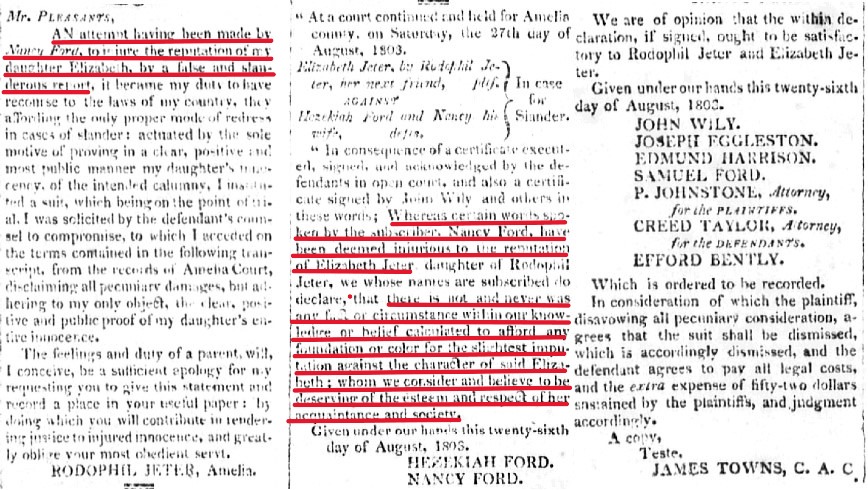
On 1 October 1803, the Virginia Argus newspaper ran the following communication sent by my 5x great grandfather Rodophil Jeter of Amelia County which began, “An attempt having been made by Nancy Ford to injure the reputation of my daughter Elizabeth, by a false and slanderous report, it became my duty to have recourse of the laws of my country, they affording the only proper mode of redress in cases of slander.” Jeter added a request for the publisher:
“The feelings and duty of a parent will, I conceive, be a sufficient apology for my requesting you to give this statement and record a place in your useful paper, by doing which you will contribute in tendering justice to injured innocence . . . “
Jeter also included was a public admission fromHezekiah Ford and his wife Nancy Ford that stated “Whereas certain words spoken by the subscriber, Nancy Ford, have been injurious the reputation of Elizabeth Jeter, daughter of Rodophil Jeter, we whose names are subscribed do declare that there is not and never was any fact or circumstance within our knowledge or belief calculated to afford any foundation or color for the slightest imputation against the character of said Elizabeth; whom we consider and believe to be deserving of the esteem and respect of her acquaintances and society.”[1]
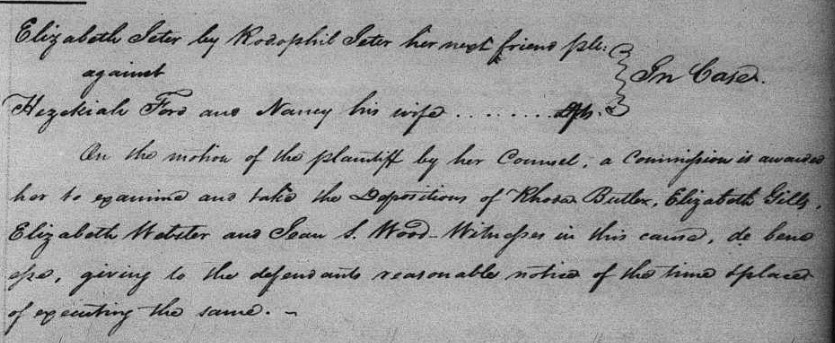
Rodophil Jeter had sued the Fords on behalf of his daughter. In August 1802, the Amelia Court appointed a commission to take depositions from “Rhoda Butler, Elizabeth Gills, Elizabeth Webster, and Jean S Wood[2] witnesses in this cause” referring to the case of Elizabeth Jeter by Rodophil Jeter her next friend against Hezekiah Ford and Nancy his wife.[3] Unfortunately, I found no record of these depositions. While the specific details of Nancy Ford’s remarks are not provided, Elizabeth Jeter was 15 at the time. It seems likely that her remarks suggested some form of sexual impropriety, which would have been incredibly damaging to a young woman’s reputation.
While digging into the lives of the people involved, I did some research on the Fords and may have stumbled across new Jeter and/or Ligon family lines.
Hezekiah and Nancy Ford
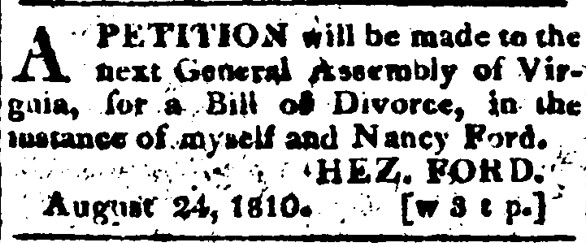
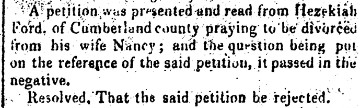
Hezekiah Ford and Nancy Muse were married in 1797 in Amelia County. Theirs was not a happy union. By 1810, he was living in his native Cumberland County with their children while she lived with her Wood grandparents in Amelia County.[4],[5] A notice dated 24 August 1810 from Hezekiah Ford was published in the Virginia Argus newspaper announcing he would be presenting a petition to the General Assembly “for a bill of divorce, in the instance of myself and Nancy Ford.”[6]
Within a few months, his petition was rejected by the legislature:[7]
Denied a divorce, Hezekiah Ford took his daughters and left Virginia and was in Madison County in the Mississippi Territory [Alabama from 1819] by 23 April 1815.[8] On that day he wrote to his brother in Virginia describing his journey south and his intention to open an apothecary shop in Huntsville. While the letter does not mention his wife, it does include a sentence that reads, “All unsettled matters of mine you and my brothers will please settle as soon as you can as I wish a final close of all my matters in that Country.”[9]
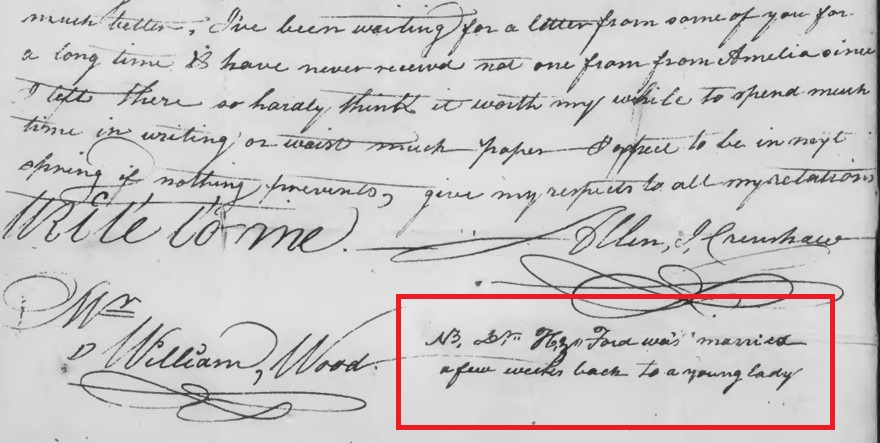
Dr. Hezekiah Ford settled with his family at Huntsville on 13 August 1817, he married Nancy Vining. Word of the marriage made its way back to Virginia in a letter dated 2 November 1817 from Allen Crenshaw of Huntsville, Madison County, Alabama to William Wood of Amelia County [Nancy (Muse) Ford’s uncle] with a postscript that reads “Dr. Hezh Ford was married a few weeks back to a young lady.”
Nancy (Muse) Ford Reacts
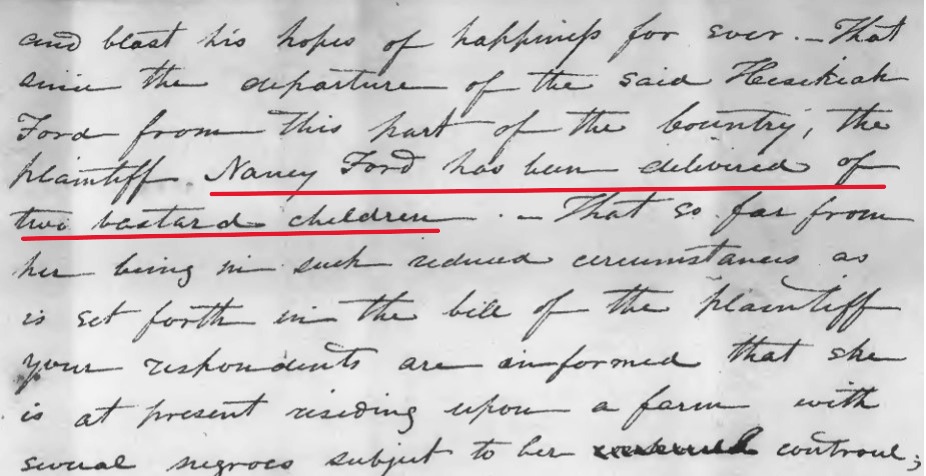
As one might imagine, Nancy (Muse) Ford was not happy about the news. In January 1818, she filed a suit against William Wood [her uncle], exor. of William Wood, Sr. [her grandfather], Hezeziah Ford and his agents in Virginia [also his brothers] William Ford, Paschal Ford and John Ford. In his answer to the suit, Paschal Ford stated that he has never had any of Hezekiah’s property and would rely on his brothers answers. William Ford & John Ford had more to say. They began by admitting that Nancy Ford and Hezekiah Ford were lawfully married and that they had never been divorced. They also admitted that “Hezekiah Ford is at this time a resident of some part of the western country,” but that they totally disbelieved the charge he was “living in unlawful cohabitation with another woman.”
The brothers then testified “that whilst the said Hezekiah would willingly have cherished for her sentiments, of the fondest regard, and have cemented their union by every affection which was due from a husband to his wife: such was the imprudent, nay criminal course of conduct, persisted in by her, as at once cut off from him, every source of enjoyment which ought naturally to have arisen from the existing ties between them and blast his hopes of happiness forever. That since the departure of the said Hezekiah Ford from this part of the country plaintiff Nancy Ford has been delivered of two bastard children.” They denied having any of Hezekiah Ford’s property.[10]
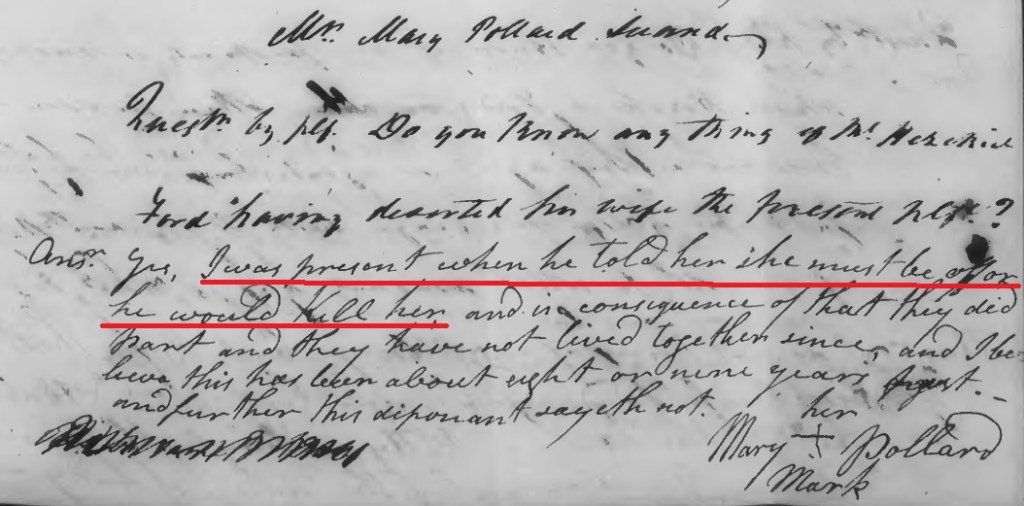
Mary Pollard was deposed and she testified that she “was present when Hezekiah Ford told Nancy Ford that he would kill her and in consequence they parted and have not lived together since.”[11]
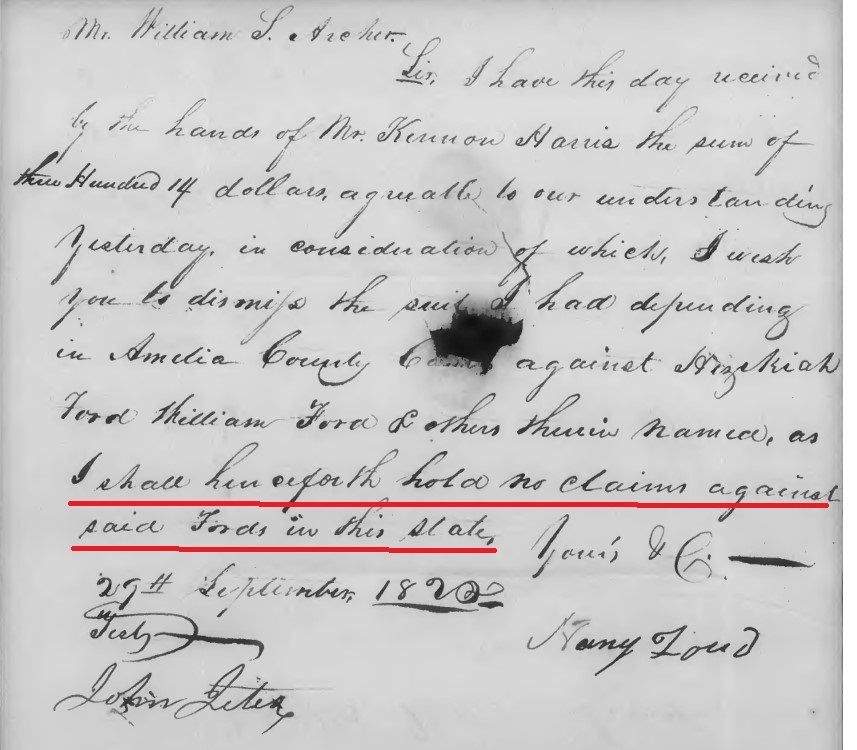
In 1820 Nancy Ford received $314 from Kennon Harris [her son-in-law] and agreed and voluntarily dropped her suit.[12]
Meanwhile Back in Alabama
Hezekiah and Nancy (Vining) Ford went on to have two sons named John Vining Ford, b. 17 May 1821 and Hezekiah Ward Ford, b. 15 November 1824. In 1837, Hezekiah Ford conveyed by deed of trust to John Ford [his brother] and John Vining [his 2nd wife’s brother] all his property for the benefit of William Moore and James Moore, sons of David Moore [widower of a daughter of Hezekiah & Nancy (Muse) Ford] and Kennon Harris [husband of their other daughter Frances (Ford) Harris] as well as his 2nd wife Nancy (Vining) Ford and their sons John Vining Ford and Hezekiah Ward Ford.
Then in 1839 Hezekiah Ford died.
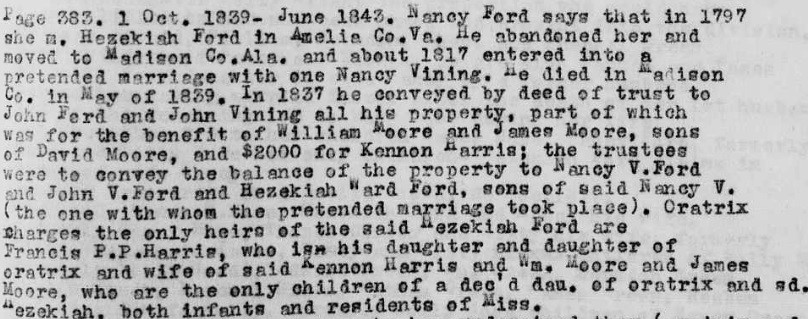
That’s when first wife Nancy (Muse) Ford filed a suit in Madison County, Alabama against his estate for her dower interest in his property. Nancy (Muse) Ford said that she and Hezekiah Ford were married in 1797 in Amelia Co. Virginia. She added that he abandoned her and moved to Madison County, Alabama and about 1817 entered into a “pretended marriage” with one Nancy Vining.
Depositions Tell the Story
The suit reveals that the wives of Hezekiah Ford were familiar with one another. First wife Nancy (Muse) knew of her daughters circumstances [one dead, one married] and of her grandchildren. She had likely not seen her daughters since they left Virginia in 1815 – nearly 25 years earlier. And she probably never met her grandsons who were living with their widowed father in Mississippi.
Nonetheless, Nancy (Muse) Ford, who was living on land in Amelia, given to her by her brother James W Muse though a deed of Trust. He asserted that Hezekiah Ford had taken property [enslaved people] she inherited from her grandfather William Wood, Sr., which she asserted he had no right. And she wanted her 1/3 dower interest in his Alabama property. Her burden of proof was to show that she and Hezekiah Ford were legally married and never divorced. That suit contains a number of depositions that shed light on the separation of Hezekiah and Nancy (Muse) Ford as well as names of their children and grandchildren.
Nancy (Muse) Ford asserted that “the only heirs of the said Hezekiah Ford are Frances P. P. Harris , who is his daughter and daughter of oratrix and wife of said Kennon Harris and Wm. Moore and James Moore , who are the only children of a dec ‘d dau of oratrix and d. Hezekiah, both infants and residents of Miss.”
Hezekiah’s brother John Ford stated that “the first intimation of trouble was when someone dropped an anonymous letter at Hezekiah’s mill door.”He added that after the separation“Oratrix Nancy Ford lived at her grandfather ‘s and Hezekiah with Dr. Newton Ford in Cumberland County.” According to the testimony of 2nd wife Nancy (Vining) Ford, she “understood they (oratrix and Hezekiah) were never married butlived together till 1808 when said oratrix committed adultery.”
Nancy (Muse) Ford’s brother James W. Muse and Henry Hasken testified that they were “present at the marriage and saw the ceremony performed.”
Nancy V. Ford [Nancy Vining Ford] stated that she “understood they (oratrix and Hezekiah) were never married but lived together till 1808 when said oratrix committed adultery. She added that she and Hezekiah were lawfully married on 21 Aug. 1817 and that he died 1 May 1839 leaving two children John Vining Ford aged 18 on 17 May 1839 and Hezekiah Ward Ford aged 15 on 15 Nov 1839.

Mary Gaston testified that she was present at the marriage of Hezekiah Ford and Nancy Vining — Parson Shackelford married them. Ford passed as a single man but had a wife in Virginia, and brought his daughters to Alabama. Sometime after bringing his daughters to this state he exhibited a letter with a black seal saying his wife was dead — she didn’t see it but heard the mother and father of Nancy Vining speak of it.
Then We Get The Gold
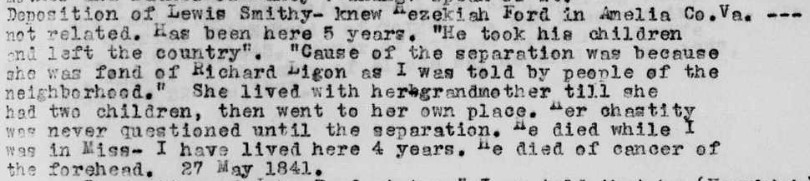
Lewis Smithy testified that he knew Hezekiah Ford and that he [Ford] took his children and left the country. Smithy further stated that “the cause of the separation was because she [Nancy Ford] was fond of Richard Ligon as I was told by people of the neighborhood.” ” Smithy added that “She lived with her grandmother till she had two children , then went to her own place, her chastity we never questioned until the separation.”
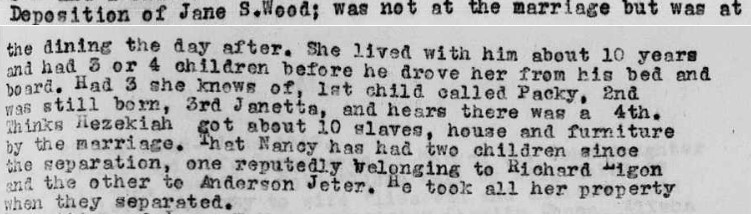
Jane S Wood [Jane Stern (Jeter) Wood] [13] testified that Hezekiah and Nancy Ford lived together for about 10 years and had three or four children before he “drove her from his bead and board.” She further added that she knew of three children including one called “Packy,” one that was stillborn and one called “Janetta,” and she “hears there was a fourth.” She added that Hezekiah Ford took all of Nancy Ford’s property when he left. Finally she added “Nancy has had two children since the separation , one reputedly belonging to Richard Ligon and the other to Anderson Jeter.”
In perhaps the ultimate irony, Anderson Jeter was a son of Rodophil Jeter and a brother of the reputationally maligned Elizabeth Jeter back at the beginning of this story.
The Verdict
The judge ‘s decree states [in part] ‘the evidence is that the marriage was entirely legal, that the Virginia statutes stating that adultery bars the wife from dower does not apply in Alabama, therefore she is entitled to dower in a certain tract of land, but he refuses to allow her any of the rest of the property conveyed in the deed of trust.”[14]

Epilogue
Rodophil Jeter (c.1765-1843) was a son of Ambrose and Jane (Stern) Jeter.[15] On 15 October 1785, he married Lucy Ann Gills, daughter of John & Elizabeth (———-) Gills.[16] His wife died on 31 October 1829.[17] Rodophil Jeter was very active in the community serving as Amelia County coroner (1812), Justice of the Peace (1810-1821) and (1824-1842) and Sheriff (1821). He also represented the county in the Virginia House of Delegates for several terms (1818-19, 1819-20, 1824-25, 1825-26, 1827-28, 1829-30 and 1838).[18] Rodophil Jeter made his will on 18 April 1843 and it was recorded in Amelia County on 28 December 1843. Issue: Anderson Jeter, Rebecca Jeter (m. Richard Webster) [my line], John Jeter, Elizabeth (m. James Allen), Jane Jeter, Harriett Jeter, William Jeter and Lucy Ann Jeter.
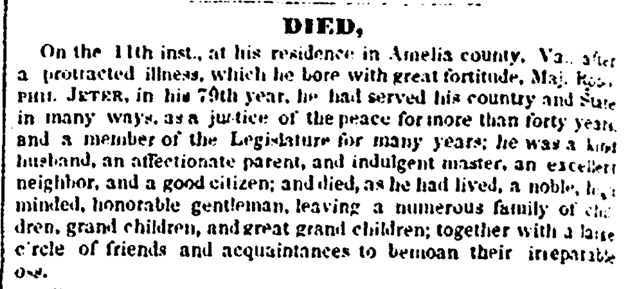
Newspaper notice regarding the death of major Rodophil Jeter (c.1765-11 December 1843).[19]
Elizabeth Jeter was born on 20 July 1788 in Amelia County.[20] She was just 15 years old when Nancy Ford made remarks “injurious to the reputation of Elizabeth Jeter.” Elizabeth’s reputation restored, she went on to marry James Anderson Allen in 1806.[21] They lived in Cumberland County and had five children: Benjamin, Mary J (m. Peter Phillips), Rebecca R (m. William Catlin), Lucy Ann (m. Josiah Gouldin) and Elizabeth (m. Samuel Garrett).[22] James Allen died in 1859 and Elizabeth (Jeter) Allen died on 3 June 1862 at the age of 74.[23]
Nancy (Muse) Ford lived in Amelia County, Virginia until her death at age 77 in May 1854.[24] She did indeed have two children well after her separation from Hezekiah Ford including a daughter named Louisa Ford (b.c. 1813) and a son named Yelverton Ford (b.c. 1817).
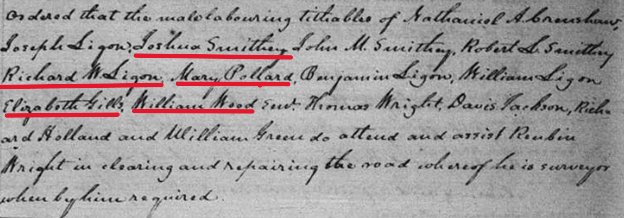
Richard Ligon is likely the Richard W Ligon who married Nancy Smithey, daughter of Joshua Smithey. An 1813 Amelia County Court Order listing neighbors whose laboring tithables were to assist Reubin Wright in repairing a road includes Richard W Ligon, Joshua Smithey and William Wood Sr – Nancy (Muse) Ford’s grandfather with whom she resided from about 1808. Other neighbors included Elizabeth Gills and Mary Pollard who were both deponents in the Ford suits.[25] Louisa Ford was born about 1813.
Anderson Jeter married Sorrow Allen in 1809 in Amelia County. He last appears on the Amelia County personal property tax rolls in 1816[26] [Yelverton Ford b.c. 1817] and by 1820 he was living in Green County, Kentucky. He died there in 1842 leaving children George W Jeter, Lucy Harriet (Jeter) Langhorn, Mary R (Jeter) Mitchell, Rodophil E Jeter, Sarah A (Jeter) Marshall and John Anderson Jeter.[27]
If you are a descendant of Louisa (Ford) Taylor you may have Ligon connections and if you are a descendant of Yelverton Ford you may have Jeter connections. Any DNA testers out there?
[1] The Virginia Argus, 1 October 1803, Richmond, Virginia, Volume XI, Issue 1083, Page 3; genealogybank.com
[2] This is Jane Stern (Jeter) Wood, wife of William Wood, Jr.. She was a daughter of Ambrose Jeter and sister of Rodophil Jeter.
[3] Amelia County Virginia Order Book 25 1801-1802, p. 229; “Amelia, Virginia, United States records,” images, FamilySearch (https://www.familysearch.org/ark:/61903/3:1:3Q9M-CSL6-M5J9?view=fullText : Jan 25, 2025), image 132 of 140.
[4] 1810 United States Census, Cumberland County, Virginia, Roll: 68; Page: 127; Image: Vam252_68-0246; FHL Roll: 0181428; Ancestry.com
[5] “Alabama, United States records,” images, FamilySearch (https://www.familysearch.org/ark:/61903/3:1:3Q9M-C953-79VW-6?view=fullText : Jan 25, 2025), image 476 of 1152.
[6] 7 September 1810, Virginia Argus, Richmond, Virginia, Volume 18, page 5; genealogybank.com
[7] 14 December 1810, Norfolk Gazette and Publick Ledger, p. 3; genealogybank.com
[8] Hezekiah Ford letter to his brother dated 23 April 1815. Alabama Department of Archives & History Digital Collections; https://digital.archives.alabama.gov/digital/collection/hgpub/id/29215
[9] Prior to the Civil War (1861-1865), people called the home state “my country.”
[10] Amelia County Virginia Chancery Suit 1821-011 (Nancy Ford vs. William Ford, Etc.), Images 10-11, Virginia Memory Digital Collections, Library of Virginia, Richmond, Virginia
[11] Ibid, Image 17 of 62.
[12] Ibid, Image 35-62.
[13] Jane Stern (Jeter) Wood [Rodophil Jeter’s sister] married to Nancy (Muse) Ford’s uncle William Wood, Jr.
[14] “Alabama, United States records,” images, FamilySearch (https://www.familysearch.org/ark:/61903/3:1:3Q9M-C953-79VW-6?view=fullText : Jan 25, 2025), image 476 of 1152.
[15] The Will of Anne Stern dated 12 September 1773 names son-in-law Ambrose Jeter and grandchildren Allen Jeter, Rodophil Jeter, Tabitha Jeter, Mason Jeter and Jane Jeter. Amelia County Virginia Will Book 2 1771-1780, p. 157; “Amelia, Virginia, United States records,” images, FamilySearch (https://www.familysearch.org/ark:/61903/3:1:3QS7-L9P4-XQWJ?view=fullText : Jan 29, 2025), image 85 of 193.
[16] Will of John Gills dated 9 January 1808 names daughter Lucy Jeter and names Rodophil Jeter as one of his executors. Amelia County Virginia Will Book 7 1803-1811, p. 496; “Amelia, Virginia, United States records,” images, FamilySearch (https://www.familysearch.org/ark:/61903/3:1:3Q9M-C9TH-PJB1?view=fullText : Jan 29, 2025), image 105 of 178.
[17] Richmond Enquirer, 8 December 1829, p. 3; newspapers.com
[18] Hadfield, Kathleen H. Historical Notes on Amelia County, Virginia (Richmond: William Byrd Press/Expert Graphics, 1990.), pp. 486, 490, 495, 540-41.
[19] Richmond Whig and Public Advertiser, Friday, Dec 22, 1843, Richmond, VA, Vol: 20, Issue: 102, Page: 2
[20] Find a Grave, database and images (https://www.findagrave.com/memorial/181142736/elizabeth-allen accessed January 29, 2025), memorial page for Elizabeth Jeter Allen (20 Jul 1788–3 Jun 1862), Find a Grave Memorial ID 181142736, citing Allen Cemetery, Cumberland County, Virginia, USA; Maintained by A Anderson (contributor 48106703).
[21] Ibid.
[22] Cumberland County Order Book 1858-1859, p. 372; “Cumberland, Virginia, United States records,” images, FamilySearch (https://www.familysearch.org/ark:/61903/3:1:3Q9M-CSY6-QS4S-1?view=fullText : Jan 24, 2025), image 216 of 298.
[23] Find a Grave, database and images (https://www.findagrave.com/memorial/181142736/elizabeth-allen accessed January 29, 2025), memorial page for Elizabeth Jeter Allen (20 Jul 1788–3 Jun 1862), Find a Grave Memorial ID
[24] Amelia County Virginia register of Deaths 1853-1862, p. 26; “Amelia, Virginia, United States records,” images, FamilySearch (https://www.familysearch.org/ark:/61903/3:1:3QHN-B3YR-M646?view=fullText : Jan 28, 2025), image 16 of 57; The Library of Virginia (Richmond, Virginia).
[25] Amelia County Virginia Order Book 28 1812-1814, p. 314; “Amelia, Virginia, United States records,” images, FamilySearch (https://www.familysearch.org/ark:/61903/3:1:3Q9M-C373-596V-F?view=fullText : Jan 28, 2025), image 179 of 264.
[26] Amelia County Virginia Personal Property Tax Lists 1782-1853; FamilySearch; https://www.familysearch.org/search/catalog/775675
[27] Find a Grave, database and images (https://www.findagrave.com/memorial/197773811/anderson-jeter:accessed January 29, 2025), memorial page for Anderson Jeter (12 Sep 1786–19 Feb 1842), Find a Grave Memorial ID 197773811, citing Jeter Cemetery, Greensburg, Green County, Kentucky, USA; Maintained by Millie Pickett (contributor 47804068).
 A Son of Virginia