
Robert Vaughan III (c.1770-c.1819) was born in Nottoway Parish, Amelia County, Virginia [1] to Robert II and Elsie (Motley) Vaughan. You can read about Robert Vaughan II here: https://asonofvirginia.blog/2024/08/11/robert-vaughan-ii-c-1736-c-1805-of-amelia-and-nottoway-counties-virginia/
In 1800, Robert Vaughan II bequeathed Robert Vaughan III a 484 acre tract in Henrico County, which Robert III sold in 1802 never having lived there.[2] He was already living in Amelia County when he obtained a marriage on 20 January 1799[3], so he could marry the widow of his neighbor William Cross Craddock[4] who died about 1797.[5] The widow, Sarah (Truly) Craddock (c.1770-1839) was a daughter of John and Jane (Hatchett) Truly of Amelia County. Sarah Truly married William Craddock shortly after a 15 December 1791 marriage bond was issued and had one child – a daughter named Jane Hatchett Craddock (b.c. 1797).[6]

Not long after their 1799 marriage, Robert III and Sarah (Truly) Craddock Vaughan filed suit in Amelia County Chancery Court to secure her dower interest [7] in her first husband’s estate. William Craddock died intestate [without a will] and by law his widow was entitled to the use of one-third of his real and personal estate for her life or widowhood. The other two-thirds was due to his heirs – in this case one daughter – Jane Hatchett Craddock – who would ultimately inherit her mother’s dower interest as well. Practically speaking, Robert and Sarah (Truly) Craddock Vaughan would have managed the entire estate until Jane Hatchett Craddock came of age or married.
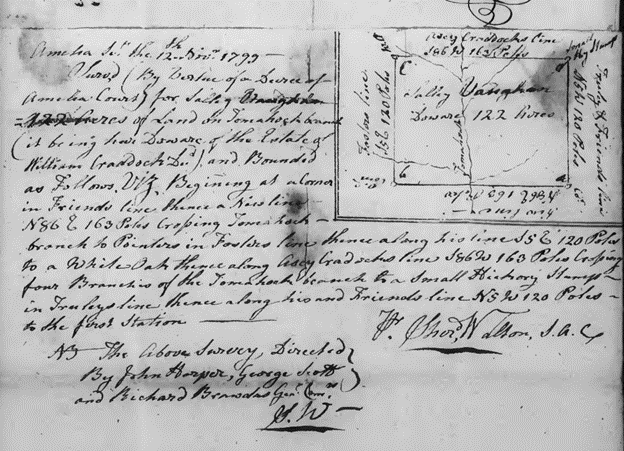
Sarah (Truly) Craddock Vaughan received use of 122 acres [8] bounded by Tomahawk branch, Foster’s line, Craddock’s line, four branches of Tomahawk branch, Truly [9] and Friend’s line. She also received use of three enslaved people named Ned, Darkus and Aggy. She also received furniture, household goods, two cotton wheels, a loom and tools. She is referred to as “Sally” Vaughan in this suit.[10]
Sarah and Jane’s father, John Truly, Sr., made his will in 1803 [blank date], which was proven 27 September 1804. He left daughter Sarah (Truly) Craddock Vaughan 110 ½ acres “whereon she now lives” that he purchased from Daniel Mayes’ estate. He also left Sarah 300 acres, which was part of a tract he purchased from Joshua Atkinson.[11] John Truly, Sr. also gave to “Sarah Vaughan’s children which she has or may have by her present husband Robert Vaughan,” to be allotted to them as they become of lawful age, six enslaved people named Patt, Will, Squire, Jerry, Tom & Fanny and their increase [any children they may have]. In 1803 Robert and Sarah (Truly) Craddock Vaughan were living on land willed to her by her father.

On 23 February 1810, a marriage bond was issued, and shortly thereafter Jane Hatchett Craddock married James Vaughan – another brother of Robert Vaughan III who was surety.[12]
To recap the marriages noted thus far: Three Vaughan brothers (Robert, Asa and James) married two Truly sisters (Sarah, Jenny) and the Craddock daughter (Jane) of one of those sisters.
Robert Vaughan III increases his landholdings by buying out neighbors – and family
While Sarah (Truly) Craddock Vaughan inherited their first 410 acres, it would not be long before Robert III began purchasing adjacent tracts as they came up for sale. In 1810, he bought two tracts one being a 486 acre tract on the south side of Flat Creek from the Estate of William Friend.[13] This tract was the land his father and grandfather, Robert Vaughan I and Robert Vaughan II, sold in separate tracts to Thomas Friend many years earlier. The second purchase was a 474 acre tract on the north side of Flat Creek from the Ogilby Estate.[14] In 1811 he acquired 70 ¾ acres from Robert Ligon and in 1812 he bought 366 ½ from his uncle James Vaughan and his wife Jane Hatchett (Craddock) Vaughan (also Robert III’s step daughter). This was William Craddock’s land and Jane’s inheritance, which she sold to her stepfather and mother. They had been living in Nottoway County since 1810.[15] In 1818 Robert Vaughan purchased 202 ½ acres from the executors of Jacob Ashurst.[16] He now owned more than 2,000 contiguous acres on both sides of Flat Creek. He undoubtedly grew tobacco using the labor of the nearly 60 enslaved men, women and children he held. He also had seven sons for which he needed to provide.
Death of Robert Vaughan III
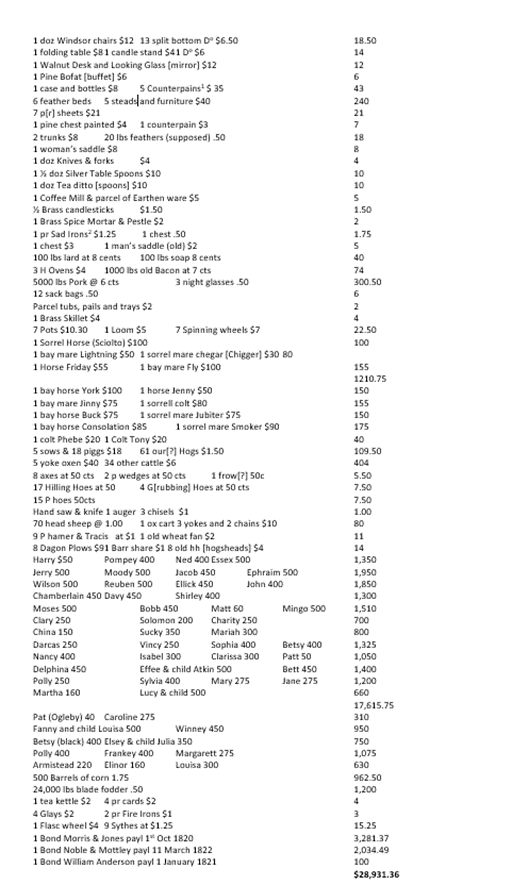
Robert Vaughan III was dead by August 1820[17] when the Amelia County Court ordered an inventory and appraisal (I&A) of his personal estate. The I&A was returned by the appraisers to the court on 14 September 1822. It is extensive and includes furniture, household goods, farm equipment, tools, horses [all named], cattle, pigs, oxen as well as harvested corn and fodder. Robert Vaughan III’s inventory also includes the names of 58 enslaved men women and children valued at $18,810 of a total personal estate value of $28,931.[18]


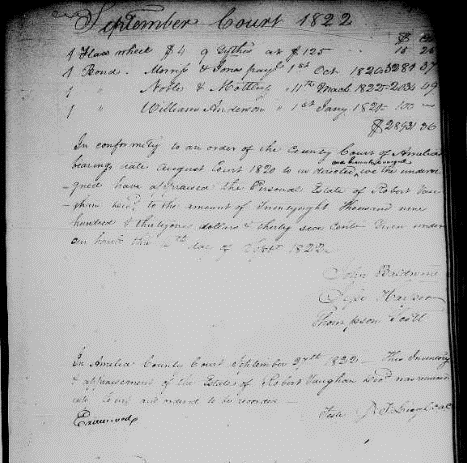
Robert Vaughan III Estate Inventory Transcription
In conformity to an order of the County Court of Amelia bearing date August Court 1820 to us directed, we the undersigned have appraised the personal Estate of Robert Vaughan, Dec’d., to the amount of Twenty eight thousand nine hundred & thirty one dollars & thirty six cents given under our hand this 14th day of September 1822.
A Public Sale
As was common in those days, a public auction was held to sell the personal estate of Robert Vaughan to the highest bidder. Family members and neighbors bought items. The proceeds of the sale were divided among the heirs. Sarah (Truly) Craddock Vaughan bought all of the furniture and household goods and a lot of corn and fodder. Son Robert T. Vaughan bought a bay mare, son James A. Vaughan bought a bay mare. Neighbors bought mostly livestock. None of the enslaved were included in the sale.[19]
Division of the Estate
Dying intestate [without a will] meant that Robert Vaughan III’s estate would be divided according to Virginia law through the Chancery Court system. Generally speaking, a widow was entitled to the use of one-third of her husband’s real and personal estate for her lifetime or widowhood. The other two-thirds would be divided among the heirs. In this case – the seven sons of Robert Vaughan III. As such two chancery suits were filed in Amelia County in January 1821 and March 1821.[20] The eldest son James Armistead Vaughan appears to have reached the age of majority at about this time, which likely prompted the non-controversial suits.
Real Estate Division
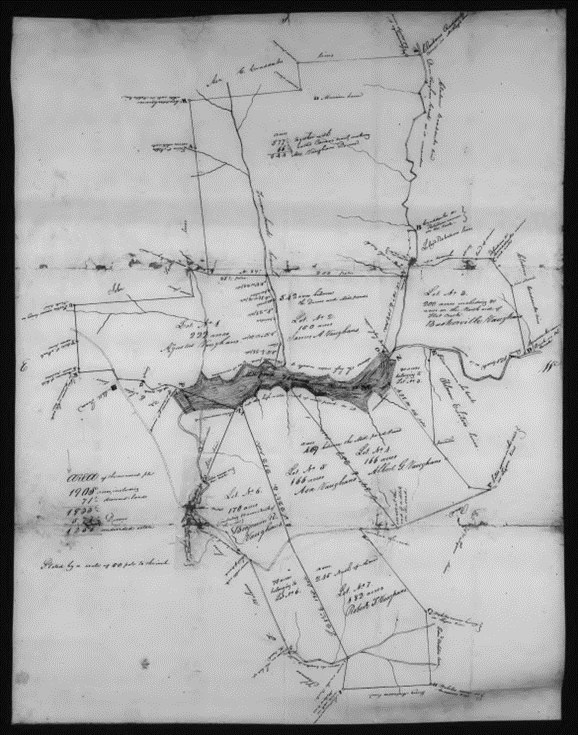
After surveying and dividing, Robert Vaughan III’s real estate amounted to 1905 acres with 71 ½ of “drowned land,” which was the Flat Creek Millpond that was used to run Grove Mill [later Jeter’s Mill].
You can read about the History of Jeter’s Mill here: https://asonofvirginia.blog/2023/11/08/history-of-jeters-mill-amelia-county-virginia/
The widow Sarah Vaughan’s dower included 577 ½ acres with the “Mansion House” and a 66 ½ acre tract called the “Canoe Tract.” Their seven sons drew or were assigned lots as follows:
Lot 1 – 222 acres to Augustus Vaughan
Lot 2 – 150 acres to James Armistead Vaughan
Lot 3 – 200 acres to Baskerville Vaughan
Lot 4 – 166 acres to Albert Gallatin Vaughan
Lot 5 – 166 acres to Asa Vaughan
Lot 6 – 170 acres to Benjamin Rush Vaughan
Lot 7 – 182 acres to Robert Truly Vaughan
Total of 1,256 acres to sons
Personal Estate Division – The Vaughan Enslaved
The 58 enslaved men, women and children held by Robert & Sarah (Truly) Craddock Vaughan were similarly divided between his widow (one-third) and seven sons (one-seventh of the remaining two-thirds).
From the estate of Robert Vaughan III – dower share to Sarah (Truly) Craddock Vaughan
Ned $300, Polley $250, Martha $150, Jane $220, Chamberlain $350, Pompy $300, Darkus $275, Viney $200, Reuben $400, Suckey $300, Patt $50. John $250, Clary $230, China $150, Caroline $180, Shirley $250, Mingo $350, Ephraim $400
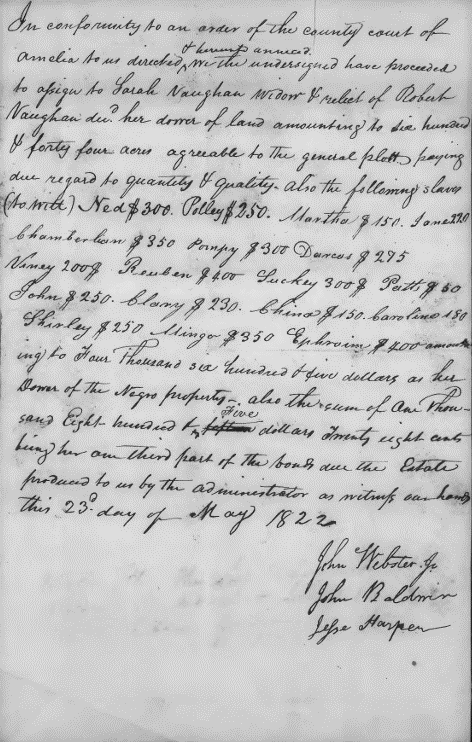
From the Robert Vaughan III Estate
[one seventh of remaining two thirds of the enslaved to each son]
James A Vaughan: Jacob $350, Armistead $200, Elsey & child Julia $350, Sylvia $300, Moriah $250
Robert T Vaughan: Alexander $380. Solomon $200, Fanny & child Louisa $400, Lucy $300, Louisa $180
Baskerville Vaughan: Moses $400, Nancy $300, Franky $300, Matt $80, Effy & child Atkin $400
Albert G Vaughan: Essex $400, Charity $200, Delphia $300, Betsey (Yellow) $300, Margarett $250
Augustus Vaughan: Moody $400, Isabel $200, Betty (B) [black] $300, Mary $200, Clarisa $280, Patt $30
Asa Vaughan: Wilson $380, Bob $300, Sophia $330, Betsey $275, Ellen $150
Benjamin Rush Vaughan: Jerry $400, Davy $300, Winney $350, Polley, Jr $300, Harry $50
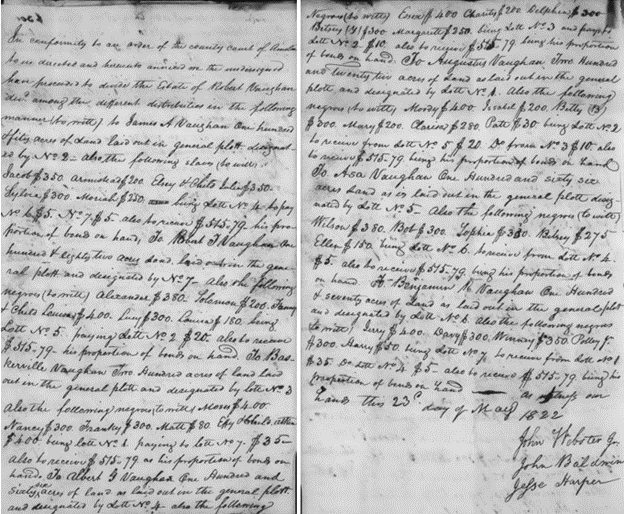
To equalize the division the brothers either paid to or received small sums from other lots. Each son also received a little more than $500 from bonds owed to their father. While the eldest son James had turned 21 when the chancery suits were filed, the other brothers were still minors ranging from about 20 to 7.
Robert Vaughan III, b.c. 1770, Amelia County, Virginia, d.c. 1819 Amelia County, Virginia, m.b. 20 January 1799, Amelia County, Virginia, Sarah (Truly) Craddock (b.c. 1770, Amelia County, Virginia, d. 1839, Amelia County, Virginia, issue:
James Armistead Vaughan (c. 1800-d.1874) m. 1825, Mary Ann Vaughan, (2) abt. 1847, Rebecca A. Bass
Robert Truly Vaughan (c. 1802-c. 1870s) unmarried
Baskerville Vaughan (1803-1854) m. 1830, Catherine G. Williams, (2) Melinda Campbell
Albert Gallatin Vaughan (c. 1806-1849) m. Martha Elizabeth Vaughan
Augustus Vaughan (c.1811-c.1851) m. 1843, Mary Spencer Farmer
Asa Vaughan (1812-1855) m. 1841, Julia Ann Walthall
Benjamin Rush Vaughan (c.1815-c.1825) unmarried
Next time: The Vaughan Brothers
[1] Became Nottoway County in 1789.
[2] On 3 December 1802, Robert Vaughan of Nottoway County sold this 484 acre tract to David W. Sharp of Henrico County for £1,000 current money of Virginia. Bounded by lands of Thomas Friend, [blank] Burton, Joseph Bailey, William Randolph, and James River. John Truly, Sr. & Robert Vaughan, Jr. (III) were witnesses. Henrico County, Virginia Deed Book 6 1800-1803, p., 424; https://www.familysearch.org/ark:/61903/3:1:3Q9M-C373-VSF7-R?i=615&cat=402648
[3] Amelia County, Virginia, Index-Transcript of Marriage Bonds, 1735-1854, unpaged, Reel 54, Library of Virginia
[4] Son of Richard and Elizabeth (Hill) Craddock. He also had an uncle named William Cross Craddock (d. 1795)
[5] William Craddock’s estate inventory is dated 11 October 1797 and was returned 26 October 1797. Amelia County Will Book No. 5 1793-1799, p. 422; https://www.familysearch.org/ark:/61903/3:1:3QS7-99P4-XXWK?view=fullText&keywords=William%20Craddock&groupId=M9X2-S4L
[6] Jane Hatchett Craddock’s birth year of 1797 is based on her age in the 1850 and 1860 federal censuses as well as the age of the unnamed white female living with James Vaughan in 1810, 1820 and 1830. Jane’s parent’s marriage bond is dated 15 December 1791, which suggests a marriage in late 1791 or early 1792. A five year gap from the marriage to Jane’s birth suggests that Sarah may have had other children that did not survive. However, as she and Robert Vaughan had seven sons between 1800 and 1815 perhaps there was another issue at hand.
[7] A widow typically was entitled to use of one-third of her deceased husband’s real and personal estate for her life or as long as she remained a widow. Many exceptions to the rule are found.
[8] One-third (1/3) of William Cross Craddock’s 366 acre tract. In 1785 his father Richard Craddock willed to him 300 acres in Amelia on Tomahawk Branch and Flat Creek. Amelia County , Virginia Will Book No. 3 1780-1786, p. 329; https://www.familysearch.org/ark:/61903/3:1:3QS7-L9P4-XQN6?i=364&cat=275408
[9] Her father John Truly, Sr. She also had a brother of the same name.
[10] Amelia County, Virginia Chancery Causes, No. 1800-025, Robert Vaughan & wife v. Admr of William Craddock & etc., Virginia Memory, Library of Virginia Digital Collection; https://www.lva.virginia.gov/chancery/case_detail.asp?CFN=007-1800-025
[11] I found no recorded deed for either of these purchases.
[12] Amelia County, Virginia, Index-Transcript of Marriage Bonds, 1735-1854, unpaged, Reel 54, Library of Virginia
[13] 1810 Friend to Vaughan Deed. Amelia County, Virginia Deed Book No. 23 1808-1814, p. 221; https://www.familysearch.org/ark:/61903/3:1:3Q9M-CSL6-M9HF-4?view=fullText&keywords=Robert%20Vaughan%2CWilliam%20Friend%2CFriend&groupId=M9XL-5HV
[14] Ogilby to Vaughan Deed. Amelia County, Virginia Deed Book No. 23 1808-1814, p. 372; https://www.familysearch.org/ark:/61903/3:1:3Q9M-CSL6-M9HZ-8?view=fullText&keywords=Robert%20Vaughan%2COgilby&groupId=M9XL-5HV
[15] 1810 United States Federal Census, Nottoway County, Virginia, Roll: 70; Page: 1010; Image: Vam252_70-0327; FHL Roll: 0181430; Ancestry.com
[16] 1818 Deed. Amelia County, Virginia Deed Book 25 1817-1821, p. 174; https://www.familysearch.org/ark:/61903/3:1:3Q9M-CSL6-SKJL?view=fullText&keywords=Robert%2CRobert%20Vaughan%2CVaughan&groupId=M9XL-56Y
[17] He was likely dead by December 1819, which is the first date listed in the account current filed with the Amelia Court by the Estate Administrator James A. Vaughan, eldest son of Robert III and Sarah (Truly0 Craddock Vaughan.
[18] Amelia County, Virginia Will Book No. https://www.familysearch.org/ark:/61903/3:1:3Q9M-C9TH-2SLT-Z?i=478&cat=275408
[19] Amelia County, Virginia Will Book 1818-1823, p. 372-381; https://www.familysearch.org/ark:/61903/3:1:3Q9M-C9TH-2SLT-Z?i=478&cat=275408
[20] Amelia County Chancery Suits No. 1824-016 (Sarah Vaughan, Widow vs. Admr. of Robert Vaughan, etc.) and No. 1824-020 ( Dist(s) of Robert Vaughan v. Admr. of Robert Vaughan, etc.), Virginia Chancery Records, Library of Virginia Digital Collections.
 A Son of Virginia
So much of your work bears out the truth that property speculation was so much of the wealth of early settlers; the getting of it, the improving it and the disposition of it. Big change from the old countries from which Europeans came
LikeLike
That feudal/class system managed to survive in Europe well into the 19th century. Hard to imagine. The Vaughans were particularly adept and “keeping it in the family” over multiple generations. Fantastic records from which to draw. Some of it rather heartbreaking but it is what it was.
LikeLike
Sent from Yahoo Mail on Android
LikeLike