
Several weeks ago I met Claude Morris when he accompanied a group of my Morris cousins to two Morris cemeteries in Buckingham County. See my earlier blog post A Field Trip to Buckingham County – meeting cousins and making new friends: https://asonofvirginia.blog/2024/05/11/a-field-trip-to-buckingham-county-meeting-cousins-and-making-new-friends/
Claude descends from Nicholas Hudson Morris (c.1770-c.1846) called “Hudson” while I descend from Nathaniel Morris (c.1745-1813). While we are not related (that we know of!), we both love history. I mentioned to Claude that that I wanted to come back and find Morris’s Mill, which was associated with Cutbanks Plantation. The Plantation and Mill are associated with two generations of my Morris ancestors including Nathaniel’s son John Morris (1779-c.1862) and John’s son John James Morris (1812-c.1857) called “James.”
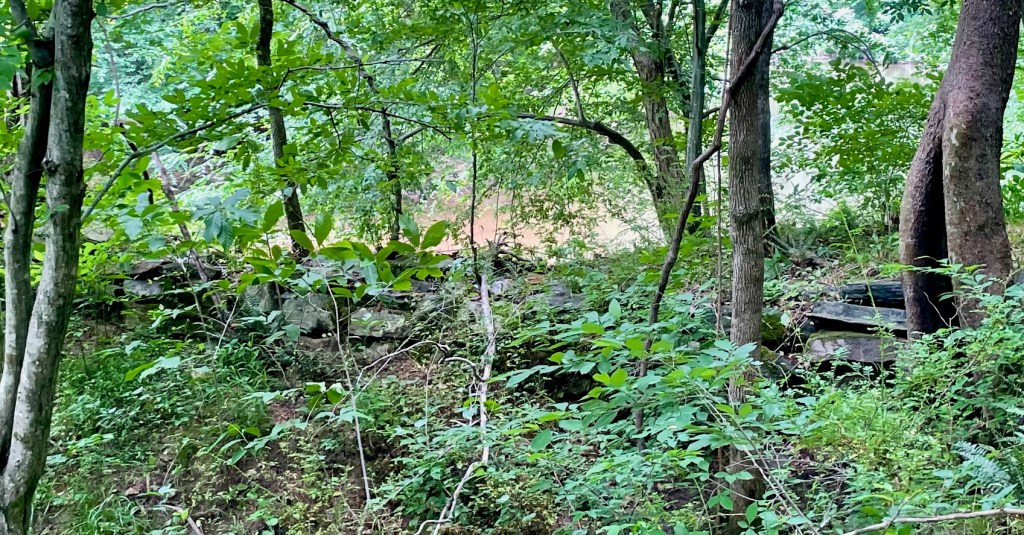
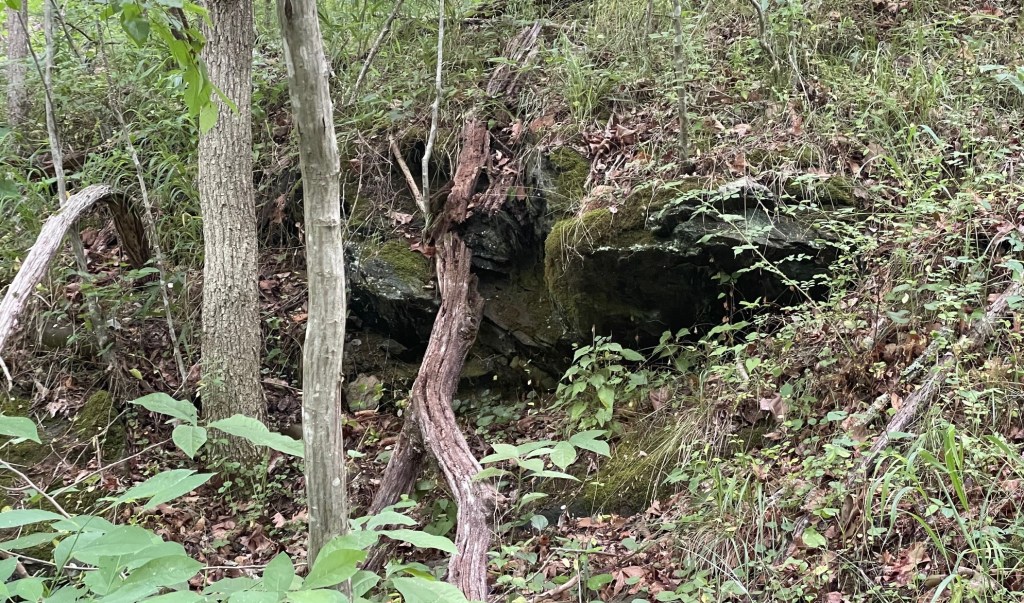
In one of those small world coincidences, Claude’s cousin Larry Morris is the current owner of Cutbanks Plantation. Larry gave us permission to visit and was kind enough to do some weed eating to make access easier for us. Independently of meeting Claude, I met L.D. Phaup through a Buckingham County genealogy researcher group. L.D. also loves history and as it turns out Claude and L.D. are friends so we decided we should all go exploring together. We met up with another history lover, nine-year-old Kemp Beasley, whose family live nearby and who is well known to Claude and L.D. We stumbled around a bit, but found the old mill site fairly easily.
John Morris, Esquire (1779-c.1862) of Buckingham County – my 4x great grandfather
On 18 May 1818, John Morris of the County of Buckingham sold to Charles Woodson, Escheator for the county of Prince Edward, the land of John McMurry who died without heirs. It’s possible that John Morris was serving as the estate administrator, a role he filled many times during his time as a Buckingham justice of the peace. This parcel of 422 ¾ acre tract was located “upon Appomattox on the east side of the road leading from Peter Fores to the cut banks upon said river.” It was described as “bounded by cut bank road and the lands of said Morris to the west, land of Mrs. Hubbard also westwardly, lands of John Cheadle & Mrs. Arnold Southwest, Appomattox River East and North, and lands of Isham Gillam & Silas Watkins opposite in the county of Buckingham.”[1] The reference to “lands of said Morris” indicates John already owned land in Prince Edward County by 1818, but I have found neither patent nor deed for his prior acquisition.
Interestingly, while the above deed has John Morris selling this tract to Woodson, a deed for the following year indicates that Morris ended up purchasing the tract from Woodson, although I haven’t found a deed for the transaction. On 15 February 1819 John Morris paid $154 for 21 ½ acres from Joel Simmons who had purchased it for back taxes from the Prince Edward County sheriff. The deed notes that the tract was never laid off but was included in the lines of the 422 acres. This deed states, “being a part of the estate of John McMurray, decd, which escheated to the Commonwealth and was sold by Maj. Charles Woodson to John Morris, Esq with the reserve of 21 ½ acres.”[2]
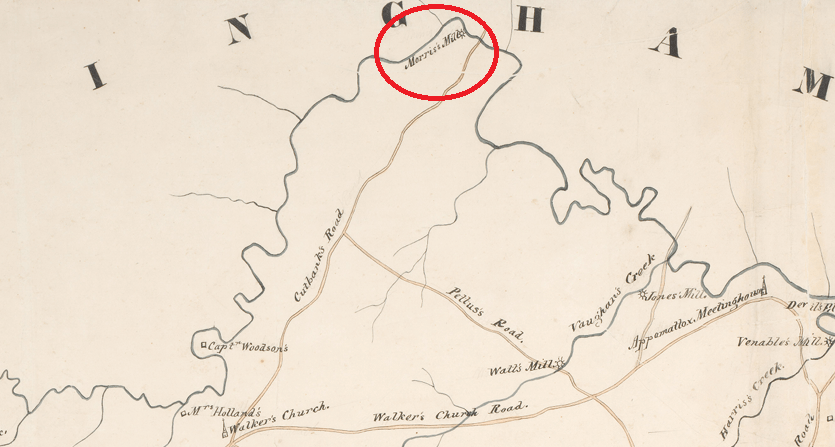
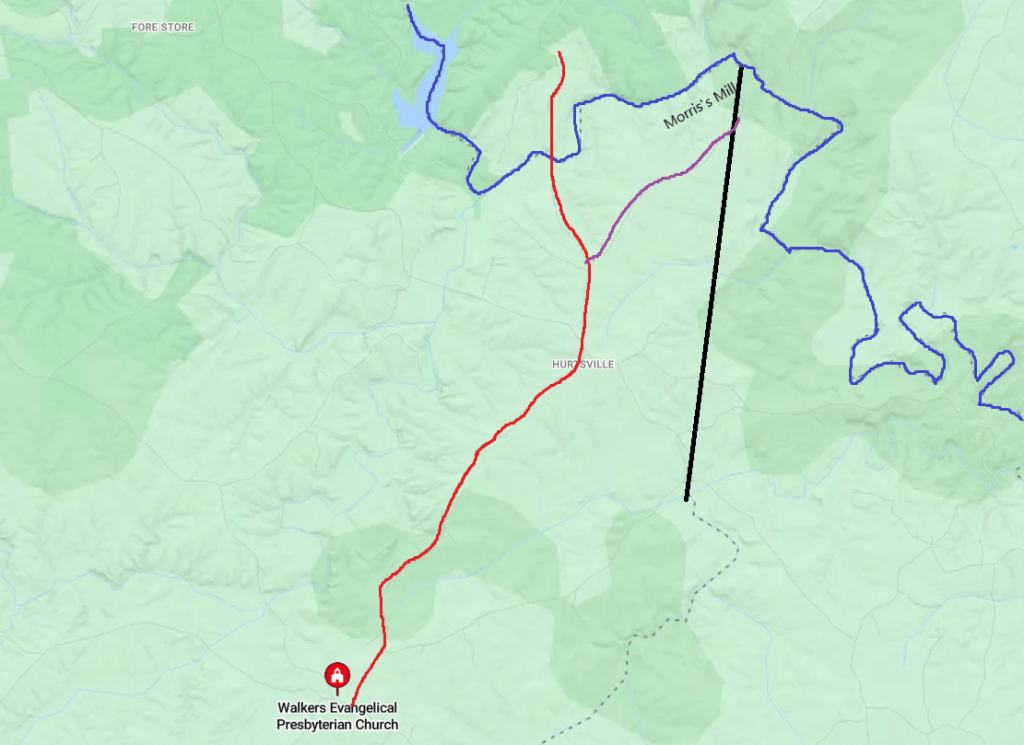
Also in 1819 John purchased 284 acres from Joseph Fuqua in Buckingham County on the Appomattox River 16 miles south of the courthouse.[3] On 26 July 1822, he received a patent for an adjacent tract in Prince Edward of 401 1/4 acres adjoining his 422 acre tract.[4] John Morris owned 824 acres in Prince Edward County not including the tract of unknown acreage he acquired before 1818. Combined with the 284 acres in Buckingham County, these tracts in both counties straddling the Appomattox River at the cut banks,[5] came to be known as Cutbanks Plantation. An 1820 map of Prince Edward County shows that Morris’s Mill was just west of Cutbanks Road. [6]
John and Nancy (Holland) Morris never lived at Cutbanks Plantation. He was a Buckingham County Justice of the peace from 1812 through at least 1841.[7] They first lived at Green Springs, which was a 660 acre tract that later was purchased by John’s brother Samuel Morris and became the Buckingham White Sulphur Springs Resort. About 1819, John Morris bought 496 acres in Buckingham County from his brother-in-law, Richard Holland. Jr.. Holland had inherited the property from his half-brother Dr. James Walker. Both men were brothers of John Morris’s wife Nancy (Holland) Morris whose mother Martha Jones married (1) Henry Walker and (2) Richard Holland. At some point, John and Nancy (Holland) Morris moved from Green Springs to this tract, which along with subsequent purchases became known as Mt. Rush.
John James Morris (1812-c.1857) – my 3x great grandfather
John James Morris[8], eldest son of John and Nancy (Holland) Morris, was born about 1812 in Buckingham County, Virginia.[9] About 1837, he married Elizabeth Smith Gills, daughter of Miles A. & Mary A. D. (Atkinson) Gills of Amelia County, Virginia.[10] The couple made their home at Cutbanks Plantation, which contained some 900 acres, and was located on the Appomattox River in both Prince Edward and Buckingham County. Most of the acreage and the residence were in Prince Edward with less than 200 acres in Buckingham. James Morris had been given joint ownership of Cutbanks by his father; along with his brothers-in-law, Nathan H. Thornton, George W. Motley and John W. Yarborough in 1836. He bought out his brothers-in-law’s interests and, by 1838, was the sole owner. Details of the ownership of Cutbanks Plantation are outlined in a legislative committee document reporting their conclusions with respect to contested votes in Buckingham County.[11]

Cutbanks Plantation and the 1840 Buckingham General Assembly Election
John J. Morris was one of 47 voters whose ballots were challenged by John W. Haskins and Dr. James Jones. Haskins and Jones were Democratic candidates from Buckingham who lost to Whig candidates Thomas H. Flood and George W. Kyle. The initial results were remarkably close with Kyle receiving 504 votes, Flood and Haskins 503 votes apiece and James Jones 502 votes. The 47 voters whose ballots were challenged were each deposed along with other witnesses, concerning their ownership of land in Buckingham County, which entitled them to vote. After depositions were concluded, the final election results were Flood 486, Kyle 485, John W. Haskins 470 and James Jones 468 sending the Whig candidates to Richmond. My Morris ancestors were Whigs during this period.
From James Morris’ deposition, he “voted upon the tract of land where he lives, containing about 900 acres, of which about 160 or 170 acres lie in Buckingham County; that his father, John Morris, gave the said tract of land in the year 1836, to the deponent [John J. Morris], Nathan H. Thornton, George R Motley and John W. Yarborough; sons-in-law of said John Morris; that the deponent has had possession of said land since the 1st of May 1836; that he purchased said Thornton’s interest in 1836, and has paid him for it; he purchased the interests of said Motley and Yarborough in 1838; that there is no written agreement or deed between himself and Thornton and Yarborough, though there is a written agreement between himself and Motley; that there is no deed from his said father to the donees, nor is there anything in writing from his father evidencing the gift; that the deponent has built a large dwelling house, rebuilt a mill and put other improvements on said land, to at least the sum of $8,000; that a part of said improvements have been put on the land in Buckingham County the value of four or five hundred dollars, that he believes no one else voted on said land; that said land is charged on the Commissioners books to John Morris; that the deponent has paid taxes on it to the sheriff of Prince Edward ever since he had possession; that he has resided on that part of said land in Prince Edward for the last four years, during which time he has cultivated the part lying in Buckingham; that he has paid no rents, nor is there any agreement by which he is to pay any sort of rent for said land; that he commenced putting the improvements on said land shortly after he went to live on it in 1836 – there has been no division of the land between himself and the donees aforesaid; that said land was given to them jointly; that neither of the other donees was in occupation within 12 months preceding the election; that the improvements on that part of the land lying in Buckingham county, consist of dyking, ditching, &c. but no houses. And by the deposition of John Morris, it appears that he, the said John Morris, substantially confirms the statements made by his son, the said John J. Morris, in his deposition;” His vote in Buckingham County was found to be legal as he owned improved land in Buckingham County even though he lived in Prince Edward County.
Cutbanks Plantation and Chancery Court Suits
In 1839, John J. Morris and his brothers-in law, George R. Motley and John W. Yarborough, brought a suit in the Chancery Court of Prince Edward County.[12] The suit further describes the transfer of ownership of Cutbanks Plantation. The trio formed a “mercantile partnership in 1836 operating at the Cut Banks in the County of Prince Edward under the style of John J. Morris & Co.” According to the Bill of Complaint, just prior to the forming of the partnership in 1836, John Morris of Buckingham County, father of John J. Morris gave him an estate in Prince Edward County at the “Cut Banks” on the Appomattox River, which contained “an excellent mill seat.” The partners thought they could increase their profits by rebuilding the old mill on a larger scale and by adding a sawmill. They hired one Joseph Yarborough of Halifax County to do the work. He was an older half-brother of John W. Yarborough, brother-in-law of James Morris. Joseph Yarborough was to also provide all materials at a cost equivalent to what the orators would have paid in the City of Richmond and shipped up the river. Yarborough finished the work about August 1837 and presented a bill for $1,154.78. The partners alleged that “the mill had scarcely got into motion before it was manifest that it could answer no good purpose and could grind but indifferently” so they refused to pay the balance.
Joseph Yarborough filed suit to collect in the Circuit Superior Court of Law and Equity in Prince Edward County against John J. Morris & Co. demanding the full amount. The partners alleged that during the suit John J. Morris attempted to get skillful millwrights to ascertain said works to prove his case, but no one wanted to be inconvenienced by spending time as a witness so they had to go to trial in September 1838 with no expert witness. Joseph Yarborough was awarded $1,134.56 subject to an abatement of $468.62 leaving a balance of $665.94. The partners asked for a new trial as they believed they could prove the mill was useless as one of the witnesses of the said Joseph Yarborough (his brother Richard Yarborough) was willing to examine the mill but they only learned of this after the verdict was rendered. The Court did not grant a new trial but abated an additional $50 of the award.
The partners then turned to the Chancery Court in May 1839, asking the court to grant an injunction so Joseph Yarborough could not pursue further legal action over the remaining debt, which the Court granted. They mention two bonds of $135 each that they want to be used to offset the balance and ask that 12 months of lost profits of $1,000 be counted as well. John J. Morris appeared in Lynchburg on 10 May 1839 and took an oath to say that the facts alleged are true.
Joseph Yarborough filed his Answer in August 1839 disputing the allegations and asked for the injunction to be lifted. The aforementioned bonds were for land Joseph Yarborough bought in Buckingham on installment payments. John J. Morris paid two of the $135 installments for him and Yarborough issued a bond (or bonds) to obligate himself to John J. Morris for the payments. The Answer further notes that Joseph Yarborough and his brother, Richard Yarborough, were partners in a foundry in North Carolina where iron for mill could be purchased. Perhaps it was desperation that caused John J. Morris to secure Richard Yarborough, the brother and business partner of his opponent in court. Joseph Yarborough appeared in Halifax County in August 1839 to swear his answers true and the Court ordered the injunction lifted the following month. In 1844, another chancery suit was filed in Prince Edward County styled John W. Yarborough v. John J. Morris, etc.[13] The suit notes that John W. Yarborough and George W. Motley sold their interest in John J. Morris & Co. to John J. Morris in November 1837 making him the sole owner.
Further records stating the ultimate disposition of these cases were not found, however, it is apparent that things did not end well for James Morris. He is found on the personal property tax rolls of Prince Edward County from 1837 (when he replaces his father, John Morris of Buckingham) until 1843. From 1837 until 1842, John James Morris held between 8 and 11 enslaved people, a carriage, horses and cattle. He paid personal property tax ranging from $7.18 (1838) to $10.10 (1841). In 1843, however, his circumstances had changed dramatically. There were no slaves, no carriage, no horses and no cattle and the tax owed was 14 cents.[14]
A Last Resort
On 14 Dec 1842, James Morris was forced to enter into a contract to buy himself time to satisfy his debts, using his real and personal property as collateral.[15] The Indenture was between John J. Morris and his wife Elizabeth of the County of Prince Edward – 1st part, Nathanial Morris (James Morris’ uncle) of Buckingham County – 2nd part, John Morris (his father), John Jones and Nathan H. Thornton (his brother-in-law) also of Buckingham – 3rd part. The Indenture states that “John J. Morris is indebted to John Morris in the sum of $2000 plus interest from 1 Jan 1839, said John Morris stands bound as the security of the said John J. Morris to John H. Johnson in the sum of $4,400 due by bonds including one to the Bank of Virginia for $1,000 +/-, one to Edward Woodbridge totaling $500 plus interest subject to some credits, one to Carrington, Gibson & Thornton $2,350 plus interest, John Jones & N. H. Thornton stand as securities of the said John J Morris.” The indenture went on express his desire to hold his securities harmless and went on to place into Trust with his uncle, Nathaniel Morris, “752 acres in Prince Edward and Buckingham Counties plus his crop of tobacco, horses, cattle, hogs, household & kitchen furniture, plantation tools, a carriage and harness, two wagons and the rest of his personal property.” The Indenture further provides that John J. and his wife Elizabeth are allowed to stay on the land unless the debts are not paid by a date certain when his Trustee, Nathaniel Morris, would sell the all of the property listed in the agreement. A codicil to the agreement notes a debt of $700 to Miles A. Gills (James Morris’ father-in-law) had been omitted from the agreement.
The debts could not be paid and the young couple, who by 1843 had at least three children under the age of six, lost Cutbanks Plantation they disappear from the Prince Edward County tax rolls beginning in 1844. Cutbanks Plantation is mentioned in a Buckingham County lawsuit styled Vawter vs. Morris filed in 1871 against John Morris’ estate. James Morris father appears to have retained ownership of Cutbanks Plantation.
A New Beginning
In 1845, James Morris, now age 33, his wife Elizabeth and, by now four or five young children, were living in Amelia County on a farm owned by Elizabeth’s father, Miles A. Gills.[16] By 1850, James Morris had relocated to the City of Richmond. The census taken Dec 1 for that year includes John J. Morris, 38, working as a tobacconist with real estate valued at $5,000. Three Morris children were also living in the household including Mary E. Morris, age 12, John A.R. (Augustus Rives) Morris, age 10 and Martha Morris, age 8. Other household members included Morris [Maurice] L. Guerrant, age 28, Mary E. Motley, age 35 (James Morris’ sister), and her children John J. Motley, age 18, George R. Motley, Jr., age 16 and Nancy H. Motley, age 6 (listed erroneously as Nanny Morris).[17]
Elizabeth Smith (Gills) Morris and two younger children, William H. Morris and Thomas S. Morris are not listed in the 1850 census. No death record for Elizabeth (Gills) Morris or youngest child Thomas S. Morris have been found, although it appears they both died by 1850. Son William H. Morris died in 1863 at the age of 19 in Richmond.[18] Where William H. Morris was living at age six in 1850 is a mystery as he is not listed in the census with any paternal or maternal relatives.
Aside from William’s obituary, he and Thomas are only known to us having been mentioned in an 1847 Deed of Trust between John James Morris and his father in law, Miles A. Gills.[19] The deed put into trust $1,000 from Miles A. Gills for the children of John J. and Elizabeth (Gills) Morris and named John J. Morris as the Trustee. Given the deed of trust was filed in Richmond, its appears James Morris family was living there by 1847. Mary E. (Morris) Motley’s husband, George R. Motley, Sr., is also not listed in the census his having died in Richmond, Virginia in 1848.[20]
Beyond the 1850 census there is little information about the life or death of John James Morris. In 1854, he was one of dozens of signatories of an appeal in the newspaper to establish a Board of Trade to promote manufacturing and commerce in the City of Richmond and calling for a meeting of merchants and manufacturers.[21] The last record of him is in the 1856 Richmond City Directory contains a business listing for John J. Morris & Co. located at Anderson’s Warehouse, south side of Basin, on the northeast corner of 8th & Canal Streets and a residential listing located on Main Street between 7th and 8th Streets.[22]
James Morris was certainly dead by 8 Jul 1863, when a legal notice appeared in the Richmond Whig newspaper concerning a Buckingham County Chancery Suit with the stated purpose of “obtaining a division of the estate of John Morris, dec’d.” John Morris’ surviving children and deceased children with living heirs are all listed and include Mary (Morris) Motley, Martha A. (Morris) Thornton, Nathaniel D. Morris, Benjamin S. Morris and his wife Mary (Claiborne), John J. Morris, dec’d and Helen M. (Morris) Yarbrough.[23]
John James Morris, b.c. 1812, Buckingham Co., VA, prob. d. by 1857, Richmond, VA, m. abt. 1837, Elizabeth Smith Gills, b.c. 1818, d.c. 1848, issue:
Mary Elizabeth Morris, b. 1838, d. 1873, m. John Marshall Goddin (they lived in Richmond)
John Augustus Rives Morris, b. 1840, d. 1904, m. Ann Octavia Vaughan (lived in Amelia County) – these are my 2x great grandparents.
See my earlier posts:
Fatally Gored By An Infuriated Bull https://asonofvirginia.blog/2022/02/15/fatally-gored-by-an-infuriated-bull/ and John Rives Morris Part 2 https://asonofvirginia.blog/2022/07/26/john-rives-morris-1840-1904-part-2/
Martha Ann Morris, b.c. 1842, d. aft. 1910, m. John Cecil Higginbotham (removed to California)
William H. Morris, b.c. 1844, d. 1863, unmarried
Thomas S. Morris, b.c. 1846, d. bef. 1850
[1] Prince Edward County Deed Book 16, 1816-1819, p. 338; https://www.familysearch.org/ark:/61903/3:1:3Q9M-CSL6-Q3D5-Q?view=fullText&keywords=John%20Morris&groupId=M9V3-3Q9
[2] Prince Edward County Deed Book 16, 1816-1819, p. 430; https://www.familysearch.org/ark:/61903/3:1:3Q9M-CSL6-Q3D5-X?view=fullText&keywords=John%20Morris&groupId=M9V3-3Q9
[3] Buckingham County Land Tax Book, 1814-1822, Reel 52, Library of Virginia, Richmond, VA
[4] Land Office Grants No. 71, 1822-1824, p. 157 (Reel 137), Library of Virginia, Richmond, Virginia
[5] A cut bank, also called a river cliff, is the outer bank of a curve in a stream that is constantly eroding. Cut banks are not only steep and unstable, but also where the water flows fastest and deepest, known as a “high-energy” area in geology, Wikipedia.
[6] Wood, John. 1820 map of Prince Edward County, Virginia, Board of Public Works, Library of Virginia digital collection; https://www.virginiamemory.com/collections/bpw
[7] John Frederick Dorman, Ed. The Virginia Genealogist, (Washington DC, 1996) Vol. 40 1-4, p. 212. A list of Justices certified by Buckingham County Clerk Rolfe Eldridge is among the executive papers of Gov. John Rutherfoord dated May 1841.
[8] John James Morris was called James, although he is styled John J. Morris in most records. He is referenced as James Morris in chancery records concerning his father’s estate. In Richmond City directories he is styled John J. most of the time, but a few J. James are there as well.
[9] Ancestry.com; 1850 U.S. Federal Census, City of Richmond, VA; Roll M432_951: Page 378B; Image 288
[10] Prince Edward Co., VA, Chancery Suit 1840-014, American Memory, Chancery Cause Index, Library of Virginia website (www.lva.virginia.gov)
[11] Document 32 – Report of the Committee on Privileges and Elections, Journal of the Virginia House of Delegates, 1840-41 Session, Richmond, VA, printed by Samuel Sheppard, Printer of the Commonwealth, 1840, pp. 99-101.
[12] Prince Edward Co., VA, Chancery Suit 1840-014, American Memory, Chancery Cause Index, Library of Virginia website (www.lva.virginia.gov)
[13] Prince Edward Co., VA Chancery Suit, 1844-030, American Memory, Chancery Cause Index, Library of Virginia website (www.lva.virginia.gov)
[14] Auditor of Public Accounts Personal Property Tax Records, Prince Edward Co., VA, 1832-37, Reel 283; 1838-1850, Reel 284, Library of Virginia
[15] Prince Edward Co., VA Deed Book 23, p. 460, Library of Virginia, Richmond, VA
[16] Amelia County, Virginia Chancery Causes 1892-016, American Memory, Chancery Cause Index, Library of Virginia website (www.lva.virginia.gov)
[17] Ancestry.com;1850 U.S. Federal Census, City of Richmond, VA; Roll M432_951: Page 378B; Image 288; Dwelling 614, Family 714
[18] Richmond Whig (Richmond, VA), pub. date 3 Mar 1863, p. 3
[19] City of Richmond, Virginia Deed Book 59, Page 99, Library of Virginia, Richmond, VA
[20] Ancestry.com; U.S. Find a Grave Index, 1600s-Current [database on-line]. Provo, UT, USA
[21] Richmond Whig (Richmond, VA), pub. date 6 Jun 1854, Vol. 31, Issue 45, Pg. 3
[22] 1856 Richmond City Directory, p. 184, Fiche 102, Library of Virginia, Richmond, VA
[23] Richmond Whig (Richmond, VA), pub. date 28 Jul 1863, Vol. 40, Issue 60, p.4
 A Son of Virginia