
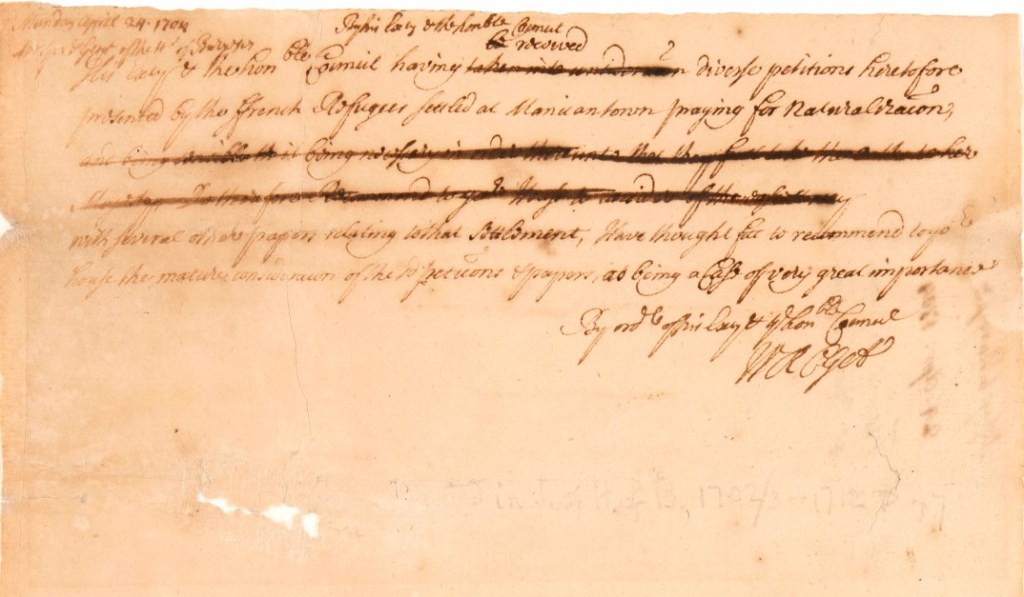
The Virginia legislature met from 18 April to 12 May 1705 at Williamsburg, which had been the capital since Jamestown was abandoned in 1699. During that session they considered a petition from a group of men “born in France and other foreign countries” asking to be made naturalized English citizens. Among them were my 8x great grandfathers Bartholomew Dupuy and John Levillain and my 7x great grandfather Abraham Remy. As citizens they would enjoy all the “rights, privileges and immunities” of any “natural born Englishman.” It was signed on 12 May 1705 attested by William Randolph, Jr., Clerk of the House of Burgesses.[1]
The Huguenots
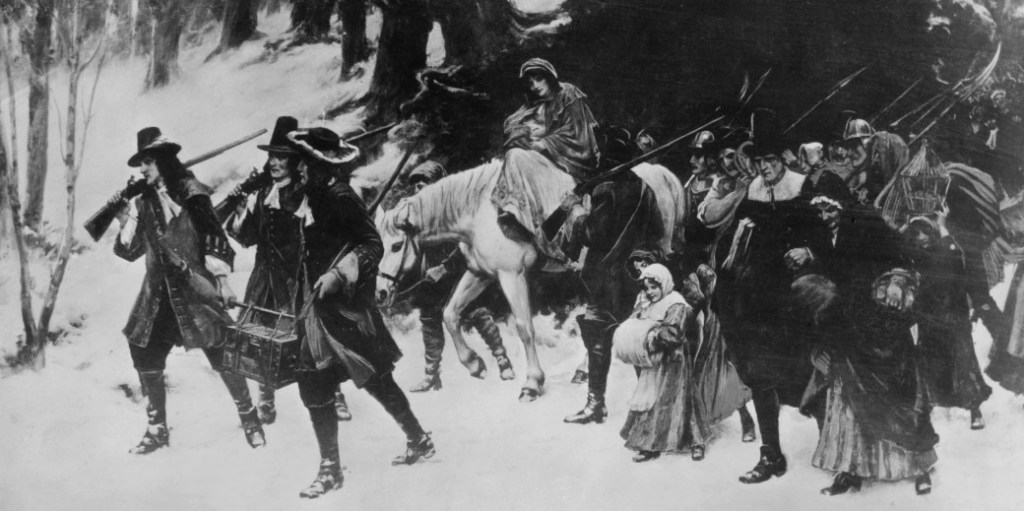
These men were part of a group known to Virginia history as the Huguenots. They were French Protestants and their road to Virginia and English citizenship began in 1685 when the Catholic French King Louis XIV revoked the Edict of Nantes,[2] which had granted rights to the religious minority including tolerance of their faith. The 1685 Edict of Fontainebleau revoked these rights and subjected the Huguenots to severe persecution causing an estimated 500,000 to flee France. They went to a variety of countries, but many ended up in England where the Protestant King William III granted them asylum. By the late 1600s, the number of Huguenot refugees had grown large enough to create economic problems for England. The King and his advisors decided to send some of them to its American colonies. A Protestant Relief Committee was formed to raise funds and plan for the transportation of the Huguenots from London to Virginia. Some £15,000 was raised including £3,000 from the King himself. About 800 people were expected to make the trip.[3] These were not the first Huguenots to immigrate to the American colonies nor even the first Huguenots to arrive in Virginia. Huguenots arrived in (Old) Rappahannock County during the 1680s including minister John Bertrand. Another minister named James Boisseau immigrated to New Kent County in 1690. Both arrived with dozens of households of Huguenot refugees.[4]
The first ship arrives
On a Friday in late July 1700, a ship called the William and Mary dropped anchor at the mouth of the James River at present day Hampton. The 207 men, women and children aboard were no doubt exhausted from a 13 week Atlantic voyage from Graveshead, England. Many of the passengers were ill with dysentery and/or malaria from being in crowded, unsanitary conditions aboard the ship. Among those greeting the group was Lt. Governor Francis Nicholson. After all, the patron of these passengers was the English King himself. Passengers promptly reported that the ship’s captain had “abused them and their goods” during the voyage. They must have been relieved to have made it to Virginia. This was the first of five such ships to arrive in Virginia over the next eight months.
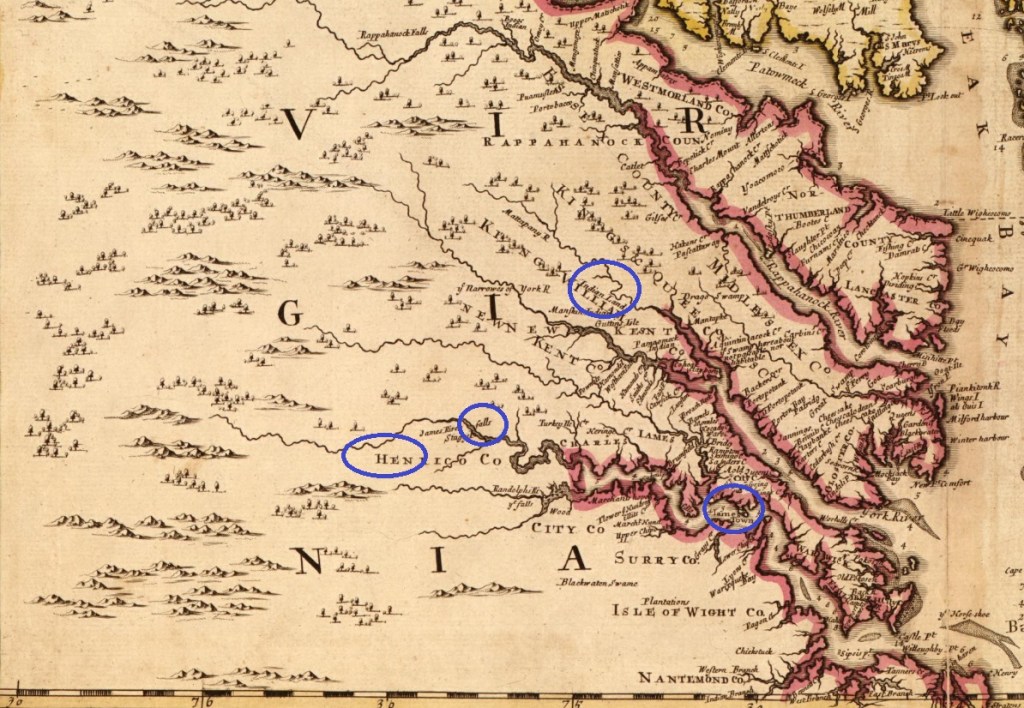
Two proposals had been presented to the English King for the Huguenots settlement in Virginia. One was from Dr. Daniel Coxe of England who proposed settling the refugees in Norfolk County [present day City of Chesapeake] south of the James River. A second proposal was made by William Byrd of Virginia for a settlement further up the James River past the fall line [present day Richmond] in Henrico County [present ay Powhatan County]. While both men may have had a genuine interest in helping the refugees, neither was being entirely altruistic. Both were land speculators that had patented large tracts in the respective areas and wanted to divide and resell smaller tracts to other colonists. After some back and forth, the King chose Dr. Coxe’s proposal and the Huguenots made their way to Virginia.
Upon their arrival at Hampton thinking their journey was nearly over, the Lt. Governor surprised them by telling them that instead of being settled in Norfolk County, they would settle further inland up the James River in what was touted a better place for them. Virginia’s leaders defied the King’s order and later wrote to the English Board of Trade giving their reasoning. The noted that Manakintowne had a healthier climate, better land, and the land was not subject to an ongoing boundary dispute between Virginia and the Lord Proprietors of the of the Carolina Province. These were the same arguments they had made to the King when he rejected their petition in favor of Coxe.

Up the river
With no other choice, the group continued up the James River until they reached Jamestown where they met the aforementioned William Byrd as well as Benjamin Harrison, both of whom lived at the Falls [present day Richmond], which was the English frontier at the time. The Huguenots bad luck continued as one of the small boats they hired to move goods upriver sank at Jamestown taking with it some £300 worth of goods. The Huguenots had arrived with a common fund of some £1,443 so this was a big hit to their finances.
The group continued up river to the Falls learning along the way that they would settle at an abandoned Monacan Indian village some 25 miles further up river. The large ship could not go beyond the Falls so all of their goods had to be off loaded, portaged around the Falls and reloaded onto smaller boats for the rest of the trip. Nearly 90 of the group was too ill to go beyond the Falls leaving only 120 of the group’s men, women and children to make their way to their new home.
By now it was early August, a hot and humid time in Virginia. The group got to work patching old huts, building temporary shelters, clearing fields and cutting a road through 20 miles of forest to William Byrd’s mill on Fall Creek. Arriving too late to plant anything, the Huguenots had to use their common fund to buy food and other supplies to tide them over.
The second ship arrives: the group splits
In September a second group of some 169 refugees arrived on the ship Peter and Anthony. Only a small number were ill and remained at the Falls, while 150 new settlers went on to Manakintown. The settlement leaders advised the second group that there was no food or supplies for them, that they must turn over their common fund and supplies, and that they must take an oath of allegiance to the local leadership that had formed. They were told that if they refused, they would receive nothing from the common fund nor would they share any of the land set aside for them.
As one might imagine the ultimatum was not well received and most of the new colonists decided to leave. They chose to settle four or five miles east of Manakintown closer to the James River. The second group soon got permission from Lt. Gov. Nicholson to settle the land on which they had squatted. This became known as the lower settlement. Passengers on the Peter and Anthony included three of my ancestors, Abraham Remis (Remy), his unnamed wife as well as Jean Le Villain [John Levillain].
A third ship arrives: a third settlement
A third ship arrived in October, its name and its passengers lost to history. Given the Manakintown settlement’s difficulties, Virginia’s leadership decided that this group of refugees would be dispersed. While some did go on to Manakintown and others remained in the Jamestown area, the majority settled on the Mattaponi River [the York splits into the Pamunkey (south) and Mattaponi (north) Rivers at modern day West Point. This was in then King William County, but became Caroline County in 1727. A 1971 article by Cameron Allen suggests that several Huguenot families including the Jeter family from whom I descend were part of this group [see footnote].[5] My 8x great grandfather John Jeter was the first of that line to settle in Virginia. The Jeter family will be explored more fully in future blog posts.
The last ships
The following March, the ship Nassau brought another 191 refugees to Virginia. About 50 of these refuges ended up at Manakintown, while the rest settled on the Rappahannock River. Among the Nassau passengers were my 8x great grandparents Bartholomew & Susanna (Lavillion) Dupuy who went to Manakintown.
A fifth ship named the William & Elizabeth arrived last at an unknown date and no passenger lists survives.
The Huguenots Assimilate
The Huguenots were treated well by their English neighbors. The Virginia legislature and the colony’s leading men provided financial support, provisions and perhaps most important the legislature set aside 10,000 acres of land to be assigned at 133 acres per family. While their initial aim was to have their own French community and to cultivate wine and silk, by 1710 the Huguenots began to adopt English ways including growing tobacco and purchasing enslaved people to work their lands. It was not long before the Huguenots moved beyond Manakintown as new opportunities arose. Their children and grandchildren intermarried with the English and many Huguenot surnames are still prevalent in Virginia today.[6]
Ancestor Family Sketches (my line in bold)
Dupuy family
Dupuy Surname Origin
French: topographic name – du ‘from the’ for someone who lived on or near a hill with a rounded summit puy (from Latin podium) or a habitational name for someone from any of various places called Le Puy named with the same word.[7]
My 8x great grandparents Bartholomew & Susanna (Lavillion) Dupuy arrived in Virginia in March 1701 aboard the ship Nassau. He appears on extant tithable lists for King William Parish from 1710-1738.[8] Bartholomew Dupuy served on the parish vestry from 1723-25 and then was elected a church warden. He was elected again as a vestryman in 1726 and served until 1731.[9]
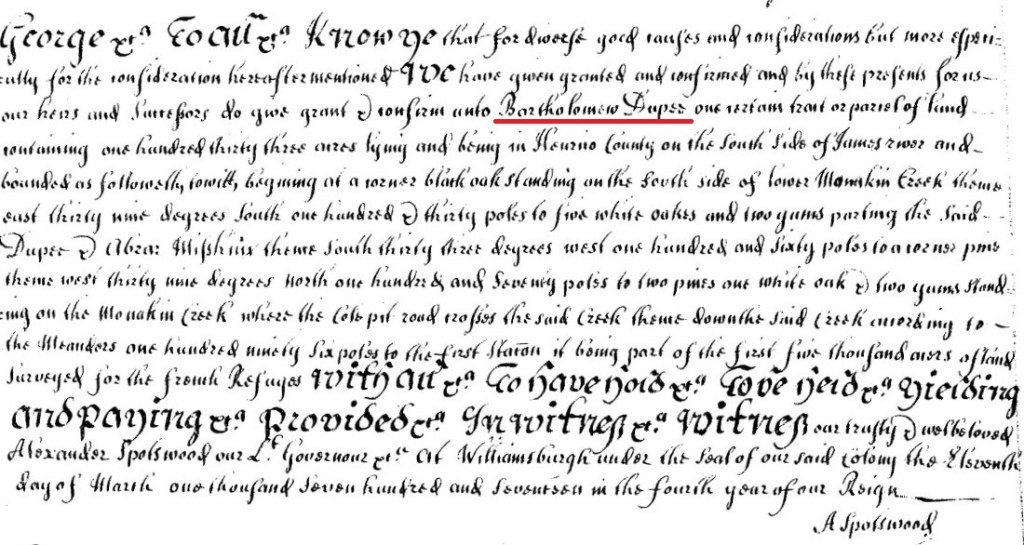
On 11 March 1717 Bartholomew Dupee [Dupuy] received a grant for 133 acres in Henrico County on the south side of James River and on the south side of lower Manakin Creek and adjacent Abraham Misshuix [Michaux]. The grant noted this was part of the land surveyed for the French refugees.[10] This land fell into Goochland County when it was created by the legislature in 1727 and formed in 1728.
Bartholomew Dupuy made his will on 7 March 1742/3 and died shortly after as his will was recorded on 17 May 1743. To his eldest son Peter Dupuy, he left £5 and to son John James Dupuy, he left £10. He left £2 to grandson John Bartholomew Dupuy [son of Peter]. To the poor of King William Parish he left £5. He named his son-in-law John Levillain, Jr. as executor and also left him the balance of his estate.[11]
Bartholomew Dupuy, b.c. 1652, France, fled to Germany 1685, immigrated to England in 1699, arrived in Virginia March 1701, d. 1743, Goochland County, Virginia, m. Susanna Lavillion, d. by 1737, Goochland County, Virginia, issue:
John Peter Dupuy, b.c. 1695[12], m.c. Judith Lefevre
Martha Dupuy, d. 1740, m. Stephen Chastain
John James Dupuy, b.c. 1698, d, 1775 Cumberland County, Virginia, m.c. 1728, Susanna Levillain*
Phillipa Dupuy, d.c. 1738, m.c. 1730, John Levillain, Jr.*
* Both children of John Levillain, Sr.
John James Dupuy (my 7x great grandfather)
John James Dupuy was born about 1704 in Virginia.[13] He married Susanna Levillain about 1728 and served as a King William parish Vestryman and Church warden from at least 1731-1738.[14] Though grants and purchases John James Dupuy acquired 1,446 acres in the portion of Goochland County that became Cumberland County in 1749 as well as 1,200 acre in Amelia County.
Grants and Deeds (deed date; deed recorded)
21 January 1734/5; 15 June 1736 – Nicholas Solie [Sallie?] to John James Dupuy for £20, 400 acres in Goochland County on south side of James River adj. Fontaine, Dutoy’s Branch.[15]
23 April 1740; 20 May 1740 – will of Martha (Dupuy) Chastain – to my brother John James Dupuy 46 acres on the south side of James River adjacent widow Carnor and John Harris.[16]
15 July 1740; 15 July 1740 – Anthony Bennon to John James Dupuy for £21, 200 acres in Goochland County on Dittoi’s [Dutoy’s] branch on south side James River
17 May 1743; 17 May 1743 – Peter Dupuy to John James Dupuy for £26, 200 acres in Goochland County on the south side of James River that was granted to Stephen Chastain and conveyed by Chastain to Peter Dupuy. Adjacent to John Levillain and John Peter Bilboa.[17]
20 September 1745 – John James Dupuy granted 800 acres in Amelia County on both sides of Ellis’s Fork of Flatt Creek. Adjacent Turner’s corner, Edward Jones line, Childrey’s corner and line.[18]
25 June 1747 – John James Dupuy – granted 400 acres in Amelia County on both side of Flat Creek bounded by Edward Jones upper corner on north side of said creek.[19]
20 May 1749 – John James Dupuy granted 400 acres in Goochland County on the south side of James River and on the west side of the Lower Manakan Creek. No neighbors listed – just metes and bounds.[20]
22 January 1755; 26 May 1755 – John Durham to John James Dupuy of Cumberland County for £30, 200 acres on Lower Manakin Creek adjacent to the several lands of John James Dupuy & others.[21]
Death of John James Dupuy
John James Dupuy wrote his will on 9 February 1775 and died 27 February 1775 when his will was recorded.[22] He left his son Bartholomew Dupuy 400 acres in Amelia County where he was already living along with enslaved people named Ben, Doll and all her children and an enslaved man named Jack. To his granddaughter Susanna Dupuy [daughter of son Bartholomew Dupuy] an enslaved girl named Dilcy when she reaches 18 or is married.
To his son John Dupuy he left 200 acres [purchased from John Durham], also 300 acres [part of the tract John James Dupuy lived on] and enslaved people named Philis, her child Phil as well as a man named Tom purchased from Wm. Salley. To son James Dupuy he left 100 acres [the remainder of the tract where John James Dupuy lived], also 200 adjoining acres bought from his brother Peter Dupuy, also 200 acres being part of a 400 acre tract adjoining the lower Manakin Creek – him to have the upper 200 acres. James also inherited enslaved people named Peter, Hanner and her child Jupe and a boy named Tom.
To daughter Olympia Trabue he left 200 acres on Ellis’ Fork in Amelia County where she was already living and enslaved people named Stephen, Temp, Betty and her daughter Jane. Grandson Benjamin Hatcher received 190 acres on the headwaters of Flat Creek in Amelia County being a moiety of a 380 acres patented by John James Dupuy and already divided. Daughter Martha Foster was lent the other moiety for life and then to grandson George Foster as well as enslaved people named Luce, Joe, Dick and Great Jane. Daughter Mary Hatcher was given enslaved people named Moll and all her children as well as Joe, Charles and Frank.
Daughter Elizabeth Dupuy received 200 acres – the lower half of the tract of 400 acres lying on lower Manakin [upper half to James above] and enslaved people named Joe, Nell and her child called Luce, Sara, and Randol. Grandson John Lockett [son of daughter Susanna Lockett] received 200 acres [in possession of his father James Lockett] lying on Ellis’s Creek in Amelia County. Other grandchildren including Susanna Foster, James, Joel and Britton Lockett, Susanna Trabue, Susanna Hatcher, Mary Foster all received monetary bequests to be paid at adulthood or marriage. John James Dupuy left to his “beloved wife a mare called Ronoak, side saddle & bridle.” He directed that everything else was to be sold to pay debts and legacies and that no appraisal be made of his estate. Lastly, he named his sons Bartholomew and James and son in law Benjamin Hatcher Executors.
John James Dupuy, b.c. 1704, Henrico County, Virginia, d. Feb 1775, Cumberland County, VA, m.c. 1728, Susanna Levillain. Issue:
Olympia Dupuy, b. 12 Nov 1729, d.c. 1822, Woodford Co. KY, m.c. 1744, John James Trabue
Bartholmew Dupuy, w.d. 5 June 1790, Woodford Co. KY, m. Mary Mottley
Susanna Dupuy, b. 25 April 1734, d. bef. 1775, m. James Lockett
Mary Dupuy, b. 26 Feb 1736/7, m. Benjmain Hatcher
Rev. John Dupuy (Baptist), b/ 17 March 1738/9, d. 7 Sep 1831, Shelbyville, KY, m. Elizabeth Minter
Elizabeth Dupuy, b. 4 Sep 1740, m. (1) ——- Dixon, m. (2) 25 September 1775 Thomas Atkinson
Rev. James Dupuy (Baptist), b. 29 Jan 1743/4, d. 5 May 1837, KY, m. Anne Starke
Martha Dupuy, b. 21 May 1747, m. James Foster
Just seven months after her father’s death on 25 September 1775, my 6x great grandmother Elizabeth Dupuy married Thomas Atkinson of Amelia County with her brother James Dupie [Dupuy] as security.[23] They had three children including Ann “Nancy” Atkinson, born 24 September 1776, son John Atkinson, born 4 December 1777 and daughter Martha “Patsy” Atkinson born in November 1778.[24]
For more on the Atkinson family see my earlier blog posts:
Thomas Atkinson of Essex and Amelia County, Virginia
Thomas Atkinson’s Daybook
https://asonofvirginia.blog/2024/01/02/thomas-atkinsons-daybook/
Le Villain [Levillain] family
Le Villain Surname Origin
From Anglo-Norman French villein, vilein ‘serf bondman servile tenant’ denoting an occupier or cultivator of land who was entirely subject to a lord or was attached to a manor.[25]
Jean Le Villain [John Levillain] arrived in Virginia aboard the ship Peter and Anthony in the Fall of 1700.[26] He traveled alone so he married his unknown wife in Virginia. John Levillain appears in the extant records of King William Parish from 1710-1738. He served on the parish vestry in 1731-1732.[27]
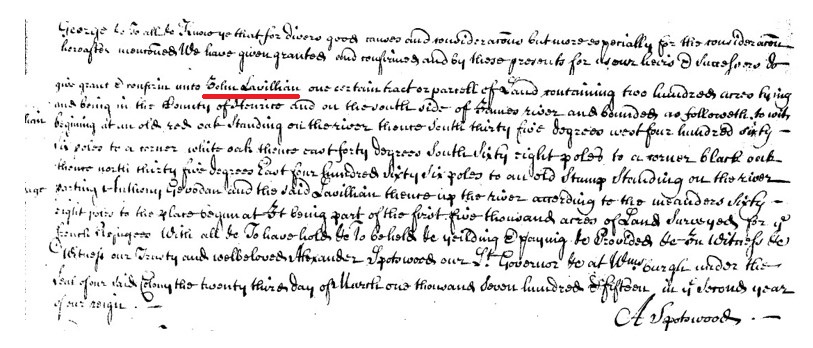
John Levillain received a grant for 200 acres in Henrico County on the south side of James River adjacent the river and standing on the river, parting Anthony Gevodan and the said Levillain.[28] On 10 August 1725 he received a grant for 400 acres of new land [not having been previously granted] in Henrico County on the north side of Appomattox River adjacent John James Flournoy.[29] A week later, on 17 August 1725 he received a grant for 400 acres of new land in Henrico County on the north side of the Appomattox River adjacent John James Flournoy.[30] Finally on 28 September 1730 he received a grant for 170 acres of new land in Goochland County on the south side of James River adjoining his own and the land of Judith Vallow.[31] Goochland was created out of Henrico in 1728.
Death of John Levillain
John Levillain made his will on 18 April 1730, but it was not recorded in Goochland County until 17 June 1746. His will notes that he was born in the town of Essey in lower Normandie, Kingdom of France and was currently living in King William Parish in Goochland County, Virginia. To his eldest son John Peter [Peter] Levillain he left 200 acres in Cumberland County – half the plantation on which John Levillain was living and enslaved people named Peter, Mary and Olive. To son Anthony Levillain he left 200 adjacent acres in Cumberland County and enslaved people named Cezar, Nanny and Dirk. To daughter Susanna he left enslaved people named Robert and Betty. To goddaughter Olympia Trabue he left four guineas. Finally, his three children John Peter Levillain, Anthony Levillain and Susannah Dupuy received an equal share of his “two plantations in Henrico County on north side of Appomattox containing 400 acres and all of his other “moveables” or personal property.[32]
Jean Le Villain, issue:
John Peter Levillain, b.c. 1708[33], m. Phillipa Dupuy
Anthony Levillain, b.c. 1714[34], m. Elizabeth LaPrade
Susanna Levillain m. Jean Jacques [John James] Dupuy – see Dupuy family above
Remy Family
Remy Surname Origin
French: Altered form of French Rémy. Derivative of Old French ra(i)m ‘branch’ (from Latin ramus) hence a topographic name for someone who lived in a thickly wooded area.[35]
Abraham Remis [Remy] and his unnamed wife arrived in September 1700 aboard the Peter and Anthony.[36] As they were not traveling with any children, their children were born in Virginia. The Remy’s also appeared [she unnamed] on a subsequent Peter & Anthony passenger list taken in December of that year.[37] They were living at Manakintown on 10 November 1701 according to a census taken by William Byrd.[38] Abraham Remy appeared on a list of refugees who were to receive one bushel of corn per head from the miller to begin in February 1700/1.[39],[40] In a letter dated 2 September 1707 from Huguenot leader Abraham Salle to the Virginia Council, he lists Abraham Remy as one of 12 men elected to the vestry of Monacantown [sic] Parish [called King William Parish].[41]
Abraham Remy appears on King William Parish tithable lists from 1710-1714.[42],[43],[44] An undated list (c.1714) includes “Abra. Remy.” The record notes that a woman (presumably his wife) and three children were living with him (1 boy; 2 girls).[45] Preceding the list of tithables, there is an accounting of payments made by the parish for provision of various services. One entry is for Abraham Remy who received £4.13.0 “for the orphan which he has at his house.”[46]
We learn the name of Abraham Remy’s daughters by way of the will of Andrew Aubry dated 28 November 1715 and recorded 6 February 1715/6. Aubry left one-third of his “goods & chattles” to his godson Andrew Ammonet, one-third to Joseph Cailland and one-third to both Margarett Anna & Elizabeth Remy. Aubrey stated no relationship for either Cailland or the Remy girls.[47] While some researchers suggest Abraham Remy’s wife was Marie D’Aubry, I found no record indicating her first or last name. The will of Andrew Aubry is interesting in that it does not name Abraham Remy. Godson Andrew Ammonet received £4 pounds “upon Jacob Ammonet his father” suggesting he was underage. No such distinction was made for the Remy girls who would have been no more than 14 at the time.[48] Aubry’s estate inventory and appraisal amounting to £48.10.9 was returned by his executors Jacob Ammonet & Joseph Cailland [the other beneficiary] on 5 March 1715.[49]
On 23 March 1715/6, Abraham Remy was granted two tracts of land of 85 acres each on the south side of James River in Henrico County. The first grant was for 85 acres adjacent to the river and Jacob Flournoy – “it being part of the last 5,000 acres of land surveyed for the French Refugees.”. The second grant for the same acreage was described as being adjacent to the river, John Martin, Anthony Trabue – “it being part of the first 5,000 acres of land surveyed for the French Refugees.”[50]

I found no record for either Abraham Remy or his wife after the 1715 so they probably died soon after.
Two deeds from the 1730s are the last records mentioning Abraham Remy. In both cases, his daughter Margaret Anne is selling the 85 acres tracts her father was granted in 1715. The first deed dated and recorded 2 October 1732; as Margaret Neal, she sold Anthony Trabue the 85 acres bounded by Jacob Flournoy. The deed noted that the tact was “part of 5000 acres surveyed for the French refugees and granted Abraham Ramey 23 March 1715.”[51] In a second deed dated 1 December 1734 and recorded the following day, “William Hatchett and Margaret Anne his wife, late widow of John Neal, dec’d, and the only surviving daughter of Abraham Remmy, late of the parish of King William in the County of Henrico, deceased” sold to Jacob Trabue 85 acres “granted said Abraham Remmy 23 March 1715” bounded by John Martin, “being part of 5000 acres surveyed for the French refugees.”[52]
Abraham Remy, b.c. 1665, France, d.c. 1715, Manakintown, Henrico County, Virginia, m. Unknown, b. France, d.c. 1715, Henrico County, Virginia, issue:
Margaret Anne Remy, b.c. 1701, Manakintown, Henrico County, Virginia, d. 1792, Nottoway County, Virginia, m. (1) John Lewiston, m. (2) John Neal, m.c. 1733, (3) William Hatchett
Elizabeth Remy, b.c. 1703, dead by 1734
My 7x great grandmother Margaret Anne (Remy) Lewiston Neal Hatchett’s will is dated 13 March 1788 and was recorded 7 June 1792. She names her daughter Elizabeth Thomson, daughter Mary Marshall, her grandchildren David Neal, Thomas Neal and Tabitha Neal, son John Hatchett, daughter Martha Roberts, son William Hatchett, daughter Jane Truly, son Archer Hatchett, son Abraham Hatchett.[53]
My descent from Bartholomew & Susanna (Lavillion) Dupuy and John Levillain
Bartholomew Dupuy (c,1652-c1743) m. Susanna Lavillion (d. by 1737)
John James Dupuy (c.1704-1775) m. Susanna Levillain (c.1705-c.1775), dau. of John Levillain, Sr. (d.c. 1746)
Elizabeth Dupuy (4 September 1740-bef.1803) m. Thomas Atkinson (c.1731-c.1803)
John Atkinson (1777-1808) m. Elizabeth Smith (c.1780-c.1805)
Mary A. D. Atkinson (c.1802-1875) m. Miles A. Gills (c.1796-1870)
Elizabeth Smith Gills (d. bef. 1850) m. John James Morris (c.1812-c.1858)
John Rives Morris (1840-1904) m. Ann Octavia Vaughan (1844-1942)
John Stewart Morris (1868-1958) m. Anna May Blanton (1884-1977)
Rebecca Blanton Morris (1913-1994) m. James Irvin Eisenbeis (1915-2006)
Rebecca Suzanne Eisenbeis (1943-2009) m. Paul Franklin Craig (1941-
Paul Steven Craig (1964-
My descent from Abraham Remis (Remy/Remmy/Ramey):
Abraham Remy (c.1662-c.1715) m unknown
Margaret Remy (c.1702-1792) m. William Hatchett (c.1700 -1785)
Jane Hatchett (1750-1825) m. John Truly (1750-1804)
Sarah Truly (c.1770-1839) m. Robert Vaughan (c.1770-1822)
Augustus Vaughan (c. 1811-c.1851) m. Mary Spencer Farmer (c.1825-1848)
Ann Octavia Vaughan (1844-1942) m. John Rives Morris (1840-1904)
John Stewart Morris (1868-1958) m. Anna May Blanton (1884-1977)
Rebecca Blanton Morris (1913-1994) m. James Irvin Eisenbeis (1915-2006)
Rebecca Suzanne Eisenbeis (1943-2009) m. Paul Franklin Craig (1941-
Paul Steven Craig (1964-
[1] Winfree, Waverly K. The Laws of Virginia: Being a Supplement to Hening’s The Statutes At Large; (The Virginia State Library, 1971), p. 39
[2] Edict of Nantes – Wikipedia
[3] Crewdson, R. L. (1986). The Manakin Experiment: A French Protestant Colony in the New World. Historical Magazine of the Protestant Episcopal Church, 55(3), 203–211. http://www.jstor.org/stable/42974798
[4] Lee, L. H. (2022). Huguenot-Anglicans in Seventeenth Century Virginia. Anglican and Episcopal History, 91(3), 291–322. https://www.jstor.org/stable/27166373
[5] Passengers on the third ship settled on the Mattaponi River. Here is an excerpt from an article by Cameron Allen taken from Genealogical Research by the American Society of Genealogists (1971, 2 volumes): “The Mattapony group settled in what was then King William County, perhaps attracted by the fact that a Huguenot clergyman, James Boisseau had settled there a decade or so earlier. Later the Mattapony area was cut off as Caroline County. Here we know that another Huguenot clergyman, the Rev. Francis Fontaine, served in St. Margaret’s parish, Caroline County,1721-1722. Unfortunately, the county records of both King William and Caroline (save the Order Books of the latter) have been destroyed, as have the Church of England Parish Records. Among the Huguenots residents in this settlement were the families of Seay, Peay, Derieux, Desmaizeau, Dismukes (originally DesMeaux, it is said), Jeter, Mallin, LaFoe, Chenault, DeJarnette, Micou, Flippo, Duval, Vigon, Micalle Debusie, and DeShazo (DeChazeau). The Mattapony settlement seems never to have been as strong as Manakintown, and there was some tendency to gravitate from the first to the latter….Contact between the two must certainly have been maintained for decades. Families from both participated and were closely associated in the development of Amelia County.” (II, 283);https://www.huguenotmanakin.org/history-of-virginia-and-huguenot-se
[6] Adapted from an article written by James L. Bugg, Jr., retired president of Old Dominion University and published in Virginia Magazine of History and Biography, Vol. 61, No. 4, October 1953, p.. 359-392; https://www.huguenotmanakin.org/huguenot-settlement-of-manakin-town; accessed 28 July 2023
[7] Dictionary of American Family Names 2nd edition, 2022, Anestry.com
[8] Fife, R. H. (1904). The Vestry Book of King William Parish, Va., 1707-1750. The Virginia Magazine of History and Biography, 11(3), 289–304. http://www.jstor.org/stable/4242618, The Virginia Magazine of History and Biography, 11(4), 425–440. http://www.jstor.org/stable/4242639, The Virginia Magazine of History and Biography, 12(1), 17–32. http://www.jstor.org/stable/4242651 The Virginia Magazine of History and Biography, 12(3), 241–256. http://www.jstor.org/stable/4242683, The Virginia Magazine of History and Biography, 13(2), 175–190. http://www.jstor.org/stable/4242736, The Virginia Magazine of History and Biography, 13(3), 265–280. http://www.jstor.org/stable/4242745
[9] Dupuy, Rev. Benjamin Hunter. The Huguenot Bartholomew Dupy and his descendants, (Louisville: Courier-Journal Job Printing Company, 1908), p. 139
[10] Land Office Patents No. 10, 1710-1719, p. 364 (Reel 10). Library of Virginia, Richmond, Virginia
[11] Goochland County, Virginia Will Book 4 1741-1745, p. 173-174
[12] Pierre [Peter] Dupuy first appears on the King William Parish tithable lists in 1711 when he turned 16 (b.c. 1695); The Vestry Book of King William Parish, Va., 1707-1750 (Continued). (1904). The Virginia Magazine of History and Biography, 11(4), 425–440. http://www.jstor.org/stable/4242639
[13] Jean Jacques [John James] Dupuy first appears on the King William Parish tithable lists in 1720 when he turned 16 (b.c. 1704); The Vestry Book of King William Parish, Va., 1707-1750 (Continued). (1905). The Virginia Magazine of History and Biography, 12(3), 241–256. http://www.jstor.org/stable/4242683
[14] The Vestry Book of King William Parish, Va., 1707-1750 (Continued). (1905). The Virginia Magazine of History and Biography, 12(4), 369–384. http://www.jstor.org/stable/4242704, The Virginia Magazine of History and Biography, 13(1), 65–80. http://www.jstor.org/stable/4242726, The Virginia Magazine of History and Biography, 13(2), 175–190. http://www.jstor.org/stable/4242736
[15] Goochland County, Virginia Deed Book 2 1734-1736, p. 50
[16] Goochland County, Virginia Deed Book 3 with Wills 1737-1742, p. 285
[17] Goochland County, Virginia Deed Book 4 1741-1745, p. 161
[18] Land Office Patents No. 22, 1743-1745 (v.1 & 2 p.1-631), p. 563 (Reel 20), Library of Virginia, Richmond, Virginia
[19] Land Office Patents No. 26, 1747-1748 (v.1 & 2 p.1-730), p. 76 (Reel 24), Library of Virginia, Richmond, Virginia
[20] Land Office Patents No. 27, 1748-1749, p. 156 (Reel 25), Library of Virginia, Richmond, Virginia
[21] Cumberland County, Virginia Deed Book 2 1752-1760, p. 214 n
[22] Cumberland County, Virginia Will Book 2, 1769-1792, pp. 169-172.
[23] Cumberland County Marriage Bonds, William and Mary College Quarterly Historical Magazine, Vol. 20, No. 1.
(Jul., 1911), p. 28
[24] Atkinson, Thomas. Account Book, 1755-1829. N.p., 1755. Print, Library of Virginia, Richmond, Virginia
[25] The Oxford Dictionary of Family Names in Britain and Ireland, 2016, Ancestry.com
[26] Brock, R. A. Documents Chiefly Unpublished relating to the Huguenot Immigration to Virginia and to the Settlement of Manakintown; (Baltimore: Genealogical Publishing Company, 1862), p. 15
[27] Fife, R. H. (1904). The Vestry Book of King William Parish, Va., 1707-1750. The Virginia Magazine of History and Biography, 11(3), 289–304. http://www.jstor.org/stable/4242618 ; The Virginia Magazine of History and Biography, 11(4), 425–440. http://www.jstor.org/stable/4242639, The Virginia Magazine of History and Biography, 12(1), 17–32. http://www.jstor.org/stable/4242651, The Virginia Magazine of History and Biography, 12(3), 241–256. http://www.jstor.org/stable/4242683, The Virginia Magazine of History and Biography, 13(3), 265–280. http://www.jstor.org/stable/4242745, The Virginia Magazine of History and Biography, 12(4), 369–384. http://www.jstor.org/stable/4242704, The Virginia Magazine of History and Biography, 13(2), 175–190. http://www.jstor.org/stable/4242736
[28] Land Office Patents No. 10, 1710-1719, p. 283 (Reel 10), Library of Virginia, Richmond, Virginia
[29] Land Office Patents No. 12, 1724-1726, p. 321 (Reel 11), Library of Virginia, Richmond, Virginia
[30] Land Office Patents No. 12, 1724-1726, p. 253 (Reel 11), Library of Virginia, Richmond, Virginia
[31] Land Office Patents No. 13, 1725-1730 (v.1 & 2 p.1-540), p. 539 (Reel 12), Library of Virginia, Richmond, Virginia
[32] Goochland County, Virginia Will Book 5 1745-1749, p. 136-139 (in both French and English); https://www.familysearch.org/ark:/61903/3:1:3QSQ-G9P6-9SND?i=374&cat=406600
[33] John Peter Levillain first appears on tithe list in 1724 (b.c. 1708)
[34] Anthony Levillain first appears on tithe list in 1730 (b.c. 1714)
[35] Dictionary of American Family Names 2nd edition, 2022, Ancestry.com
[36] Brock, R. A. Documents Chiefly Unpublished relating to the Huguenot Immigration to Virginia and to the Settlement of Manakintown; (Baltimore: Genealogical Publishing Company, 1962), p. 15
[37] Brock, R. A. Documents Chiefly Unpublished relating to the Huguenot Immigration to Virginia and to the Settlement of Manakintown; (Baltimore: Genealogical Publishing Company, 1962), p. 24
[38] Brock, R. A. Documents Chiefly Unpublished relating to the Huguenot Immigration to Virginia and to the Settlement of Manakintown; (Baltimore: Genealogical Publishing Company, 1962), p. 46
[39] The year began on March 25 until 1752. Dates from 1 Jan to 24 March in years prior are shown as 1700/1.
[40] Brock, R. A. Documents Chiefly Unpublished relating to the Huguenot Immigration to Virginia and to the Settlement of Manakintown; (Baltimore: Genealogical Publishing Company, 1962), p. 27
[41] Brock, R. A. Documents Chiefly Unpublished relating to the Huguenot Immigration to Virginia and to the Settlement of Manakintown; (Baltimore: Genealogical Publishing Company, 1962), p. 70
[42] 1710-1711. Fife, R. H. (1904). The Vestry Book of King William Parish, Va., 1707-1750. The Virginia Magazine of History and Biography, 11(3), 289–304. http://www.jstor.org/stable/4242618
[43] 1712-1713. The Vestry Book of King William Parish, Va., 1707-1750 (Continued). (1904). The Virginia Magazine of History and Biography, 11(4), 425–440. http://www.jstor.org/stable/4242639
[44] 1714. The Vestry Book of King William Parish, Va., 1707-1750 (Continued). (1904). The Virginia Magazine of History and Biography, 12(1), 17–32. http://www.jstor.org/stable/4242651
[45] Brock, R. A. Documents Chiefly Unpublished relating to the Huguenot Immigration to Virginia and to the Settlement of Manakintown; (Baltimore: Genealogical Publishing Company, 1962), p. 75
[46] The Vestry Book of King William Parish, Va., 1707-1750 (Continued). (1904). The Virginia Magazine of History and Biography, 12(1), 17–32. http://www.jstor.org/stable/4242651
[47] Henrico County, Virginia Wills and Deeds 1714-1718, p. 67; https://www.familysearch.org/ark:/61903/3:1:3QS7-89P6-SL19?i=46&cat=397197; accessed 22 April 2023
[48] The early lists of the French Refugees listed no children with Abraham Remy and his wife as was the case for others on the lists. This means their daughters were born in Virginia. The latest list noting Abraham and his wife without children is dated 10 November 1701 so they would have been born sometime after that date.
[49] Henrico County, Virginia Wills and Deeds 1714-1718, p. 71; https://www.familysearch.org/ark:/61903/3:1:3QS7-89P6-SL1Q?i=48&cat=397197
[50] Land Office Patents No. 10, 1710-1719, p. 284, 286 (Reel 10; Library of Virginia, Richmond, Virginia
[51] Henrico County Deeds and Wills 1725-1737 No. 2, Part 1, p. 370; https://www.familysearch.org/ark:/61903/3:1:3QS7-89P6-SG3K?i=375&cat=397197; accessed 22 April 2023
[52]Henrico County Deeds and Wills 1725-1737 No. 2, Part 1, p. 456; https://www.familysearch.org/ark:/61903/3:1:3QS7-89P6-SGM5?i=419&cat=397197; accessed 22 April 2023
[53] Nottoway County, Virginia Will Book No. 1 1789-1802, p. 64; https://www.familysearch.org/ark:/61903/3:1:3QS7-99PX-643D?i=49&cat=379144; accessed 28 July 2023
 A Son of Virginia