
Over an 18-month span from 1746-1747, Surry County, Virginia Court records refer to my 6x great grandfather James Price as a “common profane swearer” and “a wicked dissolute person.” He was also indicted by a grand jury for “living in adultery with Ann Williams.”
James Price an Orphan
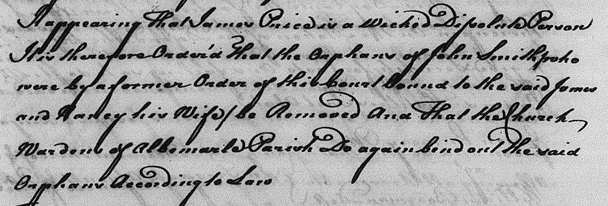
James Price enters the record on 15 October 1735, when William Seward and John Chapman bound themselves to the Surry Court for £50 the “condition of this obligation is such that whereas the above bound William Seward is guardian to James Price an Orphan.” Seward was to “take care of and educate said James Price according to his estate and pay the same to the said James Price when he shall arrive at thew age of twenty one years without any abatement or allowance (other than the Profitts of the said Estate) for Dyett, Cloathing or any matter whatsoever.”[1] Given the small bond required, the estate must have been small.
On 21 July 1736, Thomas Edwards and John Hancock similarly bound themselves to the same conditions for Edwards performance as guardian of Martha Price an orphan.[2] Perhaps she was a sister to James. Neither record identifies the father of James or Martha.
James Price reaches adulthood
While the record of his guardianship does not reveal his age, it does mean that James was under 21 years old thus he was born no earlier than 1715. In a deed dated 18 December 1738 and recorded 17 January 1738/9, John Clements sold James Price for £38, 100 acres in Surry County described as “on the head of a branch that divides the said land and Mr. Sam’l Thompsons land,” Edward Wesson’s land and Mary Boston’s land.[3] James Price would have had to have been 21 to buy this land without any noted restrictions in the deed thus he was born no later than 1717. Thus James Price was between 18-20 when Edwards became his guardian.
No Good Parental Candidates
A Francis Price died in 1721 in Sury County leaving a will mentioning, but not naming his wife and “all my children.” His wife, whom he named executrix, died within weeks and his will was presented by “John Price next of kin to the Deced.”[4] Francis Price’s inventory and appraisal (I&A) dated 24 June 1721 was valued at £99.15.8. John Price died in 1747 lending his estate to his wife then to his son-in-law Stephen Simmons.[5] Francis Price is not likely James Price’s father given James’ guardianship began in 1735 when he was about 19 years old suggesting his father died about that time.
A Richard Price died intestate in Surry County in 1735, his inventory and appraisal dated 12 June 1735 and recorded 18 February 1735/6. I was initially optimistic, but Richard’s estate inventory was valued at £421.1.4 and included 16 enslaved people as a number of books including six law books.[6] James Price was illiterate and the guardian bond posted by William Seward was just £50. Richard Price is not likely to be James Price’s father.
Troubles with the Surry Court
On 21 May 1746 a grand jury presented against James Price “for [being] a common profane swearer.”[7] He failed to show up at court on 18 June 1746 to face the profane swearing charges so the court fined him and directed “That he make his fine by the payment of five shillings to and for the use of the poor of the Parish.”[8]

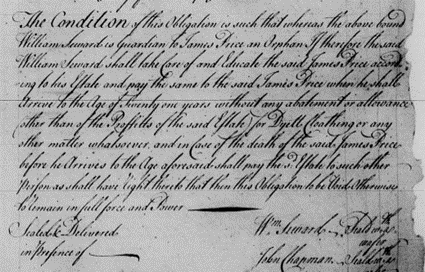
It would get more serious for James later in the year when on 17 November 1747, a grand jury indicted him for “living in adultery with Ann Williams.”[9]The following day the Surry Court found that “James Price is a wicked dissolute person. It is therefore ordered that the orphans of John Smith previously bound out to James and Nancy his wife be removed and that the Church Wardens of Albemarle Parish do again bind out the said orphans according to law.”[10]

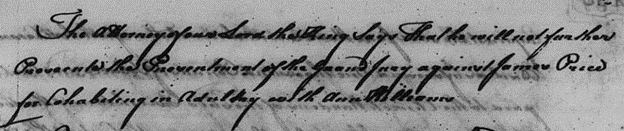
Fortunately by the following spring things had calmed down. On 15 March 1747/8, the “Attorney for Our Lord the King, says he will not further prosecute the presentment of the grand jury against James Price for cohabitating in adultery with Ann Williams.”[11]
Was James Price committing adultery and cohabitating with Ann Williams while married to Nancy? Not likely. Rather, it seems the prosecutor dropped the charges because James and Ann “Nancy” Williams got married between November 18 November 1747 and 15 March 1747/8 [first day of year until 1752 was March 25]. Nancy was a very common diminutive for the name Ann.
Who was Ann Wiliams?
Ann Williams was a daughter of William Williams (1673-1741) whom he named in his will dated 17 November 1740 and recorded 16 April 1741.[12] She was mentioned again as having received her legacy when her brother Lewis Williams, as his father’s executor, filed an account current of his estate with the Surry County Court on 21 July 1741.[13] Ann Williams witnessed the will of Thomas Beard dated 20 September 1741, which was proven in court on 17 October 1749 by the oaths of Ann Williams and Elizabeth Dugall.[14] These are the only records I could find for Ann Williams.
William Williams (1673-1741) was the son of Lewis and Ann (Sessums) Williams (my 8x great grandparents). See my earlier blog post on Lewis Williams here: https://asonofvirginia.blog/2023/04/26/lewis-williams-c-1650-c-1679-of-surry-county-virginia/
James Price adds to his landholdings and becomes a miller
In a deed dated 18 January 1747/8 and recorded 19 January 1747/8, Robert & Mary Pettway sold to James Price for £120, 160 acres in Southwark Parish bounded by the late Benjamin Harrison, the main run of the Great Swamp that turns into Crouches Creek, said Prices other land, Samuel Thompson, William Wilkenson[15] On 19 January 1747/8, the Surry Court ordered recorded a deed between Robert & Mary Pettway and James Price.[16] This was an adjacent tract – note references to “Prices other land” and Samuel Thompson whose land Prices deed from Clements referenced.
Six months later Price apparently ran into financial difficulty and mortgaged the land, two enslaved people named Peter and Hannah, her increase, and 20 head of cattle back to the Pettways. In a deed dated 10 June 1748 and recorded 6 August 1748, they entered into a mortgage deed for £120, a tract or parcel “commonly called Digbys” containing 160 acres on head of Crouches Creek. The deed includes a schedule of due dates out to 1751 for various payments from Price to Pettway for £120 plus interest or Price would loses his property.[17] On 16 August 1748 the Deed of Mortgage from James Price to Robert Pettway acknowledged and ordered recorded.[18] Whatever the issue, James Price found a way to keep his property. His son Randolph Price inherited it as it is listed in his 1779 estate inventory as “Digbys 140 acres.”[19]
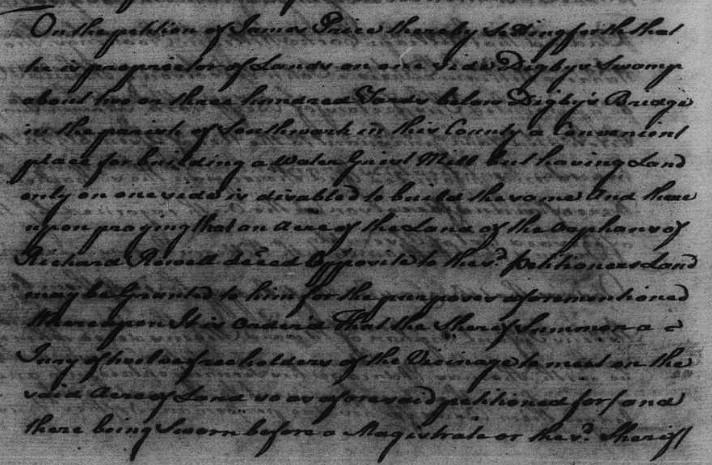
On 14 August 1749, in a petition presented to the Surry Court on 15 August 1749, James Price noted that he was “the proprietor of lands on Digby’s Swamp about two or three hundred yards below Digby’s Bridge in the Parish of Southwark,” which he described as being “a convenient place for building a water grist mill but having land only on one side is disabled to build same.” He asks for “an acre of land belonging to the orphans of Richard Rowell, decd, opposite to the said petitioners land.” He asks that a jury be empaneled to determine damages owed.[20] On 19 September 1749 James Price’s petition for the mill was granted by the Court with him owing damages to Richard Rowells orphans of £3.12 and to Anna Adams 15 shillings.[21] On 22 January 1755, the Surry Court ordered that the old road over the head of Price’s Mill Pond be continued and out in repair according to the prayer of the petition in relation to the same.[22]
James Price becomes a good citizen
Apparently cured of his wickedness and low morals, James Price served his community as men did in those days. On 19 January 1747/8, a report was filed by a court panel that included James Price, which had been appointed to determine damages owed to neighbors by Gilbert Gray in response to his petition to build a gristmill.[23] On 19 April 1748, he served on a jury.[24] On 15 May 1750, James Price was security for Thomas Lane as guardian of orphan William Lancaster.[25] On 21 May 1751, James Price was appointed an appraiser of the estate of Benjamin Broadribb.[26]
On 15 May 1753 James Price was one of eight men fined 400 lbs of tobacco each for not appearing for jury duty.[27] But on 19 June 1753 he appeared at court and “made his excuse” for not attending and his fine was waived by the court.[28] He was appointed “surveyor of the road” on 21 May 1754[29] He served on another jury on 16 May 1758[30] James Price, Samuel Judkins and Nathan Sebrell appraisers of inventory of Edward Pettway dated 18 Nov 1766 and recorded 17 Feb 1767.[31]
On 20 January 1767, James Price was appointed guardian to Nicholas and Benjamin Pyland orphans of Richard Pyland.[32] This a full 20 years after the court called him a “wicked dissolute person” and removed the orphans of John Smith from his care. Finally, on 16 January 1770, James Price and Matthias Marriott granted administration on the estate of Joseph Newsum.[33]
Legal proceedings
Completely normal in the colonial days, James Price often sued others and was sued himself for debts. On 21 July 1752, James Price sued the estate of William Moore and received an attachment against the defendant’s estate for £1.8.[34] On 18 December 1753, the suit styled John Ruffin v. James Price was dismissed for failure to prosecute.[35] On February 1754, James Price made a motion against Mary Clements, administrix of William Clements for counter security. The record notes that Mary Clements and Samuel Thompson, the other security, were “removed out of this colony and Price prays to be indemnified.” The Court ordered that Price take the estate “into his possession and retain so much thereof as will be sufficient to satisfy all just debts due from the estate ‘till she give counter security.”[36]
James Price sued John Bamer for debt on 22 June 1757, but the case was continued.[37] Continuations followed on 20 July 1757[38] and on 21 March 1758.[39] On 16 May 1758, he got his money. William Phillips, a garnishee in this cause, confessed he had in his hands of the defendants estate £4.10. The court ordered judgement for the plaintiff for £10.9.10 and the garnishee was ordered to pay £4.10 toward the debt.[40] On 20 July 1757, Price was sued by “Our Sovereign Lord the King” in his capacity as surveyor of the road “for not keeping the same in repair.”[41] On 21 August 1764, Benjamin Phillips was ordered to pay James Price 125 lbs of tobacco for 5 days attendance as a witness for him.[42]
James Price adds to his landholdings and loses a son
In a deed dated 19 October 1762 and recorded 17 May 1763, Peter Warren sold to James Price for £120, 225 acres on the head of Gray’s Creek between lands of John Harris, Joseph Newsum, Thomas Adams, Drury Warren and the said Price.[43]
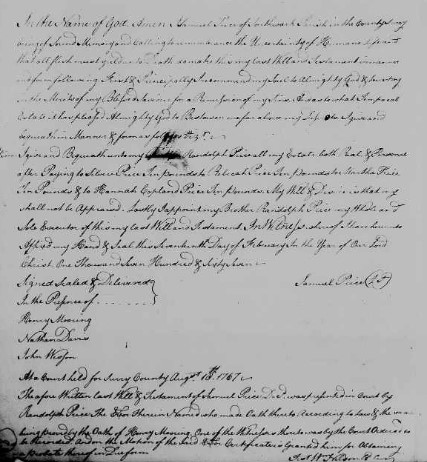
We learn the names of James Price’s children when his son Samuel made his will on 17 February 1767 and it was recorded on 18 August. He named his brother Randolph Price as executor and left him his whole estate real & personal on the condition he pay his sisters Silvere [Silvia], Rebecah, Martha and Hannah Copeland Price £10 each.[44]
James Price’s will
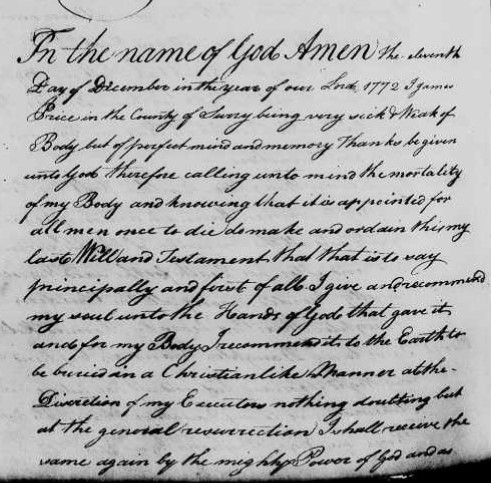
James Price made his own will on 11 December 1772 and it was recorded just 11 days later on 22 December 1772. He does not mention his wife so she likely predeceased him. He left his now only son Randolph, whom he named executor, the “plantation whereon I now live and all my land adjoining and my water grist mill, negro man Jemmy and all the stock of cattle and hogs.” To his daughters James Price bequeathed enslaved people, horses, saddles, featherbeds and furniture. To daughter “Cilviah Bell” he bequeathed “my negro woman Sue and boy Joe.” He also willed her one young mare, feather bed, furniture and a desk. Daughter “Rebekkah Holt” got one horse, one feather bed and furniture. Daughter Martha Holt received “the labour of my negro woman Hannah and my negro girl Sarah and after her death to be divided among her children borne by Thomas Holt.” Daughter Hannah Copeland Price, was willed a “negro woman Lid, negro boy Harry, featherbed, furniture and woman’s saddle.” Granddaughter Hannah Bamer Holt, a “negro girl Chiner.” Son Randolph also received “my two negros York and Peter, stock of horse, cattle and hogs, the rest of my estate not given as a legacy for to enable him to pay for a piece of land agreed for with Thomas Davis and my son. Son to get a good deed and make deed to Thomas Holt and Martha his wife during their life and after their death to be sold and divided between their children.” James Price made his mark rather than sign his name[45]
Just two days after the will was recorded, Randolph Price placed an ad in the Virginia Gazette advertising a public auction to be held on 4 January 1773 of James Price’s “dwelling house” as well as “all the personal Estate of the said deceased, consisting of household and kitchen furniture, stocks of various kinds, corn, fodder, plantation utensils, and sundry other things too tedious to mention; also a complete set of house joiners and cabinet makers tools.” Randolph also called on “all persons who are indebted to the said Deceased are desired to make immediate payment, and all those who have any demands against the same are requested to bring them in by the day of sale, as all that are not brought in within three months’ time will be deemed generously given to the Estate.”[46]
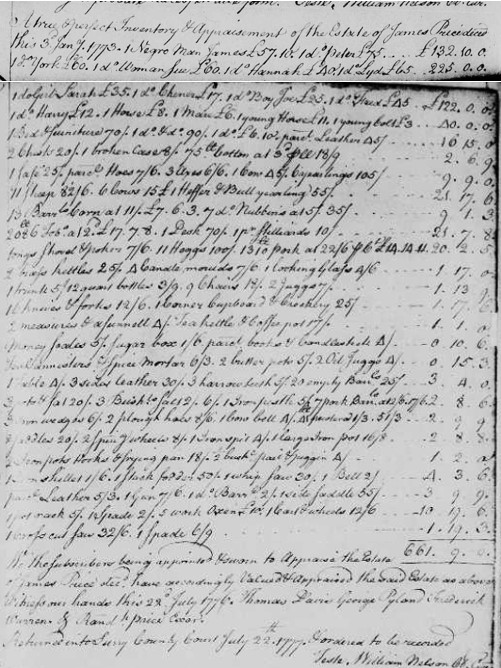
On the day before the sale, 3 January 1773, appraisers Thomas Davis, George Pyland and Frederick Warren conducted an inventory and appraisal of James Price’s personal property. Randolph Price filed it with the Surry Court on 22 July 1777. The value of the estate was £661.9.6 of which £491 was the value of the 10 enslaved people he held including James, Peter, York, Sue, Hannah, Lyd [Lydia], Sarah, Chiner [China], Fred and Harry.[47]
Randolph Price dies
Son Randolph Price made his own will on 18 October 1778 and he was dead by 24 November 1778 when his will was recorded. He gave his wife Lucy Price the use of “that part of my mannor [Manor] Plantation that my Father James Price purchased of John Clements.” He also gave her use of “the following five Negroes, to wit York, Rose, Prisey, Silvia and Moses.” He also gave her use of “one Negro Fellow Peter” on the condition “she has the present Nursery of Apple and Peach Trees, pruned and kept in good condition until they are fit to plant out, and then shall plant them out on the most convenient part of the mannor plantation, and after planted take proper care of them.” He added that if she failed to do so the enslaved Peter would revert back to his estate to either be sold or hired out by his executors. Randolph Price also noted his wife was “great with child” and made provisions should the child survive. He also gave his wife use of his “grist mill so long as she is fit for use, without Rebuilding or untill the Dam shall Break so as to render her unfit for use.” Lastly, he gave her a long list of household furniture and goods and plantation tools “in lieu of her dower.” Randolph Price then specified that the “remainder part of my Estate my Lands excepted together with my Cobham house, and one pair of Millstones with their appurtinences be exposed to sale.” The funds raised were to be used to pay his debts and provide for his son David Price and his unborn child. He referenced his son David’s inheritance from his grandfather Robert Hunnicutt’s Estate and directs what is to happen if his wife’s unborn child is a boy or a girl. He named his wife Lucy and his friend John Wesson as executors.[48] Turns out the baby was a boy named Randolph Price, Jr.[49]
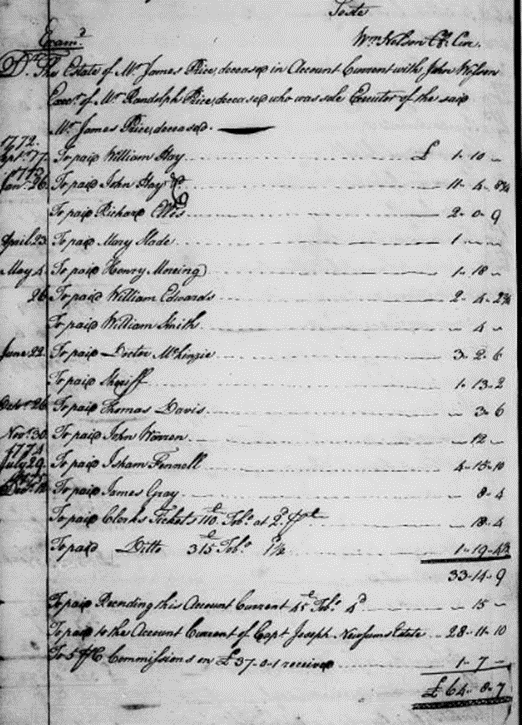
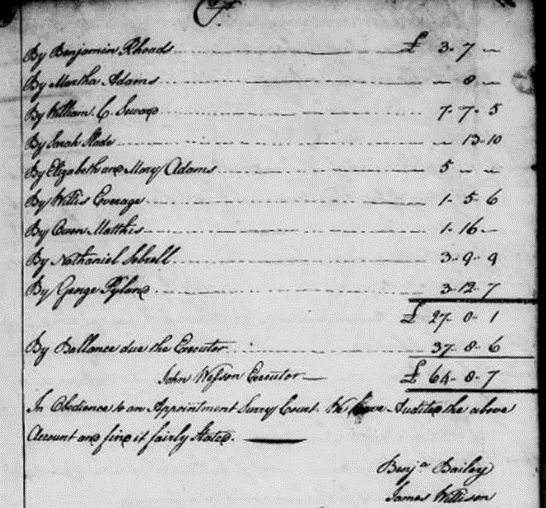
The last mention of James Price was at Surry Court on 22 June 1779, when an account current was filed for the estate of James Price by John Wesson, executor of Randolph Price who was executor of James Price.[50]
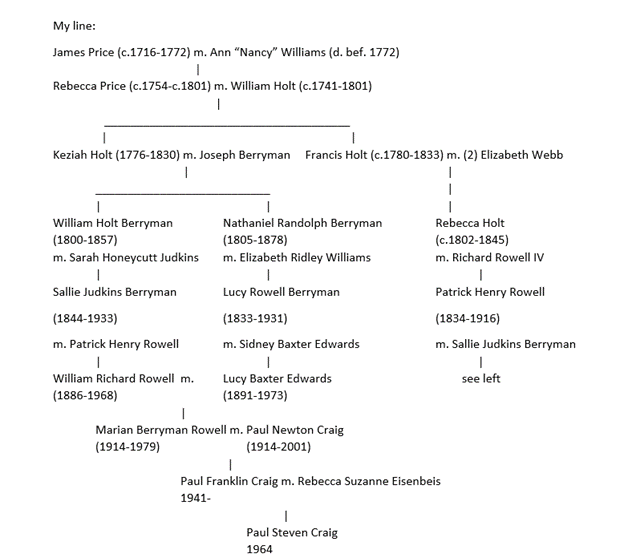
James Price, b.c. 1716, Surry County, Virginia, d. December 1772, m. abt. 1747 poss. Ann “Nancy” Williams, issue:
Randolph Price, w.d. 18 October 1778; recorded 24 November 1778, Surry County, Virginia, m. Lucy Hunnicutt (dau. of Robert Hunnicutt), issue:
David Price, Randolph Price
Samuel Price, d. 1767, Surry County, Virginia – unmarried
Silvia Price, w.d. 9 October1782; rec. 23 November 1784,[51] Surry County, Virginia, m. between 17 Feb 1767 & 11 Dec 1772, Micajah Bell, w.d. 14 July 1779; rec. 24 August 1779,[52] issue:
James Price Bell, John Bell, Samuel Bell, Nancy Champion Bell, Rebekah Bell, Betsy Bell
Rebekah Price, m. between 17 Feb 1767 & 11 Dec 1772, William Holt, w.d. 13 December 1800; rec. 27 January 1801[53], issue:
Hannah Bamer Holt m. 9 January 1796, William Evans Thompson[54]
Keziah Holt m. 24 August 1796, Joseph Berryman[55]
Francis Holt m. (1) 25 June 1799, Mary Scammell,[56] m. (2) 18 Nov 1800, Elizabeth Webb[57]
William Holt w.d. 6 January 1805, rec. 23 April 1805, unmarried[58]
Catherine Holt m. 12 March 1808, Willis Thompson[59]
Martha Price, m. between 17 Feb 1767 & 11 Dec 1772, Thomas Holt
Hannah Copeland Price, m.b. 15 Mar 1788[60], Surry County, Virginia, Jeremiah Banks (c.1760-c.1815[61])
[1] Surry County Deeds, Wills, Etc., No. 8, Pt. 2 1730-1738, p. 528; https://www.familysearch.org/ark:/61903/3:1:3Q9M-C9PX-K9DX?i=293&cat=366316
[2] Surry County Deeds, Wills, Etc., No. 8, Pt. 2 1730-1738, p. 615; https://www.familysearch.org/ark:/61903/3:1:3Q9M-C9PX-K9CL?i=342&cat=366316
[3] Surry County Deeds Wills Etc., No. 8 Part 2, 1730-1738, p. 914; https://www.familysearch.org/ark:/61903/3:1:3Q9M-C9PX-K91D?i=494&cat=366316
[4] Surry County, Virginia Deeds, Wills, Etc. No. 7, Pt. 2 1715-1730, p. 348; https://www.familysearch.org/ark:/61903/3:1:3Q9M-C9PX-296X-M?i=377&cat=366316
[5] Surry County, Virginia Deeds, Wills, Etc. No. 9 1738-1754, p. 579; https://www.familysearch.org/ark:/61903/3:1:3Q9M-C9PX-KBQ?i=339&cat=366316
[6] Surry County Deeds, Wills, Etc. No 8, Part 2 1730-1738, p. 568, https://www.familysearch.org/ark:/61903/3:1:3Q9M-C9PX-K9CG?i=313&cat=366316
[7] Surry County Virginia Order Book, p. 168; https://www.familysearch.org/ark:/61903/3:1:3Q9M-CSKK-XS6X-Z?i=112&cat=374004
[8] Surry County Virginia Orders 1744-1749, p. 183; https://www.familysearch.org/ark:/61903/3:1:3Q9M-CSKK-XS6Z-T?i=119&cat=374004
[9] Surry County Virginia Orders 1744-1749, p. 391; https://www.familysearch.org/ark:/61903/3:1:3Q9M-CSKK-XS63-P?i=223&cat=374004
[10] Surry County Orders 1744-1749, p. 406; https://www.familysearch.org/ark:/61903/3:1:3Q9M-CSKK-XS6C-M?i=232&cat=374004
[11] Surry County, Virginia Orders 1744-1749, p. 437; https://www.familysearch.org/ark:/61903/3:1:3Q9M-CSKK-XS63-H?i=247&cat=374004
[12] Surry County, Virginia Deeds, Wills, Etc. 1738-1754, p. 294; https://www.familysearch.org/ark:/61903/3:1:3Q9M-C9PX-K94T?i=184&cat=366316
[13] Surry County, Virginia Deeds, Wills, Etc. 1738-1754, p. 412; https://www.familysearch.org/ark:/61903/3:1:3Q9M-C9PX-K9S5?i=250&cat=366316
[14] Surry County, Virginia Deeds, Wills, Etc. 1738-1754, p. 618; https://www.familysearch.org/ark:/61903/3:1:3Q9M-C9PX-KYR?i=360&cat=366316
[15] Surry County, Virginia Deed Book No. 5 1746-1749, p. 188; https://www.familysearch.org/ark:/61903/3:1:3Q9M-CSKK-DRSN?i=400&cat=401177
[16] Surry County, Virginia Orders 1744-1749, p. 411; https://www.familysearch.org/ark:/61903/3:1:3Q9M-CSKK-XS6W-X?i=234&cat=374004
[17] Surry County Deed Book No. 5 1746-1749, p. 267; https://www.familysearch.org/ark:/61903/3:1:3Q9M-CSKK-XS6W-L?i=344&cat=374004
[18] Surry County, Virginia Orders 1744-1749, p. 485; https://www.familysearch.org/ark:/61903/3:1:3Q9M-CSKK-XS67-C?i=271&cat=374004
[19] Randolph Price’s Inventory included 1398 acres land to wit: Home Tract 100 acres (1738 Clements to James Price), Digby’s 140 acres (1747/8 Pettway to James Price) Cypress Swamp 970 acres and a house and loft in the Town of Cobham. Surry County Will Book 11 1776-1783, p. 157; https://www.familysearch.org/ark:/61903/3:1:3Q9M-C9PX-K36S?i=639&cat=366316
[20] Surry County, Virginia Order Book 1749-1751, p. 4; https://www.familysearch.org/ark:/61903/3:1:3Q9M-CSKK-XS6W-L?i=344&cat=374004
[21] Surry County, Virginia Order Book 1749-1751, p. 17; https://www.familysearch.org/ark:/61903/3:1:3Q9M-CSKK-XS6M-5?i=350&cat=374004
[22] Surry County, Virginia Orders 1753-1757, p. 193; https://www.familysearch.org/ark:/61903/3:1:3Q9M-CSL6-T3DX-S?i=400&cat=374004
[23] Surry County Virginia Orders 1744-1749, p. 403; https://www.familysearch.org/ark:/61903/3:1:3Q9M-CSKK-XS68-2?i=230&cat=374004
[24] Surry County, Virginia Orders 1744-1749, p. 448; https://www.familysearch.org/ark:/61903/3:1:3Q9M-CSKK-XS6H-L?i=253&cat=374004
[25] Surry County, Virginia Order Book 1749-1751, p. 78; https://www.familysearch.org/ark:/61903/3:1:3Q9M-CSKK-XS6W-C?i=382&cat=374004
[26] Surry County, Virginia Order Book 1749-1751, p. 212; https://www.familysearch.org/ark:/61903/3:1:3Q9M-CSKK-XS6X-C?i=449&cat=374004
[27] Surry County Orders 1751-1753, p. 370; https://www.familysearch.org/ark:/61903/3:1:3Q9M-CSL6-T38H-V?i=212&cat=374004
[28] Surry County Orders 1751-1753, p. 443; https://www.familysearch.org/ark:/61903/3:1:3Q9M-CSL6-T3Z1-F?i=248&cat=374004
[29] Surry County, Virginia Orders 1753-1757, p. 88; https://www.familysearch.org/ark:/61903/3:1:3Q9M-CSL6-T365-N?i=347&cat=374004
[30] Surry County, Virginia Order Book 1757-1763, p. 88; https://www.familysearch.org/ark:/61903/3:1:3Q9M-CSY6-6KWY?i=62&cat=374004
[31] Surry County, Virginia Deed Book 10 1754-1768, p. 441; https://www.familysearch.org/ark:/61903/3:1:3Q9M-C9PX-KQ4R?i=239&cat=366316
[32] Surry County, Virginia Order Book 1764-1776, p. 104; https://www.familysearch.org/ark:/61903/3:1:3Q9M-CSY6-6JR3?i=296&cat=374004
[33] Surry County, Virginia Order Book 1764-1776, p. 199; https://www.familysearch.org/ark:/61903/3:1:3Q9M-CSY6-6JWY?i=343&cat=374004
[34] Surry County Orders 1751-1753, p. 102; https://www.familysearch.org/ark:/61903/3:1:3Q9M-CSL6-T381-K?i=70&cat=374004
[35] Surry County, Virginia Orders 1753-1757, p. 5; https://www.familysearch.org/ark:/61903/3:1:3Q9M-CSL6-T36N-T?i=304&cat=374004
[36] Surry Count, Virginia Orders 1753-1757, p. 51; https://www.familysearch.org/ark:/61903/3:1:3Q9M-CSL6-T365-Q?i=328&cat=374004
[37] Surry County, Virginia Orders 1753-1757, p. 516; https://www.familysearch.org/ark:/61903/3:1:3Q9M-CSL6-T38G-X?i=562&cat=374004
[38] Surry County, Virginia Order Book 1757-1763, p. 21; https://www.familysearch.org/ark:/61903/3:1:3Q9M-CSY6-6K79?i=28&cat=374004
[39] Surry County, Virginia Order Book 1757-1763, p. 66; https://www.familysearch.org/ark:/61903/3:1:3Q9M-CSY6-6V5X?i=51&cat=374004
[40] Surry County, Virginia Order Book 1757-1763, p. 96; https://www.familysearch.org/ark:/61903/3:1:3Q9M-CSY6-6KDH?i=66&cat=374004
[41] Surry County, Virginia Order Book 1757-1763, p. 24; https://www.familysearch.org/ark:/61903/3:1:3Q9M-CSY6-6KNL?i=30&cat=374004
[42] Surry County, Virginia Order Book 1764-1776, p. 32; https://www.familysearch.org/ark:/61903/3:1:3Q9M-CSY6-6JYK?i=257&cat=374004
[43] Surry County Deed Book No. 8 1760-1769, p. 185; https://www.familysearch.org/ark:/61903/3:1:3Q9M-C3QP-NQ62-N?i=105&cat=401177
[44] Surry County, Virginia Deed Book 10 1754-1768, p. 480; https://www.familysearch.org/ark:/61903/3:1:3Q9M-C9PX-KQCL?i=259&cat=366316
[45] Surry County, Virginia Will Book 10a 1768-1779, p. 253; https://www.familysearch.org/ark:/61903/3:1:3Q9M-C9PX-K3B7?i=405&cat=366316
[46] Virginia Gazette, Thursday, 24 December 1772, p. 3; newspapers.com
[47] Surry County, Virginia Deed Book 11 1768-1779, p. 469; https://www.familysearch.org/ark:/61903/3:1:3Q9M-C9PX-K3LV?i=517&cat=366316
[48] Surry County Will Book 10a 1768-1779, p. 505; https://www.familysearch.org/ark:/61903/3:1:3Q9M-C9PX-K32M?i=535&cat=366316
[49] An Account Current for Randolph Price’s estate was filed by John Wesson and recorded 27 July 1790 naming David Price and Randolph Price as orphans of Randolph Price. Also noted was that John Ellis married the widow. Surry County Will Book 12 1783-1792, p. 278; https://www.familysearch.org/ark:/61903/3:1:3Q9M-C9PX-KZGH?i=149&cat=366316
[50] Surry County, Virginia Wills, Deeds, Etc. No. 11 1776-1783, p. 82; https://www.familysearch.org/ark:/61903/3:1:3Q9M-C9PX-K3X1?i=602&cat=366316
[51] Surry County Will Book 12, p. 45; https://www.familysearch.org/ark:/61903/3:1:3Q9M-C9PX-KZK8?i=32&cat=366316
[52] Surry County Will Book 11, p. 90; https://www.familysearch.org/ark:/61903/3:1:3Q9M-C9PX-K3FD?i=606&cat=366316
[53] Surry County Will Book 1 1792-1804 , p. 467;
[54] Virginia, Select Marriages, 1785-1940; Ancestry.com
[55] Virginia, Select Marriages, 1785-1940; Ancestry.com
[56] Virginia, Compiled Marriages, 1660-1800; Ancestry.com
[57] Virginia, Select Marriages, 1785-1940; Ancestry.com
[58] Williams Holt’s 1805 will names brother Francis Holt, sister Catherine Holt and sister Keziah Berriman. Surry County Deeds, Wills, Etc. No. 2 1804-1815, p. 29; https://www.familysearch.org/ark:/61903/3:1:3Q9M-C9PX-KHWC?i=24&cat=366316
[59] Dodd, Jordan R., Et Al.; Early American Marriages: Virginia to 1850; Publication Place: Bountiful, UT, USA; Publisher: Precision Indexing Publishers, Virginia, U.S., Compiled Marriages, 1740-1850, Ancestry.com
[60] Virginia, Select Marriages, 1785-1940; Ancestry.com
[61] Administration bond for estate of Jeremiah Banks. Surry County, Virginia Administrators Bonds 1797-1850, p. 125; https://www.familysearch.org/ark:/61903/3:1:3Q9M-C9PX-VS59-K?i=141&cat=366404
 A Son of Virginia