
When my 7x great-grandfather Michael Holland wrote his will in Goochland County, Virginia on 10 October 1746, he made land bequests totaling 6,622 acres to his wife, children and one grandson. His will also names 40 enslaved men, women and children who he divided among his wife and children. There were also other enslaved people alluded to but not named. Within six months Michael Holland was dead, his will recorded in Goochland County, Virginia on 17 March 1746/7.[1]
The 6,622 acres he distributed were only part of Michael Holland’s estate. His will further directed that “All the rest of my lands, negroes and personal estate not before mentioned, I will, direct, and appoint to be sold by my Executors Henry Martin, Pouncy Anderson, and Richard Holland and the money to be applyed towards the payment of my debts and legacies and maintaining my daughters Anne, Susanna and Mercy. The residue (when all the land negroes and personal estate shall be sold) I give to be equally divided among my sons John, Michael, Richard, George and my daughters Eliz. Anderson and Judith Martin.”

Michael Holland owned considerably more land than he devised in his will. Based on 61 extant patent and deed records, when Michael Holland wrote his will on 10 October 1746, he owned 38,714 acres including 8,668 in Hanover County, 3,921 in Henrico County, 18,195 in Goochland County, 5,000 in Louisa County and 2,930 in Amelia County.
Additionally, he held an interest in 34,000 acres acquired with others between 1734-1738. On 14 June 1734, Michael Holland and Charles Hudson co-patented 6,000 acres in Goochland County on Ivy Creek. He and Hudson along with Abraham Venable, Nowel Burton, and David Hariss co-patented 8,000 acres in Amelia County. After surveying, it was determined that the tract did not amount to 8,000 acres so they were granted leave to make up the remainder below Vaughans Creek and on the head of Cubb Creek, a branch of the Roanoke River.[2] With Henry Chiles, Alexander Tynson, James Walker and Joseph Walker, Holland co-patented another 20,000 acres on the head of Falling River in Brunswick County.[3]
While he owned more acres in Goochland County than anywhere else and both he and Judith died there – she in 1751 – they only moved there during the summer of 1745 having spent the last 34 years [1711-1745] in the portion of New Kent that became Hanover County in 1720. From his first deeds in 1725 he is regularly referred to in deeds as “of Hanover” until 30 August 1745 when he is “of Goochland.” Beginning in 1735, he was sometimes styled Michael Holland, Gentlemen. On 11 June 1740, the Governor appointed Michael Holland sheriff of Hanover County[4] and on 4 November 1742, a Hanover Justice of the Peace.[5] What prompted the move is not known, but it may have been to be in a more geographically centered location relative to his various land holdings.
Michael Holland’s Origins
If you Google “Michael Holland of Goochland County, Virginia,” you will find plenty of information. What is to be found suggests Michael Holland was born about 1666 in Nansemond County, Virginia, son of John Holland and grandson of Gabriel Holland who arrived in Virginia in 1620. In terms of his wife, he is supposed to have married about 1685 either Judith Weeks (daughter of John & Martha) or Judith Merryman with their first children being born in the early 1690s. Alternatively, some researchers say he was born in England between 1685-1695 and one suggests an association with the Hollands of Shropshire, England. Not one factual record is attached to these claims, in part because so many early Virginia records have been lost.
The Library of Virginia (LVA) published a summary of records loss by county and city.[6] Among the 22 counties and cities that have experienced what LVA describes as “catastrophic records loss” are the counties of Nansemond (1734, 1779, 1866 fires), New Kent (1787, 1862, 1865 fires) and Hanover (1865 fire). Early Virginia Parish records have also been lost to the ravages of time. The parish records for East, South and West Parishes (Nansemond County) do not survive. The surviving records for St. Peters Parish (New Kent County) from 1682-1758 do not include Michael Holland – or any Holland for that matter. It is not until we get to St. Paul’s Parish created in 1704 out of the western portion of New Kent County (Hanover County from 1720) that we find him. Let us see what, if any, conclusions can be drawn about Michael Holland and his family from the records that do exist.
Michael Holland Enters the Record
The St. Paul’s Parish vestry processioning record[7] first naming Michael Holland is dated 10 October 1719 and states “The lands of John Anderson, Thos. Anderson, Mary Anderson, Ciclia Anderson, John Chiles, Geo. Alves & Michael Holland being one precinct, whereof John Anderson & Thos. Anderson were Overseers, who made this return 1 February 1719. Order duly Executed, excepting a line which Capt. Dangerfield, hath run, and taken in some of the Land of Mary Anderson, Mr. Holland’s and Chiles now Mr. Sym’s, all within mentioned being present with us the subscribers.”[8]
While two earlier processioning records refer only to “Holland”; it is evident from the names of adjacent landowners (e.g., Anderson, Chiles, Alves) that this was Michael Holland. At a Vestry held 3 Apr 1716, which contained a number of processioning returns dating back several years, it was noted that [in part] that “The lands of Jno. Anderson, Matth: Anderson, Capt. Robt. Anderson, Jno. Chiles, Geo: Alves, Holland, Mr. Biggers for Mr. Carr’s Orphans being made one precinct” about a return made 19 November 1711 and that “The lands of John Anderson, Matthew Anderson, Capt. Robt. Anderson, Thos. Anderson, Jno. Chiles, Geo. Alves and Holland being made one precinct” about a return made 1 March 1715/6.”[9]
Notably, Michael Holland is not listed in either the 1704 Quit Rent tax rolls listing landowners in the Colony nor does he appear in the St. Paul’s parish processioning return dated 14 March 1708/9 (immediately preceding the return for 19 November 1711), although it does include many of his future neighbors including ” Capt. Robert Anderson, Capt. William Anderson, William Pulliam, Thomas Anderson, Matthew Anderson, David Anderson, John Anderson and George Alves.” [10]
Based on the above records we can conclude that Michael Holland did not own land in Virginia in 1704 and that he became a landowner in St. Paul’s Parish, New Kent County sometime between 1709-1711.
Location of Michael Holland’s land in Hanover County

While the aforementioned processioning records do not reveal where Michael Holland’s land was in New Kent/Hanover County, patents issued to his 1711 neighbors give us a general idea. In 1690, Robert Anderson, Jr. was granted 1,200 acres “on the branches of Mattpony and Crumps Creek”[12] while 355 acres was issued to John Chiles “on Crumps Creek and Mechum’s Creek.[13] In 1703, George Alves received 1,668 acres described as “beginning at a corner tree of Robert Anderson’s, on Totopotomoy’s Creek.”[14] Totopotomoy’s Creek, Crump’s Creek and Mechum’s Creek are all tributaries of the South Anna River and are relatively close together. This is the area of New Kent and Hanover County where Michael Holland lived.
The Yamasee War in South Carolina
One interesting record I found comes from the minutes of a 2 May 1719 meeting of the Virginia Governor and Council: In part, “On Petition of Michael Holland Setting forth by the encouragement offered by the Government of South Carolina, he Listed himself as a Soldier to goe to the relief of that province and continued in the said Service for the space of Three months untill by an impostumation [an abscess] in his Knee and he was disabled and obliged to return back to Virginia, that during the time of his said Service in Carolina he received no pay or any other Consideration from that Province, and altho the Soldiers Sent to its assistance by agreement was to be Transported back at the charge of South Carolina Nevertheless the Petr was obliged to pay Three pounds for his passage, and praying to be relieved therein: It is thereupon ordered that the Sum of Six pounds Seven shillings and Sixpence be paid to the Petr out of his Majastys Revenue of 2s hhd &c in [tax of 2 shillings per hogshead and caske] Consideration of his Service in South Carolina and defraying the Charge of his passage back.”[15]
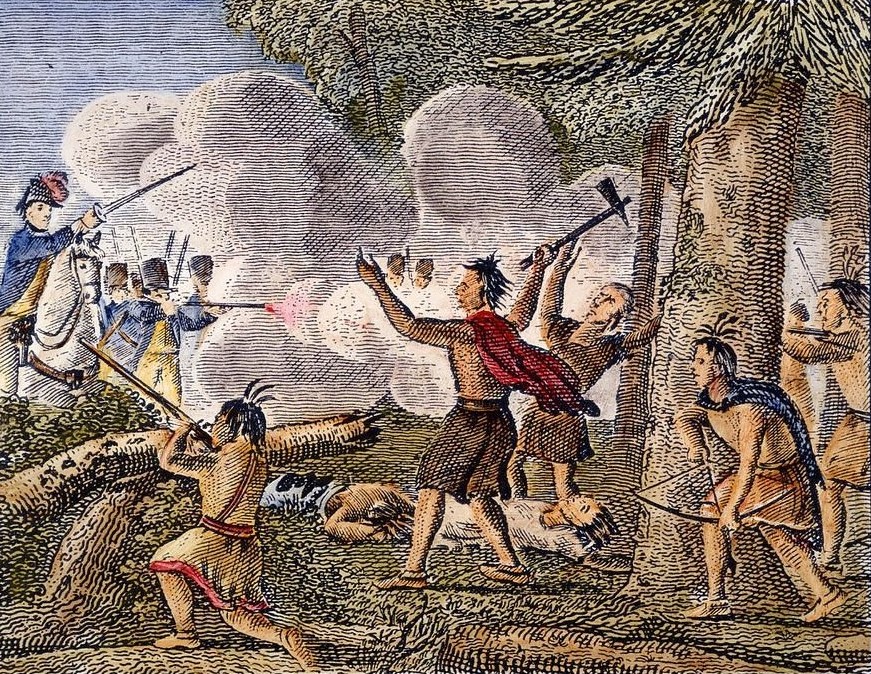
While the record does not indicate the purpose of his service, Michael Holland appears to have been one of the 300 or so Virginians that went to the aid of South Carolina in its defense against a number of Native American tribes known as the Yamasee War (1715-1717). The Indigenous people were frustrated with their treatment at trading posts and with settlers encroaching on their lands. Other colonies sent supplies and soldiers to help the South Carolinians who managed to prevail.[16]
While this record does provide his age, Michael Holland was certainly of the “right age” between 1715-1717 to volunteer to go to South Carolina and spend three months potentially fighting Indians at close quarters. If he were born in 1666, he would have been 49 years old in 1715, which seems too old for this service. A man in the 18-30 [1685-1697] range seems more likely. Being a landowner in 1711, which would make him 14 if he were born 1697, pushes that range tighter by at least four years so let us consider a 1685-1693 birth range.
Next Time: Michael Holland of Hanover County acquires land – and lots of it
[1] Goochland County, Virginia Wills and Deeds No.5, 1745-1749, p. 222-224; https://www.familysearch.org/ark:/61903/3:1:3QSQ-G9P6-9SF9?i=417&cat=406600; accessed 14 June 2023
[2] McIlwaine, H. R. Executive Journals, Council of Colonial Virginia, Vol. IV, (Richmond: The Virginia State Library, 1930), p. 380, 404
[3] McIlwaine, H. R. Executive Journals, Council of Colonial Virginia, Vol. IV, (Richmond: The Virginia State Library, 1930), p. 403, 429
[4] Hall, Wilmer L. Executive Journals, Council of Colonial Virginia, Vol. V, (Richmond: The Virginia State Library, 1930), p. 10
[5] Hall, Wilmer L. Executive Journals, Council of Colonial Virginia, Vol. V, (Richmond: The Virginia State Library, 1930), p. 104
[6] Library of Virginia, Research Note 30, Lost Records Localities: Counties and Cities with Missing Records, https://www.lva.virginia.gov/public/guides/rn30_lostrecords.pdf
[7] Processioning was a periodic process for landowners to reaffirm their property lines.
[8] Chamberlayne, C. G. The Vestry Book o St. Paul’s Parish, Hanover County, Virginia 1706-1786, (Baltimore: Genealogical Publishing Company, Inc. reprinted for Clearfield Company, 1999), p. 262
[9] Chamberlayne, C. G. The Vestry Book o St. Paul’s Parish, Hanover County, Virginia 1706-1786, (Baltimore: Genealogical Publishing Company, Inc. reprinted for Clearfield Company, 1999), p. 241, 253
[10] Chamberlayne, C. G. The Vestry Book o St. Paul’s Parish, Hanover County, Virginia 1706-1786, (Baltimore: Genealogical Publishing Company, Inc. reprinted for Clearfield Company, 1999), p. 213
[11] Senex, J. (1719) A new map of Virginia, Maryland, and the improved parts of Pennsylvania & New Jersey. [London: s.n] [Map] Retrieved from the Library of Congress, https://www.loc.gov/item/2007625604/.
[12] Land Office Patents No. 8, 1689-1695, p. 103 (Reel 8), Library of Virginia
[13] Land Office Patents No. 8, 1689-1695, p. 97 (Reel 8), Library of Virginia
[14] Land Office Patents No. 9, 1697-1706 (v.1 & 2 p.1-742), p. 533 (Reel 9), Library of Virginia
[15] McIlwaine, H. R. Executive Journals, Council of Colonial Virginia, Vol. III, (Richmond: The Virginia State Library, 1930), p. 505
[16] Britannica, T. Editors of Encyclopaedia (2013, July 30). Yamasee War. Encyclopedia Britannica. https://www.britannica.com/event/Yamasee-War; accessed 19 May 2023
 A Son of Virginia