
If you missed the earlier posts in this series, you can check them out here:
Part 1 – Bacon’s Rebellion in Surry County, Virginia
Part 2 – meeting the ancestors – Samuel Judkins and Edward Pettway
Part 3 – meeting the ancestors – Samuel Plaw
Part 4 – meeting the ancestors – Arthur Long
In this final installment of the series, we find out what happened to my ancestors when the rebellion ended.
The Governor and Grand Assembly Decide Rebel Fates
With the rebellion over, Berkeley, the Council and the Burgesses (The Grand Assembly) met at Green Spring (The Governor’s home) on February 20 1676/7 where they began passing various acts related to the rebellion – specifically punishing those who rebelled.
The Assembly began by pardoning all rebels – with certain exceptions. The first exceptions were for those 23 rebel leaders all of whom were dead. Some died during the fighting and some were executed. Others died in jail awaiting trial or for their sentence to be carried out. No matter – they were declared traitors and, as such, their estates were forfeited to the King. An order to inventory and appraise each estate was made and they ordered those who were in control of the property to maintain it “unmolested.”
Another group of 12 men including my ancestor Arthur Long were also excluded from the general pardon. This group was described as “notorious actors in the said rebellion, but that they and every of them shall suffer and undergo such pains, penalties and punishments not extending to life, as by an act or several acts of the said present grand assembly, or by order or orders, awards or judgments of the right honorable the governor and council already hath passed, or shall for that purpose passe.” This must have been terrifying, not to know how or to what extent one would be punished.
For Arthur Long and several others, the Assembly passed an act requiring a humiliating public submission to be made twice – one before the Governor and Council and the other before the Surry Court. The Surry submission took place on 4 July 1677:
“And further be it enacted by this present grand assembly and by the authority thereof, that Arthur Long of Surry County do upon his bended knees, with a rope about his neck acknowledge his treasons and rebellions before the right honorable the Governor and Council, and beg pardon for his life, and that in like manner he does acknowledge his crimes in the county court of Surry, and that he be committed to safe prison until he shall give good security for his future good behavior.”
The Assembly also passed an Act ordering those that suffered property losses to present a list at the next court and anyone who had any property of someone else was to return it or be guilty of a felony. Then came the hammer. The Grand Assembly added that if someone refused to return property of someone else’s [or could not], the owner of the property could sue for damages.[1] Those negatively impacted during the rebellion were eager to take advantage of this section and began filing suits against the rebels.
Arthur Long – and his family suffer the consequences of a failed rebellion
A meeting of the Surry Court on 3 July 1677 included justices , Lt. Col. George Jordan, Mr. Robert Caufield, Mr. Arthur Allen, Mr. Benjamin Harrison, Mr. Nicholas Meriweather and Mr. Francis Mason. Justice Arthur Allen, owner of Allen’s Brick House, occupied by Bacon’s men for a few months during the rebellion, “exited” the bench meaning that he stepped down present his complaint against Arthur Long for damages to his property caused by Long’s actions during the rebellion. This is what Allen asserted about Arthur Long:
“For during the late most wicked rebellion he assumed a command amongst the rebel crew, which kept garrison at the plaintiff’s house & combining with them gave order and command for killing and destroying the said plaintiff’s stock and provisions by which notorious villainy of his, as well as the rest, in destroying & conveying away the plts. [plaintiffs] Estate.” A jury found Long guilty and awarded Allen 1,400 pounds of tobacco plus his costs to bring the suit.[2]
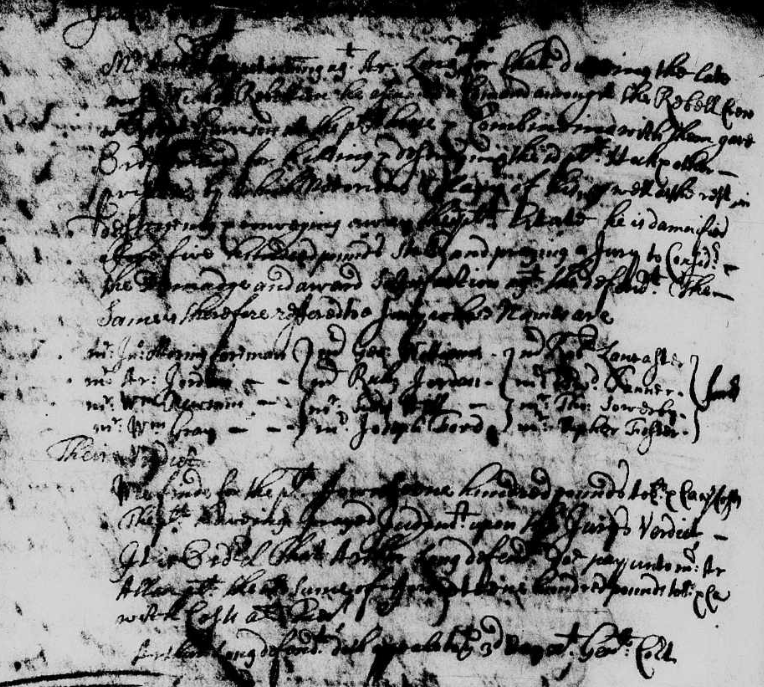
On the same day, depositions were taken from numerous people against the rebels. Those offering testimony about Arthur Long’s actions included John Price, John Clarke, William Kitto and Thomas Gibbons.
John Price told the Court that he was at Arthur Long’s house “about the last of August” and that Roger Rawlings arrived and Long said to him “O that is well you are come, for I was going to send to you for you must be ready to Carry men over to Towne [Jamestown] tomorrow morning for the Governor is coming up with several Indians and other to destroy us all.”
John Clarke testified that “three men that came from Nansemond [County] pressed me to show them the way to Rogr Rawlings for Mr. Long had sent them to the sd. Rawlings to carry them over the River, they said they had Capt. Long’s warrant, and when we came down to the sd. Rawlings & his boat, he asked them who sent them, and Mr. Collins gave him a paper but what was in it, I do not know.”
William Kitto offered that Long told him to get his boat ready to transport men over to Jamestown the following morning. Kitto said he went to see Long and told him his boat would only carry seven or eight men. He said that Long told him “that is noe matter, I have pressed Rogr Rawlins & his boat” andthen said, “ well she is bigg Enough to carry all that is to go.” Kitto then offered that when they were at Jamestown a Mr. Alsope told them that they had all the Governor’s Goods at Lawrences [Richard Lawrence of Jamestown was one of Bacon’s chief men]. He added that Rawlings said, “a pock take it they have brought us to keep their Stolen goods.” Kitto testified that he “wished himself at home” and went to see Arthur Long the next day to ask about going home. He said that Long snapped at him and said, “no you shall wait my Leisure, you shall not go.”[3]
The depositions continued the following day. Thomas Gibbons was deposed and John Price was deposed again. Price told the Court that about 23 September last, he had been a prisoner at Arthur Allen’s house and heard Arthur Long order Thomas Gibbons to shoot some of Mr. Allen’s cattle and to grind some of Mr. Allen’s wheat. Gibbons corroborated Price’s testimony.[4] This was certainly for feeding the 70-80 of Bacon’s men occupying Allen’s home.
An Order from the Governor
Captain Robert Spencer then arrived at Surry Court with an Order from the Governor. He wanted to make sure that the Surry Court understood that Arthur Long was to make his submission both in Surry Court and before the Governor and Council. The Surry Court indicated that they understood.[5] The minutes of the court session include the following submission by Arthur Long:
“I Arthur Long, that all bystanders may take notice of this, my sincere Repentance of my Rebellion, doe here most humbly upon my knees with a Roape aboute my Neck Implore Pardon of God, my King, the Honoble Govnor, Counsell & Majastrates of this his Majties County and humbly crave the benefitt of his Majties most Gracious Acts of Mercy & Pardon for my Treason and rebellion, And that this my submission & his Majties Royall Pardon to be granted me thereupon may be Entered on Record to make the same available to mee, in the Pleading thereof if Oration(?) shall hereafter bee. God save the King, and Prosper the Govnor & Majistrates of the County with all happiness Good success.”.[6]
As humiliating as this may have been, Arthur Long’s troubles were not over. When the Surry Court held its next meeting on 4 September 1677, Roger Rawlings sued Arthur Long claiming that Long had “pressed him and his boat several times.” The Court ordered Long to pay Rawlings 200 pounds of tobacco plus his costs.[7] On 16 November 1677, the Surry Court awarded Robert Spencer 800 pounds of tobacco to be paid by Arthur Long, but the judgment was suspended temporarily.[8]
The very next day, Long was back at Surry Court where it was noted that during the rebellion, Long had “commanded” 100 pounds of powder and 80 pounds of shot from Captain Charles Barham and from Lt. Col. Jordan 57 pounds of powder and 100 pounds of shot. Long was in Court to give security to return the powder and shot with in a year (by 1 November 1678) or pay 2,210 pounds of tobacco.[9] In all, Surry County juries had decided Arthur Long should pay some 4,610 pounds of tobacco plus interest for his actions during the rebellion.
Two months later, on 2 January 1677/8, Arthur Allen was in Court suing Sheriff Robert Spencer because Arthur Long – who was in prison because he couldn’t pay Allen the judgment that he won – had gotten out. Allen asserted the sheriff was now responsible for the debt. The court rejected Allen’s request saying “ye [the] said Long was but a small time out of prison & yt [that] time wth. a keeper.” Back then one could sue the sheriff for damages if he failed to produce the defendant.”[10]
Arthur Long goes missing – and turns up dead
He did make it out of jail as on 5 March 1677/8, the Surry Court noted that Arthur Long and his security John Goring had failed to go the Clerk’s office to give their bond for return of the ammunition so the Court ordered that they do so or face prosecution at the next session of the court.[11]
Arthur Long didn’t post his bond because he had left Virginia. A single record for Arthur Long comes from the Berkeley Precinct in North Carolina where on a list of births, marriages and deaths we find “Aughter Long Late of Verginia, Departed this Life the 30th of October and was buried at Caleb Calloway’s house.”[12] Caleb Calloway (b.c. 1640-1687) and Arthur Long (b.c. 1642-1677) were both natives of Isle of Wight County, Virginia and given their similar age, they were probably friends. Calloway relocated to North Carolina in the early 1660s – about the time Long went to Surry County. Berkeley Precinct was renamed Perquimans in the 1680s and became a county in 1739 and is located on the northern side of the Albemarle Sound less than 90 miles south of Surry County, Virginia.
The news of Long’s death made its way back to Surry County where on 2 July 1678, the court granted Arthur Allen a judgment against the Estate of Arthur Long for 500 pounds of tobacco plus costs. The same day judgments against Long’s estate were granted to Nicholas Meriweather for 487 pounds of tobacco[13] and to Samuel Plaw for 500 pounds of tobacco.[14] Now Long’s estate owed nearly 6,100 pounds of tobacco plus interest.
The death of the Widow Mary Long
Mary Long found herself a widow with six young children and a husband’s estate deeply in debt. Perhaps the stress of it all contributed to her death, which probably occurred in either November or December 1678 given her estate inventory is dated 27 January 1678/9. [15] On 4 November 1679, Mary Long’s will was proven in Court by the oath of Arthur Allen.[16] This is the same Arthur Allen whose house Arthur Long and others commandeered an occupied during the rebellion. On 18 November, probate on Mary Long’s estate was granted to her executor Robert Caufield and the court ordered an appraisal of the estate.[17] Caufield was married to Elizabeth Allen, sister to Arthur Allen above. Mary Long’s will is undated, but fortunately it states that she had six children and gives us the names of four of them.
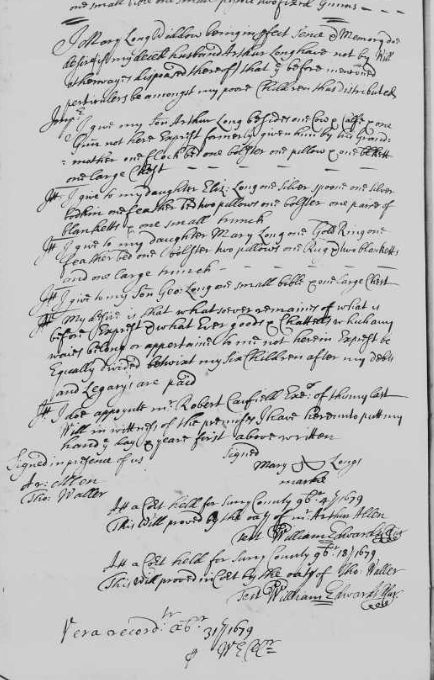
Mary Long’s will[18] transcription:
I Mary Long Widdow being in Pfect sense & memory doe desire if my deced husband Arthur Long have not by will otherways disposed thereof, that ye before mentioned perticulers be amongst my poore children thus distributed, Imp: I give my son Arthur Long besides one cow & calfe & one gun not here except formerly given him by his grandmother[19], one flock bed, one bolster, one pillow & one blanket, one large chest. I give my daughter Eliz: Long one silver spoon, one sliver bodkin, one feather bed, two pillows, one bolster, one paire of blankets & one small trunk. I give to my daughter Mary Long one gold ring, one feather bed, one bolster, two pillows, one rug & two blankets and one large trunk. I give to my son Geo: Long one small bible & one large chest. My desire is that whatsoever remains of what is before except & what ever goods & chattles which any ways belong or appertaine to me not herein expressed be equally divided betwixt my six children after my debts and legacy’s are paid I doe appoynt Mr. Robert Caufield Exer of this my last will in witness of the promises I have hereunto put my hand ye day & year first above written (no date is written above in the will book).
Signed in the presence of us signed
Ar: Allen Mary “X” Long
Tho: Waller marke
Mary Long’s estate inventory:
An Accot or Inventory of the Estate of Mary Long Widdow
One pied cow wth a crop & 2 slitts on ye right ear and an underkeele on ye left[20]
Two black and brown cow purchased of Mr. Ni: Meriweather
Two bulls, one two yrs old ye other 3, two shoats of ye like age, all lately purchased of Mr. Samll Plaw & marke of ye cow first mentioned
One yearling bull calfe of ye same marke
Severall sums of tobo lately given me by sundry psons [persons] amounting to two thousd two hundred forty pds tobo & caske
Six brooding sowes 3 marked with a crop & 2 slitts on ye right ear & ye crop & underkeele on ye left, ye other 3 being of ye aforementioned marke.
Three small shoats wth a crop & 2 slitts on ye right ear & ye crop & underkeele on ye leftThree larger shoats of ye marke first mentioned
Twenty fower [four] young pigs unmarked
Two feather beds, one flock bed with 2 shagd ruggs. Five blankets, one feather & 2 flock bolsters & five feather pillows
One small round table & large Carpet
One large brass kettle about 20 gall
One stew pan about 4 gall
One large and one small iron pott wth two pair of pott hooks
Two cargo chests one large one small, trunk, two looking glasses, one spit, one iron ladle, one grid iron, one flesh fork, one shovall
Five broad pewter dishes, 3 deepe ditto, two pewter basons, two chamber potts, one pewter candlestick, one brass ladle and brass skimmer, six pewter spoons, one flat brush, three hand sifters
Twelve fathoms of ½ inch roape, one crosscut saw, four iron wedges, one smiths sledge
Three augers, three chisels, two gouges, 3 pr of hooks & hinges, one pick axe and grubbing hoe, one old lanthorn & two dyeing sieves, one trowel, one pr sheep sheers, three roapeing hooks one pail, one piggon
Two pairs of small stillyards, one small pewter pott, one pewter salt, one silver bodkin, one silver spoon & one gold ring at Carolina, one small bible, one small pistol, two fixed guns
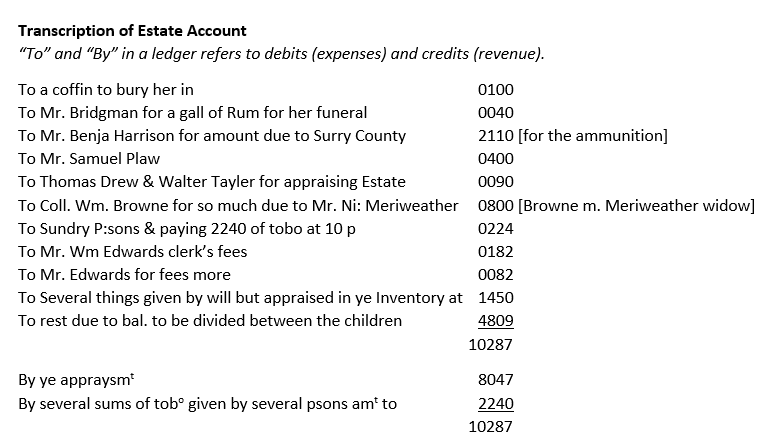
Mary’s executor, Robert Caufield, filed an appraisal of her estate on 4 July 1682 covering the period beginning 20 January 1678/9 shortly after her death:[21]
Mysterious relationships raise questions
There is a lot to unpack in these records relating to Mary Long. First is her will. She chose Robert Caufield, one of the Surry justices, as her executor. He also happened to be the brother-in-law to Arthur Allen, another justice and owner of the home Mary Long’s husband and others occupied during the rebellion. Arthur Allen also witnessed her will. Why would Mary Long have Arthur Allen witness her will and why choose Caufield as executor?
Her will is also interesting in that she devised personal property herself by will. Her property – not her husband’s. Her will devises a gold ring to daughter Mary and her unappraised inventory mentions “one gold ring at Carolina.” Did her husband have this ring with him when he died? Caufield also reported that he had received on behalf of the estate “Severall sums of tobo lately given me by sundry psons [persons] amounting to two thousd two hundred forty pds tobo & caske.” This is confirmed in the estate account. Who donated 2,240 of tobacco to Mary Long or her estate right after her husband committed treason and died?
The accounting of the estate is very interesting – or rather what is not included. Previous judgments against Arthur Long for the ammunition owed to the county, to Samuel Plaw [500 pounds of tobacco] and to Nicholas Meriweather [487 pounds of tobacco] appear to be accounted for here, but not the two judgments for 1,400 and 500 pounds to Arthur Allen.
Two final records both answer questions and raise new ones
On 6 July 1680, George Long, orphan of Arthur Long, “having no estate to bring him up” was bound to Mr. Robert Caufield until he turned 21 years old. Caufield obligated himself to provide George Long two cows & calves, a good suit of apparel and three barrels of Indian corn at the end of his term.[22] On 7 September 1680, Abigaill Long, orphan of Arthur Long “having noe Estate whereby shee may any otherway be maintained” was bound to Francis Mason until her 21st birthday or married.[23]
We find the name of a fifth child of Arthur and Mary Long – a daughter named Abigaill. And here is Robert Caufield again. It has been suggested that these various interactions between the Longs and the Allens and their allies is because Arthur Long’s wife Mary was Arthur Allen’s sister. That mystery will be the subject of a future blog post.
Arthur and Mary Long were in their 30s when they died leaving behind six children under the age of 16:
Arthur Long II, b.c. 1662 [first appears as a Surry tithable in 1678]
Elizabeth Long, b.c. 1665
Mary Long, b.c. 1668
George Long, b.c. 1671 [first appears at a Surry tithable in 1687]
Abigail Long, b.c. 1674
Unknown Long, bef. 27 January 1678/9 [mother’s inventory taken]
My ancestors who were subject to the general pardon fared better
Edward Pettway, Samuel Judkins and Samuel Plaw
For my other ancestors who among the 40 Surry County men mentioned as having been pardoned, life pretty much returned to normal after the rebellion. These men went back to their farms and lived out their lives in Surry County. They served on juries, conducted inventories and appraisals, and served in the Surry County militia.
Edward Pettway and his wife Elizabeth (———-), the widow of William Carter, had five known children (from his will) including four daughters including Elizabeth, Joyce, Fortune, and Sarah and one son named William Pettway. He may have had another daughter who married Samuel Judkins II brother, Robert Judkins as in his will Edward Pettway provided Sarah, daughter of Robert Judkins, one sheep.
Edward Pettway made his will on 27 October 1690 and it was recorded on 6 January 1690/1.[24] He was about 60 years old. His wife Elizabeth is not mentioned so she likely predeceased her husband. As was customary at the time, Edward Pettway left most of his estate to his son William including “all my land, housing, freeholder tenements [rental properties]” and after his debts were paid, “all ye rest of my goods, chattles, credit and estate.” His daughters Elizabeth, wife of Samuel Judkins and Joyce[25], wife of Bartholomew Brittle received 20 and 10 shillings respectively.
Daughter Fortune Pettway was to receive “my second best featherbed & furniture, six pewter dishes, a new basin, the best iron pot, three brooding cows, a mare, three ewes, and a ram provided my said daughter Fortune does not adjoin herself in marriage with one Will: Huggins.” He went on to note that if she did she was to receive only 10 shillings.
Samuel Judkins married Elizabeth Pettway, daughter of his neighbor and fellow Baconian rebel, Edward Pettway above. They raised two sons named Samuel III and John and perhaps unknown daughters on the 100 acres Samuel inherited from his father in 1672. Samuel Judkins II died in 1705 at about age 52 without leaving a will. His son Samuel Judkins III filed his inventory dated 18 May 1705 with the Surry Court on 6 November 1705.[26]
Samuel Plaw is mentioned regularly in Surry records until his death about 1698 serving on juries, conducting inventories and appraisals of estates, and suing and be sued over debts. There are a few notable records.
On 4 January 1680/1, the Surry Court granted a petition from Thomas Warren, son of Thomas Warren, deceased. Noting that he would be of age “on the 9th day of this instant” (meaning this month), the Court ordered Samuel Plaw (his stepfather) to deliver him part of his father’s estate on the 15th instant (presumably the balance was his mother’s dower portion) and further ordered, with Samuel Plaw’s consent, that Thomas Warren’s younger sons (Allen, b.c. 1663, Robert, b.c. 1667 and William, b.c. 1669) portions of their father’s estate be turned over to their brother Thomas to manage until they came of age.[27]
On 5 March 1687/8, Samuel Plaw sold 100 acres “more or less” in Southwark Parish to Allen Warren for 1,000 lbs tobacco. The parcel was describes as adjacent to Allen Warren’s older brother Thomas Warren. His wife Jane Plaw (Allen’s mother) waived her dower rights, indicating this was her second husband Thomas Warren, Sr.’s land to which she had a life right.[28]
On 3 December 1695, Samuel and Jane Plaw made a deed of gift to Jane’s eldest son Thomas Warren and Samuel’s daughter (and only child) Elizabeth (Plaw) Warren. They gave their “son and daughter” all of their “goods, debts and chattles” in exchange for providing their “maintenance during their natural lives.”[29]
Know all men by these psents [presents] that wee Saml and Jane Plaw of Southwarke Pish [Parish] in Surry County, doe for & in consideration of maintenance during our natural lives, give and bequeath unto our son and daughter Thomas & Eliza Warren of this County all & every part and pcell [parcel] of our goods, debts, chattels, & wee doe further give & bequeath unto our daughter Eliza Waren wife of ye said Tho: Waren all & every part and pcell [parcel] of our housing & land with all manor properties, conv:e [conveyances?] appurtenances thereunto belonging unto her & her heirs forever and wee doe fully & freely possess here & her heirs therewith in ye fee simple thereof to have & to hold, from this time forth & forever. In witness hereof wee have hereunto sett our hands and seales this 3: day of December 1695
Signed, sealed & delivered Samuel “SP” Plaw
In ye p:ence [presence] of us Jane “O” Plaw
Wm Gray, junr
Wm “W” Warren
[1] Hening’s Statutes at Large, Vol. II, Acts of Assembly, June 1676, p. 344; https://vagenweb.org/hening/vol02-17.htm; accessed 8 November 2022
[2] Surry County Orders Part 1 1671-1691, p. 146; https://www.familysearch.org/ark:/61903/3:1:3Q9M-CSKK-X9BW-N?i=172&cat=374004; accessed 8 May 2023
[3] Surry County Orders Part 1 1671-1691, p. 130; https://www.familysearch.org/ark:/61903/3:1:3Q9M-C9PX-KZQS?i=401&cat=366316; accessed 14 May 2023
[4] Surry County Orders Part 1 1671-1691, p. 134; https://www.familysearch.org/ark:/61903/3:1:3Q9M-C9PX-KZSP?i=405&cat=366316; accessed 14 May 2023
[5] Surry County Orders Part 1 1671-1691, p. 149; https://www.familysearch.org/ark:/61903/3:1:3Q9M-CSKK-X9BH-Y?i=173&cat=374004; accessed 8 May 2023
[6] Surry County, Virginia Deeds Wills Etc. No. 2 1671-1684, p. 133; https://www.familysearch.org/ark:/61903/3:1:3Q9M-C9PX-KZ9G?i=404&cat=366316; accessed 8 May 2023
[7] Surry County Orders Part 1 1671-1691, p. 154; https://www.familysearch.org/ark:/61903/3:1:3Q9M-CSKK-X9BQ-T?i=176&cat=374004; accessed 8 May 2023
[8] Surry County Orders Part 1 1671-1691, p. 176; https://www.familysearch.org/ark:/61903/3:1:3Q9M-CSKK-X9BW-C?i=187&cat=374004; accessed 8 May 2023
[9] Surry County Orders Part 1 1671-1691, p. 178; https://www.familysearch.org/ark:/61903/3:1:3Q9M-CSKK-X9BH-8?i=188&cat=374004; accessed 8 May 2023
[10] Surry County Orders Part 1 1671-1691, p. 190; https://www.familysearch.org/ark:/61903/3:1:3Q9M-CSKK-X9B4-Q?i=195&cat=374004; accessed 8 May 2023
[11] Surry County Orders Part 1 1671-1691, p. 196; https://www.familysearch.org/ark:/61903/3:1:3Q9M-CSKK-X9BH-W?i=198&cat=374004; accessed 8 May 2023
[12] The North Carolina Historical and Genealogical Register, Vol. 3, No. 3, p. 365; https://www.google.com/books/edition/The_North_Carolina_Historical_and_Geneal/uEU9AQAAMAAJ?hl=en&gbpv=1
[13] Surry County Orders Part 1 1671-1691, p. 209; https://www.familysearch.org/ark:/61903/3:1:3Q9M-CSKK-X9BH-J?i=205&cat=374004; accessed 8 May 2023
[14] Surry County Orders Part 1 1671-1691, p. 210; https://www.familysearch.org/ark:/61903/3:1:3Q9M-CSKK-X9BC-8?i=206&cat=374004; accessed 8 May 2023
[15] Surry County, Virginia Deeds Wills Etc. No. 2 1671-1684, p. 241; https://www.familysearch.org/ark:/61903/3:1:3Q9M-C9PX-KCY9?i=512&cat=366316 ; accessed 8 May 2023
[16] Surry County Orders Part 1 1671-1691, p. 273; https://www.familysearch.org/ark:/61903/3:1:3Q9M-CSKK-X9BV-N?i=239&cat=374004; accessed 8 May 2023
[17] Surry County Orders Part 1 1671-1691, p. 283; https://www.familysearch.org/ark:/61903/3:1:3Q9M-CSKK-X9BV-H?i=244&cat=374004; accessed 8 May 2023
[18] Surry County, Virginia Deeds Wills Etc. No. 2 1671-1684, p. 242; https://www.familysearch.org/ark:/61903/3:1:3Q9M-C9PX-KCRT?i=513&cat=366316; accessed 8 May 2023
[19] I read this twice to be sure – in the abstract is says grandfather but in the record it says grandmother.
[20] Colonists often marked their livestock by notching and/or cropping their ears to create a unique pattern.
[21] Surry County, Virginia Guardian Accounts 1672-1750, Image 31; https://www.familysearch.org/ark:/61903/3:1:3Q9M-C9PX-KXMS?i=30&cat=366398; accessed 17 May 2023
[22] Surry County Orders Part 1 1671-1691, p. 308; https://www.familysearch.org/ark:/61903/3:1:3Q9M-CSKK-X9B2-M?i=257&cat=374004 ; accessed 8 May 2023
[23] Surry County Orders Part 1 1671-1691, p. 310; https://www.familysearch.org/ark:/61903/3:1:3Q9M-CSKK-X9B2-L?i=258&cat=374004; accessed 8 May 2023
[24] Surry County Wills, Etc., No. 4 1687-1694, p. 182; https://www.familysearch.org/ark:/61903/3:1:3Q9M-C9PX-VSR1-H?i=215&cat=366316; accessed 17 November 2022
[25] She was previously married to John Fiveash (d.c. 1688) and had two children Francis & Mary. On 9 January 1688, Bartholomew Brittle acknowledged that he had a cow with its female increase that was a gift Francis Fiveash with a stipulation that if he died before coming of age the said cattle to his sister Mary Fiveash and if Mary to die before coming of age, the cattle would be returned to Joyce, his now wife. Edward Pettway also signed the acknowledgement. Surry County Wills, Etc., No. 4 1687-1694, p. 92; https://www.familysearch.org/ark:/61903/3:1:3Q9M-C9PX-VSTZ-C?i=124&cat=366316; accessed 17 November 2022
[26] Surry County Deeds, Wills, Etc. No. 5, p. 339; https://www.familysearch.org/ark:/61903/3:1:3Q9M-C9PX-V39V-Q?i=358&cat=366316 ; accessed 17 November 2022
[27] Surry County, Virginia Orders, Part 1, 1671-1691, p. 329; https://www.familysearch.org/ark:/61903/3:1:3Q9M-CSKK-X9BL-R?i=270&cat=374004 ; accessed 17 May 2023
[28] Surry County, Virginia Deeds, Wills, Etc. No. 4, 1687-1694, p. 29; https://www.familysearch.org/ark:/61903/3:1:3Q9M-C9PX-VST6-C?i=55&cat=366316; accessed 9 December 2022
[29] Surry County, Virginia Deeds, Wills, Etc. No. 5, Part 1, 1694-1709, p. 73; https://www.familysearch.org/ark:/61903/3:1:3Q9M-C9PX-V397-R?i=88&cat=366316; accessed 9 December 2022
 A Son of Virginia
Steve,
Another excellent piece of research – I learn so much from your articles. My hats off to you if you can read these old documents. I’ve tried and I can generally make out only about every 4-5th word.
Dianne Honeycutt Shields
LikeLike
Thank you so much! Those old documents are very hard to read! I love doing it though.
LikeLike