
When I was first starting my family history pursuits as an eleven-year-old, I remember my maternal grandmother telling me that her parents were cousins. She said, “They were kin through the Gills.” I laughed having no idea Gills was a last name. Her parents – my great-grandparents – were second cousins connected through the Gills family of Amelia County. Well, technically of Louisa, Nottoway and Amelia Counties, but we’ll get to that.
My great-grandparents John Stewart (1868-1958) and Annie May (1884-1977) (Blanton) Morris each had a grandmother who was a daughter of Miles A. & Mary A.D. (Atkinson) Gills of Amelia and Nottoway Counties. See chart below.
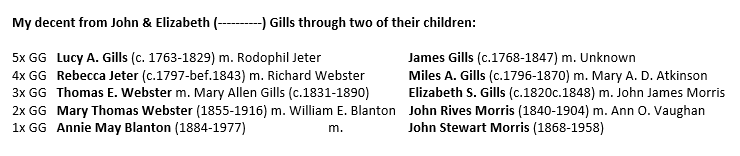
Another familial connection to the Gills family is my 2x great-grandmother Ann Octavia (Vaughan) Morris (1844-1942). She lost both of her parents when she was very young, so she and her younger sister were raised by their material uncle and aunt Charles Willson Farmer and his wife Alice Gabriella Gills (1835-1915). She was another daughter of Miles A. and Mary A. D. (Atkinson) Gills. Alice (Gills) Farmer also happened to be the aunt of my 2x great grandfather, which is probably how he and Ann Vaughan knew – or got to know – one another.
As my grandmother said, “They were kin through the Gills.” Here’s the story of the first of this line, my 6x great grandparents John and Elizabeth Gills and their seven children – six boys and a girl.
The Gills family of Louisa County
Like many of my Amelia County ancestors, the Gills arrived from elsewhere in Virginia. John and Elizabeth Gills were probably born about 1740. From the early 1760s through the early 1770s, he appears in various Louisa County, Virginia records. Many researchers believe Elizabeth’s maiden name was Perkins as John and Elizabeth named their first-born son William Perkins Gills.[1]
John Gills origins are unknown. The surname Gills is a variant of Gill and is English and Scottish. It is a topographical name coming from ‘Gille’ [hard G, silent e] meaning “a valley or woody glen; a narrow dell with a brook running through it; a small stream.”[2] He may have been an immigrant given that Virginia’s white population increased from 200,000 to 260,000 – an increase of 30% from 1760 to 1770.[3] If John Gills was born in Virginia, one connection may be the William Gills who patented 152 acres on the upper side of Beaverdam Swamp in Hanover County, Virginia on 20 September 1745.[4] Louisa County was formed out of Hanover County in 1742. Unfortunately, Hanover has experienced catastrophic records loss and I have found no other record for this William Gills or any connection between the two men. Another potential connection is the John Gills who died in Cumberland County in 1752 leaving an inventory and appraisal of his estate and a record of the sale of his goods. In the second case, the list of buyers includes no Gills, which suggests he was single.[5]
Buying land on Goldmine Creek
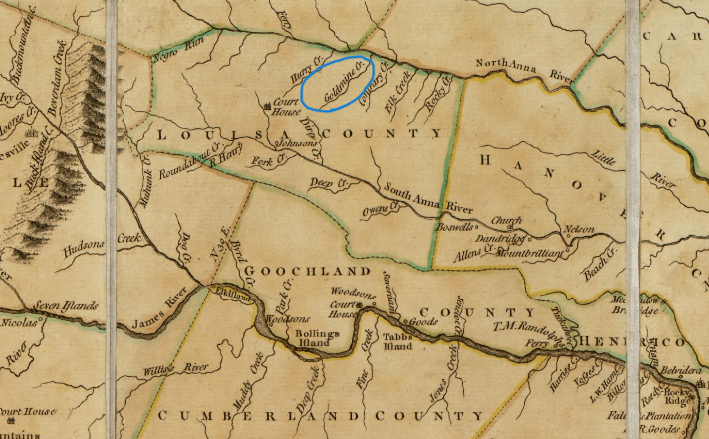
My John Gills bought his first tract of land on 8 November 1763, when he purchased 100 acres from Gravet & Milly Edwards for 40 pounds current money of Virginia [pounds, shillings and pence]. The land was described as being situated in Louisa County on the Northside of Goldmine Creek adjoining Col. John Symes line.[6] He added 50 adjacent acres on 12 August 1765, when William Tandy of Albemarle County sold the tract to him for £25. Described as being on the road leading over Goldmine Creek and adjacent to John Thomson, William Poindexter, Rowland Gooch, the said Gills line and Joseph Lipscomb.[7]
John Gills in other Louisa County records
John Gills witnessed the will of Richmond Terrell of St. Martins Parish in Louisa County dated 31 October 1764 and proven by the oaths of the witnesses on 12 August 1765.[9]
Louisa County tithe lists from 1743-1766 are missing as are other years between 1767-1785. John Gills appears on five lists from 1767-1773 in Trinity Parish:
1767 – 150 acres and tithing on himself and four enslaved people: Harry, George, Sarah and Jamy.[10]
1768 – 144 acres and the same tithables.[11] Probably the result of a survey or processioning process. 1770 – 100 acres [likely an error] and paid tax on five unnamed tithables.[12]
1771 – 144 acres and paid on six unnamed tithables.[13]
1773 – no acreage listed and he paid tax on himself and four enslaved people: named George, Jenney, Sarah and Janny.[14]
Finally, his wife’s name is revealed on 10 Nov 1777 when John Gills and Elizabeth, his wife sold their land in Louisa County to Isaac Ware for 100 pounds. The deed is interesting as it does not mention the acreage.[15] We know from the tithe lists it was about 144 acres. This is the first and only mention I found of Elizabeth Gills in Louisa County.
The Gills family of Amelia County
While they didn’t sell their Louisa land until 1777, John Gills was in Amelia County when as “John Gill” when he witnessed a deed on 26 November 1772.[16] While the name surname Gills was sometimes recorded as Gill, this appears to be a separate and distinct family unrelated to the Guille [Gill] families of Virginia. On 22 September 1774, John Gills of Amelia County purchased 283 acres of land from Jonas Jordan of Bedford County for £212. The tract of land is described as “where the said Jordan formerly lived and bounded by the line of Philip Major, to the [tobacco] rolling road, lines of Thomas Munford and Joel Meadows and Stock’s Creek.” The deed was witnessed by John Wright and Thomas Atkinson (another ancestor).[17] Described as “of Amelia County” this tells us John Gills was already living in Amelia County.
He added to his Amelia land holdings on 14 Feb 1784 when he purchased 120 acres from William Pollard for 8500 pounds of “neat, inspected tobacco”. This tract was located on both sides of Stock’s Creek adjacent to the lands of William Ford, Jr., William Butler and the said Gills.[18] This acquisition increased his farm to just over 400 contiguous acres on both sides of Stocks Creek.

Amelia County tax lists
Land and Personal Property tax records began in 1782 and generally only list by name the person responsible for the tax. In a few instances, the names of enslaved people and/o white males 16 or older are provided. Where the information is provided, I am including it. Tax lists are useful for understanding an ancestor’s financial condition over time.
For example, in 1782 when the first property tax list was taken, John Gills was the head of a family on Christopher Ford’s list in Amelia County in 1782 that included 7 whites and 8 enslaved.[20] Four of their names – Sam, Bob, Phill and Judy – are included on another list taken by Ford entitled “A List of Negroes under 16 years old”[21] For 1785, he is listed a head of a family including 8 whites with 3 dwellings and 6 other buildings.[22] In 1790, John Gills paid personal property tax on 4 blacks over 16, 1 black under 16 [ 5 enslaved] and 4 horses.[23] In 1800, he was taxed for 2 white males over 16, 5 blacks over 16 and 3 blacks 16 or under [8 enslaved].[24] In 1805 he was taxed on 3 white 16+, 8 blacks 16+, 1 black under 16 [9 enslaved] and 7 horses.[25] Finally, in 1810, the Estate of John Gills paid tax on no white males 16+, 6 blacks 16+, 1 black under 16 [7 enslaved] and 5 horses. Over the nearly 30 year period, John Gills seems to have experienced a relatively stable financial situation. His 405 acres remained constant, he enslaved between 5-9 people and owned between 4-7 horses.
Petitioning the Virginia legislature
Legislative petitions from groups of citizens all over Virginia were common during this period. On 5 Nov 1783, John Gills, along with other Amelia County inhabitants, signed a petition asking the Virginia General Assembly to allow them to pay their taxes in “the staples of the Country” rather than specie so as to avoid having to sell their crops at low prices. Citing a twenty-five percent drop in tobacco prices and taxes imminently due, the signers note that they are “well apprised of the necessity of imposing taxes adequate to the public expenditure as well as for the ordinary expenses of government and the extinguishment of the debt necessarily incurred in the late happy contest for the independence of America.”[26] John Gills was among the citizens of Raleigh Parish in Amelia County to sign a Petition to the Virginia General Assembly dated 24 Oct 1787 asking that the same [tax] rate be applied to the Parish lands of Raleigh and Nottoway Parishes.[27]
Road maintenance responsibilities
Road building and maintenance were important public projects during this era. Just about everyone was required to either labor or provided enslaved laborers to build and maintain roads. At a Court session held in Amelia County on 23 Apr 1789, John Gills and John Gills, Jr. were among several men described as hands to work for William Gray, appointed to surveyor of the road between Sandy Creek and Paulin Anderson’s.[28]
John Gills in court
On 31 May 1786, he was the plaintiff in a case against William Pollard and Thomas Wright over a debt, but the suit was dismissed, “the plaintiff failing to prosecute his suit.”[29] From 29 March 1793 through 24 March 1796, William Norvill was ordered by the Amelia Court to pay John Gills between 50 and 53 cents per day for attending court ten times (some for 2-3 days) as a witness on his behalf in his suit and Marshall Booker & Co. Norvill is a plaintiff and a defendant frequently in the index of the Order Books, but I couldn’t discover what this case was about.[30],[31],[32],[33],[34],[35],[36],[37],[38],[39],[40],[41],[42] On 25 March 1796, John Gills appeared as a plaintiff in a suit against Mathew Robertson & Richard Phillips, executors of Edmund Booker, late sheriff. The parties were both represented by attorneys and the court said it was satisfied that the defense had received property notice and continued the case to the following day. It wasn’t until two months later on 27 May 1796 that the case was back in Court where the Justices continued it again “until tomorrow.” They did meet the following day and everyone appeared. The court awarded John Gills £1.3.1/2 “it being the balance due on an Execution [of a] suit out of this Court by the Plt against Thomas Whitworth and Joshua Chaffin” as well as £0.3.5 “for his damages occasion[ed] by the detention of the said debt together with his costs by him in this behalf expended.”[43]
The death of John Gills
John Gills made his will in Amelia County on 9 January 1808, which was proven at Court on 28 April 1810.[44] He probably died in 1810 shortly before his will was proven at about age 70. He lent his wife his land for life or until she remarried, then it was to go to his youngest son Pleasant Gills. He gave £20 each to his “four eldest children” including (1) William (married and living in Buckingham County), (2) Lucy (married and living in Amelia County), (3) John (widowed and living in Bedford County, Virginia) and (4) James (married and living in Amelia County). His two other sons, Anthony and Anderson were both married and living in Nottoway County which was formed out of Amelia County in 1789. Only youngest child Pleasant Gills was unmarried when his father died.
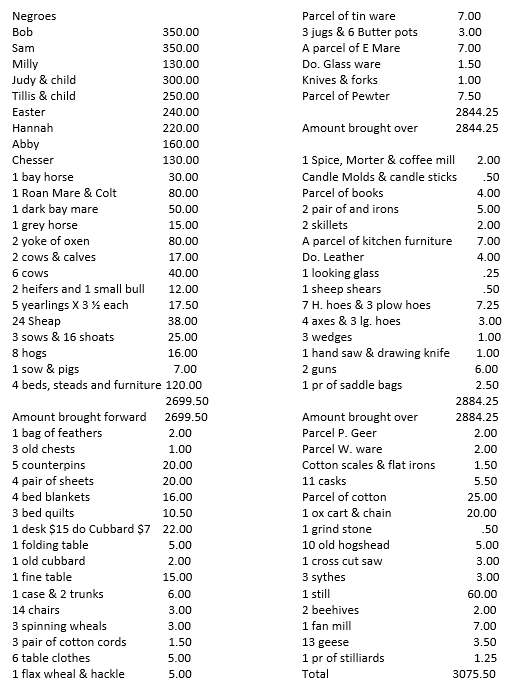
John Gills also left his son Pleasant Gills three enslaved people including Polly and her two children Dick and George. He also received some furniture and livestock. John Gills directed that his wife be lent nine enslaved people named Bob, Milley, Judy, Sam, Easter, Tillis, Hannah, Abby and Chesser. At her death or remarriage, these nine people along with any children they may have had were to be divided between all seven of John Gills children. He appointed his son William, son-in-law Rodophil Jeter and sons James and Anthony as executors. Two months later, on 28 June 1810 the inventory and appraisement of the Estate of John Gills, deceased, was presented to the Amelia County Court. Note that two of the enslaved women Judy and Tillis gave birth since John Gills will was written in 1808 so 11 enslaved people are included in his inventory.

Transcription of John Gills Estate Inventory & Appraisal [45] (spelling as found in original)
The impact on the enslaved when an estate was distributed
A Chancery Cause (Suit) filed in Amelia County in 1819 and concluded in July 1821 contains a division of the personal estate of John Gills widow Elizabeth Gills. She was alive when the suit was filed as she provided an answer to the allegations as one of the defendants, but she died before 1820 as she is not listed in the census for that year. There was no controversy – this was the process to divide an estate. The Amelia Court ordered that a valuation of the enslaved people lent to Elizabeth Gills for life be made so they could be divided among the heirs. The heirs were the six living children of John and Elizabeth Gills and the children of son William Gills who died in Buckingham County in 1816. The estate consisted of 15 enslaved people – up from 11 when John Gill’s I&A was filed in 1810. To daughter Lucy Jeter – Juda, Anniss, & Wilson, to son John Gills – Sam & Rachel, to son James Gills – Chesar & Milly, to son Anthony Gills – Phillis & Aaron, to son Anderson Gills – Hannah & Jane, to son Pleasant Gills – Will & Easter and to son William Gill’s estate – Abba & Tilmon.[46]
When an enslaver’s death resulted in an estate distribution, enslaved people – some families – were often separated – some destined to move far away. In the Gills case, in 1820 while daughter Lucy, son James and son Pleasant all lived in Amelia County, they lived on different plantations. The enslaved Sam and Rachel likely went to Bedford County where son John Gills, Jr. lived, Hannah & Jane probably to Allen County, Kentucky where son Anderson Gills lived and Abba and Tilmon probably went to Buckingham County where son William’s widow lived. This must have been terrible for them, but sadly not nearly as terrible as what the rest of being enslaved entailed.

Below is a brief summary of the children of John and Elizabeth Gills.
These seven children produced nearly sixty children. The six sons produced nearly 30 sons themselves. I guess there are a lot of people who are kin through the Gills!
John1 GILLS, b.c. 1740, d. by 26 Apr 1810, Amelia County, VA, m. about 1760, Elizabeth (possibly Perkins), d. after 1821. Children of John and Elizabeth (possibly Perkins) Gills include:
William Perkins2 Gills, b. 1761, Louisa County, Virginia, d. 1816, Buckingham County, Virginia, m. 5 February 1784, Amelia County, Virginia, Mary Wright (c.1760-c.1851). In adulthood he lived in Prince Edward County, but eventually settled in Buckingham County where he died in 1816. His widow, Mary (Wright) Gills filed a pension application from Buckingham County in 1840 for his service during the Revolutionary War. [47] The file contains a family register transcribed from a blank page at the end of a New Testament and provides the names and birthdates for this family. Issue:
Thomas Wright3 Gills
Sarah Perkins3 Gills
George W.3 Gills
William3 Gills, Jr.
Polly3 Gills
Archibald3 Gills
James3 Gills
Lucy2 Gills, b.c. 1763, Louisa County, Virginia, d. 1829, Amelia County, Virginia, m. 1785, Amelia County, Virginia, Rodophil Jeter. They lived in Amelia County, issue:
Anderson3 Jeter
Elizabeth3 Jeter
Jane Stern3 Jeter
Lucy A. 3 Jeter
Rebecca3 Jeter
Edmund3 Jeter
Harriet3 Jeter
William3 Jeter
John3 Jeter
Maria L.3 Jeter
John2 Gills, b. 6 March 1764, Louisa County, Virginia, d. 1845, Bedford County, Virginia, m. (1) 1786, Amelia County, Virginia, Tabitha Anderson Jeter (c.1760-c.1804). Applied for a pension in 1834 from Bedford County. He described his service as noted that he was born in Louisa County on 6 March 1764 entering the service out of Amelia County at 16 years old. He also said that since the Revolution he had lived in Amelia, Richmond, & Fluvanna and that in 1790 he moved to Bedford County, Virginia, where he was currently living.[48] Issue:
Ambrose3 Gills
William3 Gills
Lucy Jane3 Gills
Anthony3 Gills
Elizabeth3 Gills
James3 Gills
James2 Gills , b.c. 1768, Louisa County, Virginia, d. 1847, Amelia County, Virginia, m. (1) probably ———- Miller; m. Amelia County, Virginia, (2) Nancy Scott Woodson; issue:
1st marriage
Miles A.3 Gills
Armistead Miller3 Gills
2nd marriage
James3 Gills
William H.3 Gills
Elizabeth W.3 Gills
Judith W.3 Gills
Lucy Ann3 Gills
Robert3 Gills
Martha Elvira3 Gills
Joseph Madison3 Gills
Louisa3 Gills
Anthony2 Gills, b.c. 1773, Fluvanna County[49], Virginia, aft. 1850, Nottoway County, Virginia, m. abt. 1800, Mary Ann (Nancy) Hundley (c.1780-1824). Lived in Nottoway County, Virginia. Issue:
John Anderson3 Gills
Joel Anthony3 Gills
James3 Gills
Asa Hundley3 Gills
William3 Gills
Mary Ann3 “Nancy” Gills
Anderson2 Gills, b. 1779, Amelia County, Virginia, d. 1861, Obion County, Tennessee, m. 1807, Amelia County, Virginia, Mary “Polly” Woodson (c.1788-c.1860). Anderson Gills left Virginia and was in Allen County, Kentucky in 1820 and 1830. By 1840, he was in Obion County, Tennessee. Anderson Gills, 81 and Mary Gills, 72 are listed in the 1860 census in Obion County, Tennessee. Issue:
John3 Gills
James3 Gills
Mary3 Gills
Anderson3 Gills
Joseph Woodson3 Gills
Nancy3 Gills
William3 Gills
Beverly3 Gills
Pleasant2 Gills, b.c. 1784, Amelia County, Virginia, d. 25 September 1877, Amelia County, Virginia, m. 1813, Amelia County, Virginia, Nancy Fowlkes (c.1792-c.1865). They lived in Amelia County, but relocated to Green County, Alabama by 1850. By 1860, they had moved to Perry County, Alabama. His wife appears to have died in Alabama between 1860 and 1870 as he listed with a Mary Ann Gills in 1870. Pleasant Gills retuned to Amelia County after 1870 where he died in 1877. Issue:
John William3 Gills
Lucy Tate3 Gills
Margaret Ann3 Gills
Mary Jane3 Gills
James Armistead3 Gills
Sarah Francis3 Gills
Thomas P.3 Gills
Richard H.3 Gills
Eliza V.3 Gills
[1] Many Gills researchers believe that John Gills’ wife was Elizabeth Perkins; the name of the eldest son William Perkins Gills no doubt the source. There were Perkins in Louisa County when John and Elizabeth Gills were in Louisa. The general consensus is that she may have been a daughter of William & Lucy (Watkins) Perkins of Buckingham County, Virginia where William died about 1800. William Perkins was a descendant of Nicholas Perkins came to Virginia from England in 1641 and settled in Charles City County where he died in 1654. From “The Perkins family of Virginia : descendants of Nicholas Perkins who died ca. 1654 in Charles City County” by William K. Hall, 1953.
[2] Arthur, William, M.A. An Etymological Dictionary of Family and Christian Names With An Essay On Their Derivation and Import (New York; Sheldon, Blake, Beeker & Co., 1857)
[3] U. S. Census Bureau, Bicentennial Edition: Historical Statistics of the United States, Colonial Times to 1970, Chapter Z, Colonial and Pre-Federal Statistics, p. 1168; https://www2.census.gov/library/publications/1975/compendia/hist_stats_colonial-1970/hist_stats_colonial-1970p2-chZ.pdf ‘ accessed 10 May 2023
[4] Land Patents Book No.22 1743-1745 (Vol.1 & Vol.2), p. 477, Library of Virginia, Richmond, Virginia
[5] Cumberland County Will Book No. 1 1749-1769, p. 66-68; https://www.familysearch.org/ark:/61903/3:1:3Q9M-C9TH-G3VC-5?i=49&cat=367904 ; accessed 7 May 2023
[6] Louisa County Deed Book C (1759-1765), p. 240; https://www.familysearch.org/ark:/61903/3:1:3Q9M-CS42-GSV5-2?i=228&cat=281398; accessed 3 May 2023
[7] Louisa County Deed Book C ½ 1764-1766, p. 102, https://www.familysearch.org/ark:/61903/3:1:3Q9M-CS42-GSK9-1?i=60&cat=281398 ; accessed 3 May 2023
[8] Henry, J. & Jefferys, T. (1770) A new and accurate map of Virginia wherein most of the counties are laid down from actual surveys. With a concise account of the number of inhabitants, the trade, soil, and produce of that Province. London, Thos. Jefferys. [Map] Retrieved from the Library of Congress, https://www.loc.gov/item/74693087/.
[9] Louisa County, Virginia Will Book 1, p. 73; https://www.familysearch.org/ark:/61903/3:1:3QS7-99P6-5SRB?i=38&cat=382751; accessed 3 May 2023
[10] Davis, Rosalie E. Louisa County Tithables & Census 1743-1785 (Manchester, MO, self-published, 1988), p. 6
[11] Davis, Rosalie E. Louisa County Tithables & Census 1743-1785 (Manchester, MO, self-published, 1988), p. 10
[12] Davis, Rosalie E. Louisa County Tithables & Census 1743-1785 (Manchester, MO, self-published, 1988), p. 17
[13] Davis, Rosalie E. Louisa County Tithables & Census 1743-1785 (Manchester, MO, self-published, 1988), p. 21
[14] Davis, Rosalie E. Louisa County Tithables & Census 1743-1785 (Manchester, MO, self-published, 1988), p. 26
[15] Louisa County Deed Book E 1774-1784, p. 198; https://www.familysearch.org/ark:/61903/3:1:3Q9M-CS42-P9X1-7?i=129&cat=281398 ; accessed 3 May 2023
[16] Amelia County, Virginia Deed Book 12 p., 11: https://www.familysearch.org/ark:/61903/3:1:3Q9M-CSYD-LSS4-K?i=21&cat=282005 ; accessed 3 May 2023
[17] Amelia County, Virginia Deed Book 13 1774-1776, p. 47; https://www.familysearch.org/ark:/61903/3:1:3Q9M-CSYD-LS9B-D?i=170&cat=282005 ; accessed 3 May 2023
[18] Amelia County, Virginia Deed Book No. 17 1784-1786, p. 117; https://www.familysearch.org/ark:/61903/3:1:3Q9M-CSYD-295M-L?i=288&cat=282005 ; accessed 3 May 2023
[19] Fry, J., Jefferson, P. & Jefferys, T. (1755) A map of the most inhabited part of Virginia containing the whole province of Maryland with part of Pennsylvania, New Jersey and North Carolina. [London, Thos. Jefferys] [Map] Retrieved from the Library of Congress, https://www.loc.gov/item/74693166/.
[20] First Census of the United States 1790, Records of the State Enumerations: 1782-1785 – Virginia, Genealogical Publishing Company, Inc., 1986, p. 12
[21] 1782 Amelia County, Virginia Personal Property Tax Lists; https://www.familysearch.org/ark:/61903/3:1:3Q9M-CSQF-2BVB?i=63&cat=775675; accessed 3 May 2023
[22] First Census of the United States 1790, Records of the State Enumerations: 1782-1785 – Virginia, Genealogical Publishing Company, Inc., 1986, p. 81
[23] 1790 Amelia County Personal Property Tax List; https://www.familysearch.org/ark:/61903/3:1:3Q9M-CSQF-2BWL?i=217&cat=775675 ; accessed 8 May 2023
[24] 1795 Amelia County Personal Property Tax List; https://www.familysearch.org/ark:/61903/3:1:3Q9M-CSQF-2Y5K?i=382&cat=775675 ; accessed 8 May 2023
[25] 1800 Amelia County Personal Property Tax List; https://www.familysearch.org/ark:/61903/3:1:3Q9M-CSQF-21HF?i=502&cat=775675 ; accessed 8 May 2023
[26] Inhabitants: Petition, Amelia County, dated 5 Nov 1783, Legislative Petitions Digital Collection, Library of Virginia, Richmond, VA; http://rosetta.virginiamemory.com:1801/delivery/DeliveryManagerServlet?dps_pid=IE2585074 ; accessed 8 May 2023
[27] Freeholders & Inhabitants of Raleigh Parish: Petition, Amelia County, dated 24 Oct 1787, Legislative Petitions Digital Collection, Library of Virginia, Richmond, VA; http://rosetta.virginiamemory.com:1801/delivery/DeliveryManagerServlet?dps_pid=IE2575573 ; accessed 8 May 2023
[28] Amelia Co. Order Book 19, p. 140; https://www.familysearch.org/ark:/61903/3:1:3Q9M-CSKH-Q9Q7-7?i=479&cat=275453 ; accessed 8 May 2023
[29] Amelia County Order Book No. 17 1785-1786, p. 157; https://www.familysearch.org/ark:/61903/3:1:3Q9M-CSKH-Q996-Y?i=189&cat=275453; accessed 7 May 2023
[30] Amelia County Order Book No. 20 1792-1795, p. 48; https://www.familysearch.org/ark:/61903/3:1:3Q9M-CSKH-Q93L-H?i=627&cat=275453; accessed 7 May 2023
[31] Amelia County Order Book No. 20 1792-1795, p. 96; https://www.familysearch.org/ark:/61903/3:1:3Q9M-CSKH-Q93K-J?i=651&cat=275453; accessed 7 May 2023
[32] Amelia County Order Book No. 20 1792-1795, p. 188; https://www.familysearch.org/ark:/61903/3:1:3Q9M-CSKH-Q93F-N?i=697&cat=275453; accessed 7 May 2023
[33] Amelia County Order Book No. 20 1792-1795, p. 230; https://www.familysearch.org/ark:/61903/3:1:3Q9M-CSKH-Q93D-J?i=718&cat=275453; accessed 7 May 2023
[34] Amelia County Order Book No. 20 1792-1795, p. 237; https://www.familysearch.org/ark:/61903/3:1:3Q9M-CSKH-Q93X-2?i=721&cat=275453; accessed 7 May 2023
[35] Amelia County Order Book No. 20 1792-1795, p. 299; https://www.familysearch.org/ark:/61903/3:1:3Q9M-CSKH-Q93Z-1?i=752&cat=275453; accessed 7 May 2023
[36] Amelia County Order Book No. 20 1792-1795, p. 400; https://www.familysearch.org/ark:/61903/3:1:3Q9M-CSKH-Q9S5-6?i=803&cat=275453; accessed 7 May 2023
[37] Amelia County Order Book No. 20 1792-1795, p. 493: https://www.familysearch.org/ark:/61903/3:1:3Q9M-CSKH-Q9SS-B?i=864&cat=275453; accessed 7 May 2023
[38] Amelia County Order Book No. 20 1792-1795, p. 508; https://www.familysearch.org/ark:/61903/3:1:3Q9M-CSKH-Q99Y-K?i=872&cat=275453; accessed 7 May 2023
[39] Amelia County Order Book No. 20 1792-1795, p. 52; https://www.familysearch.org/ark:/61903/3:1:3Q9M-CSKH-Q1VK?i=42&cat=275453; accessed May 2023
[40] Amelia County Order Book No. 20 1792-1795, p. 62; https://www.familysearch.org/ark:/61903/3:1:3Q9M-CSKH-Q1J9?i=46&cat=275453; accessed 7 May 2023
[41] Amelia County Order Book No. 20 1792-1795, p. 72; https://www.familysearch.org/ark:/61903/3:1:3Q9M-CSKH-Q1NK?i=51&cat=275453; accessed 7 May 2023
[42] Amelia County Order Book No. 20 1792-1795, p. 132; https://www.familysearch.org/ark:/61903/3:1:3Q9M-CSKH-Q16B?i=81&cat=275453; accessed 7 May 2023
[43] Amelia County Order Book No. 21 1795-1797, p. 145, 194, 206; https://www.familysearch.org/ark:/61903/3:1:3Q9M-CSKH-Q14R?i=117&cat=275453 ; accessed 7 May 2023
[44] Amelia County Will Book No. 7, p. 496; https://www.familysearch.org/ark:/61903/3:1:3Q9M-C9TH-PJB1?i=461&cat=275408; accessed 7 May 2023
[45] Amelia County Will Book 7, p. 505; https://www.familysearch.org/ark:/61903/3:1:3Q9M-C9TH-PJYV?i=465&cat=275408; accessed 7 May 2023
[46] Amelia County Chancery Cause: 1821-003; Legatees of John Gills, the Elder vs. John Gills Executors, pp. 1-6, Source: Virginia Memory Digital Collection, Library Virginia, Richmond, VA; https://www.lva.virginia.gov/chancery/case_detail.asp?CFN=007-1821-003; accessed 7 May 2023
[47] Transcription of 1840 Pension Application by Mary (Wright) Gills; https://revwarapps.org/w7521.pdf
[48] Transcription of John Gills, Jr.’s 1834 pension application https://revwarapps.org/s17976.pdf
[49] This according to the 1850 U.S. Census. Fluvanna County was not created until 1777. Prior to then it was part of Albemarle County. Given his parents moved to Amelia around this time it seems unlikely they made a stop in Albemarle County.
 A Son of Virginia
I have a copy of a 1792 letter transcribed by W.S. Morton. John Jones is writing to his brother William Jones regarding their dispute over their father’s estate. In the letter, he mentions 126 acres of Gill’s (Guils) land. It made me wonder if the Gills were not connected to the Jones family much earlier.
LikeLiked by 1 person
William Perkins Gills was in Buckingham around that time I think. He was a son of John Gills (c.1740-1810) of Louisa then Amelia Co. There were earlier Gills in Goochland and Cumberland too so you may be onto something.
Thanks for writing!
LikeLike
Thanks for your reply. If you will email me, I will email you a copy.
LikeLiked by 1 person