If you missed Parts 1-3, you can catch up by visiting my WordPress blog at https://asonofvirginia.blog/
Arthur Long (my 9x great-grandfather) was born about 1642 in Isle of Wight County, Virginia, a son of Robert Long and an unknown wife. Arthur Long was the second generation to be born in Virginia as his father -circa 1624 – as he was described as “a child born in Virginia” in the 1624/5 muster and was living with his parents Richard and Alice (———-) Long along the Pagan River at Basse’s Choice in present day Isle of Wight County, Virginia.[1]
Very little is known of Arthur Long’s childhood in Isle of Wight County except that he had three brothers including Robert, John[2] and Daniel Long. He was seemingly named for his godfather Arthur Smith I (c.1607-1645) who left his “godson Arthur Long” 100 acres of land in his 1645 will.[3] Arthur Long was one of three such godsons named in Smith’s will along with Arthur Virgin and Arthur Taylor.[4] He moved to adjacent Surry County by 27 December 1661 when he witnessed a deed.[5] A few days later, on 1 January 1661/2[6], 19-year-old Arthur Long bought 300 acres from Thomas and Judith Clary (or Clarie) “at Lower Chippokes” in Lawnes Creek Parish.[7]
Six months later, Arthur Long was in Surry Court suing Clary for apparently squatting on the land. Arthur Long petitioned the sheriff (Mr. Spencer) “I pray you draw me a petition and let it be filed according to law against Thomas Clary the next court for making use of my housing and land without bargain or leave and intends to debar me putting in my crop in my own housing which will be to the loss of my tobacco. Pray don’t fail me this 27th of June [1662].” Long went on ask that Clarie be arrested and ordered to appear that the next court.[8] Clary responded by saying “I am arrested at ye suit of Arthur Long” and asking for a delay.

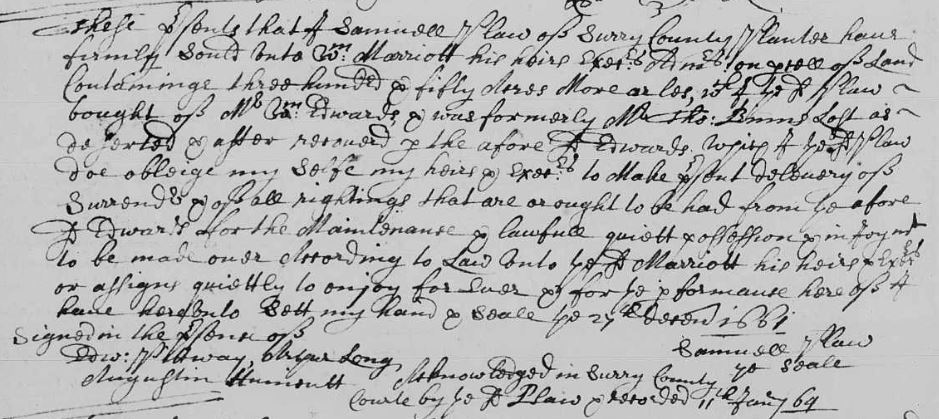
Aside from this controversy, Arthur Long appears in the record doing what free men did in their communities such as serving on inquest juries to determine causes of death, which he did four times[9],[10], [11], [12] and witnessing deeds and wills for neighbors. On 11 Jan 1664, Arthur Long witnessed a deed wherein Samuel Plaw sold to William Marriott a 350 acres parcel of land in Surry County. Other witnesses included Edward Pettway and Augustin Hunnicutt.[13] On 7 March 1667, Arthur Long witnessed a deed where Thomas Barlow assigned his patent to Samuel Judkins.[14]
While no record of the marriage survives, Arthur Long married Mary (prob. Allen) in about 1664 and started a family. Their eldest son Arthur II was born about 1665 and five more children followed over the next decade.[15] On 7 May 1672, Arthur Long bought John Dunstan’s interest in the land he had purchased from Thomas Clary in 1661. Clarie had purchased the land in 1660 from Ralph Dunstan (John Dunstan’s brother), which they had inherited from their brother Peleg Dunstan.[16]
Status in 1676 – When the Rebellion Began
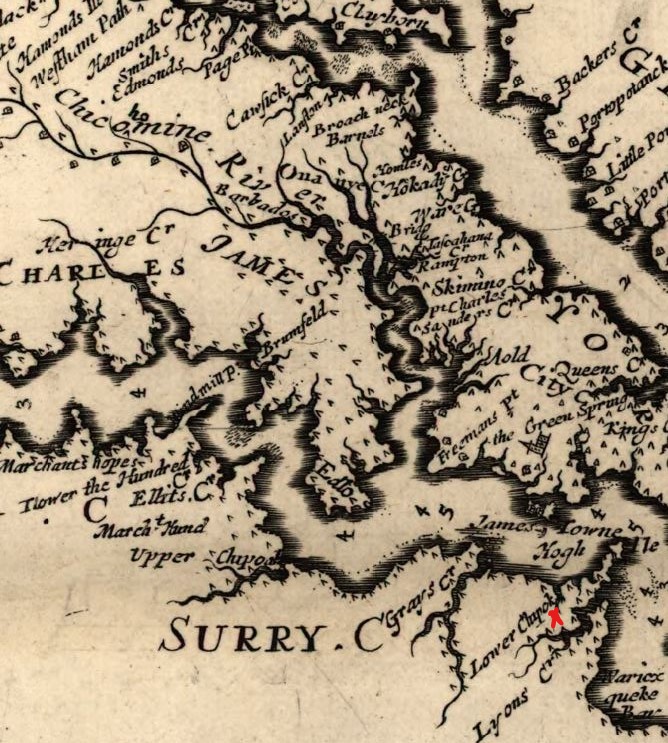
In 1676, Arthur Long was about 34 years old, married and the father of six children of whom the eldest was about 11 years old. The 1672 Dunstan buy out noted above tells us that Arthur and Mary lived on Chippokes Creek in Surry County on a 300-acre tract he bought in 1661 – maybe as many as 14 years on the same tract. Arthur Long was the only tithable (male 16+) from 1673-1675 meaning he had no servants and was working this land himself.
My Ancestors Actions During the Rebellion
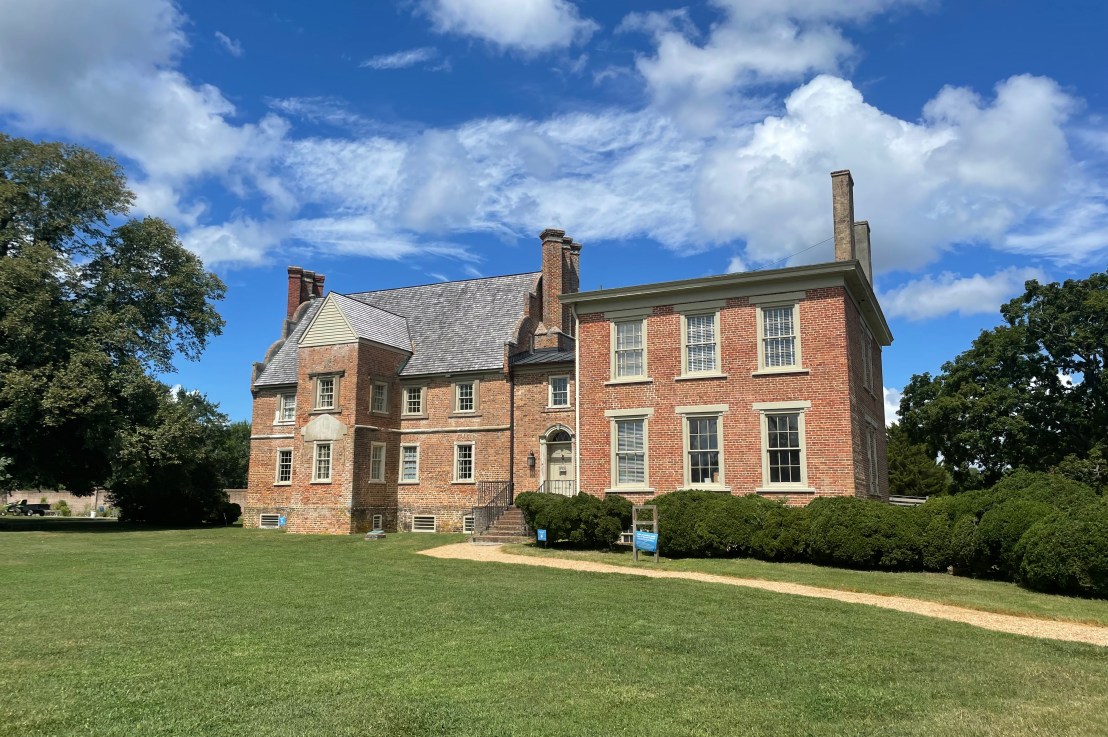
Nothing is known of Samuel Judkins, Edward Pettway or Samuel Plaw’s specific actions during the rebellion as they are only mentioned in the record pardoning 40 Surry men dated 6 February 1676/7.[18] They were most likely among the 70 or so Surry men that seized Arthur Allen’s Brick House (later known as Bacon’s Castle) on September 18 (one day before Bacon and his troops burned Jamestown) and held it until a few days after Christmas – just over three months. Alternatively, they may have been among the men seizing and occupying the Surry County homes of Robert Caufield, John Salway and Francis Mason during the same timeframe. Allen and Caufield were brothers-in-law, Caufield having married his sister Elizabeth Allen. Allen and Mason were Surry Justices and Salway, a well-to-do planter, owned the Warren House. Caufield was both a County Justice and Burgess (1676).
With Arthur Long, more is known.
Much has been written about Bacon’s Rebellion, so I’ll only cover it here with respect to Arthur Long’s rebellion story which begins in July 1676 after the so-called Bacon’s Assembly in June where Burgesses voted (or were forced to vote) for a variety of political reforms. They also voted to raise a 1,000 man army for further Indian raids and to fund it through a special levy should Bacon not be able to recruit enough volunteers.[19] Surry County was responsible for providing 32 men.[20] While the Assembly was meeting (from June 5 to about June 25), Indians attacked New Kent County settlers, which resulted in Gov. Berkeley signing 30 blank commissions for Bacon to use in filling out his officer ranks. In Surry County, Bacon provided commissions to Maj. William Rookings, Capt. Arthur Long, Lt. Robert Burgess and Ensign William Simmons.[21]
The Surry Court met twice in August. On August 10th, (Justices Jordan, Browne, Barham, Caufield, Spencer, Harrison, Meriwether, Mason, Allen all present). The first order of business was to respond to a command from “ye Honorable Nath. Bacon Esqr. Genll.” to provide the County’s share of flour for Bacon’s troops. Heads of families in Surry were to provide four pounds of flour “for good sound biscuit” per tithable in their household. Surry millers were barred from any private milling until the levy was collected. The justices gave everyone one week to deliver their proportion of the house of Capt. Arthur Long for the Lower Parish (Lawnes Creek) and to the home of Mr. William Thompson in the Upper Parish (Southwark).[22] A second Court session on August 24 added an additional levy of 5 ½ pounds of biscuit per tithable.[23]

So, now instead of attacking Indians, Bacon and his followers were now in open rebellion against Gov. Berkeley and his supporters – and ultimately King Charles II. At this point, Bacon’s followers began seizing and occupying Berkeley supporting planters’ homes to use as forts. Not only were their owners absent [they were with the Governor], but all also had the livestock and crops required to feed troops. As noted earlier, the homes of Arthur Allen, Robert Caufield, John Salway and Frances Mason were seized and held by rebel forces.
Post rebellion records indicate that Long assumed command of rebels garrisoned at Arthur Allen’s house. He also ordered the killing of cattle and other livestock – presumably to feed rebel troops.[24] He was also at Jamestown more than once, having commandeered boats belonging to Roger Rawling and William Kitto to take troops across the river. He was also apparently at Middle Plantation in York County [later Williamsburg] owned by an interesting character named Major Otho Thorpe [of whom we will meet in the final installment].[25]
Nathaniel Bacon died of disease in late October in Gloucester County and the rebellion soon fizzled. Many rebels returned to their homes. Several rebel leaders were caught, tried and hanged as they were captured and by mid-January the rebellion was over. Berkeley, the Council and Burgesses wasted little time in meting out justice to the rebels holding a Grand Assembly on 20 February 1676/7 at the Governors home called Green Spring.
Next Time – Part 5 – the last in this series – The Rebellion’s Aftermath for My Ancestors
Join me next time for our fifth and final installment of this series to find what happened to Arthur Long, Samuel Judkins, Edward Pettway and Samuel Plaw as well as to learn about my thoughts on why my ancestors chose to risk it all by joining the rebellion.
[1] Nugent, Nell Marion. Cavaliers and Pioneers: Abstracts of Virginia Land Patents and Grants 1623-1800, Volume 1 (1623-1666), (Richmond: The Dietz Printing Company, 1934), p. 242
[2] Robert Long and John Long along with their parents, Robert and ———- (———-) Long were named as headrights by Henry Watts in 1643 to secure acreage in Isle of Wight County. (C&P, Vol. I, p. 148). This obviously conflicts with the information provided in the 1624/5 muster concerning his Virginia birth. Either these are two different Robert Longs in Isle of Wight or perhaps Mr. Watts was counting on time and the cooperation of the Longs to commit fraud.
[3] Boddie, John Bennett. Southside Virginia Families, Volume I (Baltimore: Genealogical Publishing Company, 1966), p. 319. In 1661, Arthur Long received 100 acres of a patent assigned by George Smith to Christopher Holliman with Smith noting “except for 100 acres that was given to Arthur Long by my father, Arthur Smith, in his will.” Arthur Smith’s 1645 will made in 1645 in Isle of Wight County named Arthur Long as his godson.
[4] Chapman, Blanche Adams. Wills & Administrations of Isle of Wight County, Virginia 1647-1800, (Baltimore: Reprinted for Clearfield Company by Genealogical Publishing Company, 2007), p. 45
[5] Surry County Deeds, Etc. No. 1 1652-1672, p. 248; Wills and deeds (Surry County, Virginia), 1652-1907 (familysearch.org); accessed 7 November 2022
[6] New Year’s Day was March 25 prior to 1752 – so 1 January 1661 is after 27 December 1661
[7] Surry County, Virginia, Deeds Etc. No. 1, 1652-1672, p. 175; Wills and deeds (Surry County, Virginia), 1652-1907 (familysearch.org) ; accessed 7 November 2022
[8] Surry County, Virginia, Deeds Etc. No. 1, 1652-1672, p. 195; Wills and deeds (Surry County, Virginia), 1652-1907 (familysearch.org); accessed 7 November 2022
[9] Surry County, Virginia, Deeds Etc. No. 1, 1652-1672, p. 194; Wills and deeds (Surry County, Virginia), 1652-1907 (familysearch.org); accessed 7 November 2022
[10] Surry County, Virginia, Deeds Etc. No. 1, 1652-1672, p. 234; Wills and deeds (Surry County, Virginia), 1652-1907 (familysearch.org); accessed 7 November 2022
[11] Surry County, Virginia, Deeds Etc. No. 1, 1652-1672, p. 339; Wills and deeds (Surry County, Virginia), 1652-1907 (familysearch.org); accessed 7 November 2022
[12] Surry County, Virginia, Deeds, Wills, Etc. No. 2, 1671-1684, p. 27; Wills and deeds (Surry County, Virginia), 1652-1907 (familysearch.org); accessed 7 November 2022
[13] Surry County Deeds, Etc. No. 1 1652-1672, p. 248; Wills and deeds (Surry County, Virginia), 1652-1907 (familysearch.org); accessed 7 November 2022
[14] Surry County, Virginia, Deeds Etc. No. 1, 1652-1672, p. 304; Wills and deeds (Surry County, Virginia), 1652-1907 (familysearch.org); accessed 7 November 2022
[15] Mary (Allen) Long’s 1679 will mentions her deceased husband Arthur Long have disposed of personal items among “my poor children” naming son Arthur Long, daughter Elizabeth Long, daughter Mary Long and son George Long. She also noted that she desired whatever personal property remained to be “equally divided betwixt my six children after my debts and legacies are paid.”
[16] Surry County, Virginia Deeds, Wills, Etc. No 2 1671-1684, p. 6; Wills and deeds (Surry County, Virginia), 1652-1907 (familysearch.org); accessed 7 November 2022
[17] Herrman, A., Faithorne, H. & Withinbrook, T. (1673) Virginia and Maryland as it is planted and inhabited this present year. [London: Augustine Herrman and Thomas Withinbrook] [Map] Retrieved from the Library of Congress, https://www.loc.gov/item/2002623131/.
[18] Surry County, Virginia Deeds, Wills, Etc., No. 2, (1671-1684), p. 149 Wills and deeds (Surry County, Virginia), 1652-1907 (familysearch.org); accessed 7 November 2022
[19] During the prior six weeks Bacon led Indian attacks, was declared a Rebel, was elected a Henrico Burgess, had been publicly forgiven (but not really) by Berkeley and his supporters dominated the so called Bacon’s Assembly.
[20] Hening’s Statutes at Large, Vol. II, Acts of Assembly, June 1676, p. 344; https://vagenweb.org/hening/vol02-17.htm; accessed 8 November 2022
[21] Boddie, John B. Colonial Surry (Baltimore: Southern Book Company, 1959), p. 117
[22] Surry County Order Book, p. 131; Order books, 1671-1877 (familysearch.org); accessed 7 November 2022
[23] Surry County Order Book, p. 132; Order books, 1671-1877 (familysearch.org); accessed 7 November 2022
[24] Surry County Orders Part 1 1671-1691, p. 148; Order books, 1671-1877 (familysearch.org); accessed 7 November 2022
[25] Surry County, Virginia Deeds, Wills, Etc., No. 4 1687-1694, p. 106; Wills and deeds (Surry County, Virginia), 1652-1907 (familysearch.org); accessed 25 October 2022
 A Son of Virginia