
Need to catch up?
Part 1 – https://wordpress.com/post/asonofvirginia.blog/336
Part 2 – https://wordpress.com/post/asonofvirginia.blog/347
In Part 1, we learned that four of my Surry County ancestors and some of their relatives joined Bacon’s Rebellion, a 1676 uprising in the Virginia colony and that the uprising was unsuccessful. My interest is in why my ancestors were willing to risk not only dying in the fighting, but if they survived, they faced potential execution for treason, forfeiture of their estates and/or other lesser punishments. In Part 2, we met two of my ancestors including my 7x great grandfather Samuel Judkins and my 8x great grandfather Edward Pettway. In this installment, we meet my 7x great grandfather Samuel Plaw.
Samuel Plaw[1] (c.1635 – c.1698) – my 7x great grandfather
Samuel Plaw first appears in the Surry County record when he purchased 350 acres from William Edwards on Sunken Marsh near Sunken Marsh Mill on 20 April 1660.[2] Whether he arrived as an indentured servant or paid his own way is unknown. The surname Plaw is from the Middle English plaghe, plawe, pleie, ploghe, plowe – “play sport game merriment” and by transference “play-place.” Alternatively, “an epithet for someone who played games or who had a merry disposition.”[3]
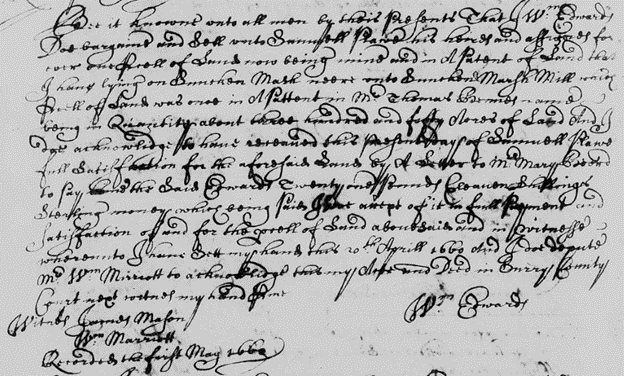
Samuel Plaw sold this 350-acre tract to William Marriott on 1 January 1664.[4] Four years later, on 4 February 1668 Samuel Plaw and Major William Marriott acknowledged that Plaw had been fully paid.[5]
Samuel Plaw’s First Wife
An incorrect abstract of this 1668 deed has led researchers to conclude that Samuel Plaw had a first wife named Mary. In Surry County Records 1652-1684 abstracted by Elizabeth T. Davis, she noted this agreement is “between Samuel Plaw and his wife Mary & William Marriott.” The original (underlined in red below) states that the agreement was “between Samuell Plaw of ye one part & Majr William Marriott on ye other.” The abstractor confused Majr and Mary, which as you can see would be easy to do. This error has been published in at least two books over the past 40 years. Abstracts are wonderful, but they are not a substitute for reviewing the actual record. Reviewing actual records will reduce errors and more important, they provide much more in the way of details that can help paint a picture of our ancestors.

Neither of these land records include mention of a wife waiving her dower right (1/3 interest in spouses’ estate), which Marriott would have wanted to avoid any potential claim down the road. This indicates that Samuel Plaw was not married on 1 January 1664/5 nor on 4 February 1668/9. He must have had a first wife (he had a daughter named Elizabeth Plaw we will meet later), but she was dead by 4 February 1668/9 and probably by 1 January 1664/5.
Samuel Plaw Marries Again
Samuel Plaw married second Jane (———-) as her third husband. She married (1) John King and (2) in 1659, Thomas Warren (c.1621-c.1670). Samuel and Jane likely married between 24 February 1670/1 and 7 May 1672 as on the former date Jane Warren witnessed[6] a prenuptial agreement between John Hunnicutt and Elizabeth Warren (her stepdaughter) wherein Hunnicutt (also a Baconian rebel) agreed to keep his hands off of Elizabeth Warren’s personal property inherited from her father when they married.[7] They were likely married by 7 May 1672, when the Surry Court ordered Samuel Plaw to give an account of the estate [inheritance] of James Buckmaster it appearing that Mr. Thomas Warren had the same in his possession.[8] Plaw likely assumed some of Thomas Warren’s community responsibilities upon his marriage to the widowed Jane Warren.
The Warren Family
Thomas Warren (c.1621-c.1670) [9] will get his own blog post soon enough, but for now what is important to know is that Warren was prominent in Surry County representing the county in the House of Burgesses from the late 1650s through the latter 1660s. He married three times and had children with each wife. When Samuel Plaw married Jane (———-) King Warren, he became stepfather to Jane’s four underage sons by Thomas Warren who ranged in age from 3 to 13 years old (Thomas, b.c. 1659, Allen, b.c. 1663, Robert, b.c. 1667 and William, b.c. 1669).
Plaw himself had a daughter from his first marriage named Elizabeth Plaw who was still a minor. As her mother died by 1664, she was at least 8 years old. Samuel and Jane and these five children comprised the household. Thomas Warren also left children from his first two marriages including William Warren (died unmarried before his father) and Alice Warren, b.c. 1643 (m. Matthias Marriott) from his first marriage to an unknown wife and Elizabeth Warren, b.c. 1655 (m. John Hunnicutt) from his second marriage to Elizabeth (Spencer) Sheppard. Both daughters were married by 1672.
A New Marriage and New Responsibilities
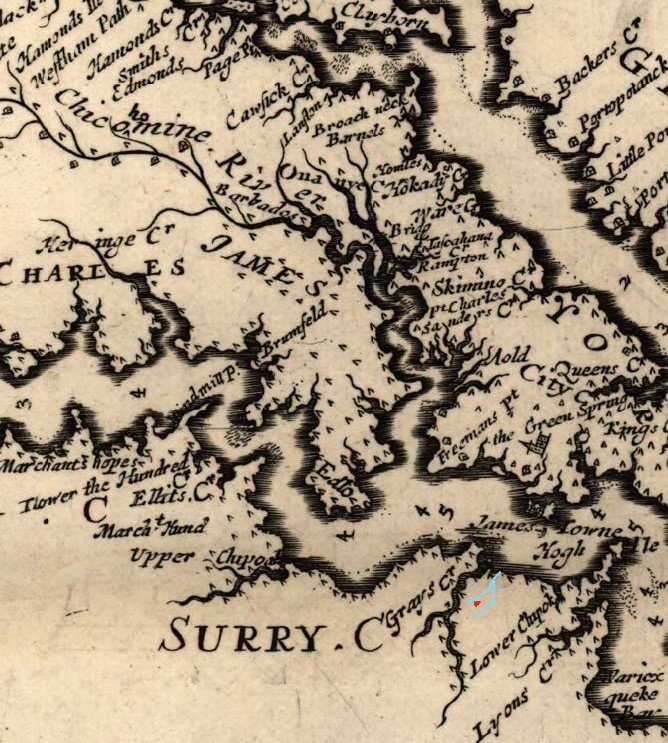
Samuel Plaw bought 100-acre tract on Gray’s Creek Richard & Isabel Case on 10 April 1672.[10] This is probably where the new blended family lived.[11]
On 16 May 1672, at a General Court held across the river at James City, Surry gentlemen Col. Thomas Swann and Capt. Edward Ramsey, executors of Captain John Grove, deceased, petitioned the Court concerning a parcel of land leased by Grove to George Domingo and subsequently sold to pay Grove’s debts. Domingo had died and he left his right to the property to his daughter Sarah Domingo. The Court referred the matter to the Surry County Orphan’s Court to secure her interest and to ensure the sale of the land would not be impeded.[12]
When the Surry Court met on 10 June 1672, Samuel Plaw, guardian of Sarah Domingo, was ordered by the Court to “remove and surrender his possession [of Sarah’ Domingo’s property] unto Col. Swann and pay her 200 pounds of tobacco annually for her life.” It is difficult to read, but it seems that the Surry Court determined that Plaw was being difficult as he “refused all offers” of some payment to Sarah Domingo in lieu of the lease. The Court described Plaw as having “refused all offers” as well as his “willful refusal.” The Court also noted that Plaw “bitterly” defended his actions. The Court ordered that that Swann and Ramsey could “make good on the sale” of the land. The record also noted that Samuel Plaw was appealing the decision to the next General Court.[13] I could find no record of an appeal. Was Samuel Plaw protecting Sarah Domingo and getting steamrolled by Swann and Ramsey and the Court? Or was he taking advantage of Sarah Domingo and getting punished? He was not removed as her guardian so one has to wonder.
As their stepfather, Samuel Plaw was also responsible for managing the inheritance of each of Thomas Warren’s sons. On 7 July 1672, Samuel Plaw presented Major William Browne and Mr. William Thomson as his securities for the “Orphans Estates of Mr. Tho. Warren, dec’d” who posted bond.[14]
During the latter part of 1674, Samuel and Jane Plaw exchanged parcels of land with George and Elizabeth Foster. At Surry Court on 1 September, the Foster’s acknowledged payment from Plaw for a 200-acre tract on the “south side of the western branch of Crouches Creek”[15] and then at court on 4 November the Plaw’s acknowledged payment from Foster for the 100-acre tract on Gray’s Creek he bought in 1672 from Richard Case. These deeds indicate that Samuel Plaw was literate while Jane (———-) King Warren Plaw was not.[16]
Status in 1676 – When the Rebellion Began
In 1676, Samuel Plaw was about 41 years old. He was married, father to a daughter and stepfather to Jane’s four sons. These children now ranged in age from 17 to 7. They lived on 200 acres they owned in Surry County on Crouches Creek. Extant tithe lists indicate he had a second tithable (16+ male) living with him in 1668 & 1669 (Anthony Evans), but from 1673-1675 Plaw was the only male 16 years or older meaning Samuel and Jane, and the five children were working the land themselves. Samuel and Jane Plaw would have been considered lower middle class. Samuel may also have had an ax to grind with the Surry Justices over his treatment in the Domingo case. In terms of familial connections, only John Hunnicutt, who married Thomas Warren’s daughter Elizabeth from his second marriage, joined the rebellion. Notably Thomas Warren II who was about 17 when the rebellion began did not join the cause.
Next Time: Arthur Long (my 9x great grandfather)
[1] Appears in the record as Plaw, Plawe, Plow and Plowe (and erroneously transcribed as Place).
[2] Surry County Deeds, Etc. No. 1 (1652-1672), p. 154 (orig. 148); Deeds, wills, inventories, etc., 1645-1686 (familysearch.org); accessed 18 October 2022
[3] Dictionary of American Family Names ©2013, Oxford University Press; Plaw Name Meaning & Plaw Family History at Ancestry.com®
[4] Surry County Deeds, Etc. No. 1 (1652-1672), p. 266 (p. 248 in original); Deeds, wills, inventories, etc., 1645-1686 (familysearch.org); accessed 18 October 2022
[5] Surry County Deeds, Etc. No. 1 (1652-1672), p. 347 (p. 324 in original); Deeds, wills, inventories, etc., 1645-1686 (familysearch.org); accessed 18 October 2022
[6] Jane made her mark – she was illiterate – on a court filing where John Hunnicutt and Elizabeth Warren (her step daughter) “contracted together to get married suddenly and for ye better clearing of all doubts and scruples that may arise as aspersions cast in ye way to either of their discredits” Hunnicutt promised to allow Elizabeth Warren to keep, use and dispose of her inheritance of “cattle, chattles & household goods as she stands possessed of by ye division made & by order of ye Court.”
[7] Surry County, Virginia Deeds’ Etc. No. 1 1652-1672, p. 380; Wills and deeds (Surry County, Virginia), 1652-1907 (familysearch.org); accessed 15 October 2022
[8] Surry County, Virginia Order Book 1, p. 6; Order books, 1671-1877 – Film # 008153305 (familysearch.org); accessed 17 October 2022
[9] I am a descendant of Thomas Warren through his daughter Alice Warren who married Mathias Marriott as well as through his son Thomas Warren who married Elizabeth Plaw.
[10] Surry County, Virginia Deeds Wills Etc. No. 2 1671-1684, p. 15; Wills and deeds (Surry County, Virginia), 1652-1907 (familysearch.org); accessed 17 October 2022
[11] The “Warren House” went to Thomas Warren’s daughter from his first marriage Alice Warren and her husband Mathias Marriott although the agreement provided that Jane was to enjoy 1/3 of the manor house and personal property during her lifetime. The Marriott’s sold that property to John Salway in 1673.
[12] Minutes of the Council and General Court of Colonial Virginia 1622-16323, 1670-1676, (n.d.) United States: Colonial Press, The Edward Waddy Company, p. 306
[13] Surry County, Virginia Guardian Accounts 1672-1750, p. 2-3; Guardian and fiduciary accounts, 1672-1922, 1947-1949 (familysearch.org); accessed 17 October 2022
[14] Surry County, Virginia Order Book 1671-1691, p. 62; Order books, 1671-1877 (familysearch.org); accessed 18 October 2022
[15] Surry County, Virginia Deeds Wills Etc. No. 2 1671-1684, p. 61; Wills and deeds (Surry County, Virginia), 1652-1907 (familysearch.org); accessed 17 October 2022
[16] Surry County, Virginia Deeds Wills Etc. No. 2 1671-1684, p. 65; Wills and deeds (Surry County, Virginia), 1652-1907 (familysearch.org)’ accessed 17 October 2022
[17] Herrman, A., Faithorne, H. & Withinbrook, T. (1673) Virginia and Maryland as it is planted and inhabited this present year. [London: Augustine Herrman and Thomas Withinbrook] [Map] Retrieved from the Library of Congress, https://www.loc.gov/item/2002623131/.
 A Son of Virginia
So interesting reading about all the Warrens. I was fortunate enough to have been given a copy of the research done on the Warren genealogy, my maternal grandmother’s lineage.
LikeLike