Need to catch up? Read about Richard Rowell I here!
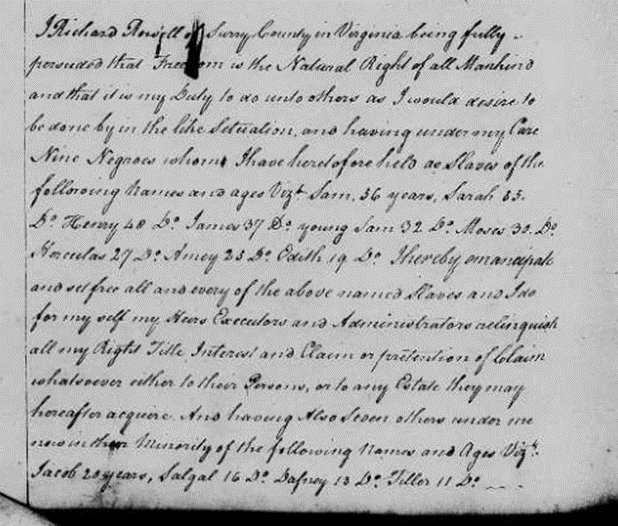
On 26 August 1782, my 5x great-grandfather Richard Rowell II went to Surry County Court and “being fully persuaded that Freedom is the Natural Right of all Mankind” freed sixteen enslaved men, women and children. While the adults were freed immediately, the children were granted freedom prospectively when they turned 21 for men and 18 for women. The nine adults with their ages included Sam 56, Sarah 55, Henry 48, James 37, young Sam 32, Moses 30, Hercules 27, Amey 25 and Edith 19. The seven children’s names, ages and freedom dates included Jacob, 20 free on 15 Jan 1783; Salgal 16 on 18 Mar 1785; Dafney 13 on 10 July 1787; Tiller 11 on 12 Dec 1789; Trecy 5 on 20 Sept 1795; Charlotte 2 on 19 Aug 1798; Daniel 1 on 22 Dec 1802.”[1]


Why would a man choose to free these enslaved men, women and children who represented the majority of his financial assets as well as a substantial portion of his children’s inheritance?
It was in reaction to the Commonwealth of Virginia enacting legislation allowing for private manumission. This permitted slaveholders to free their slaves without government approval. The law required anyone freeing their slaves to provide support and maintenance for anyone they freed who was not of “sound mind and body,” “above the age of forty-five years, or being males under the age of twenty-one, or females under the age of eighteen years.” The law also provided that if the liberator failed to provide support and maintenance the government was required to force the sale of as much of their assets as were required to meet the obligation.[2] These conditions ensured that slaveholders did not free those who could not support themselves, which would make them a public charge.
A variety of factors contributed to the passage of this law including Virginia political leaders thinking about and debating their own liberty leading to independence from Great Britain, slaves and free blacks’ role in the Revolution, religious influence, and economic considerations. In older Eastern Virginia counties like Surry (formed in 1652), inheritance customs and laws changed from providing the eldest son with all of the real property assets to sharing more equally between all sons and, in some cases, all children. This resulted in larger plantations being carved into smaller tracts. Another factor in Eastern Virginia was that tobacco production was becoming less profitable and soil exhaustion had already forced planters to move to other crops that were less labor intensive. These changed resulted in a labor surplus.
Historians estimate that as a result of the new law, about 30,000 enslaved men, women and children were freed – about ten percent of all enslaved people in Virginia. In Surry County, Virginia alone – there were 65 slaveholders that manumitted slaves including Richard Rowell II.[3]
Who Was Richard Rowell II?
Richard Rowell II was born in Surry County, Virginia about 1733. He was the second son of Richard I and Mary (———-) Rowell; an elder brother Robert Rowell having been born about 1731. Prior to her marriage to Richard Rowell I, Mary (———-) was married to Thomas Crews (d.c. 1728) by whom she had four children (William, Thomas, John & Elizabeth). So, our subject Richard Rowell II was the youngest of six children that grew up in the same household.[4]
Richard II became a slaveowner upon his father’s death in 1746 when he left Richard II “a Negro girl Sarah and a Negro boy Harry.” When Richard II’s older brother died in 1752 at the age of 21 unmarried and without heirs, he inherited the “Negro man named Peter and Negro girl Pat” left to his brother by their father. When his mother died is unknown, but Richard II would have then inherited “Negroes Jobby and Jenney” and their child who was as yet born when his father’s will was written.
The year 1754 was a big one for Richard Rowell II. First, he turned O21 and on 20 August 1754, he appeared in Surry County Court and “being of full age acknowledged the receipt of his Estate from John Davis his guardian and voluntarily discharged him.”[5] Second, he married Sarah Warren, daughter of Thomas and Lucy (———-) Warren.[6] Third, Richard II sold the 200 acres he inherited from his father. Bounded by the western branch of Crouches Creek, his father purchased the land from Benjamin Chapman in 1738.[7] Lastly, he purchased 350 acres from Thomas Warren – his father-in-law. This land was described as “bounded by Sassafras Branch, Col. John Ruffin, Thomas Binns, Carter Crawford, the Mirey Branch, David Alexander, the said Thomas Warren and the Holly Swamp.”[8] Richard and Sarah (Warren) Rowell would raise their children on these 350 acres.
Richard Rowell II appears regularly in Surry County records witnessing deeds and wills, appraising estates and serving on juries from the 1750s to the early 1790s. A few records of particular interest include:
At Court on 19 June 1759, Richard Rowell II was appointed Surry County Constable. Rowell “took the oaths of a constable and the several oaths devised by Act of Assembly to be taken by Constables.”[9]
In 1769, William Crews [his half first cousin] gifted Richard Rowell II two slaves named Jenny and Sarah “for his trouble bringing up my brothers and sisters now dead.”[10]
While Richard II would free 16 enslaved persons in August 1782, just seven months later on 11 March 1783, Richard Rowell II conveyed to John Judkins, one “Negro girl named Lucy.”[11]
Richard II and Sarah (Warren) Rowell had six known children including four sons and two daughters. On 22 June 1784, Richard Rowell, II gave to his son Richard Rowell, III “for love and affection,” 150 acres on Holly Swamp at Sassafras Branch and bounded by Nathanial Berriman and the Long Pond.[12] This was a portion of the 350 acres he bought in 1754 from Thomas Warren leaving Richard II with 200 acres – and three more sons to consider.
Surry County land tax records indicate that Richard Rowell II paid tax on this 200 acres until 1791 when he gave 15 acres to his son Samuel Rowell leaving Richard II with 185 acres. The following year, Richard Rowell III conveyed to his brother Samuel Rowell an additional 50 acres bringing Samuel’s total to 65 acres and reducing Richard III’s holdings to 100 acres. In 1794, Richard Rowell II’s other two sons, Robert Rowell and Thomas Rowell each owned 92 ½ acres, splitting their father’s 185 acres between them. This tells us Richard II died in 1793 and that the 350 acres had been divided between his four sons with eldest Richard III getting 100 acres, Samuel getting 65 acres and Robert and Thomas each getting 92 acres – an example of a larger tract being divided into smaller tracts. Adjacent to the acreage of youngest son Thomas Rowell was Reverend Nathaniel Berriman, Sr. (1748-1822) who was a Methodist minister and also my ancestor. You can read about him here! Three of the four Rowell brothers would marry daughters of Nathaniel Berriman:[13]
Robert Rowell qualified as administrator of his father Richard II’s estate at Surry Court on 24 December 1805. In that capacity in 1806, he was ordered to pay $36 to the parish “as reimbursement for supporting Sam and Sarah Trusty, two aged negroes that were liberated by the said Richard Rowell, dec’d during his lifetime from 2nd July 1805 to the 2nd of January last.”[14] These were two of the people Richard Rowell II freed in 1782. At that time, they were listed as Sam, 56 and Sarah, 55 years old. The order further directed Robert Rowell to “pay $3 each month for the said Negroes as long as they remain at the parish house.” The estate was ordered settled on 23 June 1807, presumably when Sam and Sarah Trusty died.[15]
Richard Rowell II, b.c. 1733, d.c. 1792/3, m. Sarah Warren, daughter of Thomas and Lucy (——–) Warren, issue:
Mary Rowell b.c. 1756 m. 1780, James Judkins
Sally Rowell b.c. 1760 d. 1803 unmarried – no issue
Richard Rowell III b.c. 1763 d. 1793/4 m. 1785, Sarah Gray
Samuel Rowell b.c. 1770 m. 1793, Sally Berriman
Robert Rowell b.c. 1773 d. 1820/1 m. 1796, Lucy Berriman
Thomas Rowell b.c. 1775 d.c. 1838 m. (1) 1803, Sally Davis
m. (2) 1809, Ann Berriman
Why did Richard Rowell II decide to free sixteen enslaved people?
You do not get very far back in Virginia genealogy without confronting the issue of slavery. While many of my Virginia ancestors were slaveholders, Richard Rowell II is the only one I am aware of that ever freed anyone. When I study my ancestors, I am interested in more than just names and dates. I want to know how they lived, what was going on around them and what led them to make the decisions that they made. While it is sometimes difficult, I try and set aside my 21st century morals and put myself in the shoes the people I am studying.
When I think about Richard Rowell’s decision in August 1782 for manumitting 16 enslaved people, I would like to take him at his word – “being fully persuaded that Freedom is the Natural Right of all Mankind.” Of course, it is not that simple. While he freed the nine adults he enslaved, he did not free the seven enslaved children right away. Little Daniel, just one year old would remain enslaved for another 20 years. Can you imagine being one the newly freed adults whose children were among those continuing in bondage? Continuing the enslavement of the seven children was certainly an economic consideration as he would have been financially responsible for them. He also sold poor Lucy to John Judkins a mere seven months later – probably to settle a debt. What about her natural right to freedom? In the end, Richard Rowell II was just a man who was trying to balance the competing interests of a belief in the right to freedom and his family’s financial condition.
What happened to private manumission in Virginia?
The ability to free one’s enslaved people without government approval in Virginia would prove to be short lived as events conspired to change the mood of white Virginians. The law was controversial from the start. Slave uprisings were a constant concern and the role of a suddenly expanded free Black population in such an event concerned many. Virginians were also aware of the Haitian Revolution, which began in 1791 as a slave revolt against French colonial rule and ended in 1804 with Haitian independence. Closer to home in 1800, a slave named Gabriel Prosser and others planned a rebellion. It was found out before anything much occurred and a couple of dozen conspirators were hanged. These events results in changes to the law. In 1806, the law was changed to require newly freed Black people to leave the state within a year, which essentially gutted it. Other factors in the law’s demise include the invention of the cotton gin in 1793 and the outlawing of the international slave trade in 1808. These factors reversed the decline in the monetary value of slaves and as new territories opened and states formed, Virginians began leaving the state taking their enslaved people with them or selling their enslaved people into the southern cotton producing states. As readers will know, slavery lasted for nearly six more decades until the Civil War ended in 1865.
[1]Surry County Deeds, Wills, Etc., Book 11, 1778-1783, p. 288, Library of Virginia, Reel #7
[2] William Waller Hening, ed., The Statutes at Large; Being a Collection of All the Laws of Virginia from the First Session of the Legislature, in the Year 1619 (Richmond: J. & G. Cochran, 1821): 11:39–40. Accessed through Encyclopedia Virginia on 19 September 2020: https://www.encyclopediavirginia.org/An_act_to_authorize_the_manumission_of_slaves_1782
[3] Voorn, Philip. (2020). Master’s Thesis, North American Studies: The Revolutionary Virginia Manumission Law of 1782 (University of Leiden), accessed 19 September 2020 https://openaccess.leidenuniv.nl/bitstream/handle/1887/113554/Thesis_Philip_Voorn.pdf?sequence=1
[4]Surry County Deed Book 4, p.38
[5] Surry County Order Book (1753-1757), p. 148
[6] Hart, Lyndon H. (1983). Surry County Virginia, Wills, Estates & Inventories (Greenville, SC: Historical Southern Press), pp. 70, 124. Both the 1759 will of Thomas Warren and the 1783 will of Lucy (——) Warren, filed in Surry County, name son-in-law Richard Rowell.
[7] Surry County Order Book (1753-57), p. 177
[8] Hopkins, William Lindsay. (1994). Surry County, Virginia Deeds & Estate Accounts 1734-1755 (Athens, GA: Iberian Publishing Company), p. 126
[9] Surry Co. Order Book (1757-63), p. 194
[10] Hopkins, William Lindsay. (1995). Surry County, Virginia Deeds & Estate Accounts 1757-1786 (Athens, GA: Iberian Publishing Company), p. 46
[11] Hopkins, William Lindsay. (1995). Surry County, Virginia Deeds & Estate Accounts 1757-1786 (Athens, GA: Iberian Publishing Company), p. 142
[12] Hopkins, William Lindsay. (1995). Surry County, Virginia Deeds & Estate Accounts 1757-1786 (Athens, GA: Iberian Publishing Company), p. 79
[13] This is the known beginning of numerous Rowell and Berriman/Berryman marriages in Surry County. Both of my paternal grandmother Rowell’s grandmothers were Berrymans. Her paternal grandmother was Sallie Judkins Berryman (1844-1933) who married Patrick Henry Rowell (1834-1916) and her maternal grandmother was Lucy Rowell Berryman (1853-1931) who married Sidney Baxter Edwards (1850-1920). Their fathers were brothers William Holt Berryman and Nathaniel Randolph Berryman who were both sons of Joseph Berriman, son of Reverend Nathaniel Berriman. The spelling seems to have changed naturally over time from Berriman to Berryman.
[14] Surry Co. Order Book (1804-1807), p. 317, 336
[15] Surry Co. Order Book (1807-1811), p. 17
 A Son of Virginia